


Nice is the natural gateway to the French Riviera: an easy flight from most of Europe, a direct tram from the airport into town, and a waterfront that feels made for slow strolls at sunset. For first-time visitors, the challenge is not finding things to do but deciding where to start. This guide focuses on practical, up-to-date advice to help you experience the best of Nice and use it as a base for exploring the surrounding Riviera without wasting time or money.
Get the latest updates straight to your inbox!
Getting Oriented: Neighborhoods and the Best Areas to Stay
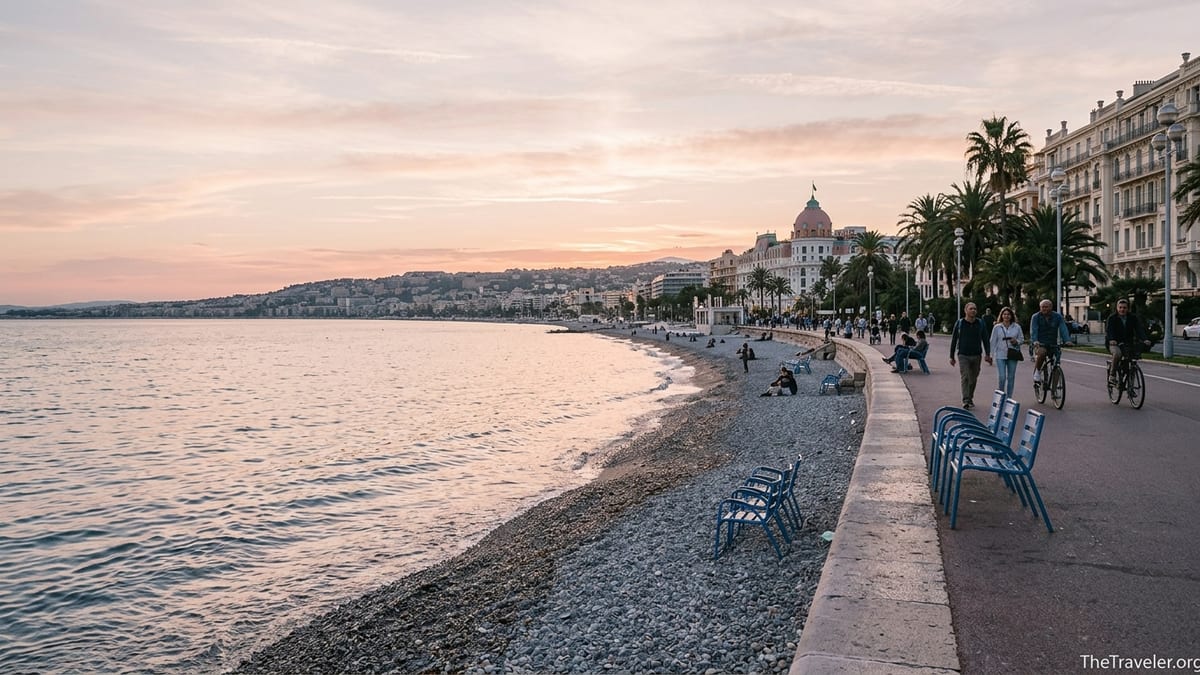
For a first trip, most visitors are happiest staying between the Old Town and the beachfront, where you can walk almost everywhere. The Promenade des Anglais is the long seafront boulevard that defines Nice. Hotels here range from legendary five-star properties overlooking the Baie des Anges to smaller three-star options a block or two inland. Expect sea-view rooms in well-known hotels along the promenade to start from the mid to high hundreds of euros per night in summer, while streets just behind the seafront often offer simpler rooms at more moderate prices.
The Old Town, or Vieux Nice, sits just inland from the eastern end of the promenade. This is a tight maze of pastel facades, shuttered windows and laundry strung between buildings. Staying here puts you steps from Cours Saleya market and some of the city’s best ice cream and socca stands. Rooms are often in smaller boutique hotels or apartment rentals, and you trade elevators and large bathrooms for atmosphere. At night it stays lively, which is ideal if you like to be out late and less ideal if you are a light sleeper.
Further north, the streets around Avenue Jean Médecin and the Nice-Ville train station are practical and usually better value. Mid-range hotels here cater to both business travelers and tourists. You are a 10 to 15 minute walk or a short tram ride from the seafront, and close to the main shopping district and the tram hub at Jean Médecin. This is a good choice if you plan several day trips by train because you can walk to the station in a few minutes.
On the eastern side, the Port neighborhood has become fashionable, with cafe terraces, design shops and a more local feel. From here you can walk to the Old Town in around 10 minutes and to the base of Castle Hill in about the same. Rooms in this area may be slightly calmer at night than those deep in Vieux Nice, and the port is convenient for boat trips along the coast in season.
Arriving in Nice and Getting Around the City
Most first-time visitors arrive at Nice Côte d’Azur Airport, which sits right on the waterfront. From both terminals, tram line 2 connects you to the city center in around 25 to 30 minutes. Direct airport tickets sold from the machines at the terminal platforms currently cost around ten euros for a return, but a regular single ticket bought through the local Lignes d’Azur system costs roughly one to two euros for 74 minutes of travel. Because airport ticket machines often prioritize the special airport fare, many budget-conscious travelers ride the tram for free as far as Grand Arénas, the first stop outside the airport zone, and then buy a standard ticket from the machines there or use the official mobile ticket app.
Once in town, trams and buses are straightforward. The main north-south line runs on the surface along Avenue Jean Médecin and skirts the western edge of the Old Town, while line 2 runs mostly underground through the center from the airport to the port. A standard single ticket is valid on both buses and trams within the city for around an hour and a quarter from validation, so you can change lines without paying again as long as the time window has not expired. You must validate your paper ticket in the machines on board or activate your mobile ticket in the app before boarding inspectors arrive.
For stays of several days, city transport passes and regional passes can be good value if you plan frequent trips. Local cards from Lignes d’Azur offer daily and weekly options covering buses and trams around Nice. For visitors who intend to travel widely along the coast between Cannes, Antibes, Nice and Menton, the regional Pass Sud Azur combines local trains, regional buses and trams for a fixed period such as three or seven days, allowing you to simply tap in and out without buying separate tickets each time.
Within central Nice, however, you will probably walk the most. From the train station to the Old Town is about 15 minutes on foot, from the Old Town to the hilltop viewpoint on Castle Hill around 10 to 20 minutes depending on the path you take, and crossing from the port area to the western hotels on the promenade is a pleasant seafront walk of around half an hour. Comfortable shoes are more important than complex transport plans for most first-time itineraries.
Essential Sights in Nice for First-Time Visitors
If you only know Nice from photos, it is probably the Promenade des Anglais and its curved bay of pebbly beach. Walking the promenade at least once, ideally in the early morning or at sunset, gives you the classic Riviera atmosphere. You will see locals jogging, families on bikes and office workers with takeaway coffees. Blue sun loungers and striped parasols line the private beach clubs in summer. Even if you do not pay for a lounger, you can sit on the public sections of beach for free; just remember that these are pebbles rather than sand, so many people bring foldable mats or water shoes.
Behind the eastern end of the promenade, Castle Hill offers the best free viewpoint over the city. There is a staircase that climbs up from close to the waterfront and also a public lift if you prefer to avoid the steps. At the top, you find landscaped gardens, a waterfall feature and several different terraces with panoramas over the port and the Baie des Anges. Many visitors bring a takeaway sandwich or pastries and treat it as a picnic spot. In high season, going early or late helps you avoid the hottest sun and the largest crowds.
Down below, the Old Town is where Nice feels at its most Italian-influenced, with narrow lanes, hidden baroque churches and small specialty food shops. Cours Saleya hosts a famous market: on most mornings you will see colorful piles of tomatoes, zucchini flowers and local cheeses, plus stalls selling lavender, soaps and flowers. On Mondays, much of the space turns into an antiques and flea market, which is ideal if you enjoy browsing vintage posters or old tableware. Just off Cours Saleya you can find simple stands selling socca, a thin chickpea pancake served hot and cut into slices, often for just a few euros.
For art and architecture, the Musée Matisse in the Cimiez district houses a large collection of works by Henri Matisse, who lived in Nice for decades. You can combine a museum visit with a stroll around the Roman ruins and olive groves in the same area. Back near the center, the Museum of Modern and Contemporary Art, housed in a striking glass and stone building near Place Garibaldi, focuses on post-war art and often hosts temporary exhibitions that appeal to visitors even if they are not specialists.
Eating and Drinking: From Beachfront Treats to Niçoise Classics
Nice has a distinctive local cuisine shaped by both Provence and nearby Italy. One of the easiest introductions is the salade niçoise, typically made with tomatoes, hard-boiled egg, anchovies or tuna, olives and local olive oil. In casual bistros near the Old Town and around Place Rossetti, a main-course salad like this usually sits in the mid-teens in euros. Pan bagnat is essentially the same salad inside a round bread roll, pressed so the olive oil soaks in, and is often sold at takeaway counters for a simple beach picnic.
Socca is another must-try. Some of the busiest socca ovens in Vieux Nice still bake it on large copper pans in wood-fired ovens, slicing it into irregular pieces as soon as it comes out. It is very affordable, commonly just a few euros for a portion that makes a hearty snack. Locals often eat it standing at the counter with a glass of rosé or a small beer. Another street option is pissaladière, a caramelized onion tart topped with anchovies and olives, which you will see in bakery windows across town.
Cafe culture is part of daily life in Nice. Around Place Masséna and along Avenue Jean Médecin you will find both international chains and independent coffee bars. Prices for an espresso at the counter are usually just a couple of euros, while a cappuccino or latte on a terrace in a prime square can easily reach several euros more. In the Old Town and by the port, many bars and wine bars offer glasses of local Provence rosé, often priced favorably during early evening happy hours. Ordering carafes of house wine instead of individual glasses is a common local tactic for keeping costs reasonable when sharing.
For dessert, gelato and sorbet shops are nearly unavoidable. Well-known parlors in Vieux Nice display dozens of flavors, some classic and others inspired by local fruit and herbs such as lemon, fig or basil. Two small scoops in a cone or cup typically fall into the mid-single-digit euro range. In hot months, these shops can develop long queues in the evening after dinner as both visitors and residents head out for a stroll and a sweet treat.
Planning Day Trips along the French Riviera
Nice works particularly well as a base for exploring other Riviera towns without a car. The coastal train line and regional buses make it relatively simple to visit places you have likely heard of in guidebooks without joining an organized tour. For example, the train from Nice-Ville to Antibes usually takes about 20 minutes, with frequent departures throughout the day. From Antibes station it is a short walk to the old town and harbor, where you can wander the fortified walls and visit the Picasso Museum.
Monaco and Monte-Carlo lie in the other direction. Trains from Nice take roughly 20 to 30 minutes depending on the service, and often cost only a handful of euros if you buy standard second-class tickets at the station machines. Once in Monaco, you can walk up to the old town on the Rock to see the Prince’s Palace and cathedral, or head downhill to the famous casino square and the luxury yachts. Keep in mind that food and drink prices in Monaco tend to be higher than in Nice, so many day-trippers choose to eat breakfast and main meals in Nice and limit themselves to a coffee or one drink in Monaco.
For dramatic coastal views, the medieval village of Èze is a popular excursion. Many travelers use a combination of train or bus and a steep walk to reach the village high on the hill, then visit the exotic garden at the top for panoramic views. Similarly, the small town of Villefranche-sur-Mer, with its deep natural harbor and ochre-colored waterfront buildings, is just one train stop from Nice and can even be reached by a scenic coastal walk of around an hour and a half if you prefer to move at a slower pace.
If you intend to make several such trips in a week, a regional transport pass can simplify logistics. Instead of buying separate tickets each time, you load a multi-day pass onto a card or app and simply present it when boarding trains or buses. Visitors report that this is especially convenient when hopping on and off regional buses like the coastal line that connects Nice with towns such as Menton and the hillside routes leading to villages like Saint-Paul-de-Vence.
Practical Tips: Money, Safety and Seasonal Timing
In daily life around Nice, card payments are widely accepted in hotels, restaurants and supermarkets. Still, it is advisable to carry a small amount of cash for market purchases, bakery stops and regional buses where card readers sometimes fail. Beach clubs, larger museums and chain stores generally accept major credit and debit cards with contactless payment. ATMs are easy to find around Place Masséna, Avenue Jean Médecin and near the Old Town.
Nice is broadly safe for visitors, but petty theft can occur in crowded areas, especially on trams, around the main station and along the promenade at night. As in many Mediterranean cities, it is wise to keep your bag zipped and in front of you on public transport and avoid leaving phones or wallets loosely on cafe tables by the street. At the beach, leaving valuables unattended while you swim is risky; many people either take turns watching belongings, use small waterproof pouches for key items or pay for a lounger at a beach club that has more supervised access.
Weather and crowds vary significantly by season. From late June through August, temperatures are hot, beaches are busy and hotel rates are at their highest. Sea temperatures are warm for swimming, but you will need to book popular restaurants and sunbeds in advance. May, early June, September and early October often offer a good compromise: pleasant temperatures, sea warm enough for most swimmers, and more availability in accommodation. In winter, many beach clubs close and some smaller businesses take holidays, but you gain clear light, fewer crowds in museums and lower room rates, which can appeal to city-focused travelers.
Language is rarely a barrier. French is the official language, but in hospitality and tourism most staff speak at least some English and often Italian as well. Learning a few basic French greetings and phrases for ordering and thanking people is still appreciated. In markets and small local cafes away from the main tourist streets, you may find fewer English speakers, but a mix of simple French, gestures and patience usually carries you through.
The French Riviera Pass and When a City Card Makes Sense
Nice and the surrounding Riviera offer a dedicated city card, the French Riviera Pass, which bundles free or discounted entry to a wide range of attractions. Options typically cover 24, 48 or 72 hours, with prices varying depending on the duration. With one card, you can visit a selection of museums in Nice, join sightseeing bus tours, and access partner attractions in nearby towns, such as certain art foundations or coastal boat trips when included in the current offer.
You can buy the pass in several ways: in person at the main tourist office near Place Masséna, at desks in Nice airport, and through partner hotels and agencies around the region. A digital version is often available through official channels as well. On arrival, you receive either a physical card or instructions on how to activate your pass in an app, along with a brochure or digital guide that lists included attractions, opening hours and any need for advanced booking.
Whether the French Riviera Pass makes sense depends on how intensely you plan to sightsee. If your idea of a perfect first visit is to wander the Old Town, enjoy the beach, climb Castle Hill and take one or two leisurely day trips, then simply buying individual museum tickets and paying standard fares on public transport may cost less. Entry to a single municipal museum in Nice is often modest compared to city cards, and many of the best local experiences, such as promenading by the sea or watching sunset from the hilltop, are free.
On the other hand, if you are an enthusiastic museum and attraction visitor planning several paid sights per day, the card can deliver good value. For example, a long weekend where you ride the hop-on hop-off sightseeing bus, tour multiple museums, join a guided walking tour, and take part in an included tasting or excursion can easily add up if paid individually. In this case, the French Riviera Pass can simplify budgets by transforming those individual purchases into a single up-front cost and encouraging you to fit as much as possible into your chosen time window.
The Takeaway
For first-time visitors, Nice combines the accessibility of a major coastal city with the relaxed, holiday pace that has drawn travelers to the French Riviera for generations. Its compact center means that you can walk from a bustling market to a Mediterranean viewpoint in minutes, and its position on the regional rail line makes day trips to famous neighbors straightforward even without a car. With a little planning around where you stay and how you move, you can spend most of your time actually experiencing the city instead of working out logistics.
Use tram line 2 or the regional passes to keep airport transfers and day trips simple, choose accommodation in or near the Old Town or the central avenues so that you can explore largely on foot, and focus your sightseeing on a mix of seafront, hilltop and neighborhood experiences. Sample socca hot from the oven, watch the light change over the Baie des Anges from the promenade, and give yourself time to wander without a fixed schedule. That combination of small, everyday pleasures and iconic Riviera scenery is what turns a first visit to Nice into the beginning of a long-lasting connection with the French south.
FAQ
Q1. How many days should a first-time visitor spend in Nice?
Most first-time visitors are comfortable with three full days in Nice itself, plus two or three extra days if you want to use the city as a base for day trips along the Riviera.
Q2. Is it easy to get from Nice Airport to the city center without a taxi?
Yes. Tram line 2 runs from both airport terminals to central stops such as Jean Médecin and the port in roughly 25 to 30 minutes, and regular public transport tickets are valid once you reach the first non-airport stop.
Q3. Do I need a car to explore the French Riviera from Nice?
No. Trains and regional buses connect Nice with Antibes, Cannes, Monaco, Menton, Villefranche-sur-Mer and Èze, making it entirely feasible to explore the coast without renting a car.
Q4. Are the beaches in Nice sandy or pebbly?
The main city beaches in Nice are pebbly rather than sandy. Many visitors bring beach shoes or rent loungers at beach clubs that provide mats and cushions.
Q5. Is the French Riviera Pass worth it for a first visit?
It can be worthwhile if you plan to visit multiple museums and paid attractions each day. If you mostly want to walk, relax and see a few highlights, paying individually is often cheaper.
Q6. What is the best area to stay in Nice for first-timers?
For most first-time visitors, the Old Town, the streets just behind the Promenade des Anglais, or the central area around Avenue Jean Médecin offer the best mix of atmosphere, convenience and access to transport.
Q7. Can I swim in the sea in Nice, and when?
Yes. Many people swim from late May to early October, with the warmest sea temperatures typically in July, August and early September, depending on yearly conditions.
Q8. Is Nice safe to walk around at night?
Central areas such as the promenade, Old Town and main squares are usually lively and feel safe, though you should take normal city precautions and avoid displaying valuables, especially late at night.
Q9. How expensive is eating out in Nice?
Prices vary. A simple takeaway pan bagnat or slice of socca can cost just a few euros, while a sit-down dinner with drinks in a mid-range restaurant often runs to several dozen euros per person.
Q10. What should I pack for a trip to Nice?
Pack light, breathable clothing, comfortable walking shoes, a hat, sunglasses, and swimwear in warm months, plus a light jacket or layer for evenings and off-season visits.