


St Peter’s Basilica can feel overwhelming. Between the security lines, tour touts and the sheer scale of the building, it is easy to leave Vatican City feeling that you missed the very things you came to see. With some smart planning, however, you can walk into the basilica with a clear route, realistic expectations and time to appreciate its masterpieces rather than just fighting through crowds.
Get the latest updates straight to your inbox!
Understanding How St Peter’s Really Works
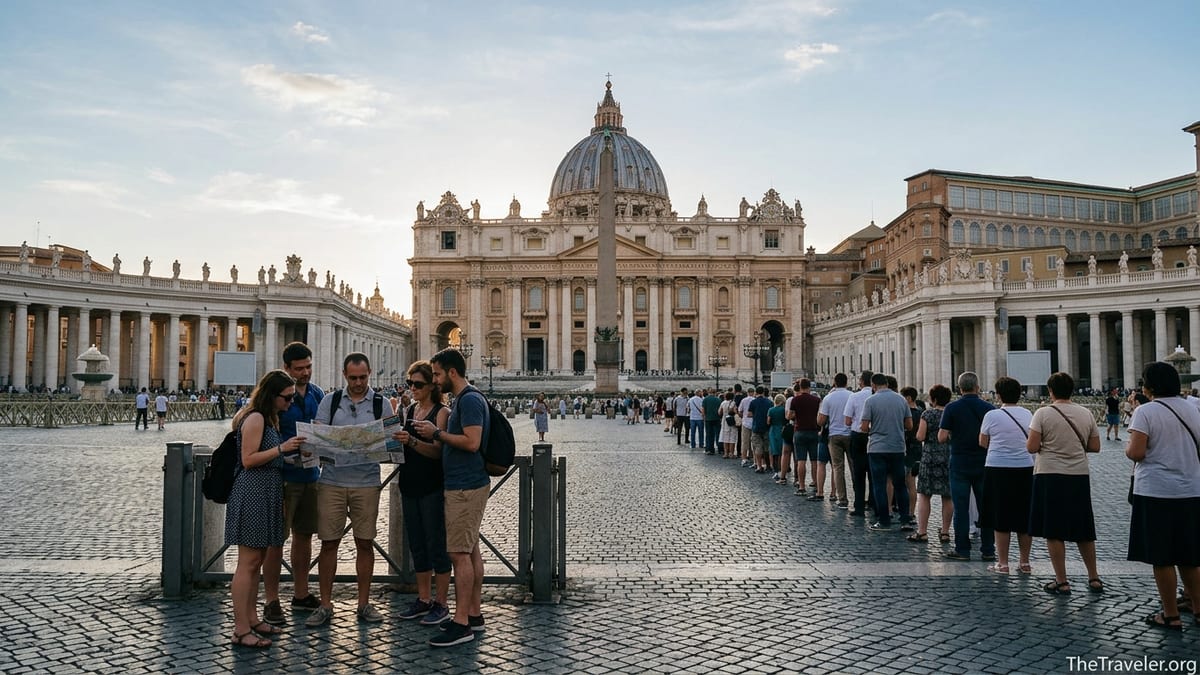
The first step to a successful visit is understanding what is free, what is ticketed and what “skip the line” actually means. Entry to the main floor of St Peter’s Basilica is free. You do not need a ticket or reservation to walk through the nave, stand beneath Michelangelo’s dome or visit most side chapels. Everyone, however, must pass through airport-style security in St Peter’s Square, and this is where queues often build, especially from mid-morning through early afternoon.
The confusion begins because some third-party sites sell products labeled as “St Peter’s Basilica tickets” or “skip the line access.” In reality, you are usually buying either a digital audio guide, dome access, a guided tour, or a combination of those services. None of these products exempt you from security screening. What some do offer is a separate, timed entrance lane that can be shorter than the general queue at busy times, particularly dome-and-audio-guide bundles sold through the official basilica channels.
The other important distinction is between the different underground areas. The Vatican Grottoes, just below the main floor, are free and open to all visitors via a staircase near the high altar area, and they contain modern papal tombs and fragments of older churches. Deeper still is the Vatican Necropolis, or Scavi, a first-century Roman burial ground and the closest you can get to the site identified as St Peter’s tomb. Access to the Necropolis is by pre-booked guided tour only and is strictly limited to small groups.
Because of this layered structure, a “complete” visit to St Peter’s can include four very different experiences: the main basilica, the dome, the grottoes and, if you can secure a place, the Necropolis tour. Knowing in advance which of these matter most to you will help you build a realistic schedule instead of trying to improvise on the day.
Picking the Best Time and Route Through the Basilica
Timing can make the difference between a contemplative visit and a frustrating one. The basilica typically opens early in the morning, often around 7:00. If you are staying in central Rome, aim to be at the security queue shortly after opening. In most seasons this first hour is the quietest of the day, and you may find yourself walking the monumental nave with only a modest crowd while soft morning light filters in through the upper windows.
If early mornings are not realistic, your next best window is late afternoon, roughly the last two hours before closing, when tour groups thin out. Midday, particularly between 10:00 and 14:00, is when queues in St Peter’s Square can easily swell to an hour or more in busy months. This pattern can shift during major liturgical events and in Jubilee years, when papal celebrations draw additional pilgrims, so it is wise to check Vatican announcements shortly before your trip and give yourself extra time if your dates coincide with big Masses or audiences.
Once inside, follow a simple route that prioritizes the major highlights before your energy fades. Many experienced visitors walk slowly up the central nave to absorb the scale, then pause beneath the bronze baldachin designed by Gian Lorenzo Bernini over the papal altar. From here you have an excellent vantage point to appreciate the soaring dome and to orient yourself to the chapels that radiate from the nave. A natural circuit then takes you clockwise along the right side aisles and chapels, across the transept, and down the left side, ending near the entrance to the grottoes and the stairs that lead toward the dome ticket office.
Be flexible enough to adjust your order if you see a short line somewhere that usually backs up, such as the rope line to the statue of St Peter or the entrance to the dome staircase. As with any major site in Rome, a rigid checklist can backfire if you insist on seeing one particular artwork at the peak of the crowd rather than detouring to a nearby chapel and returning ten minutes later when a group has moved on.
Dress Code, Security and Avoiding Common Pitfalls
The basilica enforces a conservative dress code. Shoulders must be covered, and hemlines should reach roughly to the knee. Sleeveless tops, very short shorts and low-cut outfits can result in being turned away at the security checkpoint, even if you have a timed product for the dome or an audio guide. In practical terms, this means packing a light scarf or shawl to throw over your shoulders and choosing longer shorts, skirts or lightweight trousers for the day you visit the Vatican. Closed shoes or sandals are acceptable, but beachwear or bare torsos are not.
Security itself operates like an airport line, with x-ray scanners and metal detectors in front of the colonnades surrounding St Peter’s Square. Queues here are exposed to the elements, so bring a hat and water in warm months and a compact umbrella when rain is forecast. In high season it is not unusual to hear visitors mention waits of 60 to 90 minutes around late morning, while those who arrived by 7:30 or 8:00 often report walking straight through. You cannot bring large backpacks or bulky luggage into the basilica; there is a cloakroom service just inside where smaller bags, umbrellas and items like tripods can be left without charge for the duration of your visit.
A major pitfall is misunderstanding what any advertised “skip the line” product does. For example, a family might pay extra through a reseller for a bundle that includes an audio guide and marketing language about priority entrance, only to discover that they still queue for security like everyone else. In contrast, buying an official dome ticket with basilica access and audio guide in advance often means using a specific meeting point near the square, being checked in at a set time and then directed to a dedicated entrance corridor. On a typical busy morning this can feel like joining a fast-moving business-class lane rather than the longer general queue, but you still go through scanners and may wait 20 to 30 minutes at peak times.
The other common mistake is showing up without any padding in your schedule. Because the basilica is an active church, sections sometimes close suddenly for liturgies, confessions or rehearsals. If you have booked the Necropolis or dome at a precise time, allow at least an extra hour on either side so you can adapt if part of the main floor or the grottoes are temporarily off limits when you had planned to see them.
The Unmissable Highlights Inside St Peter’s
Even travelers who are not normally interested in churches tend to be impressed by St Peter’s sheer size and artistry. To avoid wandering aimlessly, identify a small set of must-see works and spaces. Near the right-hand entrance, just past the holy water fonts, is Michelangelo’s Pietà, a marble sculpture of the Virgin Mary cradling the dead Christ. It is protected behind glass since a 1970s attack, but you can still get a clear view from in front of the first side chapel. Arriving early helps, as tour groups often cluster here later in the morning.
Continuing up the nave, notice the massive inscriptions and the sculptures of saints in the niches. The lettering that circles the base of the dome is several meters high, yet appears almost modest from the floor, a visual trick that reinforces the building’s enormous scale. At the center, Bernini’s bronze baldachin rises over the papal altar, marking the spot beneath which St Peter’s tomb is traditionally located. Just to the right, a roped-off statue of St Peter enthroned is a popular stop for pilgrims, many of whom touch or kiss the foot of the statue in a sign of devotion.
On the right side of the basilica, the Chapel of the Blessed Sacrament is reserved for silent prayer; its entrance is sometimes monitored by staff who ask that only those intending to pray enter. Farther along, the Chapel of St Sebastian has in recent years contained the tomb of Pope John Paul II and often attracts a steady stream of visitors. On the left side of the nave you will find monuments to various popes and royal figures, including the grand tomb of Pope Urban VIII by Bernini and the memorial to Queen Christina of Sweden, a famous convert to Catholicism who abdicated her throne in the 17th century.
Beneath the main floor, the Vatican Grottoes host a series of chapels and tombs of many popes and notable figures. Access is via a staircase near the high altar area; signs in multiple languages help guide you. The atmosphere here is quieter, ceilings are lower, and the connection between medieval and modern papacy becomes more tangible as you walk past simple marble slabs and more elaborate sarcophagi. Plan 20 to 30 minutes for the grottoes if you walk through steadily, more if you want to pause at specific tombs such as that of Pope Paul VI or the relocated resting place of John Paul II.
Climbing the Dome: Views, Tickets and What to Expect
For many visitors, climbing Michelangelo’s dome is the highlight of a trip to St Peter’s. The ascent rewards you with two distinct experiences: an interior balcony that circles the base of the dome high above the basilica floor, and an exterior viewing platform at the very top, offering sweeping views over Rome, the Tiber and the Vatican Gardens. Even travelers who feel they have seen many city panoramas often describe this one as uniquely impressive because of the direct view down onto St Peter’s Square and the colonnades.
Dome access is ticketed. Prices can change, but as a rough guide expect to pay a modest fee at the official ticket office inside the basilica, near the right side of the nave, with a slight surcharge if you choose to take the elevator for the first section rather than stairs the entire way. Recently, online bundles that include the dome, a timed entrance to the basilica and a digital audio guide from the official site have been priced in the range of a medium-priced restaurant meal per person. Third-party guided dome tours cost more, often adding 15 to 25 euros on top of the base ticket in exchange for a small-group guide who offers detailed explanations and manages logistics.
The climb itself is physically demanding but manageable for most reasonably fit adults. After the elevator or initial staircase, you walk along the interior balcony at the base of the dome, close enough to the mosaics to see their individual tiles. From there, narrow, sometimes sloping stairways continue upward between the inner and outer shells of the dome. At points the walls curve and the ceiling drops, so taller visitors may need to stoop. The upper staircases are too tight for large backpacks, and the environment can feel claustrophobic, especially on hot days.
To avoid long waits at the dome ticket line, many travelers aim to go straight there as soon as they enter the basilica in the morning. At that hour the queue for tickets is often short and the stairways less congested. By late morning and early afternoon, particularly in summer, the wait can stretch, and the viewing platform can feel crowded with little shade. If you are visiting during the warmer months, bringing water and wearing light clothing and sturdy shoes will make the ascent and descent more comfortable.
Exploring Beneath the Altar: Vatican Grottoes and Necropolis
Most visitors who go below the main floor of St Peter’s only see the Vatican Grottoes, but the more restricted Vatican Necropolis, or Scavi, is one of the most memorable experiences in Rome for those who can secure a reservation. The grottoes, as noted earlier, are easily accessible and show the continuity of papal burial from the Renaissance to modern times. You will see a mix of simple tomb slabs and modest chapels, some with fresh flowers or prayer cards left by recent visitors. Photography rules can vary, but it is generally expected that you maintain a respectful quiet and avoid flash.
The Necropolis sits deeper, at the original Roman street level. This was a working cemetery in the first centuries of the Roman Empire, later buried when Constantine built the first St Peter’s basilica above what early Christians believed was the apostle’s grave. Modern archaeological work in the mid-20th century uncovered rows of family mausoleums and a complex of tombs beneath the current high altar area. Today, small groups led by specialist guides walk through narrow lanes between ancient brick tombs, often still decorated with frescoes and inscriptions, before reaching the vicinity of the site identified by the Vatican as Peter’s resting place.
Access to the Necropolis is tightly controlled. Booking must be made in advance, usually by contacting the dedicated office listed on the official basilica channels or by using the official booking page for the Necropolis tour. Group sizes are small, typically around a dozen people, and only a limited number of tours run each day, mostly on weekdays. Children under a certain age are not allowed, and visitors with mobility challenges or claustrophobia are advised to skip this part of the complex due to confined spaces, humidity and uneven ground.
Because of its exclusivity, the Necropolis tour should be reserved as early as possible, often several months ahead for peak seasons. If you manage to book it, plan your entire Vatican day around the assigned time. The tour usually lasts about an hour, and some slots can be combined, on request at the time of booking, with a guided visit to the basilica afterward. Many travelers describe the Scavi experience as the moment when the layers of history, faith and archaeology at St Peter’s truly come alive, and it is often cited as the single most powerful part of a Vatican visit.
Making Sense of Tours, Audio Guides and “Skip the Line” Offers
Once you start planning your visit, you will encounter a bewildering range of products: dome tickets, basilica audio guides, combined museum and basilica tours, and bundles described as priority or fast-track access. To avoid disappointment, focus on who is selling the product and what exactly is included. The official basilica offerings typically center on three things: a multilingual digital audio guide for the main church, timed access to the basilica itself, and tickets for the dome or the treasury museum. These official bundles sometimes use a reserved entry slot that can significantly cut waiting time at security when crowds are heavy.
Third-party platforms and local tour companies add layers on top of this. A guided small-group tour that includes an expert explaining the art and history inside the basilica, helps you interpret details on the baldachin and in Michelangelo’s Pietà, and leads you directly from the Sistine Chapel into St Peter’s via the internal passage can be excellent value if you prefer context and a structured visit. Prices vary widely, but you can expect to pay the equivalent of a moderate-priced dinner or more per person for such a tour in high season, particularly if it combines the Vatican Museums, Sistine Chapel and basilica over several hours.
On the other hand, be wary of street touts in and around St Peter’s Square who approach you with laminated brochures and promises of instant entry. While some represent legitimate agencies, the pressure sales tactics and vague descriptions often leave travelers unclear about what they have bought. A typical scenario might be paying extra for an “express” basilica entrance that is simply a timed audio guide check-in, which may or may not save meaningful time depending on the crowd that day.
If you are comfortable exploring at your own pace and mainly want to ensure you see the major highlights without detailed commentary, a digital audio guide from the official site is usually sufficient. These guides are designed as self-paced routes through the basilica, identifying chapels, major artworks and tombs while allowing you to linger where you wish. You pick up a device on-site, often leaving an ID as deposit, or use your own smartphone and headphones to access the content, which can be especially convenient if you are traveling light.
The Takeaway
Visiting St Peter’s Basilica without missing the major highlights is less about seeing everything and more about choosing wisely and planning ahead. Start by deciding which layers matter most to you: the main basilica floor with its towering nave and the Pietà, the sweeping rooftop views from the dome, the quiet solemnity of the grottoes, or the rare depth of the Necropolis tour beneath the altar. With those priorities in mind, structure your day around the best time slots, aiming for early morning or late afternoon whenever possible to reduce time spent in the security queue.
Respect the dress code, travel light enough to move comfortably through stairways and narrow corridors, and be skeptical of any product that advertises miracles at the entrance. Choose official tickets and reputable tours that clearly state what they include, and build slack into your schedule so you can absorb the inevitable surprises of an active, working church. If you do, your time at St Peter’s will feel less like a checklist and more like what it is meant to be: an encounter with centuries of history, faith and art in one of the most extraordinary buildings on earth.
FAQ
Q1. Do I need a ticket to enter St Peter’s Basilica?
Entry to the main floor of St Peter’s Basilica is free and does not require a ticket, but you must pass through security, which can involve significant queues at busy times.
Q2. What parts of St Peter’s require paid tickets?
You need a ticket for the dome climb, for the treasury museum and for the guided Vatican Necropolis tour beneath the basilica. Official bundles may also include a digital audio guide and timed basilica access.
Q3. Is there a real “skip the line” option for St Peter’s?
No product lets you bypass security completely, but some official timed tickets and guided tours use separate, often shorter, entrance lanes. These can reduce waiting time, especially during peak hours, but you should still expect a security check.
Q4. What is the dress code for visiting the basilica?
Shoulders must be covered, and clothing should reach roughly to the knee. Sleeveless tops, very short shorts and revealing outfits may lead to being refused entry, so pack a light cover-up and choose modest clothing for your visit.
Q5. How difficult is the climb to the top of the dome?
The dome climb involves many stairs, some of them narrow and steep, and parts of the route pass through tight, sloping corridors. Most reasonably fit visitors manage it without trouble, but it is not ideal for those with mobility issues, heart problems or strong claustrophobia.
Q6. Can I visit the Vatican Grottoes and Necropolis on the same day?
Yes, many travelers visit both, but the experiences are different. The grottoes are freely accessible from inside the basilica, whereas the Necropolis requires a pre-booked guided tour at a specific time, so plan your day around your Scavi slot if you have one.
Q7. How far in advance should I book the Vatican Necropolis (Scavi) tour?
Places on the Necropolis tour are limited, and demand is high, especially in spring, summer and around major church events. It is wise to request a booking several months in advance if your travel dates are fixed.
Q8. Is an audio guide or guided tour worth it inside St Peter’s?
If you enjoy context and stories behind the art and architecture, a digital audio guide or small-group tour can greatly enrich your visit. If you mainly want to absorb the atmosphere and see key highlights, the free visit with a basic printed or self-made guide can also be satisfying.
Q9. When is the best time of day to visit to avoid crowds?
The first hour after opening is usually the quietest, offering shorter security lines and more space inside. Late afternoon, in the last couple of hours before closing, is often calmer than midday, though patterns can vary on major religious holidays.
Q10. Can I go directly from the Vatican Museums and Sistine Chapel into St Peter’s?
Many combined Vatican Museum tours end in the Sistine Chapel and then use the internal passage into St Peter’s with a guide, which avoids exiting and rejoining the main square queue. If you visit the museums independently, access through this door can depend on current regulations, so you may need to walk around to St Peter’s Square and pass standard security.