


Ask travelers which place in Rome floored them the most and two names come up again and again: St Peter’s Basilica and the Pantheon. Both are churches, both are free to worshippers at certain times, and both are among the most visited buildings in Italy. Yet they offer radically different experiences. One is the largest church in Christendom, fronting a vast Baroque square at the heart of the Vatican. The other is an almost perfectly preserved Roman temple with a single round space and a shaft of light pouring from its open oculus. If you have limited time in Rome, or simply want to know which one might leave the deeper emotional mark, it helps to look at them side by side.
Get the latest updates straight to your inbox!
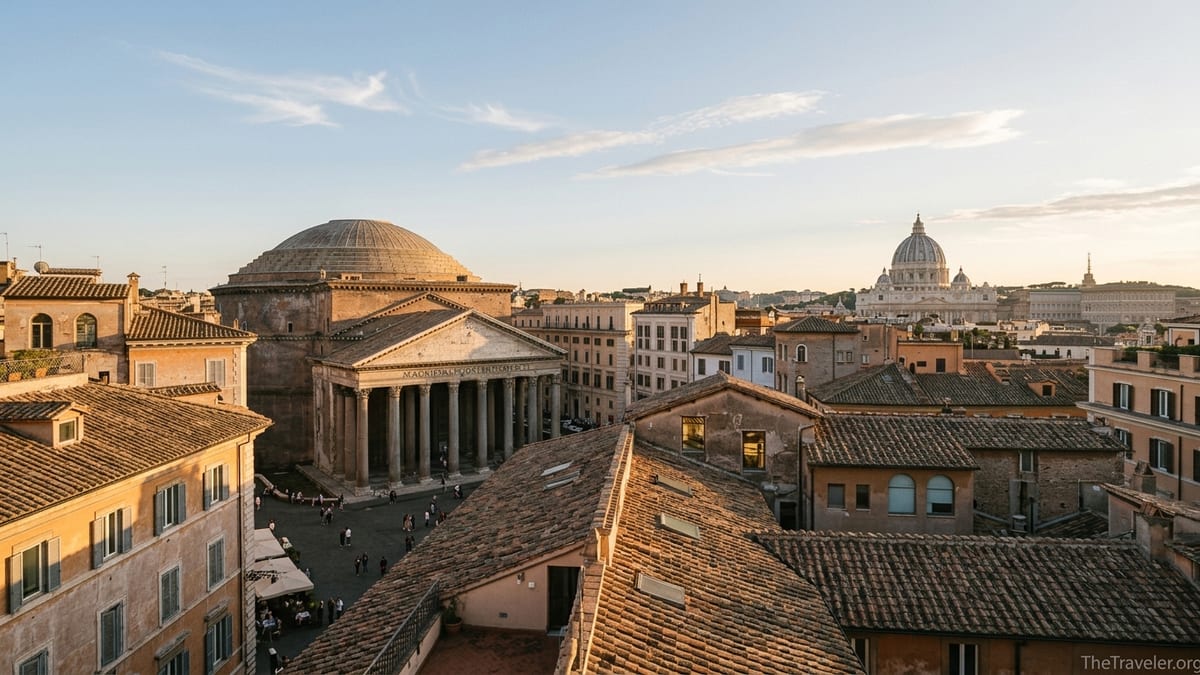
First Impressions: Scale Versus Simplicity
Walking into St Peter’s Basilica feels like stepping into a city made of marble. The nave alone is longer than a football field, the bronze baldachin above the main altar so tall that it could swallow many parish churches. Most first-time visitors arrive from Piazza San Pietro, crossing Bernini’s colonnades and queuing at security, so that when they finally step through the central doors the sudden volume of space hits like a physical force. Even seasoned travelers describe needing a few minutes simply to adjust to the scale before they can start picking out details like Michelangelo’s Pietà or the golden mosaics in the apse.
The Pantheon, by contrast, is compact from the outside. You approach through the small, irregular Piazza della Rotonda, dodging café tables and street musicians. The portico with its granite columns feels monumental, but you still expect a normal church interior behind the bronze doors. Instead you step into a single, unified space: a perfect cylinder and dome, almost the same height as width, with no side chapels to wander into. Many visitors pause after two or three steps, feeling something shift as the traffic noise from outside disappears and the marble floor, worn by nearly two thousand years of footsteps, pulls attention downward while the oculus pulls it up.
Where St Peter’s amazes with excess, the Pantheon astonishes with restraint. If you are moved by grand spectacle, processions and soaring music, St Peter’s will likely win your heart. If you prefer clear lines, geometry and a sense that almost nothing here is accidental, the Pantheon often leaves the deeper, quieter imprint.
In practice, many travelers remember the exact instant the Pantheon’s light hit them, while they recall St Peter’s more as a succession of highlights: the piazza, the Pietà, the dome, the view over Rome. The impact is different in kind rather than degree.
Practicalities: Tickets, Queues and Opening Hours
On a very practical level, how easy each site is to visit shapes your experience. St Peter’s Basilica remains free to enter as of mid‑2026. You do not need a general admission ticket for the church itself, but you must pass through airport-style security at the edge of St Peter’s Square. In peak season, mid-morning queues often stretch across the piazza. Travelers report waits of 45 to 90 minutes around 10:00 to 11:00, especially on Saturdays and during major Church events. Early arrivals around 7:00 to 8:00 usually breeze through in 10 to 20 minutes, especially outside high summer.
What you do pay for in St Peter’s are extras. Climbing the dome, one of the great experiences in Rome, costs roughly the price of a simple trattoria pasta dish. There is a slightly higher fee if you take the elevator partway up and a lower one if you walk all the way from the bottom. Guided tours and skip-the-line packages for the basilica and dome can easily run to several dozen euros per person, particularly if they combine the visit with the Vatican Museums.
The Pantheon switched from free entry to a ticketed system in July 2023. Today the official base ticket is a modest single-digit euro fee for most adult visitors, with reductions for EU citizens aged 18 to 25 and free entry for under‑18s and residents of Rome. You can buy tickets on-site at designated desks, but many visitors now reserve online time slots that sometimes include an audio guide. Third‑party tours that bundle Pantheon entry with nearby attractions can cost ten times the base ticket, so reading the inclusions carefully prevents surprises.
Opening hours also differ in ways that affect impact. St Peter’s generally opens at 7:00 and closes early evening, with slightly shorter hours in winter. The Pantheon’s visiting hours vary more through the year and are broken up by Mass times, when tourists may be asked to leave or wait. On Sundays and religious holidays, the Pantheon can feel much more like a parish church than a monument, especially in the morning. Checking schedules a day or two ahead, especially in the Jubilee year, helps you avoid turning up during a service when sightseeing is restricted.
Atmosphere and Emotion: Worship, Light and Sound
Both buildings are active churches, and both can deliver powerful emotional moments, but their atmospheres are distinct. In St Peter’s, the mood changes dramatically depending on what is happening. On an ordinary weekday at 8:00 you might share the nave with just a few dozen pilgrims and nuns, soft footsteps echoing under the dome. On a Wednesday during a papal audience period, the basilica can be closed or partially closed while tens of thousands gather in the square outside. At Mass times, especially high Mass with choir and organ, the building fills with music that seems to vibrate in the marble and gilded stucco.
Many travelers describe a sense of being overwhelmed in St Peter’s, not only by the art but by the constant motion. Tour groups queue for the dome, security guards manage flows, clergy move between side chapels, and public announcements occasionally break the hush. The impact here often comes from a combination of religious significance and being part of an international crowd: you hear languages from every continent, see pilgrims praying at tombs of popes, and feel the weight of the institution of the Catholic Church.
The Pantheon, by contrast, is quieter even when the headcount is high. Sound behaves differently in the rotunda. Murmurs bounce off the curved walls, but there is no constant roar. Light is the protagonist. Around midday on a clear day, the beam from the oculus cuts a sharp circle of brightness on the coffered dome and slowly glides across the interior. On a rainy afternoon, fine droplets fall directly through the opening, splashing on the marble floor where discreet drains carry water away. Visitors often describe staying longer than planned simply to watch the light move or to stand in the falling rain for a moment.
If you are not Catholic or not particularly religious, you may still feel a strong spiritual charge at both sites. At St Peter’s it tends to come from ritual and symbolism: the bronze statue of St Peter whose foot has been worn smooth by centuries of hands, the tombs beneath the basilica, the relics and altars. At the Pantheon the spirituality feels older and more elemental, rooted in geometry and in the way light connects sky and earth. For some, this makes the Pantheon more unexpectedly moving, because it asks less of you ideologically and more of your senses.
Architecture and History: Two Masterpieces, Two Eras
Architecturally, comparing St Peter’s and the Pantheon is like comparing an opera to a single, perfect aria. St Peter’s took more than a century to build, with contributions from Bramante, Michelangelo, Bernini and others. Its design evolved through Renaissance and Baroque tastes, and what you see today is a blend of styles, from the muscular curves of Michelangelo’s dome to the theatrical flourishes of Bernini’s chapels and monuments. It is also layered over history: beneath the current basilica lie remains of an earlier church and a Roman necropolis where, according to tradition, St Peter is buried.
The Pantheon as we see it today largely dates from the reign of Emperor Hadrian in the 2nd century AD, though an earlier temple on the site may have been founded by Agrippa. The sheer technical achievement of its unreinforced concrete dome, still the world’s largest of its kind, tends to sink in only when a guide explains that modern engineers still study its construction. The thickness of the dome decreases toward the oculus, and lighter materials were used at higher levels to reduce weight, while the coffers are not just decorative but help remove mass.
History here is not just in textbooks but visible in details. In the Pantheon, you see where bronze has been stripped from the portico in past centuries, where medieval Christian additions sit on top of pagan foundations, and where the tombs of Italian kings and of the painter Raphael occupy former niches for Roman gods. In St Peter’s, you see the visual language of papal power and Counter‑Reformation triumph: colossal statues of saints, Latin inscriptions in letters taller than a person, and chapels glowing with colored marbles from across the former Papal States.
From a historical perspective, the Pantheon is the older survivor, carrying the line from classical Rome to modern Italy. St Peter’s, though younger, encapsulates a pivotal moment when the Catholic Church reasserted itself after the turmoil of the Reformation. Depending on whether you are more drawn to the ancient or the early modern period, one of the two will resonate more deeply.
Views, Vantage Points and Surroundings
One area where St Peter’s has a clear, literal edge is in its views. Climbing the dome is a commitment: you navigate tight stairways and sloping corridors, sometimes with little headroom, especially in the final section. Yet the payoff is one of Europe’s great panoramas. From the upper terrace you look straight down onto the geometric pattern of St Peter’s Square, the straight Via della Conciliazione leading toward the Tiber, and out across the tiled roofs and domes of Rome. On clear days you see the Alban Hills in the distance. Many visitors remember this view long after details of the interior have blurred.
The Pantheon does not offer a public rooftop or dome climb. Its impact is more interior than exterior. The square in front, however, is one of Rome’s most atmospheric spots, especially in the early evening. Sitting at a café with a simple espresso or an aperitivo, watching the façade shift color as the sun sets, can be as memorable as any formal view. Street musicians set up nearby, children climb on the base of the central fountain, and the building slowly glows under warm lighting.
Location also affects how often travelers encounter each landmark. The Pantheon sits in the historic center, a short walk from Piazza Navona, Largo di Torre Argentina and the Trevi Fountain. It is easy to pass by more than once in a day. St Peter’s is slightly more out of the way on the far side of the Tiber, in Vatican City, and most people plan it as a half-day excursion combined with the Vatican Museums or Castel Sant’Angelo. The effort of reaching it, and the time you invest, can intensify its impact for those who build anticipation around the visit.
If you prize sweeping city views and the feeling of standing above Rome, St Peter’s will leave a bigger mark. If you care more about integrating a great monument into the everyday texture of your wanderings, the Pantheon often proves the one you remember most vividly.
Costs, Time Investment and Crowd Management
Considering the broader cost of your time in Rome, the choice between St Peter’s and the Pantheon is not only about admission fees but also about how much of your day each visit consumes. Visiting St Peter’s properly, even without the Vatican Museums, tends to take half a day once you factor in transport to the Vatican area, security queues, time inside the basilica and, if you choose, the dome climb. Many travelers who book guided tours with reserved entry, which might run to thirty euros or more per person, do so precisely to control queues and timing.
The Pantheon, even under the ticketed system, is still relatively low-friction. If you reserve a timed entry in advance you may spend as little as 30 to 45 minutes from arrival to exit, including a slow circuit of the rotunda and a few minutes standing under the oculus. Without a reservation in peak hours you might queue in the square for 20 to 40 minutes, a wait made more bearable by people-watching and the cafés around you. For budget travelers, the base ticket price is modest compared to the cost of a sit-down lunch nearby.
Crowd dynamics inside also differ. At St Peter’s, groups tend to cluster around key works like the Pietà, the tomb of John Paul II and the main altar. Guards keep visitors moving and enforce dress codes, turning away those with bare shoulders or shorts that are too short. The sheer size of the building can absorb large numbers, but certain bottlenecks, like the entrance to the dome staircase, can feel cramped. At the Pantheon, the entire experience unfolds in one space, but because people distribute themselves along the perimeter and around the center, it can still feel surprisingly calm even at busy times.
If travel stress dilutes your capacity for awe, the Pantheon often wins simply because it asks less of you logistically. But if you enjoy the build‑up of a big-ticket sight, are willing to book ahead and accept the crowds as part of the story, St Peter’s offers a sense of occasion the Pantheon does not aim to match.
Which Leaves a Bigger Impact for Different Travelers?
Ultimately, the question of which landmark leaves a bigger impact depends as much on you as on the buildings. Pilgrims and practicing Catholics often speak of St Peter’s as a once‑in‑a‑lifetime destination. Attending Mass there, praying at the tomb of a favorite pope, or hearing the pope speak in the square can carry intense personal meaning that no other monument can rival. Even for those less tied to ritual, the mix of monumental architecture and living faith can be deeply affecting.
Architecture enthusiasts, engineers and lovers of antiquity, on the other hand, frequently single out the Pantheon as the highlight of Rome. Standing under a dome that has survived since the height of the Roman Empire, still functioning in essentially the same way, can feel like touching the past more directly than at more ruinous sites. The precision of the geometry, the way the oculus frames a patch of sky, and the absence of later clutter make it a pure experience of space and light.
Families with children sometimes find the Pantheon easier, because it is compact, visually immediate and free of long stair climbs, while the novelty of “a hole in the roof” that lets the rain in is easy to explain. Teenagers and adults hungry for Instagram‑ready views gravitate toward the St Peter’s dome, where the sweeping skyline shots feel like a reward after the effort.
Many travelers who visit both in a single trip discover that their initial expectations flip. They may assume St Peter’s will be the emotional peak but later realize that the memory that returns most often is of standing in the Pantheon, watching dust dance in the beam of light. Others come away feeling that nothing in Rome matches the drama of walking into the Basilica at the end of a long morning in the Vatican Museums, emerging later onto the square with the city spread out in front of them.
The Takeaway
If you can, you should see both St Peter’s Basilica and the Pantheon. They are two sides of Rome’s genius for sacred architecture: one a vast, ceremonious statement of Christian power, the other a concentrated, almost minimalist expression of harmony and light. Together they bracket nearly two millennia of history.
For visitors trying to prioritize, a simple rule of thumb is this: if your trip to Rome is also a pilgrimage, or if you crave big panoramas and can invest half a day, St Peter’s will likely leave the larger imprint. If your time is tight, your budget modest and your curiosity about ancient engineering and quiet spaces high, the Pantheon may well be the place you think about long after you return home.
In the end, the “bigger impact” is not always the louder one. The grandeur of St Peter’s can sweep you up, but the Pantheon’s single round room, with its shifting circle of sky, often does the quieter, longer work. The best impact of all may come from letting them speak to you in their own ways, on their own terms, and noticing which one you find yourself talking about years later.
FAQ
Q1. Do I need a ticket to visit St Peter’s Basilica?
For the main basilica, entry is free but you must go through security. Tickets are required only for extras such as the dome climb or guided tours.
Q2. How much does it cost to visit the Pantheon in Rome?
The Pantheon now charges a modest base admission fee for most adults, with reduced rates for some EU visitors and free entry for under‑18s and Rome residents.
Q3. Which has longer queues, St Peter’s Basilica or the Pantheon?
St Peter’s generally has longer queues because of security checks, especially mid‑morning and in peak season. Pantheon lines are usually shorter but can still build around popular time slots.
Q4. If I have only one morning in Rome, which should I prioritize?
If you want a major, “bucket list” experience and are prepared for crowds, choose St Peter’s. If you prefer a shorter, calmer visit that still feels unforgettable, choose the Pantheon.
Q5. Is the dome climb at St Peter’s worth it compared with visiting the Pantheon?
Yes, if you are fit enough for stairs and not severely claustrophobic. The Pantheon does not offer a rooftop view, so St Peter’s dome is the one that gives you sweeping vistas over Rome.
Q6. Which is better for travelers on a tight schedule?
The Pantheon is usually better for tight schedules. You can visit meaningfully in under an hour and it lies close to many other central sights.
Q7. Are there dress codes for St Peter’s Basilica and the Pantheon?
Yes. Both are active churches, so modest dress is expected: covered shoulders, no very short shorts and clothing respectful enough for a place of worship.
Q8. Can I attend Mass at St Peter’s or the Pantheon?
Yes. Both host regular Masses. During services, tourist access is limited and the atmosphere is more focused on worship than sightseeing.
Q9. Which landmark is more accessible for visitors with limited mobility?
The main floors of both are relatively flat, though entry areas can be crowded. The St Peter’s dome climb involves many stairs and is not suitable for those with mobility issues.
Q10. Is it realistic to see both St Peter’s Basilica and the Pantheon in one day?
Yes, many travelers do both in one day, often starting with an early visit to St Peter’s, then exploring the historic center and the Pantheon in the afternoon or evening.