


Hugh Taylor Birch State Park is one of the smartest "backdoor" ways to enjoy Fort Lauderdale Beach. You park in a shady, calm state park, then walk a few minutes to a wide stretch of Atlantic sand across A1A. This guide explains, step by step, how to reach the beach from inside the park, how the A1A crossing works, what hours and gate rules you need to know, what to bring, and how to get the best value out of parking and your beach day.
Get the latest updates straight to your inbox!
Understanding the Layout: Park, A1A and Fort Lauderdale Beach
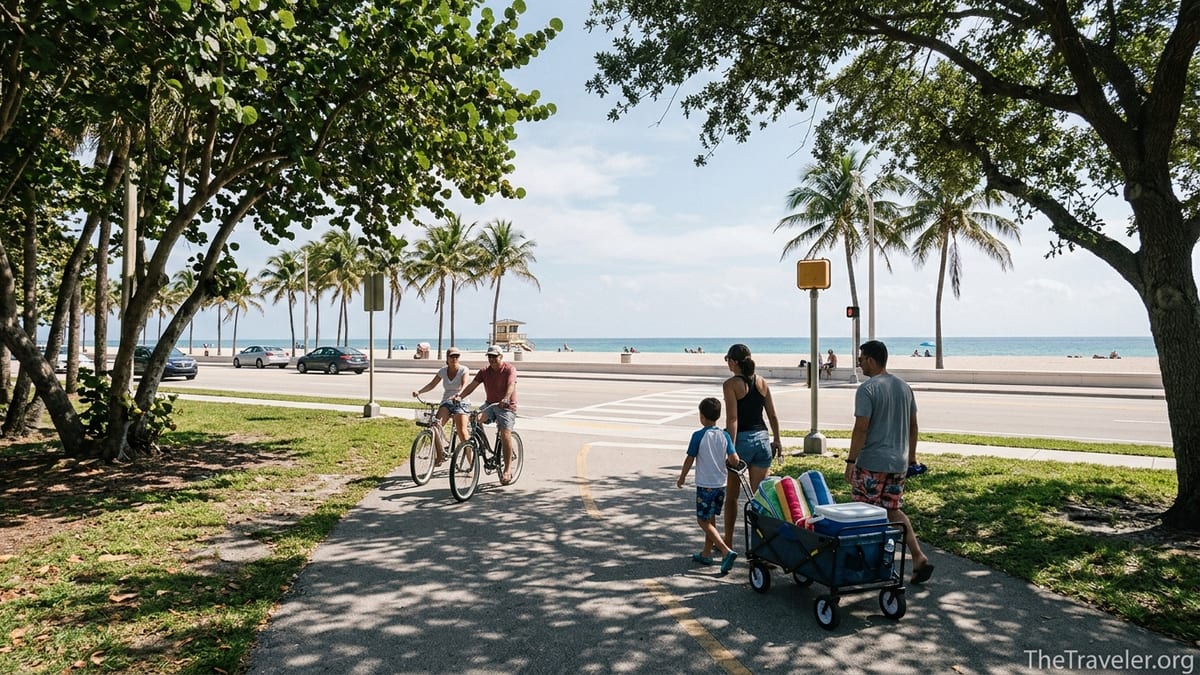
Hugh Taylor Birch State Park sits on a narrow barrier island between the Intracoastal Waterway and Fort Lauderdale Beach. Inside the park you are in a shaded, green oasis with oak hammock, a freshwater lagoon, and a two-mile, one-way road loop. Just a few hundred feet east across State Road A1A is the classic Fort Lauderdale Beach shoreline. That means beach access is not directly inside the park; instead, you park under the trees, then walk or bike out toward A1A to reach the sand.
The main vehicle entrance to Hugh Taylor Birch State Park is on Sunrise Boulevard, just west of A1A. Once you pay the park entrance fee and drive in, you follow the one-way park road. Several pull-offs and small lots sit on the east side of the loop, closest to A1A and the beach. These are the most convenient for beach access because your walk out to the crosswalk is shortest.
Fort Lauderdale Beach in front of the park is part of the city’s continuous public beach, not a private resort area. The sand and surf are free to access once you cross A1A. The feel, however, is quieter than the central restaurant-and-bar strip around Las Olas Boulevard. Travelers who prefer a more natural backdrop, plus amenities like shaded picnic areas and restrooms inside the state park, often base themselves at Birch for beach days even when staying elsewhere in town.
It helps to picture your day in two zones. Inside the park, you have parking, picnic tables, trails, playgrounds, and the Park & Ocean concession area along the lagoon. Outside the park, across A1A, you have the open beachfront and ocean. You will move back and forth between the two, so planning for that short transition is key.
Step-by-Step: How to Walk from Birch State Park to the Beach
Reaching Fort Lauderdale Beach from Hugh Taylor Birch State Park is straightforward once you know where to go. From the moment you park, look for signage pointing toward A1A and Park & Ocean. These signs usually lead you toward the eastern edge of the park loop road, closest to the beach. Many visitors aim to park near the Park & Ocean complex because it lines up well with one of the main pedestrian access points to A1A and the shore.
If you park along the eastern side of the loop, you will typically walk a few minutes on paved sidewalks through the park, heading east. In practice, it feels similar to walking from a city park to a nearby beach promenade: you stay on the internal sidewalks until you reach the exit area near A1A. You will see the traffic on the highway and, often, glimpses of the ocean between buildings on the other side. The walk is usually 5 to 10 minutes from most parking spots on the east side of the loop, a bit more if you left your car in a lot deeper in the park.
Most visitors today use surface crosswalks across A1A rather than a tunnel. Look for marked pedestrian crossings with traffic signals or flashing beacons near the Park & Ocean area and park entrances. When you approach A1A, you will come first to the sidewalk that runs along the west side of the road. From there, you cross the traffic lanes at the signal to reach the beach promenade and sand. Families with strollers and beach carts typically find this route manageable because sidewalks are wide and ramps are curb-cut.
A workable example for a first-time visitor: you arrive at 9:30 a.m., pay at the Sunrise Boulevard gate, and park in a shaded spot near the eastern loop. You lock the car, grab your beach bag and chairs, and follow signs to Park & Ocean and the beach. After five minutes of walking on level pavement, you reach A1A. At the pedestrian crossing, you press the button, wait for the walk signal, then cross to the beach side. Total time from parking to the sand is about 10 to 12 minutes at a relaxed pace.
Crossing A1A Safely: Signals, Traffic and Realistic Expectations
A1A runs north-south directly between Hugh Taylor Birch State Park and the beach. It is a busy coastal highway, especially on weekends, during spring break, and anytime weather is beach-perfect. Treat the crossing as you would any multi-lane city arterial road: use designated crosswalks only, wait for signals, and be patient when traffic is heavy.
At the main Sunrise Boulevard area and near the park’s eastern edge, marked pedestrian crosswalks and signals allow safe crossing. In practice, most beach-going visitors exit the park, walk along the sidewalk to one of these crossings, and push the pedestrian button. Signals cycle frequently, but at peak times you might wait a full light cycle or two. It is common to see locals step out aggressively the moment the walk sign appears; if you are visiting with kids or carrying gear, give yourself an extra few seconds and make eye contact with stopped drivers before you proceed.
If you are using a beach cart, wagon, or wheelchair, the curb ramps on both park and beach sides of A1A are usually adequate, but you may encounter uneven pavement or narrow spots near utility poles. Plan to cross at the largest intersection near Sunrise Boulevard if you need extra room; many families find this corner more comfortable than smaller mid-block crossings because the crosswalks are wide and clearly painted.
Traffic varies by time of day. Early morning crossings, around 8 to 9 a.m., tend to be calmer, with more joggers and walkers than cars. By late morning and early afternoon, ride-shares, delivery trucks, and beach traffic all increase, which can make the crossing feel busier and noisier. Late afternoon, when people are leaving the beach or heading to dinner, can be especially hectic. If you are traveling with children or older adults, aim for the morning window and plan to be back across A1A before the strongest afternoon rush.
Park and Beach Hours, Gates and Timing Your Day
Hugh Taylor Birch State Park operates on typical Florida state park hours: open daily from 8 a.m. until sunset, year-round. That means you can drive into the park starting at 8 in the morning, and you should plan to exit with your vehicle by sunset. In summer, this often means around 8 p.m.; in winter, closer to 5:30 to 6 p.m. Exact sunset times shift through the year, so it is wise to check the local sunset time for your visit dates and give yourself a buffer of at least 30 minutes.
The beach itself, on the city side of A1A, generally remains accessible beyond park hours because it is part of the public Fort Lauderdale Beach corridor. However, once the park gates close at sunset, you cannot bring a vehicle back inside to retrieve anything you left, and parking access ends. In practice, that means your day should be planned around the earlier closing time of the state park, not the looser hours of the beachfront. Many locals time their beach session to wrap up and cross back into the park at least 45 minutes before sunset.
City lifeguards patrol much of Fort Lauderdale Beach, including the zones near Hugh Taylor Birch State Park, during daytime hours. The City of Fort Lauderdale notes that lifeguard towers along the beach are staffed every day of the year, usually from mid-morning to late afternoon, though specific hours can vary by season and tower. When you arrive on the sand, look for a staffed lifeguard tower nearby and check the flag color; the flag system tells you about surf, rip current, and jellyfish conditions that day.
A good real-world plan for a full day: arrive at the park around 9 a.m., spend the late morning on the beach, return to the park’s shade at midday for lunch and a break from the sun, then head back out to the beach for a shorter late-afternoon session. Begin packing up from the sand by about 90 minutes before sunset, so you have time to cross A1A, rinse off if needed, and exit the park gates without rushing.
Parking Fees, Value Strategies and Annual Pass Tips
As of mid-2026, entrance to Hugh Taylor Birch State Park typically costs about 6 dollars per vehicle with 2 to 8 people, 4 dollars for a single-occupant vehicle or motorcycle, and around 2 dollars per pedestrian or cyclist walking into the park. These are Florida State Parks’ standard ranges and can adjust over time, so always confirm the current rate before you go. Compared with on-street or garage parking along Fort Lauderdale Beach, which often runs multiple dollars per hour, the flat per-vehicle park entrance can be a significantly better value for a full beach day.
For example, a family of four staying in a downtown hotel without beach parking might pay 4 to 6 dollars per hour at a beachfront meter or garage. Five hours at the beach could easily reach 20 to 30 dollars in parking alone. The same family could instead drive into Hugh Taylor Birch State Park, pay the per-vehicle fee once, and park all day under the trees while walking across A1A to the sand. Travelers who routinely visit Florida state parks sometimes purchase an annual state park pass, which can make repeated visits to Birch and other nearby parks even more economical.
Inside Hugh Taylor Birch, parking is mostly along the internal loop road and in small lots near facilities. Spaces closest to the eastern side of the loop and near Park & Ocean tend to fill up first, especially on sunny winter weekends and holiday periods. If those are full, it may be worth driving another lap around the loop to look for a shaded pull-off further north or west, then walking a bit farther to the A1A crossing. Because your beach access depends on how close you are parked to the park entrances on the east, choosing a spot wisely when you first arrive can save you several extra minutes of walking with gear.
If you are considering alternatives, compare the cost of the park entrance to other parking options. Some hotels on the beach charge daily resort or parking fees that can exceed the state park fee even if you are not using a car every hour of the day. Conversely, if you only want a quick one-hour swim at sunrise, on-street metered parking may be simpler than entering the park. The value sweet spot for Hugh Taylor Birch is the half-day or full-day visit: you pay once, then enjoy both a green park setting and easy access to the ocean.
What to Bring for an Efficient Park-to-Beach Day
Because your car will be inside the park and your beach base is across A1A, the most useful packing strategy is to think in two layers: essentials you carry every time you cross and backup items you leave in the car. Essentials usually include swimsuits, towels, reef-safe sunscreen, drinking water, a hat, and minimal valuables in a small bag that can stay with you at all times. Many visitors also bring compact folding chairs or a lightweight beach blanket; carrying a full-size cooler or heavy tent across A1A is possible but less comfortable.
Wheeled solutions are popular. Families often use a collapsible beach wagon to roll chairs, umbrellas, and toys from their parking spot through the park and across the crosswalk to the sand. Choose one with large, sand-friendly wheels and a handle that is easy to pull uphill off the beach. Similarly, a small rolling soft cooler can keep drinks and snacks cold without being too cumbersome during the road crossing.
Inside the park, you have access to shaded picnic tables, grills, restrooms, and freshwater taps. That makes it easy to leave a second-tier set of items in the car or at a picnic site: extra snacks, a change of clothes, additional sunblock, or backup toys. Instead of hauling everything to the beach in one trip, you might do a morning beach session with minimal gear, return to the park for lunch at a picnic table, then head back out in the afternoon with only what you know you will use.
Weather along the Fort Lauderdale coast can change quickly, especially in summer when afternoon showers and thunderstorms are common. To stay comfortable and safe, pack a lightweight rain shell or poncho, a dry bag or plastic pouch for phones and keys, and a small towel reserved for drying off after sudden squalls. If a storm approaches and lifeguards clear the water, you can quickly retreat across A1A into the park’s tree cover and wait it out at a picnic shelter or at Park & Ocean while keeping your essentials dry.
Planning Your Ideal Beach Day: Sample Itineraries and Tips
The park-to-beach setup at Hugh Taylor Birch lends itself to a few different styles of day. One popular plan is the early-bird beach morning followed by a shaded afternoon in the park. In this version, you arrive as the park opens at 8 or shortly after, park near the eastern loop, and walk to the beach for a quiet, cooler few hours of swimming and sun. By late morning, when the sun grows intense and the sand fills up, you cross back into the park, find a picnic table under the trees, and enjoy lunch, a stroll along the lagoon, or a short bike ride on the loop road.
Another common pattern, especially for visitors with kids or grandparents, is to split the day into shorter blocks. For example, you might do a 90-minute beach session mid-morning, break for an hour in the park playground or at Park & Ocean for food, then return to the beach for one more swim. Having your car so close makes it easy to adjust if anyone gets tired or weather shifts. If clouds and wind pick up on the beach, you can retreat to calmer, more sheltered corners of the park without feeling like your parking fee was wasted.
Couples or solo travelers might prefer a slower-paced day that mixes beach time with light activities. You could rent a kayak or stand-up paddleboard on the park’s lagoon, ride bicycles along the scenic loop, or join a ranger-led walk if one is scheduled, then transition to the beach for a swim and relaxation. Because Fort Lauderdale Beach near Birch is less built-up than some stretches, it is a good place to bring a book or simply watch the waves between swims while knowing shaded refuge is a short walk away.
No matter your style, the main planning anchors are park opening and closing times, lifeguard hours, and weather forecasts. Check the day’s UV index and heat advisory information before you go and build in breaks in the park’s shade. If you want to catch sunrise over the Atlantic, you can start on the public beach side first using metered parking, then move your car into Hugh Taylor Birch once the park gate opens at 8 a.m. and spend the rest of the day using the park as your home base.
The Takeaway
Using Hugh Taylor Birch State Park as your launch point for Fort Lauderdale Beach is a practical, good-value strategy that also makes your day more relaxing. You trade high hourly parking rates and the noise of the central strip for shaded parking, picnic areas, and an easy walk to a beautiful stretch of public shoreline. With a bit of planning around the A1A crossing, park hours, and what you carry back and forth, you can move comfortably between quiet trees and open ocean as often as you like.
If you remember only a few things, make it these: arrive early or in the late afternoon for the calmest traffic and softest light, park on the eastern side of the loop when possible, always use marked crosswalks across A1A, and keep your beach kit light enough to carry comfortably. Do that, and Hugh Taylor Birch State Park becomes less of a simple parking workaround and more of a central part of your Fort Lauderdale beach experience.
FAQ
Q1. How long does it take to walk from Hugh Taylor Birch State Park to Fort Lauderdale Beach?
Most visitors take about 5 to 12 minutes from their parked car inside the park to reach the sand, depending on where they park along the loop and how much gear they are carrying.
Q2. Is there still a tunnel from the park to the beach?
Today, most access between Hugh Taylor Birch State Park and Fort Lauderdale Beach is via marked crosswalks across A1A. Travelers should plan on using surface crossings with signals rather than relying on an under-road tunnel.
Q3. How much does parking at Hugh Taylor Birch State Park cost compared with beachfront parking?
As of 2026, the park typically charges a flat vehicle entrance fee in the single-digit dollar range for the whole day, while city beachfront parking often charges several dollars per hour. For stays of four hours or more, the park is usually the better value.
Q4. Are there lifeguards on the beach in front of Hugh Taylor Birch State Park?
Yes. The City of Fort Lauderdale staffs lifeguard towers along much of the beach, including the area near Hugh Taylor Birch State Park, generally during daytime hours every day of the year.
Q5. Can I leave the park and come back later the same day?
Re-entry policies can vary, but usually your entrance fee applies for the day. If you plan to drive out and return, confirm with staff at the entrance gate when you arrive so you know what your options are.
Q6. What should I bring if I am walking across A1A to the beach?
Prioritize a manageable load: swimsuit, towel, sunscreen, water, a hat, and perhaps a compact chair or blanket. A collapsible beach cart or wagon can make it easier to move heavier items like umbrellas and coolers.
Q7. Is the A1A crossing safe for children and older adults?
When you use marked crosswalks and wait for pedestrian signals, the crossing is generally manageable for most people. It is a multi-lane road, though, so hold hands with children, move calmly, and consider crossing at the larger Sunrise Boulevard intersection for extra space.
Q8. What time should I plan to leave the beach to get back into the park before closing?
Because the park closes at sunset, a practical rule is to start packing up on the beach 60 to 90 minutes before sunset. That gives you time to cross A1A, rinse off if desired, reach your car, and exit without rushing.
Q9. Are there food and restrooms available, or should I bring everything?
Hugh Taylor Birch State Park offers restrooms, picnic areas, and a concession area around Park & Ocean where you can buy food and drinks. Many visitors bring snacks and water, then supplement with park concessions as needed.
Q10. Is Hugh Taylor Birch State Park a good option for avoiding crowded parts of Fort Lauderdale Beach?
Yes. While the beach itself can still be busy on peak days, the area in front of the park is usually quieter than the central restaurant-and-bar district, and the park gives you shaded space to retreat from crowds and sun between swims.