


On paper, the UOB PRVI Miles card looks like a dream for travellers in Singapore: up to 2.4 miles per dollar on overseas spend, uncapped earn rates and regular bonuses on foreign currency transactions. But what are those miles really worth once you factor in hidden costs, transfer fees and the messy reality of award availability? I ran the numbers using real flight prices and redemption options, and the results were eye-opening.
Get the latest updates straight to your inbox!
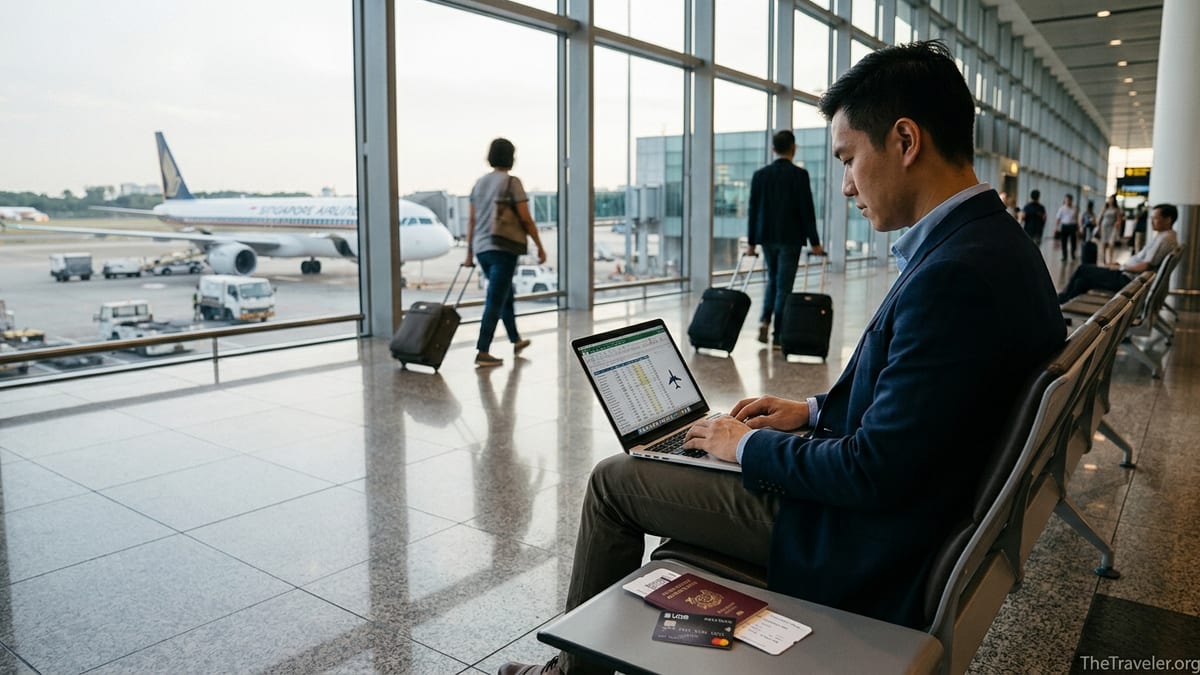
How UOB PRVI Miles Actually Earns You Miles
The UOB PRVI Miles card earns points in the form of UNI$, which you later convert to airline miles. The headline earn rates for the Singapore-issued cards are 1.4 miles per dollar on local spend and 2.4 miles per dollar on foreign currency transactions, with occasional campaigns that temporarily boost overseas dining and shopping to around 5 miles per dollar. The bank also partners with booking platforms such as major online travel agencies to offer higher rates on selected hotel or flight bookings from time to time, although these promos change frequently.
The catch is that PRVI calculates UNI$ in blocks of 5 Singapore dollars. Local spend earns 4 UNI$ per 5 dollars, which converts to 8 miles, so you effectively get 1.6 miles per dollar at the block level. But because any amount under each 5 dollar block is ignored, a 4.90 coffee earns nothing, while a 9.90 restaurant bill is treated as 5 dollars, not 10. Over hundreds of small transactions in a month this rounding quietly erodes your real-world earn rate to something closer to 1.3 to 1.4 miles per dollar on local spend.
Foreign currency spend works similarly, usually at 6.25 UNI$ per 5 dollars, which equals 12.5 miles for each 5 dollars. On paper that is 2.5 miles per dollar, but after rounding, your pragmatic effective rate often comes down to roughly 2.2 to 2.4 miles per dollar, depending on how your transactions line up against the 5 dollar blocks. In a typical month with a mix of restaurant bills, ride hailing and online purchases, it is rare to achieve the headline rate exactly.
On top of that, you pay foreign transaction fees on overseas purchases. UOB typically charges about 3.25 to 3.5 percent once you combine scheme and bank fees, so every 1,000 Singapore dollars spent overseas costs roughly 32 to 35 dollars in fees. This becomes a key number to compare against the value of the miles you earn, which we will unpack with specific examples.
What a PRVI Mile Is Worth in Economy Class
To ground the valuation, I started with a simple, popular route for Singapore travellers: a round-trip economy flight from Singapore to Bangkok on Singapore Airlines. Cash fares outside of major holidays often sit around 350 to 450 Singapore dollars including taxes when booked a few months in advance. Looking at recent award charts, saver economy awards for this route typically start around 25,000 miles return, with taxes and surcharges of about 80 to 120 dollars.
If you manage to snag a 25,000 mile saver seat and pay 100 dollars in taxes, and the equivalent cash fare would have been 400 dollars, your effective value per mile is roughly 1.2 cents. The formula is simple: subtract the taxes you still pay from the cash price, then divide by the miles. In this example, 400 minus 100 equals 300 dollars of “saved” fare, divided by 25,000 miles gives 0.012 dollars, or 1.2 cents per mile.
Now layer in PRVI’s earn side. To get 25,000 miles purely from local spend at an effective 1.4 miles per dollar, you would have to spend around 17,900 dollars on the card. If you mostly earn your miles through foreign currency spend at an effective 2.3 miles per dollar, you would need closer to 10,900 dollars of overseas charges. Seen this way, that one economy trip to Bangkok could be the reward for a year’s worth of day to day spending.
At 1.2 cents per mile, those 25,000 miles are worth about 300 dollars in value. If you earned them entirely through overseas spend, that is equivalent to about 2.75 percent back on your 10,900 dollars of spending, before fees. After subtracting roughly 3.3 percent in foreign currency fees, you have basically broken even in pure dollar terms, although you did convert that spending into a specific flight rather than general cash. For local spending with no extra fee, that same redemption looks like around 1.7 percent back, which is decent but not spectacular compared with the best cashback cards.
When Business Class Redemptions Tilt the Math
The story changes once you start pricing out business class and long haul routes. Consider a return business class ticket from Singapore to Tokyo on Singapore Airlines. Promotional cash fares can drop to around 3,000 Singapore dollars, but standard non sale fares are often higher, especially during peak seasons. A saver award for the same route, when available, typically costs in the ballpark of 103,000 miles round trip, plus about 200 to 250 dollars in taxes and surcharges.
If the revenue ticket you would realistically have bought costs 3,000 dollars, and you pay 250 dollars in taxes on the award seat, the miles are effectively covering 2,750 dollars of value. Dividing 2,750 by 103,000 gives you around 2.7 cents per mile, more than double what you got from the Bangkok economy example. Even if we assume you only get a saver seat half of the time and sometimes have to redeem at higher mileage levels, it is still common to see valuations between 2 and 3 cents per mile on long haul premium cabins when you compare with typical business class cash fares.
To accumulate 103,000 miles on PRVI from local spend at around 1.4 miles per dollar, you would be looking at about 73,600 dollars of spending. If half of your miles come from foreign currency spend at 2.3 miles per dollar and the other half from local spend, you might spend roughly 22,400 dollars overseas and 22,400 dollars locally to hit that total. At a conservative 2.2 cents per mile, those 103,000 miles are worth about 2,266 dollars in flight value, which turns your blended year of spending into roughly a 5 percent rebate in the form of a business class ticket, assuming you ignore the opportunity cost of not using a cashback card.
This is where UOB PRVI Miles begins to shine. Used strategically for high value premium cabin redemptions, particularly on medium to long haul flights where cash fares are painful, your effective rebate from miles can jump well beyond anything a straightforward cashback card offers. The price is complexity, effort and the risk that award availability does not line up neatly with your preferred travel dates.
The Hidden Costs: Transfer Fees, Expiry and Rounding Loss
Any honest valuation of UOB PRVI Miles has to include the friction in converting UNI$ to miles. UOB charges a flat conversion fee per transfer to an airline partner, usually in the mid 20s in Singapore dollars. If you only convert once a year in a large block, that fee is a small drag on your per mile value. For example, converting 50,000 miles for a 25 dollar fee effectively shaves about 0.05 cents off each mile.
If you frequently make multiple smaller conversions, that flat fee starts to really hurt. Convert 10,000 miles three times a year for three separate trips, paying the conversion fee each time, and you have lost about 75 dollars in fees for 30,000 miles in total. That is a 0.25 cent hit per mile, and it is the difference between a comfortable 1.5 cents valuation and a mediocre 1.25 cents valuation. The lesson is clear: pool your UNI$ and convert as infrequently as your travel pattern allows.
Then there is the question of expiry. UNI$ earned on UOB PRVI Miles usually have a fixed validity period, often several years, but the miles you end up with in programmes like KrisFlyer also expire if unused after about three years once credited. It is entirely possible for a casual traveller to enthusiastically open a PRVI card, earn a modest balance, convert to miles in small batches, and then watch some of those miles die before they have enough for a worthwhile redemption. In that case the real value of their miles was essentially zero.
Finally, rounding loss deserves more attention than it gets. Because PRVI awards UNI$ only in 5 dollar blocks, frequent small transactions waste a surprising amount of potential miles. Imagine a month where you make twenty 4.90 transactions on contactless payments. That is 98 dollars that earns no UNI$ at all. Over a year, even a modest pattern of sub 5 dollar taps can cost you thousands of miles, quietly dragging your effective earn rate well below what the glossy marketing suggests.
Case Study: A Year of Spending as a Frequent Traveller
To translate all of this into a real world scenario, imagine a Singapore-based professional who travels for work and leisure. Over a year, they spend 24,000 dollars locally and 16,000 dollars in foreign currency across hotels, dining and shopping. For simplicity, assume that after rounding, their effective earn rates are 1.35 miles per dollar locally and 2.25 miles per dollar overseas.
The local spend would generate about 32,400 miles, while the foreign currency spend would produce approximately 36,000 miles. In total they end the year with 68,400 miles before any sign up or promotional bonuses. If they add a targeted overseas promotion that boosts some of their foreign dining to 5 miles per dollar for a few months, they might realistically push the total to around 80,000 miles without dramatically changing their behaviour.
With 80,000 miles in hand, this traveller has interesting choices. They could redeem two return economy tickets from Singapore to Bangkok at 25,000 miles each and still have a balance for a short haul one way trip. Valued at around 300 dollars per return ticket after taxes, that is roughly 600 dollars of flight value for their 80,000 miles, or 0.75 cents per mile because they still have leftover miles that may not immediately find a use. That is not great.
Alternatively, they could save for another year, targeting about 110,000 to 120,000 miles in total, and redeem a return business class flight to Tokyo or perhaps a one way business class seat to Europe with a separate cash ticket for the other leg. In that scenario, the same 80,000 miles from the first year plus an extra 30,000 to 40,000 from the second might unlock well over 2,000 dollars of premium cabin value, pushing their effective rebate up to 3 percent or more. The lesson from this case study is that PRVI rewards patience and long term planning more than impulse redemptions.
How PRVI Compares With Straight Cashback
Many Singapore cards now offer simple cashback of 1.5 to 1.7 percent on almost every purchase, sometimes higher if you meet monthly minimums or channel specific spend. If you used a 1.6 percent flat cashback card instead of PRVI for the same 40,000 dollars of annual spend in the previous example, you would end up with about 640 dollars in statement credits or cash. There would be no transfer fees, no foreign currency bonus but also no foreign currency surcharge designed specifically to entice you to spend more overseas.
Set against that, the same 40,000 dollars of PRVI spending produced 68,400 to 80,000 miles in our earlier calculation. If you use those miles for economy flights that only deliver 1 to 1.2 cents of value per mile, you are functionally getting 684 to 960 dollars of flight value, before considering conversion fees and the fact that taxes must still be paid. Once you include one or two conversion fees, the number might edge down closer to the high 600s or low 800s, which is only marginally better than the cashback route for considerably more effort and restrictions.
Where PRVI pulls ahead decisively is when those same miles are aimed at high value business or first class redemptions, especially on long haul routes. Here, valuations of 2 to 3 cents per mile are common if you are flexible on dates and book deeply discounted saver awards. In practice, that turns your 40,000 dollars of spend into roughly 1,400 to 2,000 dollars of travel value. Comparing that to the 640 dollars in cashback, the gap becomes obvious.
The reality for many cardholders, however, is somewhere in the middle. Not everyone is willing or able to plan travel around award availability, and last minute redemptions or poorly chosen routes can drag valuations back below 1.5 cents per mile. For those travellers, the effective rebate from PRVI may end up closer to 2 percent, only slightly ahead of cashback once all costs are included. Understanding your own travel patterns is critical before you decide whether PRVI Miles really beats a fuss free cashback strategy.
The Takeaway
After crunching the numbers, the real value of a UOB PRVI mile turned out to be less about the card and more about the cardholder. Used casually for occasional economy flights on popular routes, with frequent small conversions and little attention to award charts, PRVI miles often work out to around 1 to 1.3 cents per mile. That translates to a rebate that frequently hovers just above what a straightforward cashback card would have given you, especially once you deduct foreign transaction fees and transfer charges.
Used deliberately, the picture changes. If you consolidate spend, minimise conversion fees, avoid wasting UNI$ through excessive sub 5 dollar payments and target high value premium cabin redemptions on medium to long haul routes, it is realistic to extract 2 to 3 cents of value per mile. In those scenarios, PRVI starts to look compelling, turning routine spending into aspirational trips that would be psychologically hard to justify at full cash price.
The key insight from the exercise is not that PRVI is good or bad, but that headline miles per dollar figures alone are misleading. Rounding rules, hidden fees, personal travel habits and the willingness to plan around award seats all determine whether this card quietly underperforms or unlocks outsized value. If you are the type of traveller who enjoys optimising itineraries and tracking balances, PRVI Miles can be a powerful tool. If you simply want something easy that saves money on every statement, a robust cashback card might still serve you better.
FAQ
Q1. How many miles per dollar does UOB PRVI Miles really earn?
On paper it earns 1.4 miles per dollar on local spend and 2.4 miles per dollar on foreign currency, but rounding to 5 dollar blocks means your effective rate is usually slightly lower.
Q2. What is a reasonable value to assume for each PRVI mile?
For most travellers, a conservative working estimate is about 1.2 to 1.5 cents per mile, with the potential to reach 2 to 3 cents on well chosen business or first class redemptions.
Q3. Do foreign currency fees cancel out the benefit of higher overseas earn rates?
They can. Foreign transaction fees of roughly 3.25 to 3.5 percent often offset a significant portion of the extra miles you earn, especially if you redeem those miles for low value economy flights.
Q4. How can I reduce the impact of UOB’s miles conversion fee?
The best approach is to convert in large blocks as infrequently as possible. Pool your UNI$ over many months, then make a single transfer before a big redemption rather than several small transfers.
Q5. Is UOB PRVI Miles better than a 1.6 percent cashback card?
It depends on how you redeem. If you consistently use miles for high value premium cabin flights, PRVI can beat cashback by a wide margin. If you mostly fly economy on short routes, the advantage narrows or disappears.
Q6. What kind of traveller benefits most from PRVI Miles?
Frequent or semi frequent travellers who are flexible with dates, comfortable booking award seats in advance and willing to track balances will get the most out of the card.
Q7. Do small contactless payments hurt my miles earnings with PRVI?
Yes. Because UNI$ are only awarded in 5 dollar blocks, many sub 5 dollar transactions earn nothing and chip away at your effective miles per dollar rate over time.
Q8. How risky is it to hold a large balance of PRVI earned miles?
There is some risk. UNI$ and converted miles both have expiry rules, and airlines can devalue their award charts. Holding an oversized balance without a plan can erode your real return.
Q9. Should I use PRVI for all my spending or pair it with other cards?
Many optimisers pair PRVI with specialised bonus category cards or a simple cashback card, using PRVI mainly where its uncapped general spend earn rates outperform their alternatives.
Q10. What is the simplest way to approximate the value of a redemption?
Take the cash price of the ticket you would realistically buy, subtract the taxes you still pay on the award, then divide by the miles required. The result is your cents per mile for that booking.