


Bangkok Suvarnabhumi is the kind of airport that divides opinion. Some travelers swear it is one of Asia’s great hubs, others remember only long walks and longer queues. On a recent trip I routed both into and out of Bangkok through Suvarnabhumi, using the new SAT-1 satellite terminal in one direction and the main H-shaped concourses in the other. What I found was a complex, sometimes chaotic, but ultimately fascinating gateway that surprised me far more than I expected.
Get the latest updates straight to your inbox!
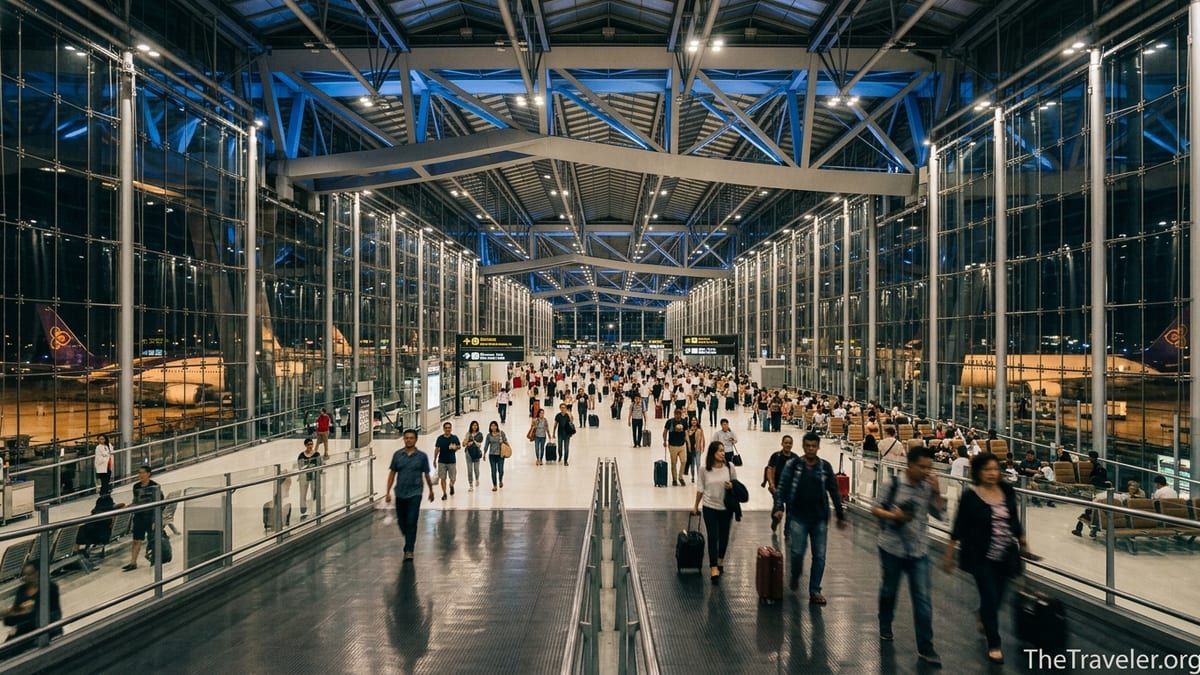
The Sheer Scale Hits You Immediately
My Suvarnabhumi experience began with a long walk. After landing on an international flight, the aircraft parked toward the far end of one of the main concourses. Even walking at a decent pace, it took around 15 minutes to reach immigration, which matches common advice that it can be 15 to 20 minutes from Concourse A to G or from a distant gate to the central terminal. The terminal’s iconic steel-and-glass design looks impressive, but you quickly realize the architecture prioritizes dramatic open spaces over short walking distances.
Along the way, I passed moving walkways that helped a little, but this is not a compact airport where you step off the plane and reach the exit in minutes. If you have a tight connection, especially when arriving at a remote gate, that walking time becomes a critical part of your planning. I met one Australian couple power-walking toward their Bangkok Airways connection, nervously checking a boarding pass that left them only 70 minutes between flights. They made it, but only because their inbound flight had parked closer to the main immigration hall than mine did.
The scale also affects wayfinding. Signage is clear, but because the concourses are so long and similar-looking, it is surprisingly easy to overshoot a turn or miss an escalator. Twice I saw travelers backtracking with cabin bags after realizing they had walked past the corridor for transfer passengers. The lesson is simple: at Suvarnabhumi, factor in more walking time than you normally would, and pay close attention to concourse letters and gate numbers from the moment you step off the aircraft.
Immigration Was Either Surprisingly Swift or Painfully Slow
Suvarnabhumi’s immigration reputation is mixed, and my trip captured both sides. On arrival in the early afternoon, the automated screens near the entrance showed an estimated 20 to 30 minutes for foreign passport queues. In reality, I was through in just under 25 minutes, helped by most counters being staffed and lines moving steadily. Recent guidance suggests that Airports of Thailand aims for around 15 minutes per arriving passenger when the system runs optimally, and on that day it felt close to that target.
What surprised me more were the stories from fellow passengers who had arrived just a few days earlier in the late evening, during the busy long-haul “bank” of flights. One British traveler described waiting close to 90 minutes in December when several widebody arrivals hit at once and only part of the hall was open. Others mentioned mornings when they were through in less than five minutes. Local fast-track operators now publish seasonal and time-of-day estimates that show wide swings, with some late-night peaks known for heavy queues and early afternoons often calmer.
On departure, passport control was much smoother. I joined the regular line about 7 pm and cleared Thai exit formalities in roughly 10 minutes. Overhead monitors hinted that the worst congestion happens from around 10 pm to 1 am, when waves of flights to Europe and the Middle East depart. Several airlines have started emailing passengers to suggest arriving a full four hours ahead of late-night flights, reflecting how unpredictable queues can be. It is not scaremongering so much as a recognition that Suvarnabhumi’s passenger numbers have outgrown the original capacity of the terminal by a wide margin.
The New SAT-1 Satellite Terminal Feels Like a Different Airport
The biggest surprise of my trip came on my outbound leg, when my long-haul flight departed from the newer SAT-1 satellite terminal. Opened in stages from late 2023 and formally inaugurated in 2025, SAT-1 is reached by an automated people mover that runs under the airfield. After check in, security, and immigration in the main terminal, signs lead you down escalators to a compact station, where driverless trains shuttle passengers to the satellite in just a few minutes.
Stepping off the train felt like entering a newer, more polished version of Suvarnabhumi. SAT-1 has high ceilings, wider walkways, and more natural light than the older concourses. The seating areas near the gates were less crowded, and there were more power outlets and quieter zones where people could actually hear boarding announcements. It also felt cooler, perhaps because the smaller footprint makes climate control more manageable than in the vast original building.
Operationally, SAT-1 has become a significant pressure valve for the airport. It is designed to handle around 15 million passengers annually, and many long-haul and regional widebody flights have been shifted there. For travelers, that means a better chance of finding a seat near your gate and a little respite from the crush you sometimes feel in the main concourses. The trade-off is planning extra time for the train ride to and from the satellite, especially if you are connecting between a main-terminal flight and a SAT-1 departure.
Lounge Access Has Quietly Changed in a Big Way
Like many frequent flyers, I arrived assuming that a Priority Pass or DragonPass card would open the doors to several airline lounges. That used to be true, but a significant shift took effect on 1 April 2025. Airports of Thailand directed that airline-operated lounges at Suvarnabhumi withdraw from these membership programs, leaving contract lounges as the main option for cardholders. Several recent lounge guides highlight that only Coral and Miracle-branded lounges now accept these programs across the concourses and in SAT-1.
In practice, this meant I had a much narrower set of choices than on previous trips. In the main terminal, the Miracle Business and First lounges near Concourse D were among the busiest, with waitlists forming during the late evening peak. Staff quietly mentioned that a three-hour stay cap is now enforced more strictly when flights bank up. In contrast, a Coral lounge I visited closer to midnight was comfortably busy but not overflowing, offering buffet Thai dishes, soft drinks, beer on tap, shower rooms, and a mix of recliners and work tables.
Paid walk up access typically ran to the equivalent of around 30 to 45 US dollars depending on the lounge and time of day, which matches current online pricing data and hotel-operated comparison guides. For a solo traveler facing a long layover, that might be good value, but families would quickly find the cost stacking up. Another surprise is that a few lounges, particularly in SAT-1, stay open almost 24 hours to match Suvarnabhumi’s late-night departure bank, which can be a real relief if you land close to midnight and have hours to wait for a regional connection.
Late-Night Energy and 24/7 Services Stand Out
One thing I underestimated is just how nocturnal Suvarnabhumi feels. Many of the airport’s long-haul flights arrive and depart between 10 pm and 3 am, and the terminal comes alive in a way that feels different from daytime operations. On my departure evening, even around midnight, cafes near Concourse E were still serving full hot menus, and several Thai chains kept coffee, rice dishes, and noodle bowls simmering for a constant stream of bleary-eyed travelers.
Retail mirrors this pattern. Duty free shops, cosmetics counters, and convenience stores largely remain open into the small hours, and contract lounges advertise 24-hour operations in their marketing material. Airport service overviews updated in mid 2026 still highlight round-the-clock food, retail, and lounge access as a key selling point. That makes Suvarnabhumi one of the more forgiving airports in Asia for those awkward 2 am departures, when many other hubs feel half closed.
Another late-night detail is the security and exit passport control pattern. Live wait time tools show evening and early-night peaks, but the data often lists average security waits in single digits of minutes during the very early hours, roughly from 1 am to just before dawn. Walking through security at around 2 am during a separate domestic connection, I was through in under five minutes. For night owls and budget travellers picking cheaper red eye flights, the airport’s 24/7 mindset is a genuine advantage.
Facilities Are Improving, but Crowding Is Still Real
On paper, Suvarnabhumi has invested heavily in smoothing the passenger experience. Airports of Thailand’s latest annual report highlights upgrades such as modernized screening equipment, common use bag drop areas, and process improvements intended to cut average arrival processing time. The new SAT-1 terminal earned a strong rating in international airport reviews, and plans for another expansion are already in the works to cope with future growth.
On the ground, however, the airport still feels busy to the point of strain at key times. In 2024 Suvarnabhumi handled more than 60 million passengers while being originally designed for roughly three quarters of that number, and news and industry commentary in 2025 and 2026 regularly flag that overcapacity. That reality is visible in the crowds at immigration, at the check in islands, and even at the taxi rank late at night, where long snaking lines can form, especially after clusters of arrivals from Europe and the Middle East.
At the same time, I was surprised by how smooth some parts of the journey felt when I hit a quieter window. During a mid afternoon domestic departure to Chiang Mai, check in took less than 10 minutes, security around the same, and there was plenty of seating at the gate. A Thai passenger next to me mentioned that her worst Suvarnabhumi memories involved Friday evening flights or the days just before major Thai holidays. The takeaway is that the airport can feel either overwhelmed or efficient, depending heavily on when you pass through.
Ground Transport and the New Airport Hotel Connection
Leaving the airport, the ground transport options are better than many first timers expect. The Airport Rail Link connects Suvarnabhumi with central Bangkok, offering an affordable ride into the city with connections to the BTS and MRT networks. Metered taxis queue on the lower level, where automated kiosks issue tickets for different taxi ranks, separating regular cabs from larger vehicles that can handle extra luggage. Rides into central districts like Sukhumvit or Silom usually fall into a mid-range price bracket, including highway tolls and the airport surcharge.
Recent infrastructure changes have also made Suvarnabhumi more convenient for short stays and business travelers. In 2026, the new Hyatt Regency Bangkok Suvarnabhumi Airport opened with a direct underground walkway linking it to the terminal in about five minutes. This is a true airport hotel rather than a shuttle ride away, designed for transit passengers, airline crews, and meeting groups. During my visit, I met a regional sales manager who was using the hotel as a base for a 20-hour layover, allowing her to shower, rest properly, and hold a small meeting in a conference room before catching an overnight flight to Europe.
For travelers with very early departures or tight next-day connections, that hotel link is a game changer. It avoids the uncertainty of Bangkok’s traffic at rush hour and removes the need to calculate wide buffer times for a taxi back to the airport. Combined with existing landside facilities like convenience stores, currency exchange counters, and cafes that open early, Suvarnabhumi is slowly becoming a more rounded, traveler-friendly hub rather than just a place you pass through as quickly as possible.
The Little Details: Smoking Rooms, Seating, and Power Outlets
Some of the smaller surprises were highly practical. Smoking rules, for example, are strict in Thailand, and Suvarnabhumi removed many of its airside smoking rooms several years ago. Yet there are still a few exceptions. On my walk through Concourse D, regulars pointed out a functioning smoking room tucked inside a Miracle Lounge near gates D5 and D6, used by nicotine-starved travelers during long layovers. Elsewhere, designated outdoor smoking areas exist landside, but once you have cleared security and immigration, options are limited unless you have lounge access.
Seating and power outlet availability also varied dramatically by area and time of day. In the early afternoon, I could find a spare row of seats in most gate areas without trouble, and renovated sections had built-in USB and power sockets. By contrast, after 11 pm near the busier long-haul gates, every seat seemed occupied and travelers resorted to leaning against pillars while charging devices from the few accessible outlets. SAT-1 again felt like a step ahead, with more consistent access to charging points and quieter waiting zones.
Other details were quietly impressive. Free Wi‑Fi was reliable enough for video calls in most areas I tried, and the selection of Thai food was noticeably better than in many international airports. At a food court in the main terminal, I paid the equivalent of less than 10 US dollars for a plate of pad kra pao, a bowl of tom yum soup, and a drink. That mix of distinctly local flavors and still-reasonable pricing, even in an airport setting, is one of the reasons many travelers end up with positive memories despite the crowds.
The Takeaway
Flying through Bangkok Suvarnabhumi in 2026 is a study in contrasts. On one hand, it is an airport that has outgrown its original design, with passenger numbers regularly pushing the building and staff to their limits. Long walks, occasional immigration bottlenecks, and crowded gate areas are real concerns, particularly at peak times and around major holidays. For an unprepared first-time visitor, that can feel overwhelming.
On the other hand, Suvarnabhumi is also modernizing fast. The SAT-1 satellite terminal, upgraded security processes, and a dense network of contract lounges have all improved the experience, especially for those who know how to navigate the layout and time their journeys. The new connected airport hotel, more generous late-night services, and reasonably priced local food options all add to the sense that this is an airport evolving to match Thailand’s role as a tourism heavyweight.
What surprised me most was how much your impression of Suvarnabhumi depends on timing and preparation. Arrive at a quieter hour, allow generous buffers for walking and queues, know which lounges your membership actually covers, and the airport can feel efficient and even welcoming. Hit it at a peak without a plan, and you may find yourself in those social media photos of hour-long lines. Either way, Suvarnabhumi is no longer just a transit point; it is a destination experience in its own right, for better and for worse.
FAQ
Q1. How much time should I allow for a connection at Bangkok Suvarnabhumi?
For international to international connections, aim for at least 2.5 to 3 hours, especially if one flight uses the SAT-1 satellite terminal. This covers walking time, passport control for certain transfers, and potential security re screening.
Q2. Are immigration queues still very long at Suvarnabhumi Airport?
They can be, but it depends heavily on time of day and season. Some travelers report being through in under 10 minutes, while others during peak evening banks or holidays have waited close to an hour. Arriving earlier and avoiding major holiday peaks helps.
Q3. Can I still use Priority Pass or DragonPass at airline lounges in Bangkok Suvarnabhumi?
No. Since April 2025, airline operated lounges have withdrawn from these programs. Priority Pass and DragonPass now mainly provide access to Coral and Miracle contract lounges around the airport, subject to capacity.
Q4. How long does it take to reach the SAT-1 satellite terminal?
From the main departure hall, it typically takes 10 to 20 minutes to walk to the automated people mover station, ride the train, and reach your gate at SAT-1. Allow extra time if you are unfamiliar with the layout or traveling with children.
Q5. Is there a hotel directly connected to Suvarnabhumi Airport?
Yes. A new airport hotel, the Hyatt Regency Bangkok Suvarnabhumi Airport, is linked to the terminal via an underground walkway of about five minutes. It is convenient for late arrivals, early departures, and long layovers.
Q6. Are there smoking rooms inside the terminal after security?
In general, smoking areas airside are very limited. A few lounges, such as some Miracle lounges near Concourse D, maintain indoor smoking rooms, but most regular passengers will not find dedicated smoking zones once they have cleared security and immigration.
Q7. How expensive is food at Bangkok Suvarnabhumi Airport?
Prices are higher than in central Bangkok but still moderate by big hub standards. A main dish and drink at a food court or casual restaurant often costs roughly the equivalent of 7 to 12 US dollars, depending on what you order.
Q8. What is the best way to get from the airport to downtown Bangkok?
The Airport Rail Link is usually the fastest and most predictable into the city, especially during rush hour. Metered taxis are convenient and reasonably priced for groups or those with heavy luggage, but journeys can be much slower in traffic.
Q9. Is Wi Fi at Suvarnabhumi Airport reliable?
Yes, the free Wi Fi generally works well in most parts of the terminal for browsing, messaging, and even video calls. Speeds can slow slightly in crowded gate areas during peak times but remain usable.
Q10. Are there arrival lounges I can use after landing?
There are no dedicated arrival lounges in the public arrivals area. Most lounges are located airside for departing or transiting passengers, so you will not be able to use them after you have cleared immigration and customs and exited to landside.