


The pitch sounds almost too easy: a chauffeur collects you from your front door, your luggage appears in your cabin, drinks and tips are taken care of, and each day you wake up to another European old town gliding past your window. When I started looking closely at Saga’s river cruises, I expected a fairly standard, slightly sedate product for British retirees. What I found instead was a very particular style of travel with some genuinely surprising details, from what "all inclusive" really means to how tailored these trips are to solo guests over 50.
A River Cruise Line With a Very Specific Audience
Saga is not trying to be all things to all travelers. The company is upfront that its river cruises are designed for guests aged 50 and over, largely from the UK, who want an easier, more curated way to see Europe’s waterways without the hassle of independent planning. That tight focus affects everything on board, from the entertainment and excursion pace to the cabin layouts and dining atmosphere.
On the rivers, Saga currently sails its own purpose-built ships Spirit of the Rhine and Spirit of the Danube, along with chartered vessels such as Douro Serenity in Portugal. The custom Saga ships carry around 170 passengers, significantly fewer than a typical ocean ship, so the onboard mood is closer to a well-run country hotel than a floating resort. That smaller scale, plus the over‑50s policy, means the experience is deliberately calm and sociable rather than high-octane.
What surprised me was how consistently the brand identity carries through. On Spirit of the Rhine, for example, cabins, public rooms and even the artwork are styled in the same cool, boutique look you see on Saga’s ocean ships Spirit of Discovery and Spirit of Adventure. The aim is to make switching from ocean to river feel seamless for loyal Saga guests who want to try something new without sacrificing familiarity.
This age focus has practical implications. Lectures tend to cover European history, art and music rather than generic trivia. Daily programs build in rest time after tours, and there is an emphasis on easy logistics rather than late-night partying. If you are used to multigenerational ocean lines with water slides and loud bars, Saga’s river product will feel like a different world.
All Inclusive, But In a Very Saga Way
The phrase "all inclusive" gets thrown around so casually in travel marketing that I have become skeptical. Saga’s version, however, is unusually comprehensive for river cruising, especially once you factor in the journey to and from the ship. The fare typically covers a chauffeur service from your home to the UK departure point, flights or Eurostar where required, transfers, all meals on board, selected drinks, Wi‑Fi and crew tips.
The home pick-up is not a gimmick. Saga’s own descriptions of the service read almost like something from a luxury tour operator: a private driver collects you from your front door (within a set mileage radius, with a supplement beyond that), handles your bags and delivers you to the airport or coach meeting point. On return, the same thing happens in reverse. For anyone who finds airport parking, rail connections or late-night taxi wrangling stressful, this door-to-door element can be a genuine deciding factor.
On board, house wines, beer and soft drinks are usually included with meals, and bar menus feature a range of house spirits and cocktails available at no extra cost, with only a handful of premium labels charged separately. In the 2026 river brochure, Saga highlights that from 2026 an excursion in every port, Wi‑Fi and crew gratuities will be included in the headline price across river sailings. That shifts Saga closer to highly inclusive competitors like Tauck or Scenic, which bundle gratuities and most excursions into their fares, though Saga generally prices a little below those top-luxury lines.
None of this makes Saga cheap. Independent analysts suggest that European river cruises in general often run between roughly 3,500 and 7,500 US dollars per person for a 7‑night sailing, depending on cabin type and season, and Saga sits comfortably in the middle to upper part of that range. What is different is how much of your total holiday cost is genuinely settled up front. If you are budgeting carefully or dislike carrying a running tab for drinks and tips, that predictability can be as valuable as a lower sticker price.
The Ships: Boutique Hotels That Just Happen to Float
When I first saw photos of Spirit of the Rhine and Spirit of the Danube, I had to double-check that they were not repurposed ocean images. These are unmistakably modern boutique ships rather than traditional river vessels with heavy drapes and dark woods. They were designed specifically for Saga and launched in 2021 and 2022, with long lines of floor-to-ceiling windows, a light color palette and a mix of casual and formal public spaces.
Cabins are compact, as on most river ships, but carefully thought through. Standard cabins on Spirit of the Rhine typically offer French balconies so you can slide open the glass and watch the river from your bed, while lower-deck cabins have smaller windows high on the wall. Storage is surprisingly generous, with under-bed space for suitcases and wardrobes designed for a mix of smart-casual clothing and a couple of dressier outfits. Bathrooms lean contemporary, with walk-in showers rather than the shower-over-bath you might find on older European river boats.
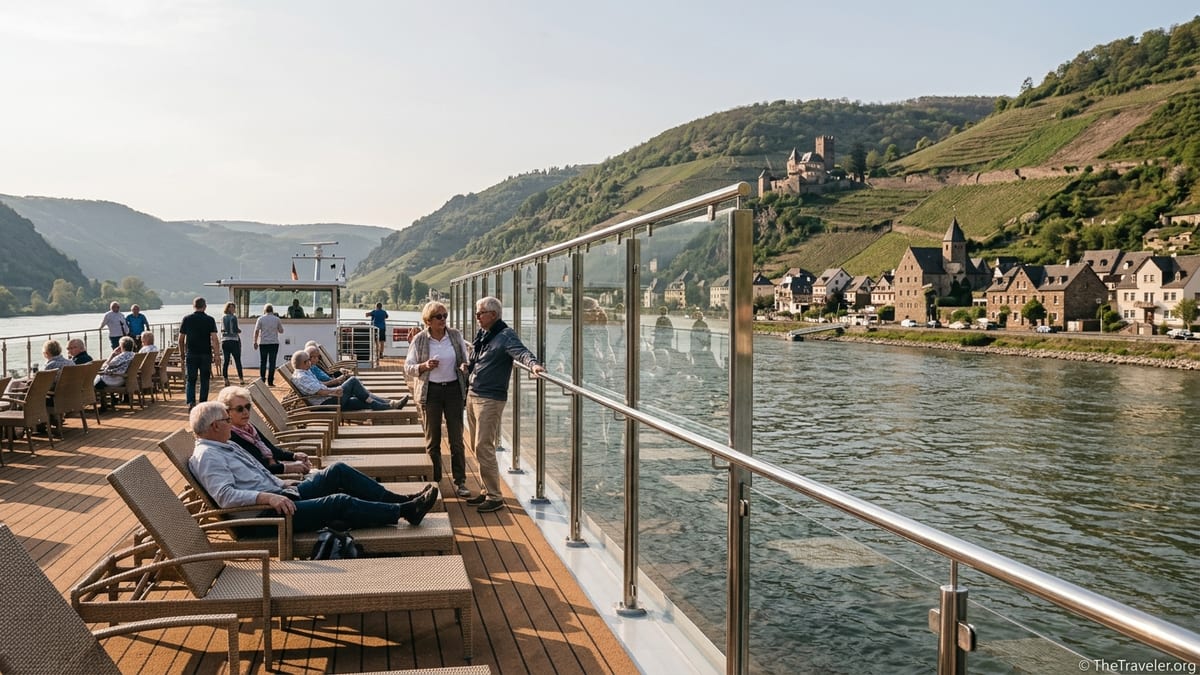
Public areas are where the boutique concept really shows. On Spirit of the Danube, for instance, the main restaurant features large windows and neutral tones that keep the space bright even on grey days along the Wachau Valley. A separate lounge hosts evening talks, quizzes and occasional performers brought on in port, such as a local folk group in Bratislava or a classical trio in Vienna. Up on the sundeck, shaded seating, a small games area and circular loungers are arranged to encourage conversation without feeling crowded.
The capacity of around 170 guests means you will see the same faces repeatedly, at breakfast, in the bar and out on deck, but there is still enough space to find a quiet corner. Compared with some European lines that pack up to 190 guests onto similar-length ships, Saga’s layout feels intentionally unhurried.
Itineraries That Look Familiar, But Run Slightly Differently
Saga’s river cruises mostly trace the classic European routes: the Rhine with its castles and vineyards, the Danube with its imperial capitals, the Moselle with steep slate terraces, Dutch waterways in tulip season and the Douro’s terraced valleys in Portugal. On paper, these look much like itineraries from Viking, AmaWaterways or Riviera. In practice, a few details stand out.
First, the pacing is deliberately measured. A typical Rhine sailing on Spirit of the Rhine might run for seven nights between Amsterdam and Basel, calling at Cologne, Koblenz, Rüdesheim and Strasbourg. Instead of packing in multiple coach tours per day, Saga tends to include one main excursion in each port, such as a guided walk through Cologne’s old town or a coach tour of the Rhine Gorge viewpoints, with free time afterward for independent wandering or a relaxed coffee in a riverside square.
On the Danube, Spirit of the Danube might sail a classic route between Budapest and Vienna, calling at Bratislava and smaller Austrian towns like Melk or Dürnstein. Here, guided tours usually focus on manageable walking distances with gentle commentary: a morning exploring Buda’s Castle District, for example, followed by an afternoon at leisure, or an included visit to Melk Abbey balanced by an optional wine-tasting for those who want more activity.
Another surprise is Saga’s growing emphasis on themed cruises. Beyond standard city-and-castle voyages, the program includes specific sailings such as music-themed Danube trips that coincide with concerts in Vienna, Christmas market cruises in December and tulip-time journeys through the Netherlands and Belgium in spring. Rather than simply rebadging regular departures, Saga often tweaks the excursion program for these, arranging, say, an evening organ recital in a small Rhineland church or a private tasting at a family-run winery along the Moselle.
Solo-Friendly Policies That Actually Matter On Board
Saga has long cultivated a loyal following of solo travelers, and river cruises are an extension of that. The company’s own travel advice for solo guests highlights smaller ships, structured social opportunities and a high staff-to-guest ratio as reasons these trips work well if you are travelling alone. When I looked closer, a number of specific touches stood out.
One is the way cabins are allocated and priced. While mainstream river lines often charge hefty single supplements, Saga frequently releases a set number of cabins on each sailing with reduced or no supplement for solo use, particularly in shoulder seasons like March or late October. These offers are not constant and do sell out, but they reflect a deliberate attempt to welcome solo guests rather than treating them as an afterthought, which remains common elsewhere on the rivers.
On board, there is usually a hosted solo travelers’ meet-up early in the cruise, giving guests a low-pressure way to find potential dinner companions or excursion buddies. Dining is open seating, with many larger tables so solos are not left hovering awkwardly at the entrance, and cruise directors are known to help shy guests find a group. The small size of the ship naturally works in solo travelers’ favor: you will see the same people on tours, in the lounge and up on deck, which makes it easier to move from polite hellos to genuine conversations.
The chauffeur service from home is another point where solo travelers often feel the difference. Instead of negotiating a taxi on your own at the end of a long travel day, you step into a pre-arranged car where the driver already knows your name and destination. For older travelers or anyone new to flying alone, that continuity from front door to cabin door can be a strong emotional safety net.
How Saga Compares With Better-Known River Lines
Looking at Saga in isolation only tells half the story. To understand its appeal, it helps to compare it with a few of the bigger names on Europe’s rivers. Viking, for instance, operates the largest river fleet, with dozens of virtually identical longships carrying around 190 guests each. Viking’s product is polished and widely advertised, but fares often do not include gratuities or many drinks beyond wine and beer at lunch and dinner, and there is no door-to-door chauffeur service as standard.
By contrast, more inclusive operators such as Tauck or Scenic typically bundle gratuities, most drinks throughout the day and a dense program of excursions into their fares, but prices reflect that, often sitting toward the upper end of the market. Saga lands in a mid‑position: more extras folded into the fare than Viking or some mid-market European lines, but without the heavy touring intensity or ultra-luxury price point of Tauck and Scenic.
Another major difference is demographic. Viking attracts a broad international mix, particularly from North America, whereas Saga’s river guests skew heavily British and are exclusively over 50. Some travelers will see that as a drawback; others, especially those who value familiar cultural references and a shared sense of humor, will see it as a selling point. Similarly, while lines like AmaWaterways or CroisiEurope might attract a greater range of ages and nationalities, they do not usually provide the kind of home pick-up or UK-oriented entertainment that Saga builds in.
If you are price-sensitive and happy to manage tips, drinks and transfers yourself, you might find a lower fare on a more bare-bones line. But if you prefer a one-and-done figure that realistically covers almost every aspect of the trip, Saga’s inclusivity and tightly defined guest profile can feel like good value, even if the initial number is not the lowest in the brochure rack.
What It Really Costs Once You Add Everything Up
Because Saga’s river fares fold in so many elements that are optional elsewhere, comparing headline prices can be misleading. A typical seven-night Rhine cruise in shoulder season on Spirit of the Rhine might be advertised at a little over the equivalent of 2,000 to 2,500 US dollars per person for a standard cabin, with peak summer departures rising above that. Christmas market or special themed cruises can carry a modest premium, while shorter four- or five-night taster sailings are priced lower per trip but often higher per night.
When you strip the package down, part of what you are paying for is the transfer infrastructure: the chauffeur service, flights or rail, and the fact that crew gratuities and at least one excursion in every port are bundled into that fare from 2026 onward. Add up equivalent elements on a more a la carte line and the gap in real-world spending can narrow considerably. For example, a competitively priced river cruise might initially look 15 or 20 percent cheaper, but once you layer in airport parking, independent transfers, pre-paid tips and drinks, the difference sometimes shrinks to a small margin.
On board, Saga is not geared toward heavy spending. There is no casino, no parade of specialty restaurants with cover charges and no constant upselling of drinks packages; bar prices are transparent for anything outside the included range, and boutique shops are modest. Optional extras still exist, from select premium excursions to spa treatments where available, but it is entirely plausible to step off the ship with only a small bar bill or a few souvenirs added to your account.
For many over‑50s on fixed or carefully planned incomes, that financial predictability is precisely the point. You can decide early what you are comfortable spending, pay most of it months before travel, and then treat the cruise itself as a largely cashless, stress-free experience. It is not the cheapest way to see the Rhine or the Danube, but it is one of the more straightforward to budget for.
The Takeaway
When I began digging into Saga’s river cruises, my expectation was of a slightly old-fashioned, gently priced product aimed at British retirees. The reality is more nuanced. Saga has built a tightly defined, highly curated river experience for travelers over 50 who value ease, predictability and a certain British sensibility. The purpose-built ships feel more like modern boutique hotels than traditional river boats, the door-to-door chauffeur service is more than a marketing flourish and the inclusions list is impressively long.
This will not suit everyone. Travelers who relish late-night bar scenes, very active touring or a broad mix of ages and nationalities might find Saga’s environment too sedate or too homogeneous. Those who enjoy tweaking every element of a trip for maximum value may balk at the bundled, take-it-or-leave-it nature of the pricing. But for guests who want to unpack once, be gently looked after and avoid dealing with tips, bar tabs and airport logistics, Saga’s rivers can offer precisely the kind of stress-free Europe they imagine, delivered with more polish than many expect.
If you are over 50 and considering your first river cruise, it is worth putting Saga on the comparison list alongside more widely advertised names. Look closely not just at the brochure fare but at what is genuinely included, how far from home you live, whether the chauffeur service will meaningfully ease your journey and how comfortable you feel with a mostly British, over‑50s crowd. Those details, more than the river name or even the cabin category, are what will determine whether a Saga river cruise fits the way you actually like to travel.
FAQ
Q1. Who are Saga river cruises best suited for?
Saga river cruises are designed specifically for travelers aged 50 and over, mainly from the UK, who value a calm atmosphere, clear inclusions and minimal travel hassle rather than nightlife or family-focused facilities.
Q2. What is genuinely included in a Saga river cruise fare?
Typically the fare covers a chauffeur car from home within a set distance, flights or rail where required, transfers, all meals on board, selected drinks, Wi‑Fi, crew gratuities and from 2026 at least one included excursion in every port, plus the services of a Saga cruise director.
Q3. How do Saga’s ships differ from other river cruise vessels?
Saga’s purpose-built ships such as Spirit of the Rhine and Spirit of the Danube carry around 170 guests, feature modern boutique styling, many cabins with French balconies, and public spaces laid out for relaxed socializing rather than large-scale entertainment.
Q4. Are Saga river cruises good value compared with other lines?
On a per-night basis Saga is mid-range to upper mid-range, but once you factor in the chauffeur service, drinks, tips and included excursions, overall trip costs can compare favorably with lines that start cheaper but add many extras.
Q5. Do Saga river cruises work well for solo travelers?
Yes, Saga has a strong solo following, often offers reduced or waived single supplements on selected sailings, hosts solo meet-ups on board and structures dining and excursions so that it is easy for solo guests to find company.
Q6. What kinds of itineraries does Saga offer on Europe’s rivers?
Saga focuses on classic routes along the Rhine, Danube, Moselle, Dutch waterways and Portugal’s Douro, including themed cruises such as Christmas markets, music-focused sailings and springtime tulip trips.
Q7. How active are the excursions on a typical Saga river cruise?
Excursions tend to be moderately paced, with guided walks on mainly level ground, coach panoramas where appropriate and plenty of free time, reflecting the over‑50s audience and prioritizing comfort over intensive touring.
Q8. Will I need to budget extra for tips and drinks?
From 2026 crew gratuities, Wi‑Fi and a good selection of drinks are built into the fare, though a few premium spirits and wines, some specialty coffees and any extra services such as spa treatments or select optional tours cost extra.
Q9. What is the onboard atmosphere like in the evenings?
Evenings usually revolve around unhurried dinners, gentle entertainment such as quizzes, live music or talks, and conversation in the lounge or bar, rather than late-night dancing or large-scale shows.
Q10. How far in advance should I book a Saga river cruise?
Because capacity is limited and solo and lower-fare cabins can sell out quickly, it is wise to book several months to a year ahead, especially for peak-season Rhine and Danube sailings or popular themed and Christmas market cruises.