


I was standing in the immigration line at Rome Fiumicino, watching the airport Wi Fi login page spin uselessly, when it hit me: I had almost ignored GigSky. Somewhere in my inbox sat an email confirming a Europe eSIM I had bought “just in case.” Ten minutes later my iPhone buzzed to life with an Italian 4G signal, my hotel confirmation finally loaded, and a bored border officer waved me through. It was not glamorous, but it was the exact moment GigSky went from theoretical app to practical lifeline.
Get the latest updates straight to your inbox!
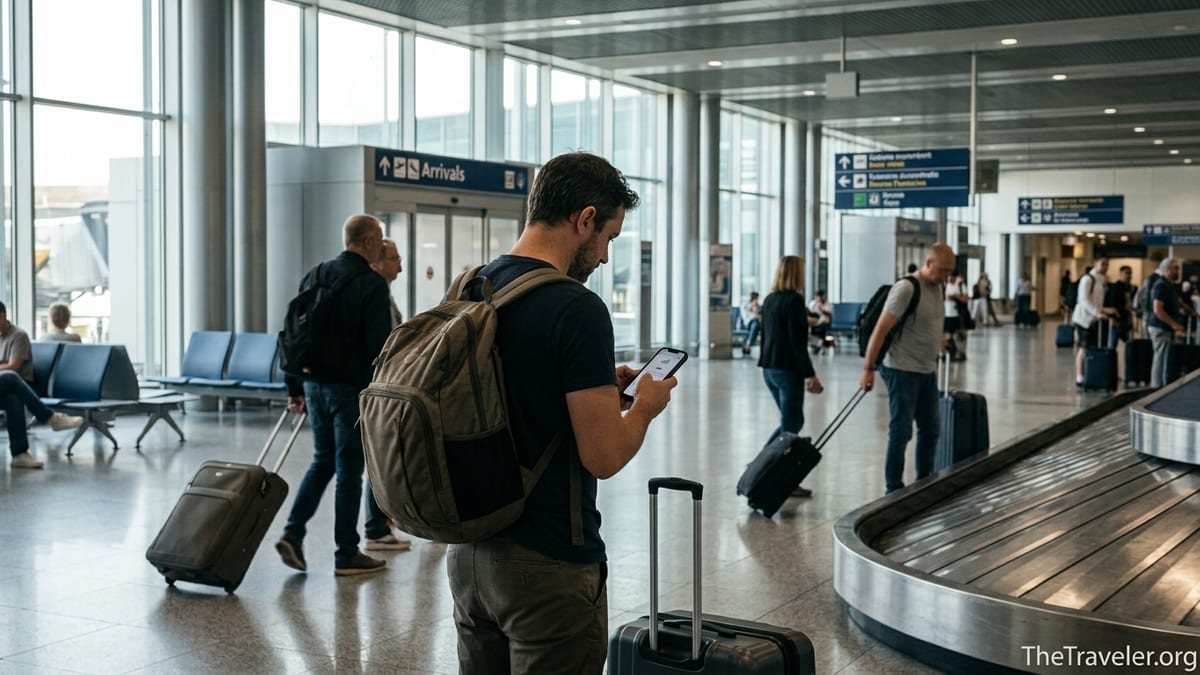
That First Ten Minutes After Landing
The gap between landing and getting connected is when modern travel either feels effortless or instantly stressful. You step off a long-haul flight into a new country and, within minutes, you may need data to pull up a QR code for immigration, answer a host’s message on WhatsApp, or order an Uber or Bolt. Airport Wi Fi often promises a smooth welcome, but in practice you get congested networks, time-limited access, or pages that never load fully.
On that trip to Rome, the airport network required a confirmation code sent by SMS. The problem was my US carrier’s roaming was switched off, precisely to avoid the kind of surprise 80 dollar data charge that still shows up in traveler horror stories. GigSky, which I had preinstalled but not activated, became the bridge: I toggled on its regional Europe plan and, within a couple of minutes, my phone latched onto a local Italian network with workable 4G speeds.
Experiences like this are common among travelers experimenting with eSIM providers. Reviews on sites like Trustpilot describe people who installed GigSky at home, landed in places like Japan or the United Kingdom, and found data active almost immediately, saving them from hunting for a kiosk that still sells physical SIM cards. At its best, GigSky collapses that vulnerable arrival window into a simple toggle in your phone’s settings.
Of course, not everyone has a completely smooth experience. Some travelers report that GigSky takes longer to attach to the local network than competitors like Airalo, and that speeds usually top out at 4G or LTE rather than 5G. But when your passport control line is creeping forward and your hotel address is buried in your email, raw speed matters less than basic, reliable connectivity.
What GigSky Actually Is, Beyond the Marketing
GigSky is one of the older names in the travel connectivity world. It started years ago as a data provider integrated into Apple’s physical Apple SIM, long before eSIM became common. Today it sells app-based, data-only eSIM plans that work in more than 170 countries on land and increasingly in the air and at sea. You do not get a phone number, calls, or regular SMS; what you get is mobile data that makes apps like WhatsApp, iMessage, Signal, email, Google Maps, and Uber function abroad.
The typical GigSky experience starts with the app. You choose your destination, and GigSky shows you several plan types: country-specific plans, regional plans such as “Europe” or “Asia Pacific,” and a more expensive global option that spans roughly 190 countries. There are also special inflight and cruise plans sold for certain airlines and shipping routes, marketed to travelers who want to stay connected between ports or above oceans.
Pricing depends on where you are going and how much data you need. For the United States, an example listed by comparison site SimSoar in mid 2026 is a 1 GB plan valid for 15 days at 6.99 US dollars, a relatively light but straightforward package for visitors who just need maps and messaging. Regional plans often start around the high single digits for a few days of light use, while unlimited-style offers for North America have been advertised around mid-teens pricing for three days during special promotions, such as World Cup-related deals highlighted by TechRadar Pro in 2026.
What makes GigSky stand out is not rock-bottom pricing but breadth and reliability. Independent reviewers at sites like eSIMS.io and esims.ca place GigSky in the premium pricing range compared with newer budget-focused brands, yet note its large catalog of supported countries, simple app, and long experience working with mobile operators around the world. In other words, you usually pay slightly more than with the cheapest eSIM, but you are betting on a smoother, more predictable experience when you land.
How GigSky Works in the Real World
The technical leap that makes GigSky possible is eSIM: the ability to download a digital SIM profile to your phone instead of swapping tiny plastic cards. Apple’s iPhone has supported eSIM since the iPhone XS generation, and current models such as the iPhone 14 and 15 in the United States are eSIM-only. According to GigSky’s own compatibility list, virtually every recent flagship iPhone and a growing number of Android devices can install its eSIM. The only hard rules are that your phone must be unlocked and compatible with eSIM in the country you are visiting.
In practice, most frequent travelers now install GigSky before departure over home Wi Fi. The app walks you through adding the eSIM in your phone’s settings. For iPhone users, that typically means tapping “Add eSIM,” scanning a QR code or following an on-screen link, and labeling the new line “Travel” or “Data.” GigSky’s help center notes that you can install the eSIM days or weeks before your trip, then leave it inactive until you actually arrive, which removes a lot of last-minute stress.
Once on the ground, the routine is simple: open Settings, switch your data line from your home carrier to the GigSky eSIM, and flip on data roaming for that eSIM. Within a few minutes, your phone should attach to one of GigSky’s partner networks in that country. Travelers report this process working smoothly across much of Europe and East Asia, although there are scattered complaints on forums such as Reddit of slower connections or delayed activation in places like Taiwan or Peru, where the eSIM took hours before data began to flow.
The other real-world detail is speed. GigSky connects you to partner networks that often support 5G, but in many destinations the eSIM itself only offers 4G or LTE service. For mapping, messaging, ride-hailing, and even casual browsing, that is usually more than enough. If you expect to tether a laptop, stream HD video, or upload large batches of photos, you will want to check the fine print in the app and consider higher-capacity or “unlimited” plans while understanding that some providers, not just GigSky, impose speed throttling or fair-use limits after a certain amount of high-speed data.
Pricing, Promotions, and When GigSky Is Worth It
Compared with rivals like Airalo, Holafly, Nomad, and Yesim, GigSky tends to sit in the upper-middle of the price spectrum. Analysis from eSIM comparison sites in 2026 regularly places GigSky in a premium category: not the highest price on the market, but clearly more costly on average than no-frills providers that focus solely on cheap regional plans. For budget travelers who are comfortable hunting down alternative apps or even buying a local physical SIM in-country, that can make GigSky a tougher sell.
But the headline price does not tell the whole story. For travelers based in North or South America who hold certain Visa Infinite or Visa Signature cards, GigSky has teamed up with Visa to offer limited free data as a cardholder perk. One recent version of the benefit offered up to 3 GB of free data over 15 days in more than 170 countries, accessible once you verified your card inside the GigSky app. The details vary by country and card type, and online forums show that some people have struggled to get the verification step working properly, but when it works it can make GigSky effectively free for a short trip.
Even without promotions, GigSky’s structure can suit particular trip patterns. If you are a US traveler planning a two-week vacation across Italy and France, for example, a single regional Europe eSIM from GigSky saves you from juggling separate country-specific packages. If you only expect to use a few hundred megabytes per day, a fixed-data plan that you can monitor in the app may be more predictable than an “unlimited” eSIM from another brand that quietly throttles speed after a few gigabytes.
There are also outlier cases where GigSky’s specialty offerings, such as inflight or cruise plans, are appealing. GigSky markets inflight data that works with certain airborne Wi Fi systems, letting you buy a plan before you leave, then switch it on once your plane reaches cruising altitude. For cruisers, its sea-and-land packages promise continuity between ports and open water, though multiple passengers have shared mixed or negative experiences when relying on those plans alone at sea, particularly on Reddit’s cruise forums where travelers complained about plans that activated at the wrong time, miscounted usage, or failed to connect reliably on specific ships.
When Things Go Wrong: Limitations and Complaints
No eSIM provider works perfectly everywhere, and GigSky is no exception. While many customers describe fast, trouble-free activations, there is a noticeable cluster of complaints from the last couple of years that revolve around three themes: delayed activation, data counters that seem inconsistent with phone usage statistics, and support interactions that feel slow or scripted.
In some of the more detailed anecdotes, travelers landed in places like Taiwan or Peru, followed GigSky’s instructions, and then had to wait many hours or even until the next day for the eSIM to attach to a network. In one case, a traveler’s plan for Peru finally began working 24 hours after purchase. Others who used GigSky cruise products reported that data stopped working mid-voyage or registered as fully consumed even though the phone’s own data counters indicated only a fraction of the purchased allowance had actually been used.
Another frustration that occasionally surfaces involves timing. A few travelers have been surprised to learn that certain cruise or regional plans start their validity clock immediately after purchase or installation, rather than on first network use. That can leave someone who buys a 7-day plan a week before departure with an eSIM that effectively expires during their trip. GigSky’s newer documentation emphasizes more flexible activation for many land-based plans, but it is still critical to read the activation rules carefully inside the app before tapping “Pay.”
Customer support generally exists via in-app chat and email, with marketing pages promising 24/7 assistance. However, online discussions suggest that response quality can vary. Some users report quick fixes and pro-rated refunds when things clearly went wrong, while others describe repeated requests to reboot devices or reinstall eSIMs without deeper troubleshooting. This inconsistency is not unique to GigSky, but it reinforces the idea that travelers should treat any single eSIM provider as a tool, not a guarantee.
Practical Tips to Make GigSky Work for You
If you decide to make GigSky part of your travel toolkit, a few practical steps can dramatically improve your odds of a smooth experience. The first is to confirm that your phone is both unlocked and eSIM-capable. On an iPhone, you can open the About section under General settings and check that the Carrier Lock field says “No SIM restrictions” and that you have an option to add an eSIM. Android devices usually have similar carrier-lock information and eSIM settings buried in the network menus.
The second step is to install the GigSky eSIM before your trip while you still have stable Wi Fi at home or at the office. Within the app you can choose your destination, select a plan that matches both your travel dates and your estimated data usage, and add the eSIM to your phone. Label it clearly as “Travel Data” or similar. Then, leave it disabled until you actually land. When your plane’s wheels touch the runway, you can switch it on instead of hunting for a QR code or confirmation email in a crowded arrivals hall.
Third, pay close attention to which line your phone uses for mobile data. On dual-SIM iPhones and many Android models, you can set one eSIM for voice and SMS and another for data. To avoid roaming charges from your home carrier, it is wise to disable mobile data on your primary line and set the GigSky eSIM as the data line for the duration of your trip. This is especially important if you use messaging apps like iMessage, which can quietly fall back to carrier data if Wi Fi drops.
Finally, be realistic about what you will do with your phone abroad. If your needs are modest, a fixed-data GigSky plan can be cost-effective and predictable. Heavy users who want to stream sports or work full-time from a laptop tethered to their phone might be better served by a local physical SIM in countries where that is easy to buy, or by a competing eSIM with larger or cheaper regional bundles. It can also be smart to download offline maps in Google Maps or Apple Maps before traveling, so that your navigation still works if your eSIM takes a few minutes to attach when you land.
The Takeaway
My own brush with GigSky at Rome’s Fiumicino Airport captured both the promise and the reality of modern travel eSIMs. The promise is compelling: install once at home, tap a few buttons after landing, and have maps, messages, and ride-hailing at your fingertips before you even reach passport control. In that moment, GigSky turned what could have been a stressful arrival into a routine transition from plane to city.
The reality, as traveler reviews and expert analyses make clear, is more nuanced. GigSky delivers broad coverage and a polished app at a price that is rarely the cheapest in the market. It excels for travelers who value convenience, regional or global coverage, and the reassurance of a brand that has been working with eSIM technology for years. At the same time, it is not immune to the typical pitfalls of roaming: occasional delays in activation, uneven support encounters, and special-case products, like cruise plans, that may disappoint if you do not read the fine print.
If you are the sort of traveler who likes to have a safety net, GigSky can be an excellent Plan B tucked into your phone: installed, funded, and ready to activate the second the airport Wi Fi stalls. You may still pair it with a local SIM in destinations where that is straightforward or experiment with cheaper competitors for longer stays. But you are far less likely to find yourself adrift in a new country, unable to load a QR code at immigration or message a driver, simply because you assumed the airport Wi Fi would be “good enough.”
In a world where so many essentials are digital, the ten minutes after landing can define the tone of an entire trip. Having GigSky preloaded and ready to go may never be the most exciting part of your travel planning, yet in that crucial window between airplane door and arrivals hall, it can quietly be the decision that keeps everything else running smoothly.
FAQ
Q1. What kind of traveler is GigSky best suited for?
GigSky works best for travelers who prioritize convenience and broad coverage over the absolute lowest price. If you take several international trips a year, move between countries on the same journey, or want a backup plan in case airport Wi Fi fails or your primary eSIM has issues, GigSky’s regional and global plans can be a reassuring option already installed on your phone.
Q2. Does GigSky give me a local phone number for calls and texts?
No. GigSky provides data-only eSIM plans, so you do not receive a local phone number, voice minutes, or traditional SMS. Instead, you use data-based services such as WhatsApp, iMessage, Signal, email, or Wi Fi calling from your home carrier if it is supported. For most modern travelers that is sufficient, but if you need to receive local voice calls or SMS, you may still want a local physical SIM or a separate service that offers a virtual number.
Q3. How much does a typical GigSky plan cost?
Prices vary by region and data allowance, but examples in mid 2026 include around 7 US dollars for 1 GB valid for 15 days in the United States and higher prices for multi-country or unlimited-style plans. Regional bundles in Europe or Asia often start in the high single digits for light-use packages covering a few days. GigSky is generally more expensive than the absolute cheapest eSIM providers but aims to offset that with broad coverage and a refined app experience.
Q4. Will GigSky work as soon as my plane lands?
In many cases, yes. If you install the eSIM before your trip and set it as your data line, your phone should attach to a partner network within a few minutes of landing. Many travelers report nearly instant connectivity this way. However, there are occasional reports of slower activation, with some users waiting hours or even until the next day in certain countries. Installing early, restarting your phone after landing, and ensuring data roaming is enabled on the GigSky eSIM all improve your chances of a smooth start.
Q5. Can I rely on GigSky for cruises or inflight internet?
GigSky sells special cruise and inflight plans designed to work with certain maritime and airline networks, and some travelers have used them successfully to stay connected between ports or at altitude. At the same time, cruise-focused forums contain several negative reviews describing connectivity issues, early activation, or confusing data usage readings at sea. If reliable connectivity on a cruise is critical, it may be wise to view GigSky as a supplement to, not a replacement for, the ship’s official Wi Fi plans.
Q6. How do I avoid roaming charges from my home carrier when using GigSky?
The safest approach is to disable mobile data and data roaming on your home carrier’s line and set the GigSky eSIM as your phone’s data line while abroad. On dual-SIM phones, you can keep your home number active for calls or SMS if needed but force all mobile data traffic through GigSky. This prevents your home carrier from silently charging for background data while still letting you receive critical messages when you have coverage.
Q7. Is GigSky faster or more reliable than competitors like Airalo or Holafly?
Performance depends heavily on the country, partner network, and even specific neighborhoods. Some independent tests and user reviews find GigSky more consistent in certain regions, while others say alternatives like Airalo or Holafly connected faster or supported 5G where GigSky only offered 4G or LTE. In general, GigSky aims for reliability and wide coverage rather than headline speeds, so if pure speed or the lowest price is your top priority, it is worth comparing offers and reviews for your specific destination.
Q8. What happens if I run out of data on my GigSky plan?
When you exhaust your included data, your connection will either slow dramatically or stop entirely, depending on the plan. The GigSky app shows how much data you have used, and in most destinations you can top up by buying another plan or adding more data with a few taps. If you expect heavy usage, it is smart to start with a plan that comfortably covers your needs or to plan for at least one mid-trip top-up.
Q9. Is it safer to buy GigSky before I travel or after I land?
Buying and installing GigSky before you travel is usually safer and less stressful. Doing it at home on Wi Fi lets you confirm that your phone is compatible, that the eSIM installs correctly, and that you understand how to switch data lines. Once everything is set up, you can simply activate the plan or enable data roaming when you land. The only caveat is to check the plan’s activation rules so you do not accidentally start the validity period too early.
Q10. Should GigSky replace local SIM cards completely?
For some travelers, especially those on short trips or complex multi-country routes, GigSky can comfortably replace local SIM cards. It is often more convenient than hunting for a kiosk after a red-eye flight, and for trips under two weeks the price difference compared with a local SIM may be small. For long stays or very data-heavy use in a single country, local SIMs still tend to be cheaper and sometimes offer better speeds. Many frequent travelers now use a hybrid strategy: an eSIM like GigSky for immediate connectivity on arrival and cross-border travel, plus a local SIM for longer stays in one place.