


More news on this day
Turkish Airlines is set to launch nonstop flights from Istanbul to Chengdu in November 2026, adding a key southwestern Chinese metropolis to its expanding mainland China network.
Get the latest news straight to your inbox!
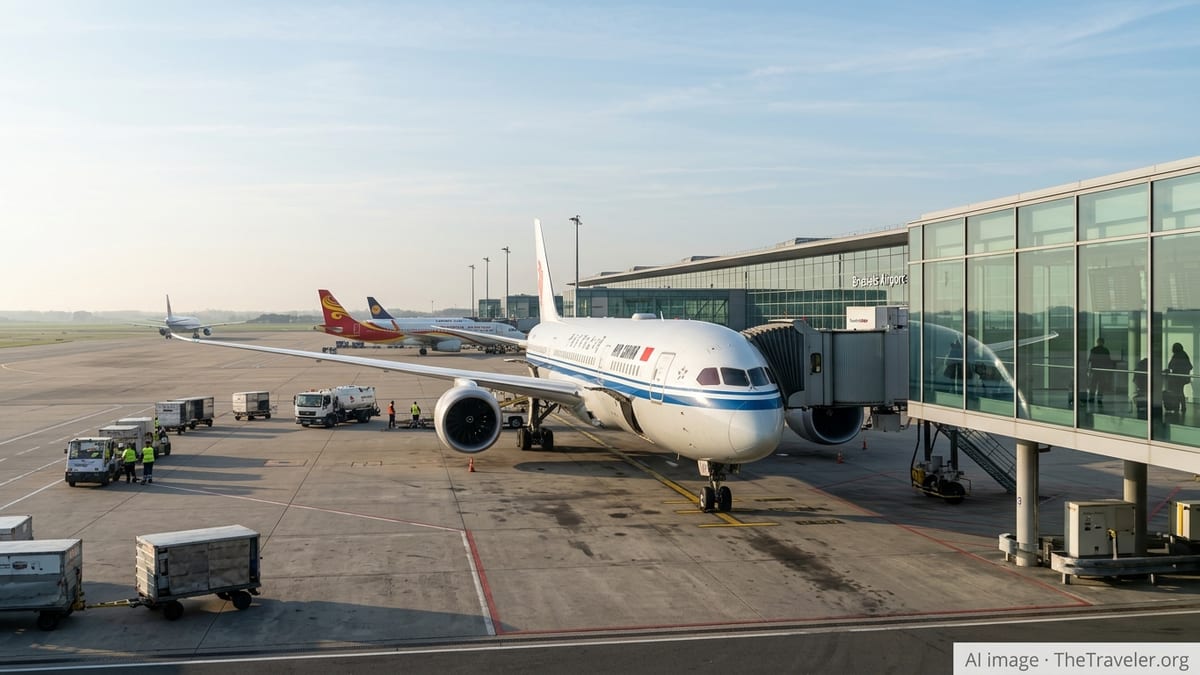
New Istanbul–Chengdu route from November 2026
Publicly available schedule data indicates that Turkish Airlines has opened reservations for a new service between its Istanbul hub and Chengdu Tianfu International Airport starting 11 November 2026. The route will operate three times a week during the northern winter 2026/27 season, giving Chengdu a new direct connection to the carrier’s global network.
The planned flight, listed as operating with Boeing 787-9 aircraft, is scheduled to depart Istanbul in the early hours and arrive in Chengdu in the afternoon, with the return sector leaving shortly after midnight and landing back in Türkiye early in the morning. The timings are structured to feed Turkish Airlines’ banks of connections in both directions, particularly to Europe, the Middle East and Africa.
Turkish Airlines already promotes Chengdu as a destination on its consumer channels, highlighting the city’s role as a major center of Sichuan cuisine and as a gateway to western China. The new nonstop service formalizes and expands that presence by placing Chengdu directly on the carrier’s passenger route map rather than relying solely on partner or codeshare connections.
The launch also reflects the growing importance of Chengdu Tianfu, which opened in 2021 to relieve capacity constraints at Chengdu’s older Shuangliu airport. Many international services have moved to Tianfu as airlines rebuild their networks into western China.
Strengthening a rapidly expanding China network
The Chengdu launch comes as Turkish Airlines accelerates a broader expansion across mainland China. Over the past two years, the carrier has steadily restored and then increased frequencies to major cities such as Beijing and Shanghai, while also adding new points including Xi’an and Urumqi.
Industry scheduling data for the northern summer 2026 season shows Turkish Airlines maintaining higher frequencies on key Chinese routes compared with pre-pandemic levels, particularly to Shanghai. Reports indicate that the carrier is targeting more than 30 weekly flights to mainland China as demand recovers and bilateral air service capacity between Türkiye and China continues to grow.
Executives have described China as a strategic growth market within Turkish Airlines’ long-term 2033 roadmap, emphasizing the role of Chinese cities in feeding the airline’s extensive network across Europe, Africa and the Middle East. The addition of Chengdu supports that strategy by anchoring the airline in the fast-developing southwest of the country, complementing its existing presence in Beijing, Shanghai and other northern and eastern hubs.
According to published coverage in Chinese and international media, Turkish Airlines has also been deepening commercial ties with Chinese carriers through interline and codeshare arrangements. These agreements are designed to extend the reach of its China network beyond primary gateway cities into secondary markets across the country.
What Chengdu gains from the new link
For Chengdu, the new Istanbul route enhances the city’s position as a key international aviation gateway in western China. Tianfu International Airport was conceived to support the Sichuan capital’s ambitions as a technology, manufacturing and tourism hub, and the addition of a major global carrier such as Turkish Airlines is likely to support that role.
The planned schedule provides one-stop connectivity from Chengdu to a wide range of destinations served by Turkish Airlines, including cities across Europe, North Africa, the Middle East and parts of the Americas. Travelers from Sichuan and neighboring provinces will gain more options for itineraries that previously required backtracking through coastal Chinese hubs or other Asian gateways.
Tourism bodies are expected to view the link as an opportunity to attract more visitors from Türkiye and from European markets that are especially well served from Istanbul. Chengdu’s tourism offering, from giant panda conservation centers and UNESCO-listed cultural sites to its well-known food scene, already features prominently in regional marketing campaigns.
The air service is also likely to be significant for business travel. Western China hosts a growing concentration of advanced manufacturing, electronics, automotive and logistics operations, many of which maintain close ties with partners and customers in Europe and the Middle East. A direct connection to Istanbul’s global hub could shorten travel times and simplify routing for corporate travelers.
Slot timing, aircraft choice and potential growth
The deployment of the Boeing 787-9 on the Chengdu route aligns with Turkish Airlines’ broader widebody strategy in Asia. The aircraft type offers fuel efficiency on long-haul sectors and a cabin product suitable for both business and leisure markets, supporting the mix of traffic expected between Türkiye, Europe and western China.
Three weekly flights is a typical starting frequency for new long-haul routes, providing a platform to test demand and build market awareness. Industry analysts often see such launches as a precursor to higher frequencies once traffic patterns stabilize and bilateral capacity permits. In the case of Chengdu, the presence of strong local demand and the city’s role as a transfer point for domestic Chinese services could support additional growth over time.
Public schedule filings suggest that the flights have been timed to dovetail with Turkish Airlines’ overnight long-haul bank in Istanbul. This structure allows passengers originating in Chengdu to connect via Istanbul to morning arrivals in many European capitals, while inbound travelers from Europe can reach Chengdu with a single overnight flight.
Observers will be watching how the new service fits alongside existing operations by Chinese carriers on the Istanbul–Chengdu corridor, including Sichuan Airlines. Competition on the route could benefit travelers with more choice of schedules and products, particularly during peak travel seasons.
Part of a wider push into East Asia
The Chengdu launch is one element of Turkish Airlines’ wider push into East Asia as long-haul demand returns. Recent schedule adjustments show increased activity on routes to Japan, South Korea and other key Asian markets, suggesting that the carrier is reallocating capacity to corridors where long-haul traffic is rebounding most strongly.
Analysts note that Istanbul’s geographic position, roughly midway between East Asia and Europe, allows Turkish Airlines to offer competitive one-stop journeys compared with traditional Western European hubs. As capacity to China ramps up, the airline is likely to position itself as a convenient bridge not only between China and Europe but also between China, Africa and parts of the Middle East.
According to published investor and strategy documents, Turkish Airlines’ long-term plan envisions continued growth in Asia as part of its ambition to become one of the world’s largest network carriers by 2033. New Chinese destinations such as Chengdu, alongside increased frequencies to existing points, form a central pillar of that growth narrative.
With reservations now open for the Istanbul–Chengdu route and the first flight scheduled for mid-November 2026, travelers in both markets have several months to plan journeys that take advantage of the new connection. The route will be closely watched as an indicator of how strongly demand between western China and the broader Turkish Airlines network can develop in the years ahead.