


More news on this day
Cambodia’s tourism authorities are preparing a proposal to grant financial support to airlines that co-invest in destination marketing campaigns, in a strategic bid to speed up the country’s tourism rebound and expand international air connectivity.
Get the latest news straight to your inbox!
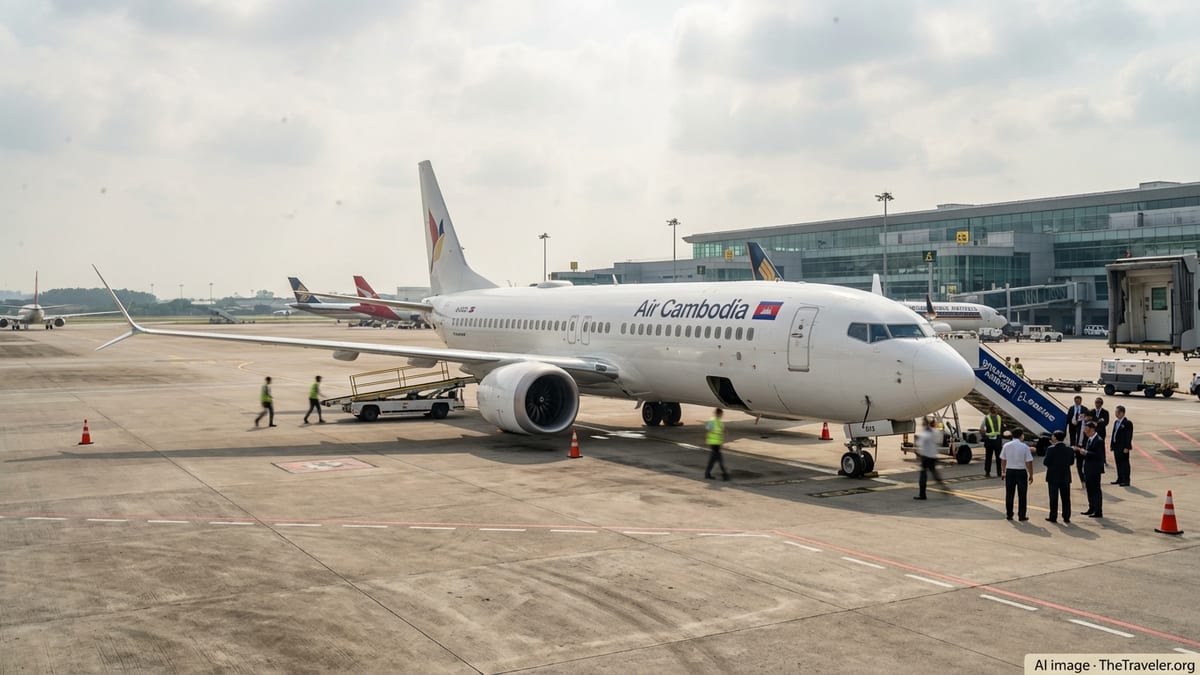
A new incentive model for rebuilding air links
Publicly available information indicates that the Cambodia Tourism Marketing and Promotion Board is working on a framework that would provide marketing grants or cost-sharing schemes to airlines willing to promote Cambodia in overseas markets. The concept under discussion is understood to link support directly to co-funded campaigns, particularly in priority long-haul and regional markets where awareness of Cambodia remains comparatively low.
The emerging proposal follows a broader regional trend in which tourism bodies and airports share the financial risk of route development with carriers. In Cambodia’s case, the focus appears to be less on direct subsidies for flights and more on co-branded destination advertising, social and digital promotions, and joint activities in source markets, such as roadshows and trade events.
Industry commentary suggests that such incentives are seen as a way to make new or expanded routes more viable at a time when airlines remain cautious about capacity deployment. By shouldering part of the marketing burden, tourism authorities aim to improve load factors in the early stages of a route, when demand is still being built.
Reports also highlight that the initiative is being designed to sit within Cambodia’s existing tourism promotion budget, rather than as an entirely new funding line, indicating a reallocation toward more targeted, performance-linked spending.
Context: tourism recovery and new aviation capacity
The proposal comes as Cambodia’s tourism sector continues to recover from the impacts of the pandemic, supported by the establishment of the Cambodia Tourism Marketing and Promotion Board in 2024 and a multi-year national promotion budget. Official tourism statistics released in recent company and government disclosures show a steady rise in international arrivals, with regional markets leading the recovery and long-haul segments still lagging.
At the same time, the country is entering a new phase of aviation expansion. A new international airport serving Phnom Penh has recently opened, and additional large-scale airport projects are advancing in Siem Reap and along the coast. Aviation-focused analyses and industry discussions describe these investments as part of a long-term bet on making Cambodia more accessible and attractive to global carriers.
Travel trade reports note that flight frequencies and seat capacity into Cambodia are increasing, supported by regional airlines and a gradual return of services from Northeast Asia. However, observers also point out that capacity remains below the potential enabled by new infrastructure, and that competition from neighboring hubs such as Bangkok, Ho Chi Minh City, and Singapore continues to influence airline route decisions.
Against this backdrop, the proposed grants for co-invested marketing are being framed as an additional tool to translate aviation infrastructure into actual routes, particularly for cities that do not yet have direct links to Cambodia.
How co-invested destination marketing could work
While detailed program rules have not yet been released, international experience provides an indication of how Cambodia’s scheme could be structured. In other markets, route-support programs typically require airlines to match or exceed the tourism board’s contribution, ensure co-branding in all campaigns, and report on campaign reach and booking performance.
Reports on Cambodia’s tourism policy suggest that similar principles are being considered. Grants would be tied to clearly defined marketing plans, such as digital campaigns in a specific origin market, joint promotions with travel agencies, or limited-time fare sales backed by destination storytelling. Funding might also prioritize routes that connect secondary cities or deliver higher-yield segments, including business travel and premium leisure.
Industry commentary stresses that any such program would need transparent criteria, time-limited support, and measurable outcomes in order to avoid becoming a general subsidy. Proposals being discussed emphasize performance indicators such as passenger numbers, load factors, and incremental visitor spending, alongside qualitative metrics like brand visibility and media coverage.
There is also an expectation that the program would dovetail with broader campaigns already run by the Cambodia Tourism Marketing and Promotion Board, ensuring consistent imagery and messaging across markets and partners.
Key target markets and strategic partnerships
Recent tourism campaigns have highlighted Southeast Asia, China, and selected long-haul markets as priorities for Cambodia. Regional travelers currently form the backbone of arrivals, reflecting strong cross-border movements from Thailand, Vietnam, and other Association of Southeast Asian Nations member states. At the same time, authorities and industry stakeholders have repeatedly underlined the importance of reviving and expanding Chinese tourism, as well as developing more direct access from North America, Europe, and Australia.
According to published coverage, the tourism board has already been working with payment providers, online travel platforms, and international tour operators to promote Cambodia’s cultural heritage, coastal areas, and emerging eco-tourism regions. The proposed airline co-investment grants are expected to build on these relationships, allowing airlines to plug into existing campaigns while tailoring offers for their specific customer bases.
Travel industry analysis indicates that long-haul markets such as the United States remain underpenetrated, despite a recent aviation agreement between the two countries. Observers argue that intensive destination marketing will be needed before airlines can justify launching non-stop services, and that coordinated campaigns across government, tourism bodies, and carriers could help create the demand required for such routes.
For regional markets, co-invested marketing could focus on short-break city and beach combinations, leveraging Cambodia’s improved connectivity with neighboring countries and the growing appeal of multi-country itineraries in mainland Southeast Asia.
Opportunities and challenges for Cambodia’s tourism strategy
Analysts view the airline grant proposal as a logical next step in Cambodia’s effort to compete more aggressively within the region. With neighboring destinations investing heavily in branding and air service incentives, a structured co-marketing program is seen as a way to keep pace and better align public and private sector efforts.
At the same time, commentary from aviation and tourism specialists points to several challenges. These include ensuring that marketing campaigns accurately reflect on-the-ground visitor experiences, managing expectations about the speed of route development, and balancing support between large international carriers and smaller regional airlines that may be more willing to pioneer new connections.
There are also questions about how the program would be coordinated with airport operators and local tourism organizations, particularly in secondary destinations that are keen to attract more flights. Clear governance, data-sharing, and joint planning mechanisms are likely to be essential if the grants are to deliver sustained benefits rather than short-lived route experiments.
Despite these uncertainties, the proposed airline co-investment grants signal that Cambodia is prepared to use more sophisticated tools to attract air services and visitors. As the tourism board refines the framework and begins discussions with carriers, the balance between infrastructure investment, marketing support, and demonstrated market demand will play a central role in shaping the next phase of the country’s tourism growth.