


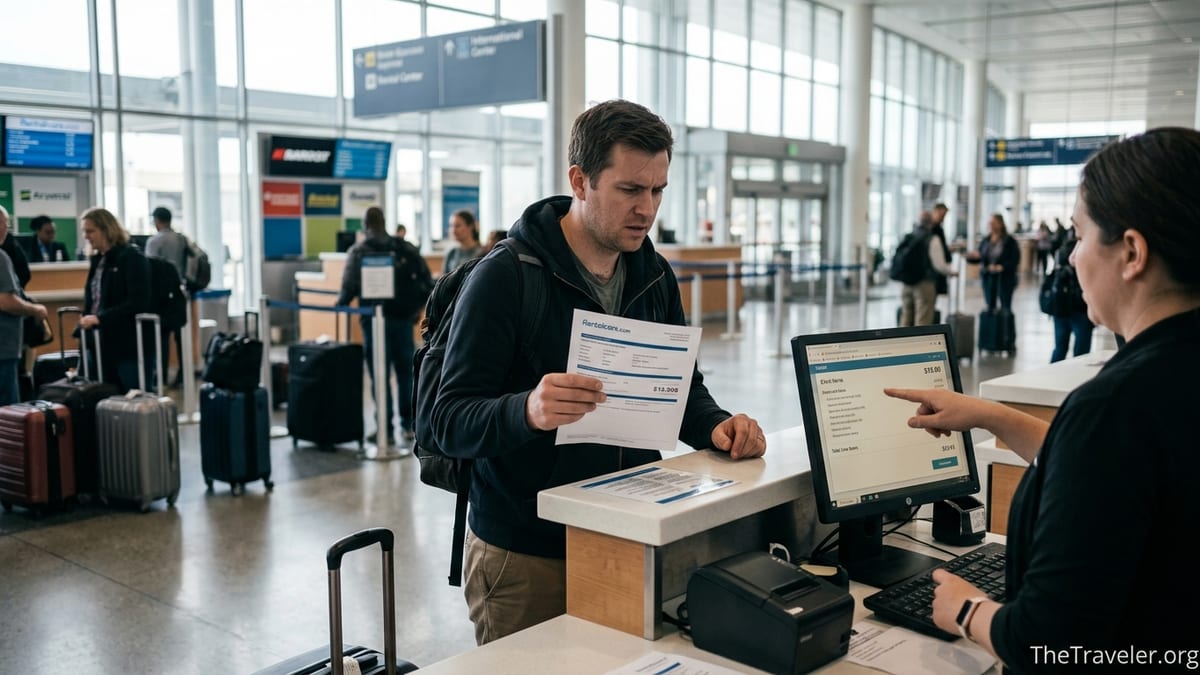
I was sure I had scored a bargain. Rentalcars.com showed a compact car in Seattle for 45 dollars a day, taxes and fees “estimated.” It beat booking directly with the big-name rental brands by 15 to 20 dollars a day, so I clicked buy without thinking too hard. Only at the very last stage of checkout, and again at the airport counter, did I realise how far the final price drifted from that tempting headline rate. Once mandatory airport surcharges, local taxes and a confusing mix of insurance terms were added, my “cheap” third-party deal was barely cheaper than booking direct, and in some scenarios it could easily have been more expensive.
Get the latest updates straight to your inbox!
Why Rentalcars.com Looks Cheaper at First Glance
Rentalcars.com is one of the largest car hire comparison platforms in the world. It pulls live rates from major brands like Hertz, Avis, Budget and Enterprise alongside regional outfits, then surfaces what appears to be the lowest price for your dates and destination. On a Seattle–Tacoma International Airport search in June, for example, it is common to see compact cars advertised around 40 to 45 dollars per day when some direct bookings show 55 to 65 dollars for similar models. At that stage, many travellers understandably assume they are looking at the true cost of the rental.
The crucial detail is that many of those eye-catching prices are base rates only. They may exclude a significant portion of the taxes and surcharges that will inevitably appear on your contract. A Sea-Tac fee calculator updated for 2026 illustrates how a 45-dollar advertised daily rate can balloon from 135 dollars for a three-day base rental to roughly 180 dollars once a 17.2 percent combined tax, a 6-dollar-per-day customer facility charge and a vehicle license fee are added. Those line items apply regardless of where you book, but on some comparison sites they are more visible only at the end of the process.
Several consumer guides now warn that some third-party platforms, including car rental sections of major travel brands, still lean heavily on this “base rate” illusion. They show you the cheapest possible figure in search results to win the click, while keeping mandatory fees either buried in small print or revealed only on the final payment screen. The risk is that you mentally anchor on the low headline price, only to discover that the real gap vs booking direct is much smaller.
Rentalcars.com is not unique in this respect. Reports on Expedia, Priceline and other intermediaries show the same pattern: a low teaser rate that does not fully reflect the all-in total. The difference is that with car rentals, taxes and fees can easily add 30 to 50 percent to the base cost, particularly at North American airports, so the gap between first impression and final bill feels more dramatic.
The Hidden Layers: Taxes, Airport Fees and Local Surcharges
When you compare Rentalcars.com with booking directly, it helps to break the price into layers. The first is the base daily rate for the vehicle. The second is government taxes, which in the United States can range from a few percent to over 20 percent of the base rental depending on state and city. The third layer is airport and facility surcharges such as concession recovery fees and customer facility charges, which are imposed on every rental at that location.
A legal briefing on car rental taxes published in May 2026 notes that taxes and mandatory surcharges alone regularly add 30 to 50 percent on top of the advertised daily rate at busy airports. It gives the example of a five-day rental at 40 dollars per day: a 200-dollar base can end up between roughly 260 and 300 dollars after taxes, and closer to 350 or 400 dollars once extra fees and a couple of optional add-ons are included. In practice, that means the 40-dollar compact you see on a comparison site might cost you 70 to 80 dollars per day all-in once the dust settles.
Real traveller stories echo this. A Reddit user describing a Hertz rental in Hawaii explained that they prepaid what looked like a complete 310-dollar price, only to be presented with a 394-dollar contract at the exit gate that included an 11.11 percent concession recovery fee, a daily customer facility charge, an operations surcharge and a 15.6 percent state tax. Another traveller at Sea-Tac discovered that a three-day rental advertised at 135 dollars before taxes produced an out-the-door figure close to 180 dollars once the 17.2 percent local surcharge, facility fees and licensing costs kicked in.
Rentalcars.com does generally show an estimated total as you move deeper into the booking path, but screenshots and complaints shared with consumer organisations and the Better Business Bureau highlight that this breakdown may come only after several clicks. One reviewer described booking a 130-euro reservation in Europe through the platform and then being charged another 170 euros in locally collected fees at the desk, more than doubling what they thought they had already paid online.
Insurance Confusion: Where the Biggest Price Jumps Happen
The second big source of price inflation is protection cover. Rentalcars.com, like many intermediaries, often sells its own collision damage waiver or full protection product layered on top of whatever basic cover the underlying rental company includes. In theory, this can be useful and sometimes cheaper than buying a similar waiver at the counter. In practice, the fine print and the way it interacts with the supplier’s own policy is one of the most common sources of surprise charges.
Recent customer reviews gathered by consumer review platforms point to recurring confusion about what Rentalcars.com’s insurance actually covers. Some travellers assumed that buying “Full Protection” on the site meant the local rental desk would treat them as fully covered, only to be told at pickup that they still faced a high excess unless they bought the rental company’s own waiver. Others believed their pre-purchased cover would prevent any deposit from being held, then discovered a 1,000 to 2,000-dollar hold placed on their credit card regardless.
On Reddit, multiple threads detail cases where travellers booked with Rentalcars.com, purchased the platform’s insurance, and later faced damage charges or administrative fees that were not automatically covered. One user who booked a car for Lisbon in 2023 wrote that they had to pay sizable local fees at pickup despite thinking the online total included everything. Another described being advised by live chat to cancel and rebook their rental simply to adjust insurance, only to find the new price more than 50 percent higher for the same dates and category.
From a price-comparison perspective, the key thing to understand is that protection products can easily double your effective daily cost. A 25-dollar per day compact might become a 45 or 50-dollar rental once a collision damage waiver, roadside assistance add-on and personal accident coverage are stacked on top. Third-party platforms sometimes present their own cover as an optional upsell early in the flow, before you have even seen how much the underlying rental brand would charge for similar protection. That makes it hard to compare apples with apples across providers.
Third-Party Middleman vs Booking Direct: Price and Risk
When you book through Rentalcars.com, your contract is effectively split. You have a commercial relationship with the platform for the reservation and any prepaid components, and a separate one with the rental brand for the actual vehicle and locally collected charges. That extra layer can be beneficial when things go smoothly, as the broker negotiates bulk deals and occasionally secures lower base rates than you will find on the supplier’s own website. It becomes a liability when anything about your trip changes or a dispute arises over the final bill.
Independent tests of car rental comparison sites published in 2026 found that third-party brokers did indeed produce the lowest final prices in a majority of trial bookings, particularly in Europe where competition is fierce. Discover Cars, another broker, had the lowest all-in price in nine of twelve test scenarios, while Rentalcars.com and direct bookings each won in a smaller number of cases. The conclusion was that brokers can be cheaper, but not consistently so across all destinations, dates and vehicle types.
Real-world examples show both sides. One Canadian traveller reported on a travel hacks forum that a Priceline package for Calgary, including insurance, came out to roughly 227 Canadian dollars when the equivalent direct quote with Sixt was over 1,000 dollars. In that case, the third party clearly delivered a huge saving. Yet other users on the same forum mention cases where Rentalcars.com’s prepay price was actually a few pounds or dollars higher than the rental company’s own prepay rate for identical dates and cars once they checked.
The other element to weigh is customer service. Complaints filed with the Better Business Bureau in Atlanta and similar organisations in Europe show a pattern where travellers caught between Rentalcars.com and the local rental desk struggle to get either side to take responsibility for unexpected charges, card holds or reservation issues. When you book direct, there is no intermediary to deflect blame. For some travellers, paying a few dollars more per day in exchange for that simplicity and clearer accountability is worth it.
Case Study: When the “Cheapest” Quote Is Not the Cheapest Trip
Consider a one-week July rental of a compact car at Orlando International Airport. On a typical search, Rentalcars.com might surface a major-brand compact at 31 dollars per day with “free cancellation” and a note that taxes and fees are estimated. The initial total it displays could be around 290 dollars for seven days once some taxes are factored in. Booking direct on the rental company’s site, you might see the same class at 35 dollars per day with a headline total closer to 330 dollars.
At first glance, Rentalcars.com looks about 40 dollars cheaper for the week. However, when you click through its payment screen you may find that the customer facility charge and some local surcharges are not fully included in the estimate. When you arrive in Orlando, the counter contract adds approximately 6 to 8 dollars per day in airport facility fees and about 15 percent in additional taxes. Suddenly that 290-dollar expectation becomes closer to 360 dollars all-in.
Meanwhile, on the direct booking, the rental company may have shown more of those line items up front. Its 330-dollar quote might already include a realistic estimate of the airport fees and local taxes, with only a small adjustment at the counter. In that scenario, the supposed 40-dollar advantage of booking with Rentalcars.com shrinks to zero and can even reverse if the direct booking offered a loyalty-program discount or a “pay now” reduction that the broker could not match.
Another case involves European rentals where mandatory cross-border fees, young driver surcharges or one-way drop charges between cities are not clearly disclosed on the broker site. Travellers report on forums that a 130-euro week-long compact booking through Rentalcars.com turned into more than 300 euros out-of-pocket once a one-way fee and local charges at both ends were added. Had they booked directly with the underlying supplier, the same one-way fee might have been highlighted more clearly earlier in the booking path, allowing a better comparison with other options like trains or rideshares.
How to Compare Final Prices the Right Way
The safest way to decide whether Rentalcars.com is actually saving you money is to compare final prices as closely as possible. That means taking each candidate booking all the way to the last page before payment, both on the broker site and on the rental company’s direct site, and noting the true expected total. Instead of writing down the daily rate, write down the total cost of the trip including estimated taxes and fees.
When you do this, pay special attention to whether the site clearly labels items like “Customer Facility Charge” or “Airport Concession Recovery Fee” and whether those numbers look plausible relative to other providers at the same airport. If the tax percentage on one quote appears dramatically lower than on another for the same location and dates, it usually means one of them is postponing some of the surcharge disclosure until later. Several consumer travel advisories now suggest that renting at non-airport neighborhood branches, when practical, can eliminate many of these charges entirely and make the final total easier to predict.
It is also wise to compare insurance on a like-for-like basis. That might mean declining Rentalcars.com’s own full protection and instead checking how much the underlying rental brand charges for a comparable collision damage waiver. In some countries, especially across continental Europe, the basic rate already includes a high level of cover, and buying extra third-party insurance may be unnecessary. In North America, where basic cover can be minimal, many travellers find that a standalone annual car hire excess policy or coverage provided by a premium credit card offers better value than either the broker or the rental desk upsell.
Finally, do not forget to factor flexibility and service into your personal equation. A fully prepaid third-party reservation that saves you 30 or 40 dollars might not look so attractive if changing your flight later forces you into complex three-way negotiations between the broker, the airline and the rental desk. For longer trips, or itineraries with multiple moving parts, some travellers intentionally pay a little more to maintain a direct relationship with the rental brand.
The Takeaway
Rentalcars.com can absolutely save you money in some situations. Its ability to aggregate inventory and negotiate bulk rates means that for certain destinations and dates, particularly outside peak season or at off-airport locations, the platform’s final price can undercut both other brokers and booking direct. There are plenty of positive reviews from travellers who picked up a car with no surprises and drove away pleased with what they paid.
However, the experience of many others shows that the apparent saving on screen is not always what it seems once mandatory taxes, surcharges and protection products are factored in. Because so much of the rental cost sits in those layers rather than in the base rate, a comparison that focuses only on the initial daily price risks misleading you. You may still come out ahead with Rentalcars.com, but you will not know for sure unless you push every contender all the way to a realistic final total.
For travellers who value transparency and simplicity, the most reliable habit is to treat any headline rate, whether from Rentalcars.com or a direct site, as a starting bid rather than a promise. Click through until you see every line item, compare equivalent cover across providers and remember that a slightly higher but clearer quote can sometimes be the better deal. In rental cars, as in airfares, it is the number on your credit card statement after the trip, not the number in the search results, that really matters.
FAQ
Q1. Does Rentalcars.com include all taxes and fees in the first price I see?
Not always. The first prices often reflect the base daily rate and may leave some airport surcharges, facility fees and local taxes for later in the booking path or for payment at the counter.
Q2. Why does my Rentalcars.com booking seem cheaper than booking direct at first?
Many comparison sites highlight the lowest base rate to win your click. Only after you proceed towards payment do you usually see the full estimate including mandatory charges that narrow the gap.
Q3. Can Rentalcars.com ever be genuinely cheaper than booking with the rental company?
Yes. Independent tests have found that brokers, including Rentalcars.com, sometimes secure lower all-in prices than direct bookings, especially in competitive European markets and at off-airport locations.
Q4. What kinds of fees are most likely to surprise me at pickup?
Common surprises include airport concession recovery fees, customer facility charges, vehicle license recovery fees, additional local taxes and, in some regions, mandatory one-way or cross-border surcharges.
Q5. How should I compare insurance between Rentalcars.com and the rental company?
First, decide the level of cover you actually need. Then compare the total cost of that cover from the broker, the rental desk and any credit card or standalone policy you already hold, making sure the deductibles and exclusions are similar.
Q6. If I buy “Full Protection” on Rentalcars.com, do I still need insurance at the counter?
That depends on your risk tolerance and the specific terms, but many travellers still face a high excess and a credit card hold at pickup. The rental company may continue to promote its own waiver even if you bought broker protection.
Q7. Are fees and taxes the same whether I book through Rentalcars.com or directly?
Government taxes and airport facility charges are the same for all providers at a given location. What differs is how clearly and at what stage each platform displays them during the booking process.
Q8. Is it safer to book directly with Hertz, Avis or another brand instead of through a broker?
Booking direct can simplify customer service and changes, because you deal with a single company. A broker may still be worth it if the confirmed final price is significantly lower and you are comfortable with the extra layer.
Q9. How can I avoid big shocks between the quoted price and the final bill?
Always click through to the final payment page before committing, read every line item on the confirmation, keep screenshots, and at pickup compare the counter contract total with your expected figure before signing.
Q10. What should I do if I am charged more than the Rentalcars.com confirmation after my trip?
Start by requesting a detailed invoice from the rental company, then contact Rentalcars.com with both documents and your evidence. If you paid by credit card and believe you were misled, you can also consider a dispute with your card issuer.