


Many travelers click "confirm" on a Rentalcars.com reservation believing they have locked in a great deal, only to discover a much higher bill when they finally reach the rental counter. As complaints have mounted in recent years, a clear pattern has emerged: while the comparison site can surface low headline prices, important local fees, insurance requirements and terms are often understood far too late, once the traveler is tired, jet-lagged and standing in front of a desk with their credit card in hand.
Get the latest updates straight to your inbox!
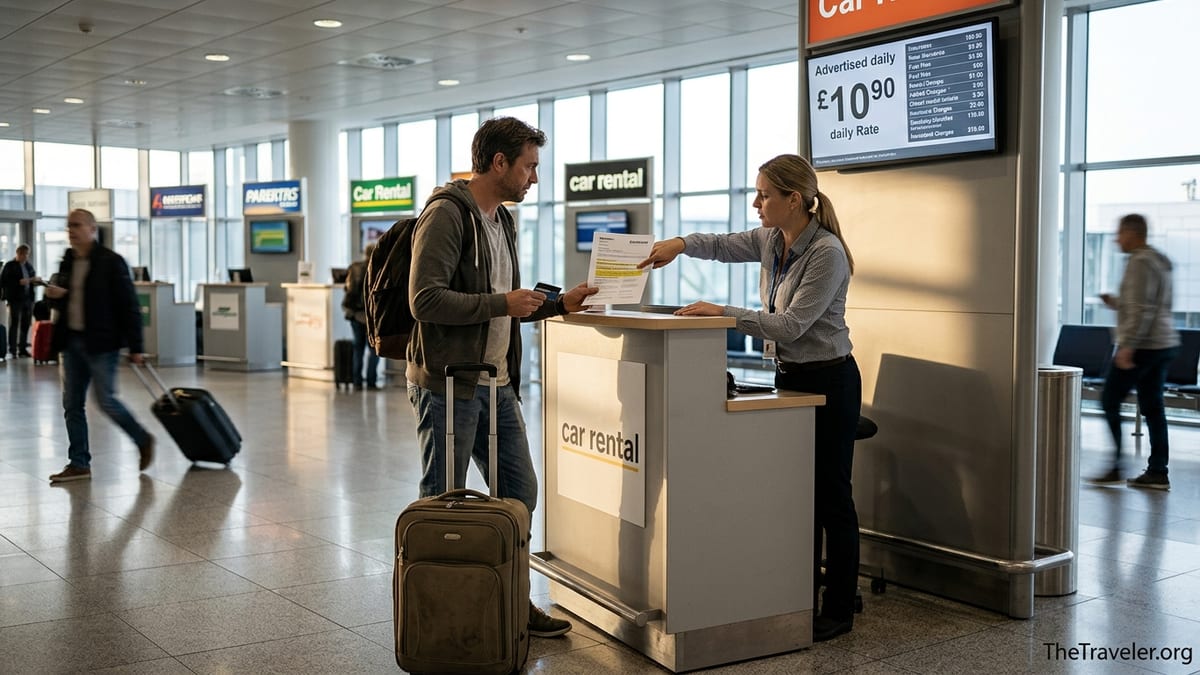
How Rentalcars.com Actually Works Behind the Scenes
Rentalcars.com is not a car rental company. It is a broker owned by Booking Holdings that sits between you and brands such as Hertz, Europcar or smaller local firms in places like Greece, Turkey or Brazil. You pay Rentalcars.com some or all of the cost upfront, then pick up the car from a separate rental company that ultimately controls the contract, vehicle and most of the fees. This middleman role is central to understanding where extra costs appear.
On the website or app, the search results highlight an attractive daily rate and a short checklist of what is “included,” such as limited or unlimited mileage and basic coverage. However, many of the key financial details sit in several different places: a tiny “terms and conditions” link next to each offer, separate “important information” for the location, and the local rental company’s own small-print about insurance excesses, deposits and out-of-hours fees. Travelers who assume the upfront price shown by Rentalcars.com is the all-in cost frequently report facing much higher charges once they arrive.
Recent customer reviews on major consumer platforms describe the same pattern. A traveler might book a week-long compact car in Lisbon for around 180 euros on Rentalcars.com, only to be told at the counter that they must either buy a local collision waiver for another 20 to 30 euros per day or accept a damage excess of well over 1,000 euros plus a large security deposit on their card. Others discover that local airport surcharges, road taxes or late pickup fees were not obvious while booking. Because the broker and the local agency can point at each other’s fine print, the traveler often ends up paying simply to get the keys and move on.
It is important to note that many renters do complete Rentalcars.com bookings without major issues, especially at larger international brands that are more standardized. The trouble is that when things go wrong, the broker’s limited control over its partners and the scattered way information is presented make disputes slow and frustrating, particularly if the local agency insists extra fees are non-negotiable under its own terms.
The Insurance Puzzle: CDW, Excesses and “Mandatory” Add-ons
The most common source of bill shock involves insurance. Rentalcars.com often advertises that a rate includes theft protection and a collision damage waiver, and may heavily promote its own “full protection” add-on during booking. On many offers, that extra policy is sold by Rentalcars.com or a third-party insurer, not by the local rental counter. It is designed to reimburse you later if the rental company charges you for damage, rather than actually waiving the damage excess at the desk.
In practice, this can create a confusing gap between what the renter thinks is covered and what the local outlet recognizes. For example, a traveler might pay Rentalcars.com an extra 60 to 100 dollars for a week of “full protection,” then arrive in Tenerife or Athens and be told by the local partner that there is still a 1,000 to 1,500 euro excess on the car unless they purchase the agency’s own premium cover. Multiple renters have reported being told that without buying this additional insurance locally, they would face a large deposit hold on their card and be fully charged for even minor scratches, regardless of the policy they bought online.
In one typical scenario described in complaints, a family booked a mid-size car through Rentalcars.com for a Mediterranean island holiday. At pickup, the local supplier announced that an extra 25 euros per day was required for a “mandatory” insurance upgrade that was not clearly disclosed during online booking. The alternative was to proceed with a 1,800 euro excess and a large deposit hold. Tired after a late flight, the family accepted the extra insurance rather than argue in a language they barely spoke. Only later, back home, did they realize the added cost nearly doubled the total price.
Even when the online information technically mentions that additional insurance may be offered at the desk, the combination of scattered fine print and persistent sales pressure leaves many travelers feeling misled. The safest approach is to assume that any “full protection” sold by Rentalcars.com will involve making a claim later if something goes wrong, and that the local agency may still attempt to sell its own product. Bringing a strong, independent policy from a reputable travel insurer and being clear at the counter that you decline further cover can help, but it requires confidence and careful documentation.
Fuel, Late Pickup and One-way Fees That Catch Travelers Off Guard
Beyond insurance, several other categories of extra fees repeatedly appear in Rentalcars.com bookings. Fuel policies are a frequent source of surprises. While many offers advertise a straightforward “full to full” policy, some partners still operate “full to empty” or charge administrative fees if the car is not refueled to a specific level. Renters in Spain and Portugal, for example, have reported paying 80 to 120 euros upfront for a full tank and then receiving only a partial refund at an unfavorable rate when they returned the car with fuel remaining.
Late pickup and out-of-hours fees are another recurring complaint. In one recent case, a traveler booked through Rentalcars.com for pickup at 9:00 pm with a local partner near a European airport. A shuttle delay meant they reached the desk a little after 9:00 pm. The rental company then added a 40 euro “late pickup” fee, arguing that any handover after the scheduled time counted as out-of-hours. The renter noted that Rentalcars.com did not clearly highlight this potential charge during booking, and customer support later pointed to local terms the traveler had technically accepted but never seen in detail.
One-way fees can be even more expensive when they are not made obvious. A New Zealand renter described booking a one-way trip through Rentalcars.com, seeing no prominent mention of an additional drop fee on the main quote or voucher, and then being charged a separate one-way fee by the local supplier that nearly doubled the total cost. While such fees are standard in the rental industry, issues arise when they are not clearly integrated into the upfront price the traveler sees on the comparison site.
Travelers should also be alert to small but annoying add-ons like road taxes, airport concession fees, winterization charges in snowy regions and border-crossing surcharges in parts of Europe. These may appear under headings like “to be paid locally” or be mentioned only in the local company’s own document. If you are planning to cross from, say, Germany into the Czech Republic or from Croatia into neighboring countries, confirm beforehand whether the car is allowed to leave the country and what extra charges will apply. Otherwise, you may be forced to adjust your route or pay unexpected border fees at the counter.
Deposits, Credit Card Rules and Denied Pickups
A less obvious, but equally costly, issue involves deposits and card requirements. Most rental companies insist on a substantial security deposit, especially on cheaper headline rates. It is common to see 800 to 1,500 euros held as a pre-authorization, and in some cases more for premium cars or for renters under 25. Rentalcars.com typically indicates that “a credit card in the main driver’s name” is required, but many travelers skim this detail, assuming any bank card will be fine.
At the counter, however, many local partners refuse debit cards for the deposit or only accept them under stricter conditions. Recent complaints include a traveler who arrived on a remote island after booking through Rentalcars.com, only to be told that their bank-issued Visa debit card would not be accepted for the deposit even though it worked for the prepaid portion online. The local agency insisted on a traditional credit card in the driver’s name and offered to rent a car only if the traveler paid the full rental and an additional 300 euros again on the spot. Because the trip depended on having a car and alternative companies at the airport were costly, the traveler paid twice and struggled for a refund later.
Other renters have encountered situations where their name on the card did not exactly match their driving license, or where they were listed as an additional driver instead of the main one, leading the local supplier to deny the booking altogether. In these cases, Rentalcars.com’s terms often treat the situation as a “no show,” meaning the prepaid amount may be partially or fully nonrefundable, even though the traveler did show up on time.
Deposit disputes can linger long after the trip ends. If the local company claims damage, fuel shortages or unpaid tolls, it may draw funds from the deposit without immediate detailed proof and then require the renter to chase invoices and photos later. Travelers who booked via Rentalcars.com sometimes find themselves bounced between the broker’s customer service and the local outlet, with each saying the other must supply the evidence. This back-and-forth can stretch for weeks, well after the traveler has returned home.
Car Class Downgrades, Availability Problems and Last-minute Changes
Another frustration reported by Rentalcars.com users is discovering that the actual car provided is smaller or less capable than the class they believed they had reserved. While all major rental firms advertise “or similar” when listing car models, there are limits to what most travelers consider genuinely equivalent. An example from a European trip described a renter who booked through Rentalcars.com expecting something comparable to a Ford Focus, then being presented at the counter with a much smaller car and told it was in the same category. The customer disagreed, but the local staff insisted there were no other vehicles available at the booked rate.
Downgrades can be especially problematic for families needing seven-seat vehicles, SUVs for mountain roads or automatic transmissions in countries where manuals dominate. One traveler who had reserved a seven-passenger van for a summer holiday reported receiving confirmation from Rentalcars.com for a smaller five-seat model just a few days before departure, leaving them scrambling to rearrange plans or pay significantly more to secure a suitable vehicle.
Availability issues also occur at pickup. Some travelers arrive at an airport expecting a desk on site, only to discover that their Rentalcars.com partner operates from an off-site lot reached by a shuttle bus, sometimes subject to reduced hours and long waits. In one case, a renter called the local number provided by Rentalcars.com multiple times from the terminal and received no answer, then had to book an entirely new car directly from a major brand at the airport at a much higher walk-up rate. When they later requested reimbursement from the broker, they were offered only a modest goodwill gesture rather than compensation for the full additional cost.
While some level of substitution is inevitable in the car rental industry, these examples highlight how vulnerable travelers can be when the broker has little direct control over fleet management. If the car class you need is critical, it is wise to confirm directly with the local provider a few days in advance, using the actual rental company’s contact details, not only the broker’s booking page.
Why Complaints Are So Hard to Resolve After the Trip
Once you have returned the car and flown home, any dispute over extra fees becomes significantly harder to fix. With Rentalcars.com, many travelers discover that customer service largely consists of email tickets and chat, and that the broker positions itself as an intermediary with limited responsibility for what the local company actually charged at the counter. Renters who attempt to challenge, for example, a damage charge or an out-of-hours fee often hear that the broker must await documentation from the partner, or that the issue is covered by local terms they agreed to during booking.
Some travelers have reported long chains of messages where the broker asks for bank statements, receipts and photos to prove that an extra amount was taken, especially when, for instance, a company such as Hertz or a regional brand adds local charges after return. Even with clear documentation, refunds can be delayed or denied, leaving the traveler to consider card chargebacks or complaints to local consumer protection agencies.
This structure contrasts with booking directly through a major global rental brand, where the same company controls both the booking and the local outlet. While direct bookings are not immune to disputes, there is at least a single entity responsible for both the online price and the on-the-ground experience. With Rentalcars.com, any disagreement tends to involve interpreting two overlapping sets of terms and conditions, and the traveler must navigate both.
The volume of negative experiences has led many frequent travelers, including digital nomads and long-term tourists, to advise one another to avoid car rental aggregators entirely or to use them only for initial research. They then book directly with a preferred rental brand, even if the headline rate appears slightly higher, on the assumption that clearer terms and simpler recourse are worth the extra cost.
How to Protect Yourself If You Still Want to Use Rentalcars.com
Despite the risks, Rentalcars.com can still offer competitive deals, especially in high-cost destinations where major brands charge steep walk-up prices. The key is to treat the platform as a starting point, not a final price guarantee. Before you pay, click into every “important information” and “terms and conditions” link for your chosen offer. Look specifically for sections on insurance excess, security deposits, fuel policy, out-of-hours fees and one-way surcharges.
If you see vague language such as “additional local charges may apply” without clear amounts, consider that a warning sign. A price that looks 20 percent cheaper than competitors may only achieve that by omitting an insurance upgrade or one-way fee that competing sites include upfront. Try searching the name of the local rental company together with the airport or city on independent review platforms, paying attention to the most recent reviews where travelers mention hidden fees, insurance pressure or depot location problems.
On the practical side, arrive at the counter prepared. Bring a true credit card in the main driver’s name, not just a debit card, and be ready to decline unwanted insurance politely but firmly. Ask the agent to confirm the total amount that will be charged to your card, including all fees, before you sign anything. If you feel pressured into buying extra products, ask the staff to note clearly on the contract that they are optional and that you declined them. Take photos of the car from all angles at pickup and drop-off to protect against later damage claims.
Finally, keep all paperwork, including the Rentalcars.com voucher, the local rental agreement, and any receipts for fuel or additional payments. If you later need to contest a charge through your bank or card provider, that documentation will be crucial. While it will not guarantee a favorable outcome, solid evidence gives you a much better chance than relying on memory weeks after your trip.
The Takeaway
Extra fees on Rentalcars.com bookings are not purely random. They tend to fall into recognizable categories: local insurance sold as “mandatory,” security deposits and strict card rules, fuel and late pickup policies that are not clear at the search stage, one-way and airport surcharges that only show up locally, and disputes over car class or availability. The platform’s role as a broker means that critical details are often scattered across several documents and that accountability is diluted when things go wrong.
For travelers, the most realistic approach is to assume that the attractive price you see on Rentalcars.com is a starting estimate, not a final figure, unless every major fee can be clearly identified and quantified in advance. If you are comfortable combing through terms, confirming details directly with the local supplier and standing your ground at the counter, you may still secure good value through the site. If not, you may be better off paying a little more upfront to book directly with a well-reviewed rental brand whose pricing and policies you fully understand before you board the plane.
FAQ
Q1. Is Rentalcars.com itself a scam, or are the problems caused by local rental companies?
Many issues stem from local rental companies that partner with Rentalcars.com, but the way information is presented on the broker’s site can make surprise fees more likely. The platform is a legitimate intermediary, yet its limited control over partners and reliance on fine print contribute to many of the complaints travelers report.
Q2. Why do I have to buy more insurance at the counter if I already paid for “full protection” on Rentalcars.com?
In many cases, the “full protection” sold online is a separate policy that reimburses you later rather than eliminating the excess at the desk. Local agencies often only recognize their own insurance products, so they may still insist on an additional waiver or a high deposit unless you purchase their coverage too.
Q3. How can I avoid hidden insurance fees when booking through Rentalcars.com?
Read the insurance section of both the Rentalcars.com offer and the local provider’s terms before you pay. Check the size of the damage excess and any deposit, and assume that aggressive upselling is possible. Bringing your own independent excess insurance and being prepared to decline extra coverage at the counter can help, but only if you are comfortable accepting the deposit and standing firm.
Q4. What should I watch for in the fuel policy on Rentalcars.com?
Look for whether the offer is “full to full,” “full to empty” or another arrangement, and whether there are administrative fees for refueling. If the wording is vague or mentions that fuel charges will be set locally, be prepared for a potentially expensive upfront fuel purchase or penalties if the tank is not returned to a precise level.
Q5. Why was my booking refused when I arrived with a debit card?
Many local partners require a traditional credit card in the main driver’s name for the security deposit, even if a debit card was accepted for the online payment. If you arrive with only a debit card, the supplier may treat the situation as if you failed to meet the rental conditions and can deny the car without refunding the prepaid amount.
Q6. Can Rentalcars.com change my car type or downgrade me shortly before the trip?
Yes, availability issues can lead to smaller or different vehicles than the ones you expected, especially for vans, SUVs or automatic transmissions. Because the contract allows for “or similar” models, challenging a downgrade can be difficult. Contacting the local supplier before departure to confirm the car class is one of the few ways to reduce this risk.
Q7. What can I do if I discover extra charges on my card after returning the car?
First, request a detailed invoice from the local rental company explaining the charges. Then contact Rentalcars.com with copies of all documentation, including the original agreement and any photos of the car. If you are not satisfied with their response, consider filing a dispute with your card issuer, as chargebacks are often more effective than prolonged email exchanges.
Q8. Are one-way rentals booked through Rentalcars.com more likely to include extra fees?
One-way rentals almost always involve drop-off fees, and problems arise when these fees are not clearly built into the upfront quote. Carefully check the “to be paid locally” and location-specific sections for any mention of one-way charges, and compare the total estimated cost with booking directly through the same rental brand.
Q9. Is it safer to book directly with a rental company instead of using Rentalcars.com?
Booking directly with a well-known rental brand can simplify terms and improve accountability, since there is only one company responsible for both the online booking and the local service. While this is not a guarantee against problems, it generally makes pricing more transparent and disputes easier to resolve than when a broker is involved.
Q10. What are the most important steps to take before confirming any Rentalcars.com booking?
Before paying, read all insurance and deposit details, confirm card requirements, check the fuel and mileage policy, look for any mention of out-of-hours or one-way fees, and research recent reviews of the specific local rental company and location. If anything remains unclear or seems too good to be true, consider choosing a different offer or booking directly with a rental brand you trust.