


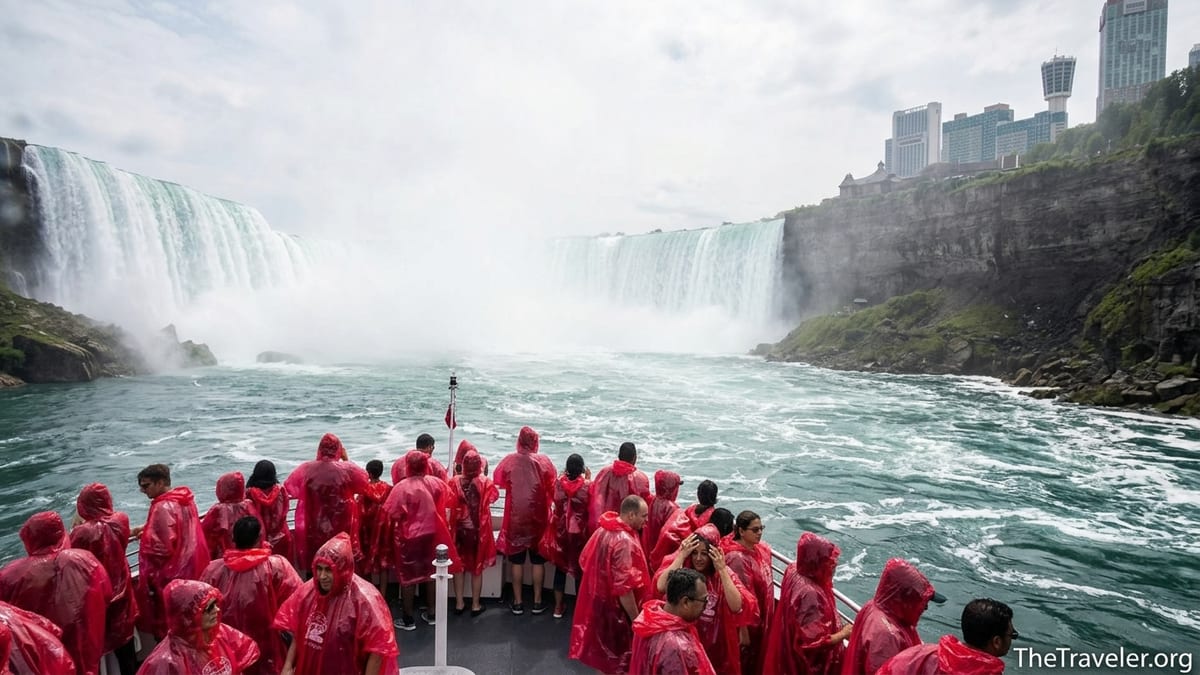
By the time our Hornblower boat spun back toward the dock below Niagara Falls, the toes of my socks were squishing in my sneakers, my jeans clung to my legs, and my red plastic poncho snapped loudly in the wind. The Canadian side’s signature boat tour, now officially called Niagara City Cruises by Hornblower, is often described as a “mist” experience. In reality, it feels much more like stepping into a sideways rainstorm at the edge of the world. Here is exactly what it was like to get completely soaked by the Horseshoe Falls, and how to plan your own ride into the roar.
Getting to the Hornblower Dock Below the Falls
Most visitors first see the Hornblower boats from the railing of the Niagara Parkway promenade, tiny compared to the wall of water collapsing behind them. The boarding area, however, sits far below street level. After buying or scanning your ticket near the top of the gorge, you follow signs for Niagara City Cruises and step onto a glass-walled elevator that glides down the cliff face to the Lower Landing in the Great Gorge. As the elevator drops, the sound of traffic fades and the white noise of the river takes over. By the time the doors open, conversation is reduced to shouting over the thunder of the falls.
The dock itself stretches along the base of the cliff, with separate queues for different departure times. On busy summer weekends, staff funnel passengers through roped lanes that feel a little like an airport boarding area. Plan to arrive at least 30 minutes early, especially in July and August, to clear the lines and have a moment to look up at the canyon walls streaked with mineral stains and hanging plants. I visited on a shoulder-season afternoon and still shared the dock with several hundred bright red ponchos flapping in the wind.
There is no on-site parking at the Hornblower entrance, which surprises many first-time visitors who arrive by car. Instead, most drivers use pay lots near Clifton Hill, Fallsview Casino, or the large lots around Table Rock Centre and then ride the WEGO shuttle down to the river level. For anyone staying in hotels along Fallsview Boulevard, walking down to the boarding area takes about 15 to 25 minutes depending on your pace and how often you stop to stare at the water. If you are coming on a tight day trip from Toronto or Buffalo, factor in that extra transfer time so you are not sprinting to catch your time slot.
Tickets, Prices, and the Reality of Crowds
The core Hornblower experience on the Canadian side is the Voyage to the Falls boat tour, a roughly 20-minute cruise that runs frequent departures in season. As of 2026, adult tickets typically cost in the low-to-mid 40 Canadian dollar range before tax, with children’s tickets generally a bit lower, and kids under three riding free. Exact rates can vary slightly by date and promotions, so it is wise to check current pricing when you book and expect a modest additional fee for taxes and service charges at checkout.
Tickets can be purchased on-site, but buying ahead for a specific time window gives you some predictability on busy days. On midweek spring visits or autumn weekdays, I have been able to walk up and join the next available sailing with little delay. By contrast, on a sunny Saturday in August or over long weekends, lines can snake back from the boarding area even with timed-entry tickets as each departure fills up. Locals familiar with the rhythm of the crowds often recommend booking early morning or late afternoon sailings to avoid peak mid-day congestion.
Each boat carries several hundred passengers, spread across two main decks with both open-air railings and partially sheltered areas toward the center. Even when a tour is technically sold out, there is usually room to move around once on board, though prime railing positions at the front fill quickly. If standing shoulder to shoulder with strangers feels overwhelming, consider visiting outside school holidays or targeting dates when the Canadian side is less saturated with tour buses, such as weekdays in May, early June, or late September.
For travelers bundling several attractions, Niagara Parks and various tour operators sell passes that combine the boat ride with Journey Behind the Falls, the Butterfly Conservatory, or the White Water Walk. These can represent reasonable value if you plan to see multiple sights in one day, and they spare you from re-entering payment details over and over. The trade-off is less flexibility if the weather suddenly shifts or you decide to linger over lunch with a view of the gorge instead of sprinting between time slots.
Ponchos, Clothing, and How Wet You Actually Get
Every passenger boarding the Hornblower receives a complimentary red poncho, printed with maple leaves and the cruise logo. Staff hand them out just before the gangway, so you join a crowd of people all wrestling the thin plastic over backpacks, camera straps, and baseball caps. The poncho is knee-length on most adults, with a hood and a simple drawstring around the neck. It does a respectable job of keeping your torso and upper legs protected from the worst of the spray, and it makes for a recognizable souvenir. It does not, however, make the experience dry.
On my most recent trip, I wore lightweight hiking pants, a quick-dry T-shirt, and a thin shell jacket underneath the poncho. By the time we pushed into the thickest part of the mist, droplets had found their way up my sleeves and down the back of my neck. My hair felt like I had stepped into a shower. The hood helped, but gusts blew it back whenever I leaned out for a clear photo. People who had arrived in jeans and cotton hoodies fared worse, their clothes staying clammy long after we disembarked. Travelers who had slipped flip-flops into their bags for the ride were patting themselves on the back as the rest of us squished around in waterlogged sneakers.
If you truly want to minimize the soak, dress as if you were heading out on a rainy coastal hike rather than a tame sightseeing cruise. That might mean breathable waterproof shell jackets under the poncho, quick-dry leggings or hiking trousers, and sandals or sneakers you do not mind getting wet. Avoid heavy denim and thick cotton sweatshirts, which hold moisture and feel cold once the wind picks up. Bringing a small microfiber towel or bandana in a pocket can be a comfort when you step back from the rail and realize water is running into your eyes.
It is also worth planning ahead for your gear. The poncho can cover a mid-size backpack, but smaller shoulder bags and open-top purses tend to get drizzled from above and splashed from below. Many travelers tuck phones into plastic sleeves or use basic waterproof pouches bought from souvenir stands along Clifton Hill. A simple resealable plastic bag also works in a pinch. Professional-level camera gear should be protected with a rain cover or at least a plastic shopping bag and rubber band. I watched more than one traveler abruptly abandon their vantage point to shield an expensive lens as the mist shifted from gentle spray to full-blown downpour.
Into the Mist: What the Ride Actually Feels Like
Once you step off the gangway and onto the Hornblower boat, there is a brief shuffle as everyone fans out to claim their spots. I followed the flow up the stairs to the upper deck and wedged myself along the front rail on the port side, the Canadian cliffs receding behind us. Almost immediately, the wind picked up. Even before we left the dock, my poncho snapped like a flag, and the plastic hoods around me flapped like the wings of strange red birds. A crew member shouted a quick safety briefing over the loudspeaker, but his words were nearly drowned out by the surrounding roar.
The boat first glides past the American Falls and the narrower Bridal Veil Falls, offering a clear side-on view that is ideal for photos. At this point, the spray is light, more like a cool mist drifting across the deck. People grin and pose for pictures, holding out phones at arm’s length with the skyline of Niagara Falls, Ontario behind them. The smell of the river is fresh and slightly metallic, a reminder that all this white water was sheer ice just a few months earlier. It is exhilarating but not yet overwhelming.
Then the captain points the bow toward the Canadian Horseshoe Falls, and the mood shifts. The curtain of water ahead looks less like something out of a travel brochure and more like a moving wall. As the boat nudges into the churn, droplets hang in the air like heavy fog. The temperature drops several degrees. The breeze that had been teasing the edges of my poncho suddenly feels more like a steady push. Water pounds on the plastic hoods around me, a staccato drumming matched to the pulsing of the falls themselves.
At the closest point, it is almost impossible to keep your face dry. The mist becomes so dense that the view ahead disappears into white, and you know the Horseshoe Falls are only a few dozen meters away because you can feel, rather than see, their presence. Conversations taper off to a few short exclamations and laughter as everyone gives up on staying tidy. When I looked down at my shoes, the deck around my feet was running with shallow streams of water; when I looked up, I could see only the outlines of other passengers, red ponchos glowing like lanterns in the haze. It felt less like a simple sightseeing tour and more like entering a natural amphitheater built entirely out of noise and water.
After the Soak: Drying Off and Exploring Nearby
The moment the boat begins to turn away from the heart of the Horseshoe Falls, the intensity eases. Within a minute or two, you are back in simple drizzle, the skyline reappearing through gaps in the mist. People peel back their hoods, wipe their faces with sleeves, and squeeze water from the tips of their hair. Crew members circulate with casual efficiency, checking that everyone is steady on their feet as the boat noses back toward the dock. The return leg feels shorter, partly because you are no longer bracing against the elements and partly because you are still processing what you just experienced.
Disembarking is straightforward. You follow the crowd back up the gangway and along the walkway past bins designated for recycling the ponchos. Many passengers keep theirs as a free souvenir, stuffing the crinkled plastic into backpacks for future yard work or rainy-day school runs. Others are relieved to drop the clingy ponchos into the bins and feel open air on their skin again. If the sun is out, you will begin drying within minutes as you walk along the gorge. On cool or overcast days, however, that dampness can linger, so it is sensible to pack a dry layer in a small daypack or to plan a quick stop back at your hotel afterward.
Directly at the landing there are basic facilities: restrooms, a small gift shop, and kiosks selling drinks and snacks. Several visitors I spoke with used this pause to check their phones, reshuffle their daypacks, and swap wet caps for dry ones. From there, you can either take the elevator back up to the Niagara Parkway or meander along the river-level path for a short distance to catch different angles of the gorge. Many organized tours pair the Hornblower cruise with Journey Behind the Falls, located a short bus ride away at Table Rock Centre. That sequencing makes sense, because you are already prepared to be wet, and it is easier to embrace a second drenching when you have not yet tried to dry out completely.
After my ride, I opted to walk up toward Clifton Hill for a late lunch, still in damp socks. Street-level Niagara is a study in contrasts: one moment you are staring at one of the most powerful waterfalls on Earth, and ten minutes later you are passing neon arcades and themed restaurants offering everything from poutine to oversized milkshakes. For many travelers, that mash-up is part of the appeal. A practical note: if you are planning to visit indoor attractions or nicer restaurants right after your cruise, consider changing into dry shoes or bringing a spare T-shirt so you do not spend the next several hours feeling chilled in overly air-conditioned rooms.
Comparing Hornblower to Maid of the Mist and Other Niagara Experiences
Travelers often ask whether they should choose the Hornblower cruise on the Canadian side or the Maid of the Mist boat tour from the American side. The short answer: both boats take a very similar route into the basin, circling past the American and Bridal Veil Falls before pushing into the spray at the base of Horseshoe Falls. You will get wet on either. The main differences come down to which country you are in, the surrounding viewpoints before and after the ride, and practicalities like parking, dining, and accommodation options.
On the Canadian side, the Hornblower ties into a more concentrated tourist strip. The curve of the Horseshoe Falls faces Ontario directly, so from the moment you arrive along the Niagara Parkway you have a sweeping, front-on view of the cascades. Many Canadian-side hotels offer falls-view rooms, and you can easily combine your boat tour with other attractions such as the White Water Walk, Whirlpool Aero Car, or a nighttime stroll along lit-up Clifton Hill. The trade-off is that this side often feels busier and more commercial, especially in high season.
The American side has a different character. Maid of the Mist departs from within Niagara Falls State Park in New York, where paths thread through islands and wooded vantage points. Trails can feel quieter, and viewpoints such as Terrapin Point and Luna Island allow you to stand nearly at the brink of the river. Accommodations and dining are somewhat more spread out beyond the park boundary, and the skyline is lower-key overall. Many visitors who have the time choose to experience both perspectives on different days, crossing the Rainbow Bridge on foot with passport in hand to sample each country’s version.
Beyond the boat rides, the Canadian side offers other ways to get close to the water. Journey Behind the Falls takes you down elevator tunnels to portals cut into the rock directly behind the curtain of Horseshoe Falls. The Cave of the Winds on the U.S. side builds a wooden walkway network at the base of Bridal Veil Falls, where you can stand yards from rushing sheets of water. All these attractions lean into the same core promise: you are going to get wet. If you are building an itinerary around them, try to cluster the soggy experiences together and save drier activities, such as a meal in the Skylon Tower’s revolving restaurant or a leisurely visit to a Niagara-on-the-Lake winery, for later when you have changed into fresh clothes.
Practical Tips From Getting Completely Soaked
Riding the Hornblower is straightforward, but a few small choices can make the difference between a mildly damp memory and chattering teeth. Start with timing. Morning cruises often combine softer light with cooler air, meaning the spray can feel brisk even on sunny days. Midday departures are usually warmer but more crowded. Late afternoon can be ideal in shoulder season, with decently warm temperatures and gradually thinning lines. If fireworks are scheduled over the falls in peak summer, special evening cruises may offer a different atmosphere, though those limited sailings often sell out well in advance and still come with a generous soaking.
Footwear is another underappreciated decision. On my first Niagara visit years ago, I wore thick leather shoes and wool socks. They stayed wet for the rest of the day, and every step felt squishy on the Clifton Hill sidewalks. On the most recent trip, I opted for lightweight trail runners with synthetic socks, and they dried enough during an hour in the sun that I did not bother changing. Many repeat visitors swear by simple water sandals or rubber flip-flops carried in a tote bag just for the cruise. Slip them on at the dock, hand your dry shoes to a non-rider if you are traveling with a group, and switch back afterward.
Families with young children should prepare kids for how loud and wet the experience will be. The scale of the falls can be overwhelming in person, and the sensation of being buffeted by wind and spray may startle smaller travelers. Ahead of time, watch a short video together to set expectations, and consider a warm layer or even a light beanie under the hood for sensitive kids in cooler months. A small, waterproofed snack in a parent’s pocket can help regain smiles once the boat turns for home.
Finally, consider how the Hornblower fits into your overall Niagara plan. If you are coming from Toronto on a long day tour that also includes winery stops in Niagara-on-the-Lake, time on Clifton Hill, and viewpoints along the Niagara Parkway, the boat ride will be an energizing centerpiece that leaves everyone suitably impressed and windblown. If you are staying multiple nights in Niagara Falls, plan your cruise for your first full day. That way, even if heavy fog, thunderstorms, or high river conditions force a reschedule, you still have time to adjust your itinerary rather than leaving disappointed.
The Takeaway
Taking the Hornblower, now Niagara City Cruises, into the heart of Niagara Falls is one of those experiences that lives up to its hype precisely because it refuses to stay tidy. No matter how carefully you cinch your hood or angle your umbrella of a poncho, you will step off the boat wetter than you expected and more exhilarated than you planned. The scale of Horseshoe Falls, the vibration of the decks under your feet, and the roar that turns simple conversation into pantomime combine into something that photographs and short clips cannot fully capture.
Going in with realistic expectations helps. You will line up with hundreds of other visitors, you will pay a not-insignificant ticket price, and on busy days you will jostle for the best views along the rail. In return, you receive a front-row encounter with one of the most powerful waterfalls on the planet, an experience that lasts only minutes but echoes for years whenever you think about the sensation of mist stinging your cheeks and plastic ponchos snapping in the wind.
If you pack a touch of patience and a change of socks, accept that your hair will be ruined for the next set of photos, and lean into the absurdity of voluntarily sailing into a manufactured downpour, the Hornblower tour becomes a highlight rather than just an item on a checklist. It is, in the best possible way, a reminder that some of the world’s most iconic sights are meant to be felt as much as they are seen.
FAQ
Q1. How wet do you really get on the Hornblower tour?
You should expect to get genuinely soaked from the chest down and have water on your face and hair. The complimentary poncho keeps most of your torso reasonably dry, but your lower legs, feet, and any exposed areas will be hit by spray, especially when the boat moves closest to the Horseshoe Falls.
Q2. What should I wear to stay comfortable during the cruise?
Wear quick-dry clothing such as synthetic T-shirts, hiking pants or leggings, and footwear you do not mind getting wet. Avoid heavy denim and thick cotton hoodies, which hold water and stay cold. A lightweight waterproof jacket under the poncho and synthetic socks or sandals can make a big difference in comfort.
Q3. Are the ponchos really free, or do you have to pay extra?
The basic red ponchos handed out before boarding are included with your Hornblower ticket at no additional charge. You can keep them as a souvenir or recycle them in bins when you disembark. If you want more robust rain gear, you will need to bring your own or purchase waterproof items from shops in town.
Q4. How long does the Hornblower Voyage to the Falls cruise last?
The actual time on the water is around 20 minutes from leaving the dock to returning, but you should allow at least 60 to 90 minutes in total. That extra time covers queuing for the elevator down to the dock, security checks if in place, boarding, and the walk back up afterward.
Q5. Do Hornblower tours sell out, and should I book in advance?
On peak summer days, holiday weekends, and during special nighttime fireworks cruises, departures can sell out or involve long waits. Booking tickets in advance for a specific time slot is strongly recommended in high season. In shoulder seasons and on weekdays, walk-up tickets are often available, though a short wait is still possible.
Q6. Is the Hornblower suitable for young children and older travelers?
Yes, many families and older visitors ride the Hornblower. The boat is stable, and there are railings and crew on hand to assist. However, the noise from the falls is very loud, and the spray can be intense, which may overwhelm sensitive children. Older travelers who are unsteady on their feet may prefer to stand toward the center of the deck or on the lower level where movement is easier.
Q7. Can I take photos and video during the cruise without ruining my phone or camera?
You can definitely take photos and video, but you should protect your devices. Many visitors slip their phones into basic waterproof sleeves or resealable plastic bags and shoot through the plastic. For cameras, a simple rain cover or plastic bag secured with an elastic band helps. Avoid changing lenses while in the mist, and keep microfiber cloths handy to wipe water from lenses between shots.
Q8. What is the difference between Hornblower and Maid of the Mist?
The experiences are very similar, but they operate from different countries. Hornblower, now branded as Niagara City Cruises, departs from the Canadian side, while Maid of the Mist runs from the American side. Both boats follow comparable routes into the basin at the foot of the falls and provide ponchos, so your choice usually depends on which side of the border you are visiting and what other attractions you want to combine with the cruise.
Q9. When is the best time of year and day to ride the Hornblower?
The boat generally operates from spring through late fall, with the warmest and busiest period from late June to early September. For fewer crowds, consider May, early June, or late September. During the day, early morning and late afternoon often offer a balance of manageable lines and atmospheric light. Midday can be hotter and more crowded but also bright for photography.
Q10. Are there facilities like restrooms and food near the dock?
Yes, there are restrooms, basic snack and drink options, and small retail areas near the Hornblower boarding area at the bottom of the gorge. More extensive dining choices are available once you ride the elevator back up to street level, where you can walk to restaurants near Clifton Hill, Table Rock Centre, and along Fallsview Boulevard.