


More news on this day
New images emerging from the Dutch-flagged MV Hondius, now linked to a rare hantavirus outbreak, are offering a stark visual record of life aboard the stranded cruise ship off Cape Verde.
Get the latest news straight to your inbox!
A Quiet Ship at Anchor After Sudden Health Crisis
Photographs circulating in international coverage show the MV Hondius lying motionless off the coast of Cape Verde, a small white vessel dwarfed by the open Atlantic as it awaits clearance to move on. The ship, which set out in early April on a wildlife-focused voyage from South America toward West Africa and the Canary Islands, now appears as a stationary speck at sea while investigations into a deadly cluster of hantavirus infections continue.
Reports indicate that three passengers have died and several others have fallen seriously ill, with two confirmed and additional suspected hantavirus cases linked to the voyage. Publicly available summaries from health agencies describe the virus involved as the Andes strain, a rodent-borne pathogen known to cause severe respiratory disease and, in rare circumstances, to spread between people in situations of close and prolonged contact.
Images taken from the air depict the ship encircled by blue water near Praia, the capital of Cape Verde, with no visible passenger transfers underway. Coverage from multiple outlets notes that the vessel was initially denied permission to dock, leaving nearly 150 passengers and crew in limbo while evacuation arrangements and onward routing were negotiated.
According to timelines compiled by news organizations and health briefings, the ship is now en route from waters off Cape Verde toward Tenerife in Spain’s Canary Islands, where remaining passengers are expected to disembark once local arrangements are finalized.
Inside the Corridors: Masks, Closed Spaces and Waiting
Interior images shared in news reports portray a ship that looks more like a floating quarantine ward than a traditional expedition cruise. Passengers appear in surgical or N95-style masks as they move along carpeted corridors, while some public rooms that would normally host lectures or social gatherings are shown nearly empty, chairs stacked or spaced apart.
Photography taken in lounges and observation areas shows small clusters of people seated at a distance from one another, looking out over the sea or down at phones and tablets. Publicly available accounts suggest that onboard activities have been heavily reduced, with travelers encouraged to remain in cabins for long stretches and to limit movement around the vessel to essential needs such as meal collection or brief periods of fresh air.
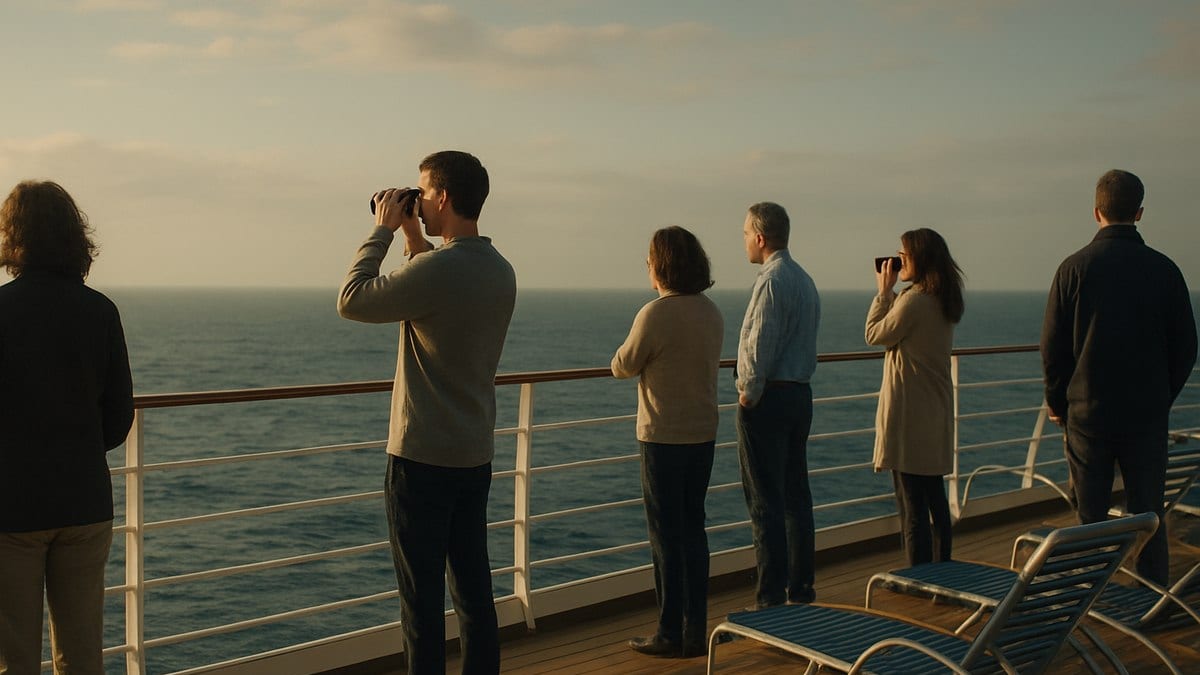
Cabin scenes that have appeared in European and Latin American media show suitcases half-packed and outdoor clothing still hanging on hooks, evidence of a trip abruptly transformed from an Antarctic and Atlantic adventure into an open-ended period of confinement. Some reports describe passengers using binoculars to scan the shoreline of Cape Verde or the passing sea birds while they await further information about their eventual return home.
Images also highlight the contrast between the ship’s original expedition character and its current role. Maps of earlier Antarctic routes remain posted on walls, and wildlife posters and brochures are visible behind passengers now focused less on spotting penguins and more on following health updates from around the world.
Medical Response Captured in Stark Detail
Some of the most striking photographs to emerge show the medical response on deck and in port. Images carried by broadcasters and news agencies depict health workers in full protective gear boarding the Hondius from small boats, as well as stretcher transfers under the bright island sun. In one widely reproduced scene, crew members in high-visibility vests assist as masked medics guide patients toward waiting ambulances in Praia.
Additional pictures show a small medical team assembled near the gangway, dressed in coveralls, gloves, masks and face shields while speaking with shipboard staff. Publicly available information indicates that several severely ill individuals, including at least two crew members, have been evacuated to shore-based hospitals for intensive care, while the body of at least one passenger was removed earlier in the voyage at a remote island stop.
Health briefings and explanatory coverage emphasize that the overall public risk from the outbreak remains low, describing hantavirus as a disease that usually spreads through contact with infected rodents or their droppings rather than casual contact between people. At the same time, the identification of the Andes strain has prompted a cautious response, given its history of occasional human-to-human transmission in close-contact settings, which a small cruise ship can easily resemble.
The visual record of the response, from hazmat suits on the pier to careful transfers into ambulances, underscores the seriousness with which local and international health services are treating the incident, even as they work to reassure the wider traveling public.
Daily Routines Reshaped as Voyage Drags On
Beyond the most dramatic scenes, many of the images now circulating capture quieter, more mundane moments of shipboard life after the outbreak was recognized. Passengers appear on open decks in small, spaced-out groups, some wrapped in jackets against the Atlantic wind, others sitting alone with books or cameras. Ocean views that once framed wildlife-watching excursions now serve mainly as a changing backdrop for days of waiting.
Travel reports describe buffet counters replaced by individually plated meals and staff serving behind improvised barriers. Photographs from dining areas show more empty tables than occupied ones, with diners seated well apart and masks set carefully beside plates. Hand sanitizer dispensers, once a routine feature on many cruise ships, have taken on new significance, prominently placed at the entrances to lounges and stairwells.
Coverage from European outlets notes that crew members face an especially drawn-out ordeal, as they continue to work and maintain the vessel while watching colleagues and guests leave in stages for medical evacuation or repatriation. Images of crew in masks, gloves and occasionally full coveralls cleaning railings and public spaces point to a heightened focus on infection control procedures throughout the ship.
For those still aboard as the Hondius moves away from Cape Verde toward the Canary Islands, daily life appears to revolve around scheduled briefings, health checks, and the slow progress of the ship on navigational screens. The tone conveyed by many of the photographs is subdued rather than chaotic, marked by fatigue, caution and an evident desire to finally set foot on land again.
Questions for Cruise Travel as Investigations Continue
News outlets in Europe, the Americas and Africa are using the Hondius incident to examine broader questions about cruise travel in an era of emerging infectious diseases. Publicly accessible analyses note that the ship had been operating in remote environments, including Antarctic waters and sparsely populated Atlantic islands, where contact with local rodent populations may have been harder to monitor than in major ports.
Images in investigative pieces juxtapose the ship’s compact interior spaces with maps of its long route from Argentina toward Cape Verde and Tenerife. Commentators highlight how the same factors that attract passengers to expedition cruising, such as close-knit groups and shared exploration of remote regions, can complicate outbreak management when a rare pathogen appears onboard.
Health agencies and scientific commentators quoted in published coverage stress that this outbreak does not represent a new pandemic threat on the scale of recent global crises, but it does illustrate how quickly a handful of severe cases can transform a leisure voyage into a complex international public health investigation. The extensive imagery from the Hondius, from its quiet decks offshore to the stark scenes of medical evacuation, is already shaping public perception of the risks associated with highly specialized cruises.
As inquiries continue into how the virus reached the ship and spread among passengers, the photographs emerging from off Cape Verde are likely to remain some of the defining images of this episode: a small expedition vessel held in place between ocean and shore, its passengers and crew caught in the uneasy space between adventure and emergency.