


Évora’s compact UNESCO-listed historic center makes it one of the most rewarding day trips from Lisbon, especially for travelers who prefer to explore independently without renting a car. With reliable rail and coach links, clear walking routes and a dense cluster of major sights, you can see Roman ruins, medieval cloisters and the famous Chapel of Bones in a single well organized day, or slow down across two or three days to taste Alentejo’s food and countryside. This guide uses current timetables and prices from late 2026 to show exactly how to plan your visit from Lisbon by train or bus.
Get the latest updates straight to your inbox!
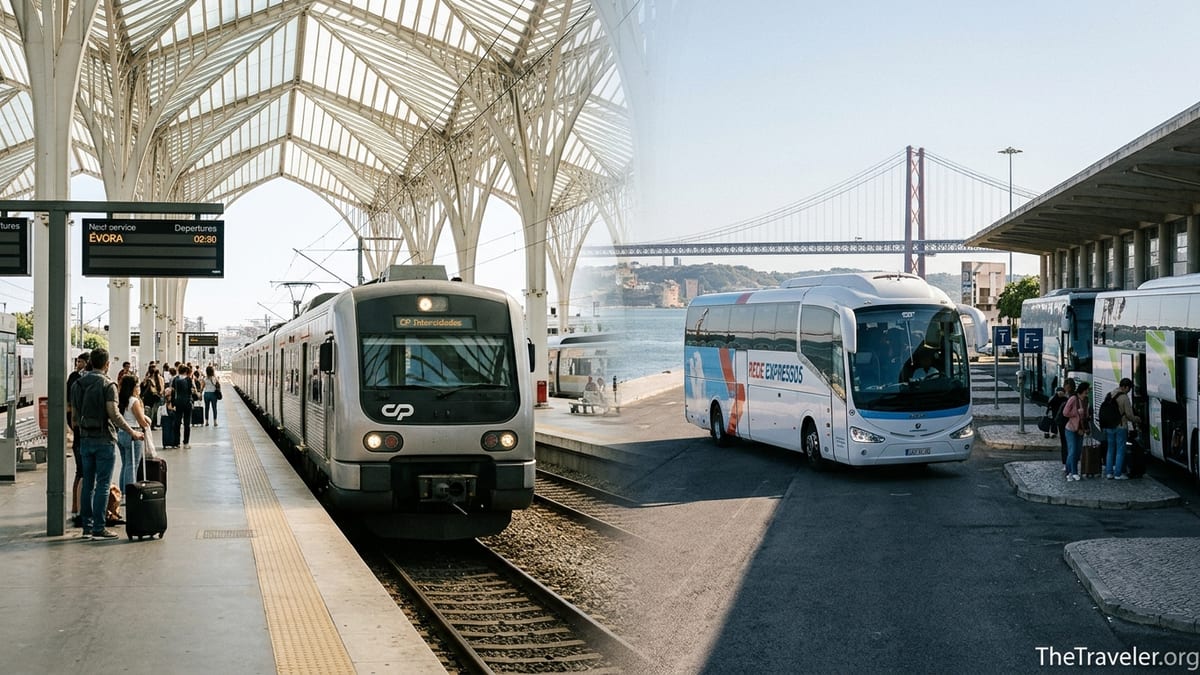
Train versus coach from Lisbon to Évora
Two public transport options link Lisbon and Évora: CP Intercidades trains on the Linha do Alentejo and long distance coaches operated mainly by Rede Expressos and FlixBus. Since 6 September 2026, the CP timetable lists Intercidades services running in around 1 hour 40 to 1 hour 45 minutes between Lisboa Oriente and Évora, with all trains requiring seat reservations in advance. Standard second class fares on this route are currently around 13.90 euros, with first class about 18.50 euros, sold as named-train tickets rather than flexible open returns. That means if you miss your booked train you normally lose the fare and must buy a new ticket, so choosing a realistic return time before planning your sightseeing is critical.
Coaches on the Lisbon to Évora corridor leave primarily from the Sete Rios terminal, with some departures at Oriente that are especially handy for travelers staying near Parque das Nações or arriving from the airport. Municipal and university information compiled in 2025 and 2026 describes Rede Expressos services as very frequent, with roughly a dozen or more journeys daily in each direction and end to end times of approximately 1 hour 30 to 1 hour 45, depending on intermediate stops and traffic. FlixBus currently advertises similar timings and one way promotional fares from around 6 euros, though typical walk up prices on either operator are often higher than the cheapest advance tariffs.
The coach advantage is density of departures and flexibility. Recent event welcome packs and training materials for conferences in Évora highlight that coaches run well into the evening, with examples listing last services from Lisbon Sete Rios to Évora around 22:30, and multiple late returns in the opposite direction. By comparison, public rail timetable summaries for 2026 note around four Intercidades trains per day on weekdays and three on weekends and holidays on the Lisbon Oriente to Évora axis. For a day tripper who wants options to leave earlier or stay for dinner spontaneously, the thicker coach timetable usually feels more forgiving.
In comfort terms, both Intercidades trains and modern long distance coaches are air conditioned and reserved seating is standard. The train offers more legroom, freedom to walk to the café car on some sets and smoother motion for those prone to motion sickness. Coaches are usually slightly faster by clock time if traffic is light, but can lose that advantage in peak hour queues leaving Lisbon or entering the outskirts of Évora. For many travelers the choice comes down to preferred departure station, sensitivity to traffic and how much they value a fixed reserved train seat over the flexibility of additional coach departures.
Understanding the 2026 CP timetable and departure stations
CP’s Alentejo line timetable that came into force on 6 September 2026 structures Intercidades trains between Lisbon and Évora around a core pattern of roughly four trains per weekday, generally including at least one early morning departure suitable for day trippers, a late morning option and a mid to late afternoon return. Journey times are typically listed between 1 hour 40 and 1 hour 45 from Lisboa Oriente to Évora, clocking around 148 kilometers with intermediate stops in the Tagus valley and at Casa Branca. Some services begin or continue beyond Évora toward Beja, but for a day trip you simply ride from your chosen Lisbon stop to Évora and back on the same Intercidades category.
Long distance services on this route call at three Lisbon urban stations: Oriente, Entrecampos and Sete Rios. Oriente is the main high speed hub in the east of the city, directly connected to the red metro line and closer to the airport and Parque das Nações hotels. Entrecampos and Sete Rios lie further west on the urban rail ring, both linked by the yellow metro line to central Baixa and by suburban trains from other districts. The ActOut University of Évora timetable for students shows typical Intercidades running between Évora and Lisboa Entrecampos in approximately 1 hour 42, mirroring CP’s published durations for Oriente with only a few minutes’ difference.
Weekend and holiday frequencies are significantly lower than weekday ones. A 2026 summary of CP’s long distance network notes explicitly that the Lisbon Oriente through Casa Branca to Évora Intercidades pattern drops from four trains on weekdays to three on weekends and public holidays. Several factors underpin this reduction: lower commuter demand on Saturdays and Sundays, continued maintenance windows on the electrified Alentejo line that are easier to schedule on quieter days, and CP’s limited fleet of long distance rolling stock, which must also cover Algarve and northern routes at busy holiday periods. The result is that a Saturday or Sunday visitor who misses a planned Intercidades might find the next one several hours later rather than the hourly pattern many travelers expect from larger European countries.
Because of that, anyone planning a rail based day trip should pick their return train before designing the sightseeing schedule. For example, you might target an evening Intercidades leaving Évora around 18:44 or 19:00 and reaching Lisboa Entrecampos or Oriente shortly after 20:20, giving you roughly eight sightseeing hours on the ground. With mandatory seat reservations and finite weekend capacity, it is prudent to book both outbound and inbound legs at least a few days ahead during spring and autumn weekends and even earlier for August. The CP smartphone app and ticket machines at Oriente, Entrecampos and Sete Rios all show real time seat maps and clearly mark Intercidades trains bound for Évora.
Arriving in Évora and station logistics
Évora’s rail station stands on the western edge of the modern city, outside the medieval walls but within realistic walking distance of the UNESCO listed center. Municipal visitor information describes the walk from platform to Praça do Giraldo as about 20 minutes at a normal pace, covering roughly 1.5 kilometers along level but partly cobbled streets. You exit the station building, follow Avenida Dr Francisco Barahona then Avenida General Humberto Delgado, and finally pass through the city gate to reach the heart of the old town. For travelers with wheeled luggage or mobility concerns, taxis and app based rides usually wait outside the station, and the short hop into the center should cost only a modest amount given the distance.
The coach terminal sits closer to the historic core, just outside the western walls near the junction of major city avenues. The municipal website notes that long distance buses including Rede Expressos and FlixBus services arrive here, from where it is roughly a 10 minute walk along mostly flat pavements to Praça do Giraldo. That shorter walk and slightly more central drop off can be attractive for travelers with heavier bags, older visitors and families. It also means that if you stay overnight, some hotels and guesthouses on the western flank of the walled town are easily reached on foot in under 10 minutes from the coach terminal.
In practice, the difference between the 10 minute coach walk and the 20 minute station walk matters most in summer heat and for visitors with mobility limitations. In July and August, afternoon temperatures in the Alentejo often climb above 35 degrees Celsius, so a shaded 10 minute stroll from the bus is noticeably easier than a 20 minute one along exposed avenues. Outside those peak months, both approaches are manageable for anyone comfortable with urban walking. There is no free shuttle between the station and the walls, but local taxis are accustomed to short transfers and their presence reduces concern about the extra distance if you arrive or depart in the heat of the day.
For orientation, it helps to picture Évora’s historic center as a compact hilltop ellipse, about one kilometer from west to east, with Praça do Giraldo at its commercial heart. From the bus station you tend to pass through the western gate and climb gently toward the square. From the train station you approach from the southwest, first meeting the outer ring road and then entering near the aqueduct. In both cases, clear brown tourist signs lead to the main monuments, and within five minutes of entering the walls you will find cafés and small groceries where you can buy water or a quick snack before beginning your walking tour.
Walking itinerary through Évora’s UNESCO center
A realistic first visit can link Praça do Giraldo, Évora Cathedral, the Roman Temple, the Church of São Francisco and its Chapel of Bones, plus a short wander through the centuries old university streets. Starting at Praça do Giraldo around mid morning lets you see the square before the hottest part of the day. The arcaded Praça hosts banks, cafés and the tourist office, and its central fountain makes a helpful landmark for navigation. Plan for 15 to 20 minutes here to orient yourself, grab a coffee and pick up a free city map if you prefer paper to smartphone navigation.
From Praça do Giraldo it is a five minute uphill walk along narrow shopping streets to the Sé de Évora, the fortified medieval cathedral that dominates the skyline. Official cathedral information dated October 2026 lists separate admission to the main church, the cloister and the rooftop panoramic terrace, with combined tickets currently priced in the high single digits in euros. Opening hours vary slightly by season, but generally run from mid morning to late afternoon with last admission around half an hour before closing, and the complex closes on 25 December and 1 January and partially on the afternoon of 24 December. Photography without flash is usually permitted in the nave and cloister, though staff may ask visitors to avoid tripods or large equipment. Allow 45 minutes for a basic visit, or up to 75 minutes if you climb to the roof for views across the tiled roofs and olive dotted countryside.
Two minutes’ walk from the cathedral lies the Roman Temple of Évora, often called the Temple of Diana although its true dedication is uncertain. The temple stands in a small landscaped square beside the former archbishop’s palace. There is no admission fee because visitors remain outside the fenced podium and colonnade, but interpretive panels explain the site’s first century origins and later history as a medieval butcher’s market. Plan 20 to 30 minutes to photograph the columns, appreciate the surrounding viewpoints and perhaps pause in the nearby public garden that overlooks the aqueduct. The open air nature of the site means it can be visited at any time of day, although low morning or late afternoon light flatters the granite and marble more than harsh midday sun.
To reach the Church of São Francisco and the Chapel of Bones, you descend from the Roman Temple back toward Praça do Giraldo and continue a further five to seven minutes south along Rua da República. The municipal and parish websites describe the main church as open every day except 1 January, Easter Sunday and part of 24 and 25 December, with free entry to the nave. The adjoining visitor complex that includes the Capela dos Ossos and small museums charges a combined ticket, with recent guides and price tables putting standard adult admission in the mid single digits in euros, with discounts for children, seniors and families. Typical opening hours run from morning to late afternoon with a short lunch closure in low season applied mainly to the museum areas. As the chapel is compact but popular, you should expect queues at peak tour times around late morning; allow at least 45 minutes from ticket purchase to exit, including time to read the interpretive displays and pass through the small exhibitions.
Opening hours, reservations and seasonal considerations
Most central Évora attractions do not require timed reservations for individual travelers, which makes independent day trips straightforward. You buy your ticket for the cathedral, Chapel of Bones or other sites on arrival at their respective ticket offices. However, capacity limits can create informal queues at busy moments, especially in the Chapel of Bones where only a limited number of visitors can stand inside the small ossuary chamber at once. For this reason, travelers visiting on summer weekends often plan to see the chapel either soon after opening or later in the afternoon, when tour groups have moved on to lunch or departed.
Official opening hours are subject to occasional seasonal adjustment and liturgical events. The cathedral complex notes closures on the afternoon of 24 December, all day on 25 December and on 1 January, and may also restrict access during major diocesan ceremonies. The Church of São Francisco website explains that the church itself remains free to enter during most daytime hours but that the paid museum and chapel areas are distinct spaces with their own timetable. On some winter weekdays, those museum rooms close for an hour or so around lunchtime, a habit that can catch out tightly scheduled day trippers. To avoid disappointment, aim to concentrate paid indoor visits between about 10:00 and 12:30 or 14:00 and 16:30, leaving early evening for outdoor strolling and relaxed cafés.
Photography rules differ slightly by site. The cathedral generally allows non flash photos for personal use in the cloister and rooftop, while expecting greater discretion inside the main nave during services. The Chapel of Bones permits photography but asks visitors to behave quietly and respectfully in line with its contemplation theme, and some displays in the adjoining museum may prohibit photos entirely to protect artworks. There are no permits required for photographing the Roman Temple, university facades or general street scenes in the historic center, but flying drones is tightly regulated and normally prohibited within the city core.
The greatest practical constraint on a day trip is summer heat. Climatic norms for the Alentejo region show average July and August afternoon maxima well above 30 degrees Celsius, with occasional spikes over 40. Stone pavements and whitewashed walls reflect light strongly, making midday walks tiring and potentially risky for visitors with heart or respiratory conditions. Sensible strategies include planning indoor visits during the hottest hours, carrying at least one liter of water per person, wearing a hat and sunblock and prioritizing shaded streets when walking between monuments. From late October through April, rainfall is more common but usually arrives as showers rather than all day downpours, and cooler temperatures make the uphill lanes more pleasant for longer strolls.
Eating in Évora and Alentejo food highlights
Évora’s historic center offers generous opportunities to sample Alentejo cuisine between sightseeing stops. Near Praça do Giraldo and along Rua 5 de Outubro and Rua dos Mercadores you will find traditional restaurants serving dishes such as migas de espargos with pork, ensopado de borrego lamb stew and açorda alentejana bread soup perfumed with garlic and coriander. In 2026 menus in family run taverns often list main courses from around 10 to 16 euros, with house wine by the glass between 2 and 4 euros, making a hearty lunch with dessert and coffee cost in the 18 to 25 euro range per person for those choosing mid priced options.
For lighter meals or shorter visits, cafés surrounding Praça do Giraldo serve tostas mistas grilled sandwiches, salads and daily specials from roughly 6 to 10 euros, along with local pastries like queijadas de Évora and almond based sweets inspired by convent recipes. A daytime visitor who prefers to maximize museum time can comfortably fit a 45 minute lunch break near the square between morning and early afternoon sightseeing, or pick up takeaway snacks from bakeries on the walk between the cathedral and the Roman Temple. Many cafés remain open throughout the afternoon without a pronounced lunch closure, which helps on Sundays when some formal dining rooms close between lunch and dinner service.
Wine is central to the Alentejo identity, and numerous restaurants in Évora pour local reds and whites from surrounding estates by the glass or carafe. A couple sharing a modest bottle with lunch can expect to pay perhaps 10 to 18 euros extra depending on the label. For teetotal travelers or those visiting in summer heat, non alcoholic options range from homemade lemonade and herbal teas to Portuguese soft drinks like Sumol and Água Castelo. Tap water is safe to drink and most eateries will provide a jar on request, though in busy periods staff may understandably prioritize paid bottled orders.
Travelers with very limited time might opt for a simple espresso and pastry on arrival, followed by a main meal in mid afternoon after seeing the Chapel of Bones and cathedral. This compressed pattern works particularly well if you have prebooked a mid evening train or bus back to Lisbon and prefer to eat your bigger meal in Évora rather than waiting until you return to the capital. On the other hand, overnight guests can treat themselves to a more leisurely dinner, when cooler temperatures and illuminated monuments lend the streets a distinctly romantic atmosphere.
Sample day trip and multi day itineraries
A practical rail based day trip for autumn 2026 could start with an early Intercidades from Lisboa Oriente or Entrecampos departing around 7:00 to 8:00 and arriving in Évora around 8:45 to 9:45. After the 20 minute walk or short taxi ride into the center, you would reach Praça do Giraldo by roughly 9:15 to 10:15. Spend your morning at the cathedral and rooftop terrace, then visit the Roman Temple and enjoy a relaxed coffee nearby. Break for lunch about 13:00 close to the square, allowing an hour for a set menu and coffee. In mid afternoon visit the Church of São Francisco complex and the Chapel of Bones, aiming to enter by around 15:00 so that you finish comfortably before last admissions. That leaves an hour or two for wandering the university streets and small shops before walking back to the station for an evening Intercidades between about 18:30 and 19:00, returning you to Lisbon by around 20:15 to 20:45.
A coach based day trip offers even more flexibility. You might leave Lisbon Sete Rios on a mid morning Rede Expressos or FlixBus departure around 8:30 or 9:00, arriving at the Évora bus terminal around 10:00. The 10 minute walk into the center lets you start with the Chapel of Bones first, then loop to the cathedral and Roman Temple after lunch. Because late evening coaches back to Lisbon often leave well after 20:00, you could stay for an early dinner in Évora and catch a 21:00 or even 22:00 service, arriving back in Lisbon close to midnight. This longer day delivers about ten hours in town and suits visitors who enjoy twilight photography and a slower lunch, with the trade off of a later bedtime.
For a relaxed two day overnight stay, you might arrive by late morning train or bus on day one, check into a guesthouse near Praça do Giraldo and spend the afternoon visiting the cathedral, rooftop and Roman Temple before an unhurried dinner. On day two, devote your morning to the Church of São Francisco complex and then explore quieter corners of the historic center, such as the medieval university cloisters and the aqueduct arches integrated into later houses. With no pressing return timetable, you can retreat to your hotel during the hottest hours and head back out in the evening for a stroll under the illuminated city walls.
An optional third day can introduce a countryside excursion, but only where public transport or organized tours make it feasible without a car. Examples occasionally promoted by local tourism offices and tour agencies include guided minivan trips to nearby vineyards for tastings, or to villages such as Monsaraz overlooking the Alqueva reservoir. Some of these tours depart from central Évora hotels and run on fixed schedules, making them accessible to visitors who prefer not to drive. Another possibility is a bus ride to smaller towns on regional lines, though frequencies are low and timetables must be checked locally. Anyone building a three day itinerary should verify excursion availability several weeks in advance and avoid planning tight connections with last evening trains or buses back to Lisbon.
Accommodation, budgets and practical challenges
Accommodation near Praça do Giraldo ranges from restored historic hotels to guesthouses tucked into former merchants’ houses. Staying within a five minute walk of the square means you can step out early to enjoy the cathedral before day trippers arrive and easily return to your room during midday heat. For this prime central location in late 2026, double rooms in mid range properties often price in the 80 to 140 euro per night range, with simpler pensões and hostels offering private rooms below that level and occasional promotional rates in the quieter winter months. These central streets are lively until late evening, especially during festivals, so light sleepers may want to check recent guest reviews for comments on noise before booking.
Quieter alternatives lie on residential lanes a little further from the square or near the edges of the walled town toward the railway station. Guesthouses on these streets may back onto gardens or the aqueduct, creating a more tranquil atmosphere while still keeping you within a 10 to 15 minute walk of most monuments. Hotels near the railway station itself cater more to drivers and business travelers, but they can suit visitors arriving by train who prioritize an easy check in before strolling into the center. Nightlife is limited compared with Lisbon, so even near the bus station noise usually dies down by midnight outside major events.
Budget calculations for 2026 suggest that a solo traveler using Intercidades trains and focusing on key paid attractions can expect a full day trip to cost somewhere in the 60 to 100 euro range. This ballpark includes around 30 to 40 euros for return train fares depending on class and booking, roughly 10 to 20 euros for combined tickets to the cathedral complex and Chapel of Bones, and 20 to 30 euros for meals and coffees if choosing mid range restaurants. A couple sharing similar experiences would therefore spend around 120 to 180 euros in total for the day. Switching from train to coach can reduce transport costs significantly, particularly if advance promotional fares closer to 6 to 10 euros each way are available, bringing the lower end of those ranges down accordingly.
For overnight stays, add at least 60 to 120 euros per night for accommodation depending on property type and season, plus another 20 to 40 euros per person per day for additional meals and snacks. Travelers on tighter budgets can self cater breakfasts from supermarket bakeries, opt for set lunch menus and light evening snacks, and limit paid sights to just one or two key monuments. Accessibility wise, note that many old streets are cobbled and uneven, with modest gradients that can challenge those with mobility impairments. Some churches and museums lack full step free access to upper galleries or rooftop terraces. During major religious festivals or university events, crowds in the narrow lanes grow thicker and hotel rates can spike, so anyone sensitive to noise or congestion should aim for shoulder seasons and check local event calendars.
Final verdict: train or bus for Évora day trips
Choosing between train and coach for an independent Évora day trip turns on how you balance comfort, flexibility and sightseeing hours. The Intercidades train from Lisboa Oriente, Entrecampos or Sete Rios delivers a smooth 1 hour 40 minute ride across the Alentejo plains with guaranteed seating and generous legroom, well suited to travelers who dislike road traffic and value the ability to read or work at a table. Yet weekend frequencies remain limited to roughly three departures in each direction, seat reservations are mandatory and the 20 minute walk from Évora station to the historic core slightly lengthens door to door time.
Rede Expressos and FlixBus coaches win on sheer number of services, later evening departures and a bus terminal closer to the walled town. For visitors who want the option to stay for an unplanned sunset drink in the square and still catch a late evening vehicle back to Lisbon, coaches offer a reassuring safety net. The shorter 10 minute walk into the center and competitive fares, sometimes far below train prices when booked in advance, also tilt the equation in favor of the bus for value oriented travelers.
In terms of net sightseeing hours, a typical early morning train out and early evening train back yields about seven to eight usable hours in Évora, while the densest coach timetables can be stretched to nine or ten hours if you choose very early outbound and late return departures. However, many travelers prefer to avoid arriving or leaving in the dark, and when you account for breakfast and evening rest, the practical usable hours converge. For most independent visitors in late 2026, the coach emerges as the default choice for a spontaneous single day excursion, with the train a very attractive alternative for those who prefer rail travel’s comfort and are willing to preplan their timetable carefully.
Whichever option you choose, Évora rewards the effort with a walkable UNESCO center, a dramatic cathedral rooftop, the haunting Chapel of Bones and gastronomy that lingers in the memory long after your return to Lisbon. With a sensible schedule, attention to summer heat and realistic expectations about walking distances and opening hours, an independent day trip or short stay here can become a highlight of any Alentejo journey.