


More news on this day
India has widened its travel advisory for the Middle East as Bahrain joins Israel, Qatar, the United Arab Emirates, Jordan, Lebanon, Saudi Arabia and other regional states grappling with airspace shutdowns, conflict-related disruptions and heightened security risks, prompting New Delhi to promise visa relief and consular support for stranded travelers.
Get the latest news straight to your inbox!
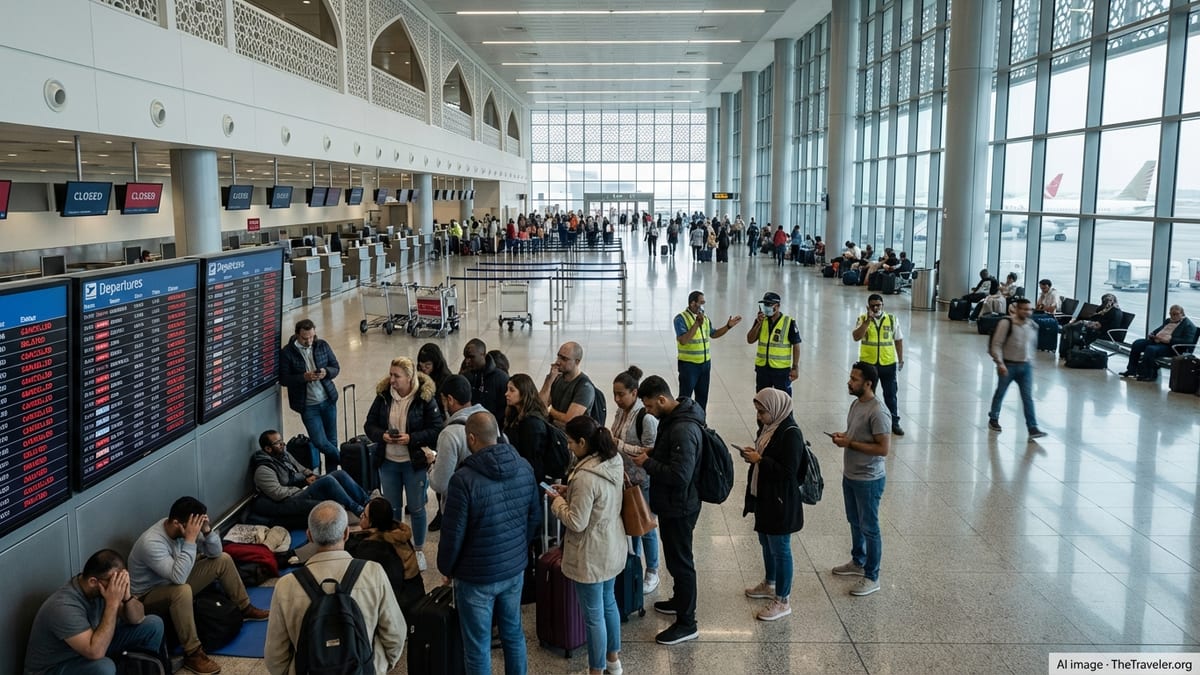
Airspace Closures Envelop Key Middle East Gateways
Publicly available aviation bulletins and risk assessments show that civil airspace across much of the Gulf and wider Middle East remains heavily restricted after a wave of missile and drone incidents involving Iran, Israel, the United States and regional actors earlier in 2026. Updated conflict zone information and European safety notices advise airlines to avoid or severely limit operations in the flight information regions covering Bahrain, Israel, Jordan, Kuwait, Lebanon, Qatar, the United Arab Emirates and large portions of Saudi Arabia and Iran.
Industry trackers indicate that Bahrain, long a critical node for east west connections, has aligned with its neighbors in enforcing full or partial airspace shutdowns. Flight disruption summaries compiled by risk consultancies and shipping agents describe Bahrain’s airspace as effectively closed to routine commercial operations, with carriers forced to suspend services, reroute via longer corridors over safer territory, or consolidate limited capacity through alternative hubs.
The impact is visible from Dubai and Abu Dhabi to Doha, Manama, Riyadh and Tel Aviv, where airport operations have oscillated between total suspensions and reduced schedules. Reports from airline operations centers describe rolling cancellations, missed connections and extensive backlogs as carriers attempt to rebuild timetables without access to traditional Gulf overflight paths that link India and wider Asia with Europe and North America.
Travel forums, aviation advisories and port status updates also highlight a pattern of temporary reopenings followed by sudden shutdowns when air defense alerts are triggered, making it difficult for passengers and airlines to rely on previously confirmed itineraries. Even when some high altitude corridors remain technically open over parts of Saudi Arabia and Oman, strict risk thresholds and congestion limits have sharply reduced usable capacity for long haul flights.
India’s Escalating Travel Guidance For West Asia
Against this volatile backdrop, India’s Ministry of External Affairs and aviation regulator have progressively expanded travel guidance for West Asia through a series of March and April 2026 notices. Coverage in Indian media outlines advisories that urge citizens to avoid non essential journeys to and through numerous Middle Eastern states, with particular emphasis on conflict affected airspaces that have experienced closures or missile alerts.
A Directorate General of Civil Aviation advisory issued in March identified nine airspaces of concern for Indian carriers, naming Bahrain, Iran, Iraq, Israel, Jordan, Kuwait, Lebanon, Qatar and the United Arab Emirates. The document, as reported in national outlets, calls on airlines to undertake stringent risk assessments, avoid certain flight levels and, where necessary, suspend or reroute services in line with evolving safety notices from international regulators.
For ordinary travelers, these technical restrictions translate into grounded flights, enforced stopovers and complex detours. Indian carriers have already cut or thinned services across several Middle East routes, including links to major hubs that traditionally serve as transit points between South Asia, Europe and the Americas. In some cases, journeys that once required a single connection now demand two or three stops through alternative corridors in Central Asia, Africa or Southeast Asia.
New Delhi’s public advisories stress that passengers should track airline notifications closely, maintain flexible itineraries and avoid non essential travel into high risk zones while the regional security situation remains unpredictable. Travel risk specialists note that the language of these advisories has hardened over recent weeks in step with the deepening airspace crisis, reflecting a wider international trend of caution toward Middle East overflights.
Visa Extensions And Consular Support For Stranded Visitors
As disruptions intensified, Indian authorities moved to reassure foreign tourists and other non residents currently in India who are unable to depart because their itineraries relied on affected Middle Eastern hubs. A March 2026 advisory, summarized by immigration and travel compliance outlets, explains that such travelers can seek emergency extensions of their Indian visas if outbound flights have been cancelled or rendered impossible by regional airspace closures.
Public information from India’s Ministry of External Affairs and Foreigners Regional Registration Offices indicates that impacted visitors are being directed to use the e FRRO platform or contact local registration offices to regularize their status. Reports describe a framework in which qualifying travelers can obtain short term extensions or exit permits without incurring overstay penalties, provided they document cancelled tickets, closed routes or other evidence that departure through the Middle East is not currently feasible.
Media coverage notes that India has framed these measures as a temporary relief mechanism, designed to prevent tourists and business visitors from falling out of legal status while airlines and governments work to reopen safe corridors. International immigration briefings similarly document how other states are adjusting visa rules and consular workflows to cope with a wave of stranded passengers across the region, as embassies in the Gulf and Levant scale back routine services to focus on emergency cases.
While these steps cannot undo the financial and logistical strain on travelers, they are intended to provide a degree of legal certainty at a time when itineraries are being rewritten with little warning. Analysts in the travel risk sector suggest that clear guidance on visa validity and exit permissions has become just as important as traditional safety messaging when airspace disruptions are prolonged.
Bahrain’s Role In A Region Wide Crisis
Bahrain’s inclusion in India’s expanded advisory reflects the island kingdom’s position at the heart of the Gulf aviation network. Prior to the latest conflict spike, its airspace and airports formed part of a dense web of routes linking India to Saudi Arabia, the United Arab Emirates, Qatar and beyond. With Bahrain now categorized by multiple governments and aviation bodies as part of a heightened risk zone, those connections have been severely curtailed.
Open source immigration and security trackers compiled by global consultancies state that Bahrain’s airspace remains either closed or subject to significant restrictions, alongside similar closures in Qatar, Israel and sections of Saudi Arabia and Kuwait. Shipping and port advisories describe knock on effects for crew changes, cargo movements and shore leave, further complicating the situation for travelers and workers who rely on regional hubs for onward journeys.
Regional travel updates also reference Indian nationals and other foreign citizens stranded in Bahrain due to cancelled services, with travelers seeking overland options via Saudi Arabia or limited repatriation flights routed through alternative airports. These accounts underscore how a relatively small state can become a bottleneck when surrounding airspaces are either shut or operating with strict safety constraints.
For India, which maintains extensive economic and diaspora ties with Bahrain and its neighbors, the evolving status of Manama’s airspace carries particular weight. Advisories urging vigilance and route reassessment are therefore framed not only around headline destinations such as Israel and the United Arab Emirates but also around secondary hubs that are integral to multi segment itineraries used by Indian citizens and inbound tourists alike.
What Travelers Should Expect In The Coming Weeks
Risk assessments produced by international aviation and security bodies suggest that the Middle East airspace situation is unlikely to normalize quickly, even if periods of calm return between incidents. Conflict zone bulletins issued in early 2026 have already been extended several times, and operators are being told to treat much of the region as a high risk area for civil aviation until further notice.
For travelers whose routes depend on Bahrain, Israel, Qatar, the United Arab Emirates, Jordan, Lebanon or Saudi Arabia, this means that sudden cancellations, diversions and overnight delays may remain common. Travel information services advise passengers to factor in longer journey times, maintain flexible booking conditions and ensure that both medical and travel insurance explicitly cover disruptions linked to armed conflict or airspace closure.
India’s decision to pair strong warnings with visa flexibilities and consular support highlights the dual nature of current travel risks in the Middle East. On one hand, there is the immediate physical danger associated with flying through or into conflict affected skies; on the other, there are secondary challenges such as expired visas, missed connections and limited access to consular services in states where embassies have scaled back operations.
Observers in the global travel and aviation sectors note that while individual announcements by India and other governments may evolve in response to day by day developments, the underlying message for anyone planning itineraries through the region remains constant: reassess routing through Middle Eastern hubs, stay closely aligned with official advisories, and be prepared for extended stays if airspace closures persist or widen.