


More news on this day
Hundreds of passengers traveling between India and the Gulf are facing last-minute cancellations and long airport waits as Indian carriers pare back services on key routes to Dubai, Abu Dhabi and other Middle Eastern hubs, with more than 40 flights scrubbed in the latest wave of disruption.
Get the latest news straight to your inbox!
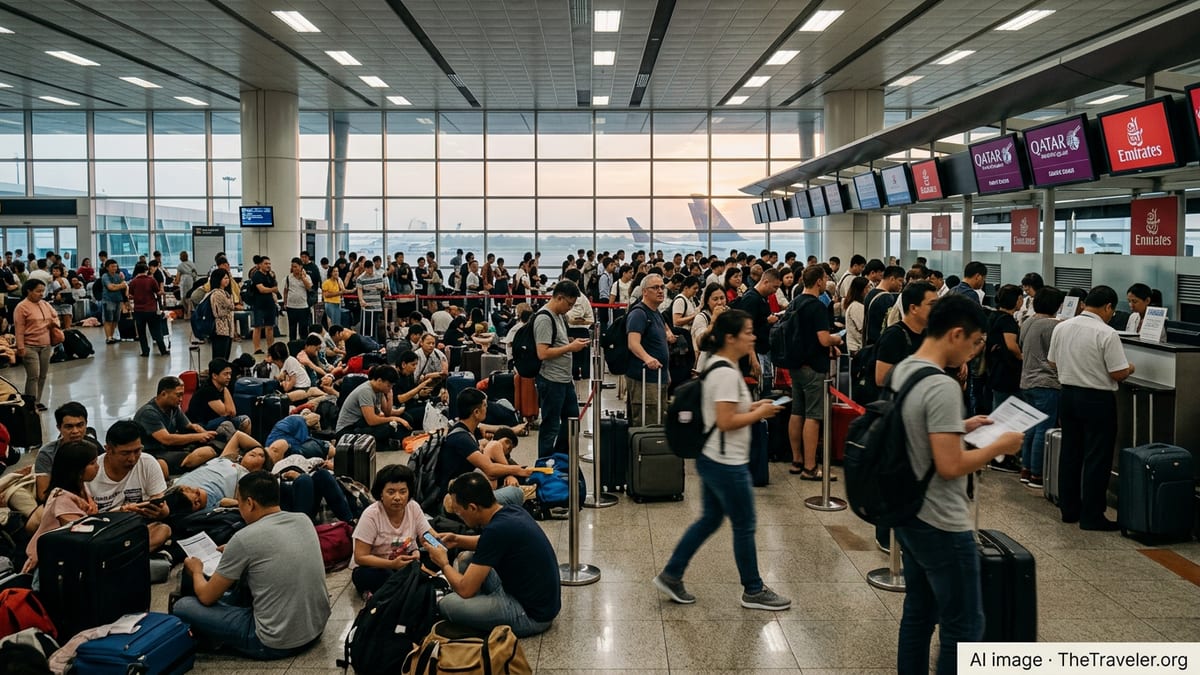
Fresh Cancellations Hit India–Gulf Corridors
Publicly available schedules and travel advisories show that multiple Indian airlines, including Air India, Air India Express, Go First’s residual charter operations and newer carrier Akasa Air, have scaled back or canceled services touching Gulf gateways such as Dubai International, Abu Dhabi’s Zayed International and Riyadh’s King Khalid International. The latest adjustments are concentrated on high-demand city pairs linking Hyderabad, Delhi, Mumbai, Bengaluru and Ahmedabad with major Middle Eastern hubs.
Recent coverage of flight operations from Indian metros indicates that more than 40 services across several days have been withdrawn or consolidated on India–UAE and wider Middle East routes. These cuts come on top of earlier suspensions and diversions introduced after repeated airspace closures and security alerts around the Gulf, which have periodically forced airlines to reroute or ground aircraft.
While some carriers continue to operate limited schedules, travelers report a pattern of rolling cancellations, particularly on evening and overnight departures to Dubai and Abu Dhabi that rely on tight onward connections to Europe, North America and Africa. The result is a patchwork of flight options that changes from day to day, complicating plans for work trips, family visits and religious travel.
Route data from online booking platforms suggests that certain trunk routes, such as Hyderabad–Dubai and Delhi–Dubai, are still operating but with fewer frequencies than originally scheduled for late May. In several cases, ad hoc extra services have been removed from sale or canceled outright, reducing the capacity available at short notice for stranded passengers.
Why Flights Are Being Pulled Back
Reports from aviation analysts and industry briefings attribute the turbulence primarily to regional security conditions and temporary airspace restrictions over parts of the Gulf. A series of missile and drone incidents since early 2026 prompted short-notice closures and capacity limits at key hubs, including Dubai and Abu Dhabi, which in turn constrained the number of arrivals and departures that airlines could operate each day.
Operational digests tracking the crisis describe how Gulf airports have been working at significantly reduced throughput compared with normal traffic levels, even after formal airspace reopenings. This has left carriers juggling scarce slots, reallocating aircraft and prioritizing routes that feed into their own long-haul networks. Indian airlines without large hub operations in the Gulf have appeared more exposed to last-minute schedule cuts as they adjust to changing slot availability and ground-handling constraints.
In parallel, some Indian carriers continue to manage their own fleet and crew limitations following an extended period of high demand and elevated jet-fuel prices. Analysts note that a combination of stretched resources and volatile operating conditions in the Middle East has made point-to-point India–Gulf services particularly vulnerable to cancellation whenever disruptions cascade through the system.
Airlines have publicly framed many of the latest cancellations as temporary and operational in nature rather than permanent route withdrawals. However, passenger experiences at Indian airports suggest that the short-notice nature of these decisions, often within 24 hours of departure, is amplifying the sense of uncertainty around travel to and through the Gulf.
Airports and Routes Most Affected
Available flight-status snapshots from Indian departure boards show repeated disruption on routes from Hyderabad, Delhi, Mumbai, Bengaluru and Ahmedabad to Dubai, Abu Dhabi and other Gulf points. Passengers traveling from secondary cities via these hubs, such as Kochi, Chennai or Kolkata, also report missed onward connections after Gulf-bound legs were canceled or substantially delayed.
Hyderabad’s Rajiv Gandhi International, a growing origin point for Gulf traffic, has seen intermittent cancellations and consolidations on services to Dubai and Abu Dhabi, according to live tracking platforms. Similar patterns are visible at Delhi and Mumbai, where evening waves of Gulf-bound flights have been thinned out, with some departures removed and others operating at altered times.
On the Gulf side, Dubai International and Abu Dhabi Zayed International remain the most heavily affected by regional security dynamics and subsequent schedule reshuffles. Industry roundups describe days when dozens of flights to and from the wider UAE were canceled or delayed, including services operated by Indian carriers that rely on these airports as key transit gateways for onward long-haul itineraries.
Reports also point to knock-on effects on routes touching Riyadh’s King Khalid International and other Gulf airports used as alternates or secondary hubs. As airlines adjust routings to work around constrained airspace, some India–Saudi Arabia services have been retimed or withdrawn, further tightening options for passengers whose journeys depend on regional connections.
Passenger Experience: Isolation, Queues and Limited Options
Travel forums and social media posts from affected passengers describe scenes of crowded check-in halls in Indian metros as travelers discover cancellations only after arriving at the airport. Some report being offered rebookings several days later or routed via less direct paths, extending what are typically short India–Gulf hops into prolonged, multi-stop journeys.
Stranded passengers connecting onward from Dubai or Abu Dhabi to Europe and North America report particular difficulties. When the initial India–Gulf leg is canceled, alternative itineraries often require seats on already busy flights or re-routing via other hubs, such as Doha or Istanbul, where capacity is also under pressure. For travelers on short business trips or tightly scheduled family visits, the loss of even one outbound or inbound flight can effectively derail the entire plan.
Accounts shared online suggest that accommodation and meal support vary widely between airlines and ticket types. While some travelers receive hotel stays and transfer assistance after missed connections in the Gulf, others recount long overnight waits in terminal seating areas while competing for limited rebooking options on later flights.
The disruption is also affecting onward domestic travel within India. Passengers returning from the Gulf into metropolitan gateways and planning to connect to smaller Indian cities are reporting missed domestic legs and additional expenses for last-minute rebookings when international arrivals land hours or days later than planned.
What Travelers Should Do Now
Given the continuing volatility, aviation advisories and consumer-travel guides are urging passengers bound for Dubai, Abu Dhabi and other Gulf hubs to monitor their bookings closely in the days and hours before departure. Travelers are being encouraged to use airline apps or official flight-status tools rather than relying solely on third-party booking portals or static itinerary emails.
Experts recommend building extra buffer time into itineraries that rely on Gulf hubs as transit points, especially for long-haul trips onward to Europe or North America. Where possible, travelers with nonrefundable hotel or tour bookings are being advised to consider flexible air tickets or routes that offer alternative connection options if a specific India–Gulf leg is canceled.
Publicly available airline notices indicate that many carriers are offering fee-free date changes or full refunds on affected routes during the current period of disruption. Passengers whose flights have not yet been canceled but who are uneasy about the evolving situation may wish to review the fare rules on their tickets and check whether voluntary changes are permitted without penalty.
With regional security conditions still in flux, industry observers expect further short-notice adjustments to Middle East schedules in the coming days. For now, travelers departing from Indian gateways such as Hyderabad, Delhi, Mumbai, Bengaluru and Ahmedabad are being cautioned that services to Dubai, Abu Dhabi, King Khalid and other Gulf airports may remain less predictable than usual, and that proactive planning and real-time monitoring are essential to avoid being left isolated mid-journey.