


More news on this day
Indian Railways is moving ahead with a plan to add two extra tracks along roughly 11,000 kilometres of its most heavily used corridors, a capacity expansion on seven high-density routes that carry an outsized share of the country’s passenger and freight traffic, according to recent media reports and publicly available planning documents.
Get the latest news straight to your inbox!
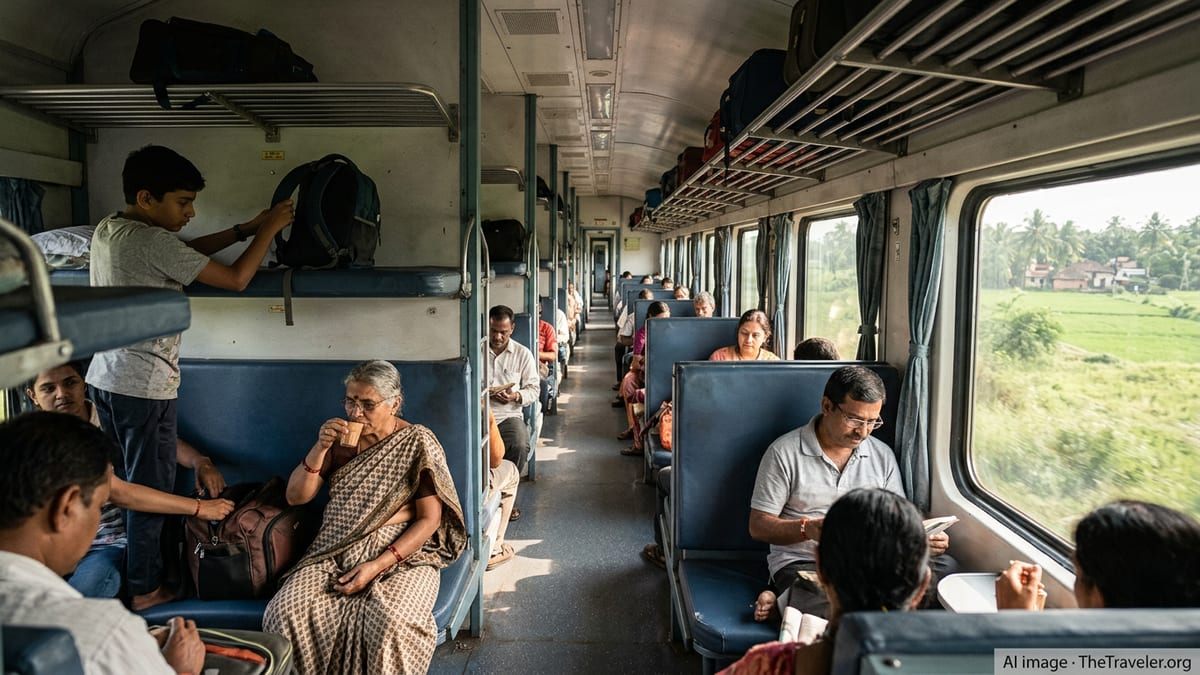
Seven High-Density Corridors Targeted for Quadruple Tracking
Recent coverage of the multitracking programme indicates that seven trunk routes, together stretching about 11,000 kilometres, have been identified for four-track expansion. These corridors link major metropolitan centres including Delhi, Mumbai, Chennai, Howrah (Kolkata), and key junctions in the north and east, forming the spine of India’s rail traffic. Reports suggest that three of the highlighted routes converge on Chennai, connecting the southern hub with Howrah, Mumbai and Delhi.
Publicly available information on the high-density network shows that these main lines were already prioritised for double and triple tracking, electrification and signalling upgrades under previous investment cycles. The new four-track plan effectively moves them into the next tier of capacity enhancement, aligning with long-term policies that seek to separate fast passenger services and heavy freight flows wherever feasible.
Though specific phasing details are still emerging, multiple outlets describe the initiative as part of a broader effort to modernise corridors that are already at or near saturation during peak hours. Current traffic patterns and government data indicate that comparable high-density and heavily used networks together carry the overwhelming majority of rail movement in India, even while occupying a relatively small share of route length.
Definitions used in international rail practice describe a four-track or quadruple-track railway as a line with four parallel tracks, typically allowing two tracks for each direction. This configuration is generally reserved for the busiest corridors, where mixed traffic and growing demand make additional paths essential for reliable operations.
11,000 km Carry Around 41 Percent of Rail Traffic
Published analyses of the plan highlight that the seven corridors identified for four-tracking handle around 41 percent of total Indian Railways traffic, despite making up only about 16 percent of the national network by length. This imbalance underscores how much of the system’s demand is concentrated on a relatively small number of arterial routes.
Background material on the high-density network describes it as a critical subset of the broader grid, connecting the four metropolitan vertices of the so-called golden quadrilateral and associated diagonals. These lines already underpin a large share of both passenger and freight flows, linking industrial belts, ports, and populous urban regions that generate heavy commuting and long-distance demand.
The planned four-track build-out is expected to complement dedicated freight corridors and other capacity projects under the Pradhan Mantri Gati Shakti framework, which has sanctioned thousands of kilometres of new lines, conversions and doublings in recent years. Together, these measures are intended to relieve bottlenecks where passenger and freight trains currently compete for limited paths, leading to delays and slower average speeds.
Analysts tracking the programme note that the high-density corridors are also being targeted for signalling enhancements and automatic train protection systems, reflecting a strategy that combines physical capacity, higher speeds and safety improvements on the same stretches of track.
Capacity, Speed and Reliability Gains for Passengers and Freight
Four-tracking high-density routes is expected to unlock several operational advantages. International experience and technical literature on quadruple-track railways indicate that two additional tracks can substantially increase the number of trains that can be run each day while also allowing for more differentiated service patterns.
On India’s busiest main lines, this could translate into separate paths for fast and slow passenger services, as well as more predictable time slots for heavy freight trains. With more paths available, planners can redesign timetables to reduce conflicts at junctions, cut dwell times, and improve on-time performance, especially in sections where current headways are tight.
Reports linked to the programme suggest that some upgraded corridors are being prepared for higher permissible speeds, in line with earlier decisions to raise design and operating speeds on select routes to around 160 kilometres per hour. That objective relies not only on additional tracks but also on stronger track structures, improved curves and gradients, and modern signalling systems capable of safely managing denser traffic.
Freight operators stand to benefit from a more fluid network that can accommodate longer, heavier trains with fewer unscheduled halts. This aligns with the policy push to shift more bulk cargo from road to rail, which is regarded as essential for reducing logistics costs and cutting emissions from long-haul transport.
Integration with Kavach and Advanced Signalling
The four-track expansion is emerging alongside a separate but connected push to deploy advanced signalling and train protection technologies on the same high-density routes. Government releases and subsequent reporting point to the rollout of Kavach, India’s indigenous automatic train protection system, on key corridors including the Delhi–Mumbai and Delhi–Howrah routes, both of which fall within the high-density category.
Earlier official updates on Kavach described commissioning across more than a thousand route kilometres, with plans to extend coverage to several tens of thousands of kilometres over time. Recent accounts indicate that newer versions of the system are being prioritised on trunk lines where train densities and speed targets are highest, reflecting the safety requirements of operating larger numbers of services in close succession.
In parallel, Indian Railways has been expanding the use of automatic block signalling and centralised traffic control on busy sections, technologies that allow closer train spacing while maintaining safety margins. These systems are particularly important on four-track corridors, where complex interactions between fast, slow and freight trains make real-time control and monitoring essential.
Observers of these developments describe the combination of quadruple tracking and digital signalling as a step toward a more metro-style operating philosophy on long-distance corridors, with higher throughput, shorter intervals between trains and more consistent journey times for passengers.
Timeline, Investment and Wider Network Strategy
While detailed completion timelines for the 11,000 kilometre four-track programme have not yet been consolidated in a single public document, the initiative aligns with multi-year capital plans that already include extensive new line, doubling and gauge conversion projects. Data released under the PM Gati Shakti National Master Plan show that hundreds of rail projects covering many thousands of route kilometres have been sanctioned in recent financial years.
Media coverage of the four-track push portrays it as one of the most ambitious capacity-building efforts yet attempted on the conventional rail network, complementing ongoing work on dedicated freight corridors and new semi-high-speed passenger services. The scale of investment required is expected to be substantial, spanning civil works, bridges, signalling, station remodelling and integration with urban transport in major cities.
Planning documents and expert commentary link these works to broader economic objectives, including lowering logistics costs, improving port connectivity and supporting manufacturing clusters located along the identified corridors. By targeting the busiest routes first, policymakers aim to secure the greatest network-wide impact from each kilometre of expansion.
At the same time, the four-track plan remains one element within a layered strategy that also covers electrification, station upgrades, rolling stock renewal and last-mile connectivity. The performance of the 11,000 kilometre high-density network is expected to play a significant role in determining how quickly India’s rail sector can absorb rising demand and shift additional passenger and freight traffic away from congested highways and short-haul aviation.
Indian Railways plans four-laning of 11,000-km high-density network
Indian Railways to quadruple capacity on 11,000 km routes
Indian Railways to four-lane 11,000-km high-density network to raise capacity
Government press information on high-density routes and Kavach rollout