


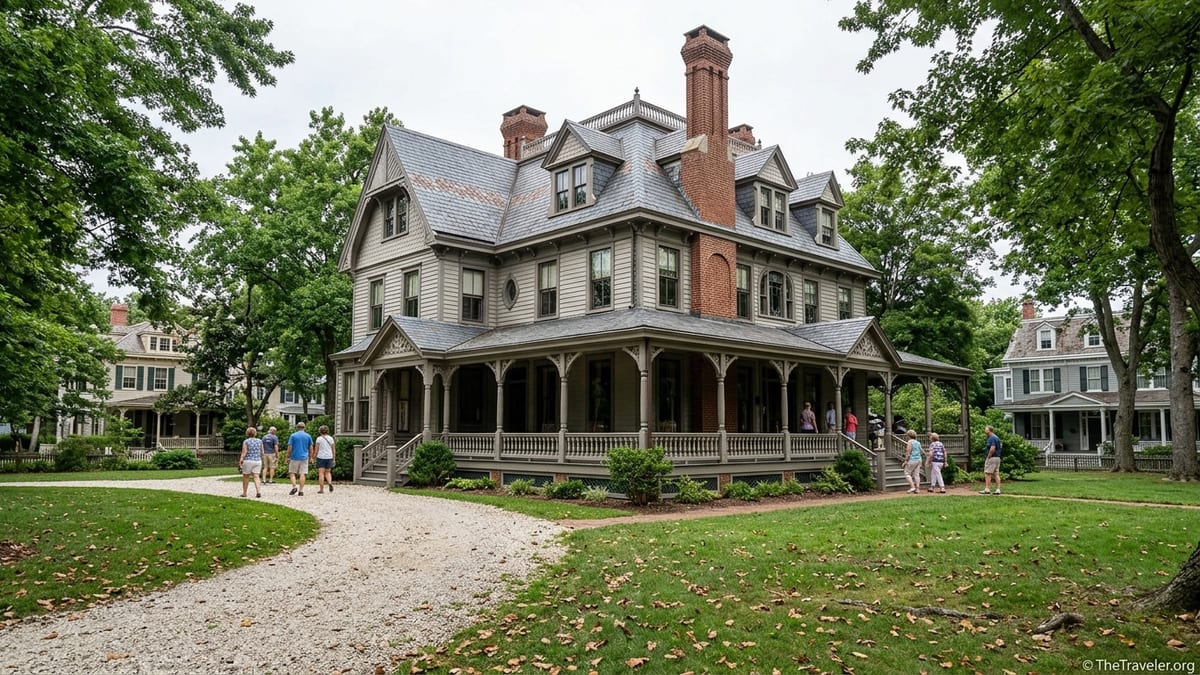
From the sidewalk on Washington Street, the Emlen Physick Estate looks like a picture-perfect Victorian mansion, all gables, chimneys, and wraparound porch. It is easy to admire it as just another of Cape May’s “painted ladies.” Step through the front door, though, and the mood shifts. Behind the ornate woodwork and patterned wallpapers are stories of privilege, isolation, eccentric medicine, and modern-day ghost hunters that are far more dramatic than you might expect from a quiet seaside town.
Get the latest updates straight to your inbox!
A Strange Victorian Doctor Who Never Really Practiced
The story of the estate begins with its namesake, Dr. Emlen Physick Jr., born in 1855 into one of Philadelphia’s prominent medical families. On paper, he followed the expected path: he studied medicine, completed his degree, and was positioned to become another accomplished city physician. Yet the man who built one of Cape May’s grandest homes never developed a typical medical career. According to accounts shared on tours today, Physick was wealthy enough through inheritance that he simply did not need to work in the way his peers did. He earned the title “doctor,” then quietly walked away from traditional practice.
That choice gives the mansion an odd undertone. Visitors standing in the front parlor hear that the house was designed to impress patients, yet almost none ever came. Instead, Physick lived as a gentleman of leisure, spending much of his time on the grounds with his beloved dogs while staff handled the day-to-day work of the property. In a town known for salt air and summer crowds, he carved out a life that was both privileged and strangely secluded inside an 18-room mansion.
Today, guides at the house museum still gesture toward the details that speak to this tension. The scale of the rooms, the size of the dining table, and the arrangement of the entrance hall all suggest a social, professional household. But when you hear that the resident doctor never really welcomed patients and rarely hosted the kind of large gatherings his home was built for, the house starts to feel more like a stage set for a role he never fully played.
Family Ties, Eccentricities, and a Household of Strong Women
If Emlen Physick was the estate’s quiet center, the dramatic energy came from the women around him. The mansion was built in 1879 not only for Emlen, but also for his widowed mother Frances Ralston and his maiden aunt Emilie. Another aunt, Isabella, is part of the broader family story told on site. Visitors quickly discover that this was not a traditional nuclear family but a tight, sometimes tense constellation of strong personalities under one roof.
Docent-led tours describe Frances as a demanding matriarch, determined to protect the family’s reputation and manage the household with strict expectations. Emilie, by contrast, appears in stories as more eccentric and headstrong. Contemporary accounts mention that some family decisions could be abrupt or extreme, and modern interpreters suggest that personalities in the house did not always blend easily. For a traveler listening in the dim hallway as a guide points out family portraits, those nuances help transform posed photographs into people whose habits shaped every room.
One of the most unsettling anecdotes shared by some visitors involves a relative who was reportedly confined to a room for years due to her mental health, reflecting Victorian-era attitudes toward women and illness. While staff today speak cautiously about the details, the mere suggestion that a family member might have spent three years effectively locked away adds a jolting layer of human drama. It complicates the comfortable image of lace curtains and decorative china with a reminder that even wealthy households could hide painful secrets behind closed doors.
Frank Furness Architecture and Rooms That Feel Like a Stage Set
The building itself amplifies this sense of drama. The Emlen Physick Estate was designed by prominent Philadelphia architect Frank Furness, whose work was known for oversized features and bold, sometimes eccentric details. The mansion is one of the country’s best surviving examples of Victorian Stick style, and when you stand outside and look up, the effect is slightly theatrical. The chimneys are unusually large, the dormers on the roof are sharply hooded, and the porch bristles with strong vertical and diagonal lines.
Inside, tours of the first and second floors guide visitors through parlors, a formal dining room, bedrooms, and service spaces that have been restored with period-appropriate furnishings. Many pieces are original to the Physick family. The carved newel post at the base of the main staircase, patterned floor tiles in the entry, and ornate light fixtures all contribute to the feeling that you are walking into an elaborate stage set left almost intact. Guides often remind guests that when the house sat empty decades ago, much of this interior character could easily have been lost.
The museum uses changing exhibits to connect the house to wider Victorian themes. One season you might find the dining room interpreted around etiquette and elaborate multi-course dinners, complete with replica menus and descriptions of what it felt like to host summer visitors from Philadelphia. Another year, the focus may shift to domestic work “below stairs,” illuminating the lives of cooks, maids, and coachmen whose stories rarely appear in family portraits. Travelers who visited the estate, for example, in 2019 and then returned in 2025 have noted how different the experience can feel depending on the specific exhibit, even though the rooms themselves have not changed.
From Neglected Mansion to Cape May’s Only Victorian House Museum
After Aunt Emilie died in 1935, the estate passed to various owners. Over time, the once-vibrant property declined, and by the late 1960s the mansion stood largely empty and deteriorating. What might surprise modern visitors is how close Cape May came to losing this landmark entirely. Local preservationists describe how, at the time, demolition and redevelopment along the Jersey Shore often seemed more attractive than restoring aging wooden houses battered by salt air and storms.
In 1970, a group of concerned citizens rallied to save the building, forming what is now Cape May MAC, a nonprofit dedicated to local history, arts, and culture. They succeeded in persuading the city to acquire the estate in 1973. MAC then leased the property, gradually restoring the interiors and outbuildings. Archival photographs on display in the Carriage House show the house with peeling paint, boarded-up windows, and overgrown grounds, offering a stark contrast to the manicured lawns and fresh colors visitors see today.
The result of that rescue is what you walk through now: Cape May’s only fully preserved Victorian house museum. Year-round tours interpret not just the Physick family’s life but also the wider story of how Cape May reinvented itself as a heritage tourism destination rather than a town of fading seaside hotels. When you pay an adult admission fee, you are not just stepping into a nicely furnished old home; you are supporting ongoing preservation work that includes roof repairs, climate control for fragile textiles, and new research into the lives of the people who lived and worked here.
Ghost Dogs, Shadowy Figures, and the Mansion’s Haunted Reputation
For many travelers, the most dramatic stories associated with the Emlen Physick Estate begin after dark. Cape May has built a strong reputation as one of America’s most haunted small towns, and the mansion is often singled out on walking tours as the city’s most famous haunted house. Evening trolley routes routinely point out the estate while guides describe unexplained footsteps, lights that flicker back on after being switched off, and the feeling of being watched from upper-story windows.
Some stories are specific. Guests on ghost tours have reported seeing a woman in Victorian dress on the second-floor landing, only to find the space empty when they climb the stairs. Others describe hearing a dog padding along the upstairs hallway or scratching at a door, even though no animals are present in the house. On certain tours, guides explain that Emlen Physick was devoted to his dogs and that a loyal pet may still be making rounds of its favorite territory. The detail can sound almost whimsical, until you are standing in a quiet corridor and hear an unexplained sound behind you.
Paranormal-themed events at the estate now regularly draw visitors who may be less interested in Victorian table settings than in electromagnetic-field meters and spirit boxes. Some programs, often offered seasonally, invite guests to join investigators in dim rooms where lights are turned low and questions are addressed to any spirits that might be present. The museum staff tend to present these experiences carefully, balancing an interest in unusual occurrences with a commitment to historical accuracy and respect for the people who once lived here. Whether you believe in ghosts or not, hearing a modern interpreter describe their own unexplained experiences inside a house filled with 19th-century belongings adds an undeniable chill to the visit.
Touring the Estate Today: What Visitors Actually Experience
For contemporary travelers, visiting the Emlen Physick Estate is as much about atmosphere as it is about facts. Standard guided tours, which typically last under an hour, lead you through the main public and family rooms on the first and second floors. Docents point out original furniture, explain the purpose of unusual architectural details, and share anecdotes about the Physick family’s habits. You might stand in the dining room and hear how many courses would have been served on a summer evening, then move into a bedroom where someone explains the complicated undergarments a Victorian woman wore to bed.
Beyond the mansion, the four-acre grounds include the Carriage House, which houses ticketing, a small gallery, and a museum shop. Exhibits in the gallery change periodically, ranging from displays about Cape May’s transformation from a modest resort to a fashionable retreat, to photo-based shows on local storms and shipwrecks. In warmer months, the on-site café offers lunches and teas, turning a history stop into an easy half-day excursion where you can pair a house tour with a relaxed meal under the shade of the estate’s trees.
Many visitors combine a daytime history tour with one of Cape May MAC’s themed evening programs. You might hear about the family’s routines on a morning visit, then return after sunset aboard a trolley for a “historic haunts” combination tour that includes time inside the darkened house. Standing in the same hallway twice in a single day, once sunlit and once lit only by low interior lamps, drives home how much the mood of the estate shifts with the light. It is this flexibility, and the way the setting supports both serious history and spooky storytelling, that keeps the estate near the top of many travelers’ Cape May itineraries.
Planning Your Visit: Practical Tips for Curious Travelers
Because the Emlen Physick Estate is operated as an active museum, schedules and pricing change from season to season, especially around major holidays and special events. In high summer, daily tours are common, while in shoulder seasons you may find a more limited roster of guided visits, specialty programs, and combination tickets that include other Cape May attractions. It is wise to check the latest listings shortly before your trip and to reserve seats in advance for popular evening trolleys or ghost-themed experiences, which can sell out on busy weekends.
Travelers often pair a stop at the estate with other nearby sites in the historic district. The walk from the beachfront hotels near Congress Hall to the mansion takes roughly 15 to 20 minutes at a casual pace, passing shaded residential streets lined with brightly painted houses. For families, this makes it easy to thread a house tour between beach time and dinner on the Washington Street Mall. Some visitors drive and park near the estate, then use the house as a starting point for exploring backyard lanes and lesser-known residential blocks they might otherwise miss.
Inside, the museum is generally manageable for older children who can handle a guided tour and a few rules about not touching fragile objects. Ghost-themed events vary in intensity, with some designed to be family friendly and others created primarily for adults who want a more atmospheric experience. Asking staff which offerings are best suited to your group’s comfort level can help ensure that a sensitive child does not end up more frightened than fascinated. Comfortable shoes, a light sweater for air-conditioned rooms, and a willingness to climb a few staircases will make the visit more enjoyable.
The Takeaway
What lingers after a visit to the Emlen Physick Estate is not just an appreciation for ornate Victorian architecture, but a sense of how complicated lives can be behind an elegant facade. This was the home of a trained doctor who did not practice, a family guided by strong-minded women, and a household that, like many of its era, likely kept uncomfortable truths out of public view. It narrowly escaped demolition, only to become one of Cape May’s most carefully interpreted historic sites and one of its most enduring sources of ghost stories.
For travelers, the estate offers layers of experience in a single stop: a lesson in 19th-century design, a window into Gilded Age privilege and constraint, and a brush with a haunted reputation that has grown over decades of whispered tales. Whether you arrive with a passion for architectural details, an interest in medical history, or a curiosity about the paranormal, you will find more drama in this quiet corner of Washington Street than its polished exterior suggests. Stepping back out into the salt air of Cape May, it is hard not to glance up at the dark windows and wonder what stories the house is still keeping to itself.
FAQ
Q1. Where is the Emlen Physick Estate located in Cape May?
The estate sits on Washington Street in Cape May’s historic district, a short walk or drive inland from the beachfront hotels and shops.
Q2. What makes the Emlen Physick Estate architecturally unique?
It is one of the country’s best surviving examples of Victorian Stick style, designed by architect Frank Furness with oversized chimneys, bold gables, and elaborate porch brackets.
Q3. Can you tour the inside of the mansion?
Yes. Guided tours of the first and second floors are regularly offered, with docents leading visitors through furnished rooms and sharing stories about the Physick family.
Q4. Is the Emlen Physick Estate really haunted?
The estate has a strong haunted reputation, with visitors and staff reporting unexplained sounds, sightings, and sensations, though experiences vary and are open to personal interpretation.
Q5. Are there ghost tours specifically focused on the mansion?
Several evening programs and combination tours include time at the estate, often pairing trolley rides past haunted sites with guided walks through dimly lit rooms.
Q6. How long should I plan to spend at the Emlen Physick Estate?
A standard house tour usually takes under an hour, but many visitors stay longer to explore the grounds, visit the Carriage House gallery, or enjoy the on-site café.
Q7. Is the estate suitable for children and families?
Daytime history tours are generally family friendly for school-age children, while some ghost-themed events are better suited to older kids, teens, and adults.
Q8. Do I need to buy tickets in advance?
Advance tickets are strongly recommended during busy seasons and for popular evening or specialty tours, as capacity is limited and certain time slots can sell out.
Q9. What else can I see nearby when visiting the estate?
Many travelers pair a stop at the mansion with strolls through the surrounding historic streets, as well as visits to Cape May’s lighthouse, beaches, and downtown shops.
Q10. Why is the Emlen Physick Estate important to Cape May’s history?
It is the city’s only fully preserved Victorian house museum, rescued from neglect and restored to tell the intertwined stories of the Physick family and Cape May’s evolution as a resort.