


Walk a few blocks back from Cape May’s famously photogenic beachfront and you step into a different kind of showcase: the 1879 Emlen Physick Estate, a sprawling Victorian Stick Style mansion that feels like it was lifted intact from the era of gaslight and horse-drawn carriages. More than just a pretty house, this four-acre property helped save Cape May’s historic character, anchors its cultural life today, and offers one of the most vivid windows into how this resort town reinvented itself through heritage rather than high-rises.
Get the latest updates straight to your inbox!
A Rare Example of Victorian Stick Style Architecture
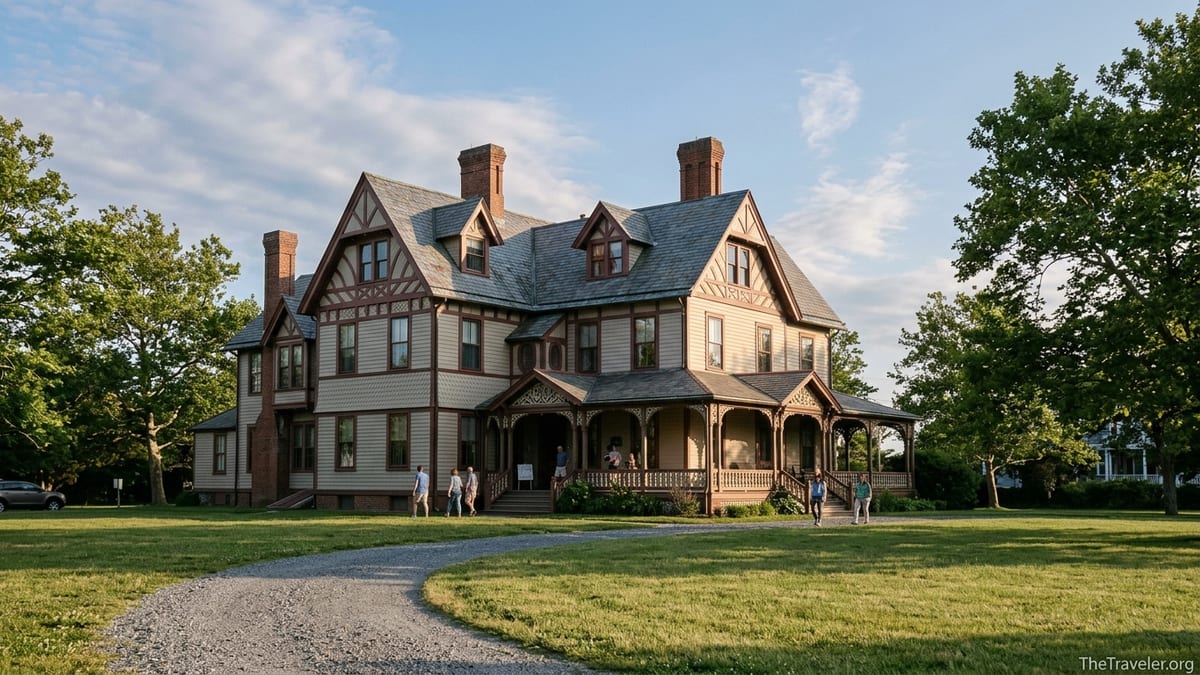
At first glance, the Emlen Physick Estate looks unlike most seashore “cottages” that line Cape May’s streets. Designed in 1879 and attributed to Philadelphia architect Frank Furness, the 18-room mansion is a textbook example of Victorian Stick Style, a relatively rare branch of Victorian architecture that emphasized visible “sticks” and cross-bracing on exterior walls. While you can find Queen Anne and Italianate houses all over Cape May, the strong geometric lines, oversized chimneys, and bold gables of the Physick house make it stand out even within a town famous for ornate homes.
On a guided tour, you see this style up close: diagonal and vertical wood trim that seems to draw the structural frame right onto the exterior, sharply pitched roofs, and asymmetrical massing that pulls your eye from the three-story main block to the attached kitchen wing and porches. Visitors often compare the look to a Victorian gingerbread house with a hint of industrial bravado. Architecture buffs who have toured Furness buildings in Philadelphia immediately recognize his love of heavy brackets, tall chimneys, and unexpected proportions, all of which appear here in residential form.
For travelers, this makes the Physick Estate one of the most photogenic spots in the historic district that is not on the beachfront itself. Its broad lawn allows you to step back far enough to capture the entire façade in a single frame, unlike many of the tightly packed guesthouses downtown. If you are used to snapping pastel bed-and-breakfasts along Jackson Street, the Physick house’s muscular lines and darker trim offer a refreshing architectural contrast and show off just how diverse Cape May’s Victorian streetscapes really are.
The estate’s significance has been recognized beyond local tourism brochures. New Jersey’s historic preservation agencies cite it as an outstanding example of Stick Style architecture, and it regularly appears in lists of notable buildings in the state. Home design sites have even singled it out as one of New Jersey’s most beautiful buildings, putting a single Cape May house museum in the same conversation as landmark courthouses and university halls elsewhere in the state.
Cape May’s Only Victorian House Museum
Despite Cape May’s dense concentration of ornate homes, the Physick Estate holds a distinction no other property can claim: it is the town’s only true Victorian house museum. Where most of the “painted ladies” you see from a trolley or on a walking tour now operate as inns, restaurants, or private homes, the Physick mansion has been carefully restored and furnished to interpret life for one prominent family from the late 1800s into the early 1900s.
Inside, guided tours lead you through both the public and private spaces of the house. You might begin in the formal parlor with period-appropriate furniture, then move into the dining room laid as if for a special evening meal. Further in, bedrooms, servant work areas, and circulation spaces reveal the invisible labor that made upper-middle-class leisure possible. Instead of generic antiques, the rooms are outfitted with objects that reflect the actual social world of the Physicks: Eastlake furniture styles, decorative arts that echoed trends from Philadelphia and New York, and household technologies that felt modern in the 1880s.
The museum team refreshes the interpretive theme each year, so a repeat visitor in 2026 encounters “The World on Display: The Centennial and Everyday Life,” a tour that connects the family’s material world with the 1876 Centennial Exposition held in Philadelphia. Guides explain how inventions and consumer goods showcased at that world’s fair trickled into homes like the Physicks’ over the following decade. That kind of storytelling helps travelers understand the house not as a frozen artifact but as part of a rapidly modernizing America, where gas lighting, improved stoves, and new decorative fashions steadily reshaped daily routines.
Unlike many small museums that are open only on summer weekends, the Physick Estate typically offers tours much of the year, with schedules ramping up in the spring, peaking in July and August, then continuing with themed events into the fall and holiday season. For visitors planning a short trip, the reliability of being able to tour the house on a random weekday in May or a crisp Saturday in October makes it a dependable anchor around which to build the rest of a Cape May itinerary.
The Estate That Helped Save Cape May’s Historic Character
It is hard to imagine today, when property values in Cape May are high and historic charm is considered the town’s signature asset, but by the mid-20th century the Emlen Physick Estate had fallen into serious disrepair. After the Physick family line in Cape May came to an end, the house sat vacant for years. Photographs from the 1960s show broken windows, graffiti, and overgrown grounds. Development pressure and a lack of funds for restoration meant that demolition became a very real possibility.
In 1970, a group of local citizens formed what is now known as Cape May MAC, an arts and heritage nonprofit, specifically to prevent the loss of the estate. Within a few years, the City of Cape May acquired the property and leased it to the organization, which then undertook the painstaking work of stabilizing the structure, restoring key interiors, and bringing the four-acre grounds back to life. Today, visitors walking through the bright, coherent rooms may struggle to picture just how close this landmark came to being replaced by parking or condominiums.
The rescue of the Physick Estate turned out to be a turning point for the entire town. With a tangible success story to point to, preservation advocates were better able to argue for the broader protection of Cape May’s 19th-century streetscape. In 1976, the Cape May Historic District was designated a National Historic Landmark district, recognizing roughly 600 buildings across about 380 acres. The restored Physick mansion became a showcase for why keeping historic structures made sense not only culturally but economically, as visitors increasingly came to Cape May specifically to experience its Victorian atmosphere.
For today’s traveler, this history matters because it explains why Cape May feels so different from many other Mid-Atlantic beach destinations. Where some resorts are dominated by high-rise hotels and generic boardwalks, Cape May offers blocks of intact 19th-century architecture, from Congress Hall near the oceanfront to tucked-away cottages inland. The Physick Estate, saved from the wrecking ball, is a big reason the town chose the path of heritage tourism over large-scale redevelopment. When you pay for a house tour ticket, you are in a very direct sense supporting the preservation philosophy that shapes the entire resort.
A Cultural Hub for Tours, Festivals, and Seasonal Events
Beyond its role as a museum, the Physick Estate functions as one of Cape May’s most versatile cultural venues. The expansive lawn and outbuildings host events that appeal well beyond traditional history buffs. On a September weekend, you might find hundreds of people sampling local craft beer and food trucks during the Harvest Brew Fest held on the grounds, with live music echoing off the Stick Style façade as families spread blankets under the trees.
During the holiday season, the estate often becomes a centerpiece of Cape May’s Victorian Christmas offerings. Candlelight house tour trolleys make the Physick mansion one of their key stops, and inside, rooms are decorated with period-inspired greenery, tabletop trees, and traditional ornaments. Visitors who come just for the holiday lights often remark that walking into the house feels like stepping onto a film set of a late 19th-century Christmas gathering, complete with the glow of lamps and the scent of pine.
For families, the estate’s programming is an easy way to slip educational content into fun activities. Story stops on the grounds offer short audio snippets that children can listen to while wandering between buildings, explaining everything from the work that happened in the Carriage House to the lives of domestic staff in Hill House. Seasonal scavenger hunts and pop-up theater experiences staged on the property introduce younger visitors to Victorian customs without the feeling of sitting through a lecture.
Even practical travelers appreciate the estate’s role as a hub. Free on-site parking, including space that can accommodate RVs, makes it a convenient starting point for exploring the inland side of the historic district. Combination tickets bundle house tours with narrated trolley rides through town, allowing visitors with only a half-day to spare to experience both the interior of a landmark home and the broader streetscape that surrounds it.
Interpreting Everyday Victorian Life, Upstairs and Downstairs
Many people arrive at the Physick Estate expecting grand rooms and ornate decoration, and they certainly find those. What often surprises them is how much of the interpretation focuses on everyday routines and the perspectives of people beyond the homeowners themselves. Earlier tours highlighted an “Upstairs Downstairs” theme inspired by the British television series, using it to explore the strict social hierarchies and invisible work that sustained households like the Physicks’.
In practice, that means visitors hear not only about Dr. Physick and his mother, Frances Ralston, but also about the maids, coachmen, and cooks whose names do not appear on the deed yet whose labor made the household run. Walking from the formal dining room to the service spaces, you can see how servants were expected to move discreetly through back staircases and narrow hallways, while the family and their guests circulated through wide corridors and well-lit parlors.
The estate’s curators use tangible objects to ground these stories. A heavy cast-iron stove in the kitchen speaks to the heat and physical effort required to produce multi-course meals. Laundry equipment illustrates the time-consuming process of maintaining the elaborate clothing on display in the bedrooms. Exhibit labels and guide commentary connect these details to broader Victorian ideals about gender, class, and domestic order, helping visitors understand that the polished rooms upstairs were built on countless hours of labor below.
For modern travelers who may be used to boutique hotels that emulate Victorian aesthetics without context, this interpretive approach is eye-opening. It encourages visitors to see the rest of Cape May’s pretty porches and turrets with a more critical eye, imagining who cleaned those fretwork details or climbed the stairs to light gas lamps each evening. In that sense, the Physick Estate deepens your experience of the entire town, giving you social and human context for all the painted trim you admire on your evening walks.
From Haunted House to Pop Culture Icon
Locals and repeat visitors like to joke that the Physick Estate is Cape May’s “original haunted house,” and the site has leaned into that reputation with a variety of ghost-themed tours and evening programs. Historic Haunts tours, for example, blend architectural history with stories of unexplained footsteps, phantom perfumes, and reported apparitions associated with the Physick family. Even skeptics who do not believe in ghosts often find these tours a memorable way to see the house after dark, when gaslight-style fixtures and long shadows dramatically change the mood of the interiors.
The house’s distinctive presence has also attracted the attention of filmmakers and television producers. In the early 1980s it served as a key location for a slasher film, and more recently it has appeared on paranormal investigation shows, which devote entire episodes to exploring alleged supernatural activity on the property. While these pop culture moments only represent a fraction of the estate’s history, they have introduced the mansion to audiences who might never have heard of Cape May otherwise.
For visitors, this pop culture status adds another layer to the experience. A horror fan might arrive eager to stand on the front porch where a favorite movie scene was filmed, then leave with a new appreciation for Frank Furness’s architecture. A family staying in town for a week might book a ghost trolley tour that culminates in a walk through dimly lit parlors, with children alternating between nervous giggles and wide-eyed questions about Victorian mourning customs.
The haunted reputation also helps sustain evening programming that diversifies Cape May’s nightlife beyond bars and restaurants. On a summer weeknight, you can see groups gathering at the Physick Estate as the sun sets, tickets in hand for a combined trolley-and-house ghost tour. For travelers who prefer history to happy hour, it is one more reason this particular landmark stands out from the many other photogenic structures in town.
A Gateway to the Wider Cape May Historic District
Though it sits a bit inland from the beachfront, the Physick Estate acts as a gateway into the Cape May Historic District both geographically and thematically. Many trolley and walking tours either start or stop on its grounds, using the house as a springboard to discuss how fire, storms, and changing tourism trends reshaped the town over time. From the steps of the mansion, guides can literally point out how the grid of streets extends toward the ocean, framing rows of Victorian and early 20th-century homes that now fall within the National Historic Landmark district.
Because Cape May MAC also operates the Cape May Lighthouse and the World War II Lookout Tower, staff at the Physick Estate are well placed to help visitors choose how to spend limited time. A traveler with only one full day might be steered toward a morning lighthouse climb, an afternoon house tour at the estate, and a sunset trolley ride through the historic district, all on a single multi-site ticket. In that sense, the mansion is not just a stand-alone attraction but a linchpin in a coordinated heritage network that stretches from the beach to the back streets.
The estate’s outbuildings reinforce this role. The Carriage House now contains a gallery and museum shop, where changing exhibits highlight topics ranging from Victorian fashion to local maritime history. A tearoom offers lunches in season, giving visitors a chance to sit and reflect on the house tour over tea sandwiches or a slice of cake, without having to rush back to the crowded restaurant scene near the beachfront. Such amenities make it easier to treat the estate as a half-day experience rather than a quick in-and-out stop.
When you leave the grounds and walk back toward Washington Street or Columbia Avenue, you can immediately apply what you have learned. Suddenly the brackets and bays on bed-and-breakfasts make more sense, and the layering of later additions on some homes becomes easier to spot. The Physick Estate thus serves as both classroom and starting point for exploring one of the most intact 19th-century resort districts in the United States.
The Takeaway
For a relatively small town, Cape May boasts an impressive number of architectural showpieces, but none carries as much interpretive and symbolic weight as the Emlen Physick Estate. Architecturally, it showcases a bold Stick Style mansion designed by one of the Victorian era’s most distinctive American architects. Historically, it is the property whose near-demolition and subsequent rescue helped crystallize a preservation ethic that now defines the town.
As a visitor experience, the estate delivers something you cannot get from simply walking past rows of pretty porches: a deeply contextualized look at how one family, their staff, and their surroundings navigated the transformations of the late 19th and early 20th centuries. Through rotating tour themes, seasonal events, ghost stories, and thoughtful interpretation of everyday life, the house keeps revealing new layers to first-time and repeat guests alike.
If you are planning a trip to Cape May, it is tempting to focus only on ocean views, seafood dinners, and sunset cruises. Yet setting aside a few hours for the Physick Estate can change how you see everything else. Once you have walked its halls and heard its stories, the town’s painted trim and gingerbread scrollwork stop being just quaint decoration and become part of a much richer narrative about how a seaside resort reinvented itself through its past.
FAQ
Q1. What makes the Emlen Physick Estate so important in Cape May?
The estate is Cape May’s only Victorian house museum, a rare example of Stick Style architecture, and a key catalyst in the town’s historic preservation movement.
Q2. When was the Emlen Physick Estate built?
The house was constructed in 1879, during the peak of the Victorian resort era, and it reflects design ideas circulating in nearby Philadelphia at the time.
Q3. Who designed the Emlen Physick Estate?
The mansion is attributed to architect Frank Furness, known for his bold, highly individual Victorian buildings, although no original signed plans have survived.
Q4. How long does a typical visit to the estate take?
Most visitors spend about 60 to 90 minutes on a guided house tour, and another 30 to 60 minutes exploring the grounds, Carriage House exhibits, and museum shop.
Q5. Is the Emlen Physick Estate suitable for children?
Yes. Story stops on the grounds, scavenger-style activities, and seasonal events help keep younger visitors engaged while still conveying meaningful history.
Q6. Can visitors combine a house tour with other Cape May attractions?
Combination tickets frequently bundle the Physick Estate with trolley tours or visits to sites like the Cape May Lighthouse and the World War II Lookout Tower.
Q7. Is the house accessible for visitors with mobility challenges?
The first floor of the Physick House Museum is typically accessible, and staff can advise on current access details for tours and facilities before you book.
Q8. Are there special events held at the estate?
Yes. The grounds host festivals such as the Harvest Brew Fest, holiday candlelight programs, themed tours, and occasional theater and ghost tour experiences.
Q9. Why is the estate often called Cape May’s “original haunted house”?
Longstanding stories of apparitions and unexplained events, along with ghost-themed evening tours and TV features, have cemented its haunted reputation.
Q10. Do I need to reserve tickets in advance?
Advance reservations are strongly recommended in peak summer and around major events, while off-season visitors may find same-day tickets more readily available.