


Florence offers endless ways to meet the Renaissance, from the crowds under Botticelli’s Primavera in the Uffizi to the queues for Brunelleschi’s dome. Yet for many travelers, the moment the era finally feels tangible comes not in a major museum, but in a small, perfectly proportioned room off a cloister: the Pazzi Chapel at Santa Croce. Step inside its pale, geometrically ordered space, and the abstract idea of “Renaissance Florence” suddenly becomes something you can feel in your body and trace with your fingertips along cool grey stone.
Get the latest updates straight to your inbox!
Finding the Pazzi Chapel in the Quiet of Santa Croce
The Pazzi Chapel hides in plain sight inside the Basilica of Santa Croce complex, a few minutes’ walk from Florence’s busy leather market and the riverside. Instead of dominating a piazza like the Duomo, it tucks itself into the first cloister on the south side of the church, behind ticket barriers that keep casual passersby from simply wandering in. Many visitors come to Santa Croce for the tombs of Michelangelo, Galileo, and Machiavelli, then leave without realizing that one of the purest statements of Renaissance architecture sits just a few steps away in the cloister garden.
Practically, that seclusion works in your favor. As of 2026, entry is via the Santa Croce complex ticket, which typically costs in the range of 8 to 12 euros depending on season, concessions, and whether there are special exhibitions. The chapel is included; you do not need a separate reservation the way you do for Brunelleschi’s dome or the Uffizi. Arriving early in the morning on a weekday, especially outside peak months like July and August, you are likely to share the space with only a handful of other visitors, which dramatically changes how the building feels.
From the church interior, you step out into the cloister and the noise of central Florence drops away. Cypresses, grass, and the simple arcade of the friars’ walks frame your approach. The Pazzi Chapel presents its loggia to the cloister: a shallow portico with slender columns, a central arch, and a small dome that hints at the geometry inside. Terracotta roundels attributed to the Della Robbia workshop run across the façade, their glazed surfaces catching the often silvery Tuscan light. It feels domestic in scale, more like entering a learned family’s private sanctuary than a public monument.
That first impression matters. By the time you reach the heavy wooden door, you have already moved from the crowded, story-filled Gothic interior of Santa Croce to an open-air rectangle of order and quiet. It primes you to notice the subtler drama inside: not fresco cycles or gilded altars, but space itself.
Brunelleschi’s Ideal Room: Proportion You Can Feel
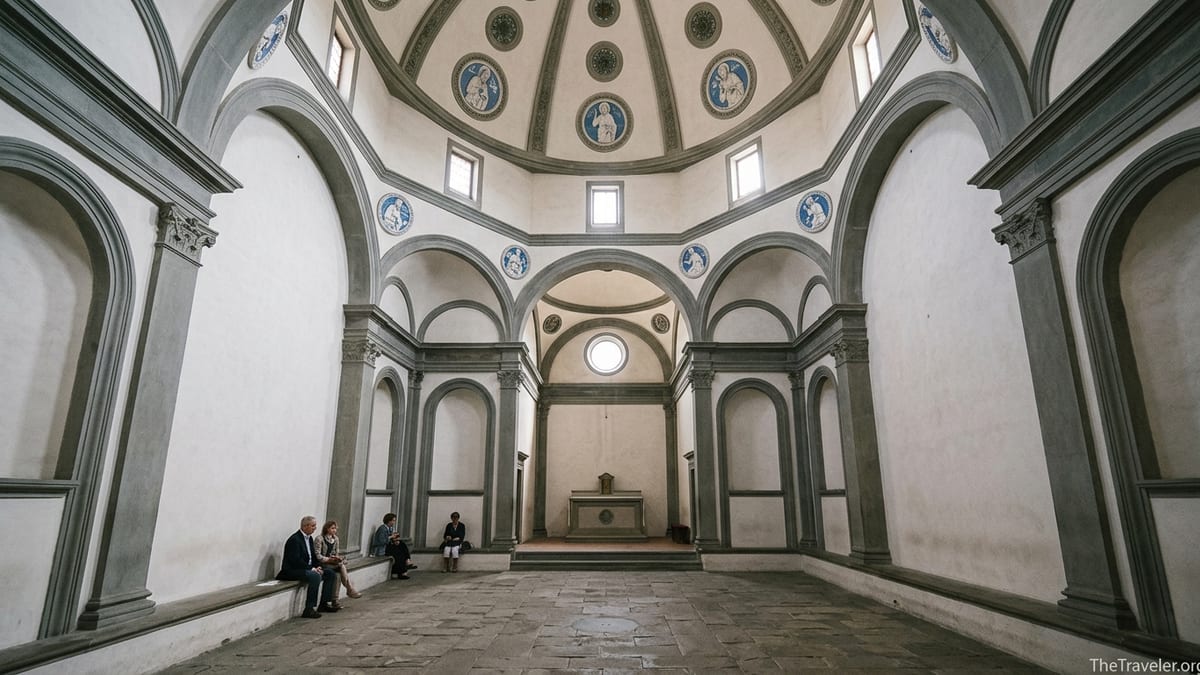
Step across the threshold and the Pazzi Chapel resolves itself almost instantly into a legible shape: a square central room, side bays extending to left and right, and a low chancel beyond. The core space is essentially a cube covered by an umbrella dome, with the two barrel-vaulted wings echoing its proportions. Grey pietra serena stone draws the skeleton of the building on top of white plaster, so clearly that even a casual traveler can sense the underlying grid without any architectural training.
What makes this powerful in person is that your own body becomes the measure. Stand roughly in the center and look up: the distance to the dome feels related to the width of the room in a way that is intuitively comfortable, almost domestic despite the sacred setting. Walk a few paces to one side, and the barrel vault overhead repeats the rhythm of the main dome at a smaller scale. It is one thing to read that Renaissance architects sought harmonic proportions based on simple mathematical ratios; it is another to feel your footsteps click into those ratios with each stride.
Many travelers describe a similar realization: after days of consuming the Renaissance as images and dates, the Pazzi Chapel is where it becomes a physical logic. You do not need to know that the design is generally associated with Filippo Brunelleschi and his circle to sense the same mind at work here as in the great dome visible from every rooftop bar. In the Duomo, engineering dazzles; in the Pazzi Chapel, proportion whispers. Both experiences are equally Florentine, but only one usually allows you to stand quietly, unhurried, and let your eyes trace every line.
If you visit after seeing other chapels in Florence, such as the Brancacci Chapel at Santa Maria del Carmine or the Sassetti Chapel at Santa Trinita, the contrast is striking. Those spaces are dense with narrative frescoes, patrons in fur-lined robes, and painted cityscapes. The Pazzi Chapel has sculptural and painted elements, but here the main story is the architecture itself. That shift from storytelling walls to a reasoning room can make the intellectual side of the Renaissance suddenly, vividly real.
Stone, Light, and Terracotta: Details That Anchor the Experience
Spend more than a few minutes inside and the chapel starts to reward close looking. The grey stone that outlines every structural element is not marble but pietra serena, a fine-grained sandstone quarried near Florence. It is the same material that shapes the columns of Brunelleschi’s Ospedale degli Innocenti and many of the city’s most refined interiors. In the Pazzi Chapel, it frames arches, pilasters, entablatures, and the ribs of the dome, turning the room into a kind of three-dimensional drawing: soft grey lines laid atop a luminous white field.
Look up at the central dome and you will see rosettes in glazed terracotta, some bearing the Pazzi family crest. In the squinches that transition from the square room to the round base of the dome, blue and white medallions depict the four Evangelists, usually attributed to the Della Robbia workshop. Below, around the walls, a series of apostle tondi in similar glazed terracotta punctuate the upper zone. In photographs these details can read as mere ornament. In person, the slightly uneven sheen of the glazes and the depth of the relief make them feel handmade, the work of a workshop rather than a factory.
Light plays an equally active role. The small windows and oculus in the chancel bring in daylight that slides across the white plaster and is caught by the edges of the pietra serena. On a bright June afternoon, the stone lines cast delicate shadows that emphasize the geometry; on a rainy November morning the room feels cooler, its colors more subdued, the blue of the terracotta medallions deepening toward slate. Spending 15 or 20 minutes just watching how the light shifts across the dome is often what turns a brief stop into a lingering visit.
The stone bench that runs around the chapel’s perimeter is another anchoring detail. This is a reminder that the space functioned as the Franciscan friars’ chapter house, where the community met to read, discuss, and make decisions. You can sit where monks once did, lean back against the plaster, and take in the whole room at eye level. That everyday physicality, so different from the “do not touch” distance enforced around masterpieces like Michelangelo’s David, underlines that Renaissance art and architecture were made to be used, not just admired behind barriers.
From Wealth and Power to Measured Calm
Understanding a little of the Pazzi family story adds an extra layer to the experience. In 15th century Florence, the Pazzi were one of the city’s wealthiest banking clans, rivals of the Medici. Commissioning a chapel in Santa Croce was both an act of piety and a statement of status. Yet the design they paid for is strikingly restrained compared with later Medici commissions like the Chapel of the Princes at San Lorenzo, where colored marble, semi-precious stones, and sculptural tombs compete for attention.
Standing under the Pazzi dome, it is hard to imagine that members of this same family were central players in the Pazzi Conspiracy of 1478, a violent attempt to overthrow Medici rule that ended in executions and disgrace. Knowing that history while looking at the chapel’s calm geometry drives home how closely Renaissance art and politics were intertwined. This is not an abstract “patronage system”; it is a specific banking family trying to secure their legacy in stone and glazed terracotta, just as another powerful clan might sponsor a hospital façade or a series of altarpieces.
For modern travelers, this connection can make the broader narrative of Renaissance Florence feel less like a list of names and dates and more like a living city of competing ambitions. You can visit the Medici Chapels to see how that rivalry played out in Baroque splendor, then return to the Pazzi Chapel and feel the earlier, more measured moment that preceded it. The contrast between these spaces, all within a 20-minute walking radius, turns a day in Florence into a kind of three-dimensional case study in power and taste.
Even the chapel’s survival reflects changing attitudes to heritage. Over the 19th and 20th centuries, storms, pollution, and time threatened its terracotta and plaster surfaces, prompting periodic conservation campaigns. Today, restorers balance preserving original materials with keeping the space open to the constant stream of visitors who arrive from all over the world. When you stand there, the quiet you experience is not accidental; it is the result of centuries of decisions about what Florence chooses to protect and how.
Planning Your Visit: Timing, Tickets, and What to Expect
To experience the Pazzi Chapel at its most evocative, timing is crucial. Santa Croce’s opening hours typically run from morning through late afternoon, with last entry often about an hour before closing. Hours can shift slightly between winter and summer or during special events, so it is wise to check the current schedule close to your travel dates. As of 2026, there is usually no need to prebook a timed ticket solely to access the chapel; you purchase admission to the Santa Croce complex either online in advance or at the ticket office on the day, then wander at your own pace.
Price-wise, travelers can expect to pay somewhere in the low double digits in euros for an adult ticket, with reduced rates for children, students, and certain age groups. Families visiting Florence on a budget often plan Santa Croce as a half-day stop that also covers the basilica, cloisters, small museum, and the Pazzi Chapel in one integrated experience. Compared with high-demand attractions like the Uffizi or Accademia Gallery, Santa Croce typically has shorter lines and a calmer atmosphere, making it a good choice for the middle of a long sightseeing week when energy is flagging.
Inside the chapel, there are usually no guided tours running continuously. Independent travelers can easily appreciate the space with a good guidebook, a self-guided audio app, or even a short description saved to their phone. Some art historians and high-end tour companies include the Pazzi Chapel in private walking tours of Santa Croce and its neighborhood; these can be worthwhile if you are particularly interested in architecture or in the political story of the Pazzi family and Medici rivalry. Expect prices for such tours to vary widely depending on group size and exclusivity, often starting in the range of 40 to 60 euros per person for small-group options.
Photography is generally permitted for personal use, though flash is typically discouraged or prohibited inside churches and chapels. A standard smartphone camera is more than adequate here, as the room’s balanced light and pale surfaces are forgiving, but be prepared to raise your ISO slightly on overcast days. The real reward, however, is less the photograph and more the memory of having inhabited a space that so precisely captures an era’s ideals.
Connecting the Pazzi Chapel to the Rest of Renaissance Florence
Visiting the Pazzi Chapel in isolation can be moving; placing it in conversation with the rest of the city’s Renaissance sites can make it transformative. One fruitful route is to pair it with Brunelleschi’s other Florentine works. Start your day at Piazza del Duomo, looking up at the cathedral dome that dominates the skyline, then visit the nearby Opera del Duomo Museum to see the original competition panels for the Baptistery doors and models connected to the dome’s construction. Later, walk to the Ospedale degli Innocenti on Piazza Santissima Annunziata to see another of Brunelleschi’s rational façades built in pietra serena and white plaster. End the day at Santa Croce, letting the Pazzi Chapel distill all those experiences into a single, quiet room.
Another approach is to use the chapel as a counterpoint to more emotionally charged Renaissance spaces. The Brancacci Chapel, for example, overwhelms with narrative and color in Masaccio and Masolino’s frescoes; the Medici Chapels stun with marble inlay and Michelangelo’s sculpted figures. After visiting those, the Pazzi Chapel’s restraint can feel like stepping into a page of an architect’s sketchbook where every line has a purpose. For many travelers, that contrast clarifies why art historians talk about Florence not only as a cradle of artistic genius but also as a laboratory of ideas about order, harmony, and civic life.
Even small, practical decisions during your stay can deepen this connection. Choosing a hotel or guesthouse in the Santa Croce neighborhood means you are likely to pass the basilica several times a day, seeing how the light changes on its façade and how locals use the surrounding streets. You might notice art students sketching in the cloister, or a temporary exhibition focused on a particular restoration. The more often you circle back to this corner of the city, the more the Pazzi Chapel begins to feel less like a single attraction and more like part of a lived-in urban fabric.
Ultimately, the chapel offers a way to move beyond the “checklist” mindset that can dominate short trips. Instead of collecting masterpieces, you are inhabiting a way of thinking about space, numbers, light, and community. Long after you have forgotten the exact date construction began or which workshop fired which medallion, you are likely to remember the sensation of stepping into that cool, measured room and feeling the Renaissance click into focus.
The Takeaway
Renaissance Florence can be overwhelming. In a compact historic center you are asked to absorb Giotto and Ghirlandaio, Brunelleschi and Michelangelo, Medici intrigues and banking history, all while navigating ticketing systems and heatwaves. The Pazzi Chapel offers a rare pause in that rush. It is small enough to grasp at a glance yet deep enough to reward repeated visits; famous among specialists yet often uncrowded; intellectually rigorous yet quietly inviting.
For many travelers, stepping inside its cube-and-dome interior is the moment when the city’s slogans about “rebirth” and “humanism” stop being museum labels and become something you can stand inside. The measured rhythm of pietra serena lines, the hush of the cloister outside, the glaze of a Della Robbia medallion catching the afternoon light: these are not abstractions but concrete experiences available to anyone willing to slow down for half an hour.
If your time in Florence is short, it might be tempting to focus solely on the headline sites with the longest lines. Yet setting aside a slice of your itinerary for the Pazzi Chapel can change how you remember the city. It reframes the Renaissance from a parade of masterpieces to a lived world of spaces and decisions, of families and friars, of stone and light. In that sense, crossing the cloister and pushing open the chapel door may be one of the simplest yet most profound steps you take in Florence.
FAQ
Q1. Where exactly is the Pazzi Chapel located in Florence?
The Pazzi Chapel is inside the Basilica of Santa Croce complex, opening onto the first cloister on the south side of the church, a short walk east from Florence’s historic center.
Q2. Do I need a separate ticket to visit the Pazzi Chapel?
No, access to the Pazzi Chapel is included in the standard ticket for the Santa Croce complex, which covers the church, cloisters, museum areas, and the chapel itself.
Q3. How much time should I plan to spend in the Pazzi Chapel?
Most visitors are satisfied with 20 to 30 minutes inside, but architecture enthusiasts and photographers often stay closer to an hour to observe the light and details.
Q4. What is the best time of day to visit for a quieter experience?
Early morning on weekdays, soon after Santa Croce opens, usually offers the calmest atmosphere, with fewer tour groups and more space to sit and absorb the room.
Q5. Is photography allowed inside the Pazzi Chapel?
Photography for personal use is generally permitted, but flash and tripods are usually not allowed; always follow posted signs and staff instructions during your visit.
Q6. Can I visit the Pazzi Chapel without touring the rest of Santa Croce?
In practice, no; entry routes and ticketing are organized for the entire complex, although you are free to focus most of your time on the cloister and chapel areas.
Q7. Is the Pazzi Chapel accessible for travelers with limited mobility?
Access routes and conditions can change, but the chapel is on the cloister level with no internal stairs; travelers using wheelchairs or with mobility concerns should check current details with Santa Croce staff before visiting.
Q8. Do I need to book a guided tour to understand the chapel?
A guided tour is not essential; a good guidebook or audio guide provides enough context, though specialized architecture or art-history tours can add depth for interested visitors.
Q9. How does the Pazzi Chapel compare to more famous Florentine sites like the Duomo?
The Duomo impresses with scale and engineering, while the Pazzi Chapel is intimate and focused on proportion; together they reveal different sides of Brunelleschi’s legacy and Renaissance thought.
Q10. Can children enjoy a visit to the Pazzi Chapel?
Yes, especially if you frame it as a “shapes and patterns” room, inviting them to spot circles, squares, and domes; its small size and bench seating also help younger visitors feel comfortable.