


Hidden in the quiet first cloister of Santa Croce in Florence, the Pazzi Chapel looks like a calm oasis of pale stone, grey pietra serena and soft light. Yet this refined Renaissance space was born from one of the city’s most ambitious banking dynasties and is forever tied to a failed coup, public executions and the ruthless politics of 15th century Florence. Stepping into the chapel today, travelers encounter not only one of Brunelleschi’s most elegant designs, but also the carefully constructed legacy of a family that dared to challenge the Medici and paid a heavy price.
Get the latest updates straight to your inbox!
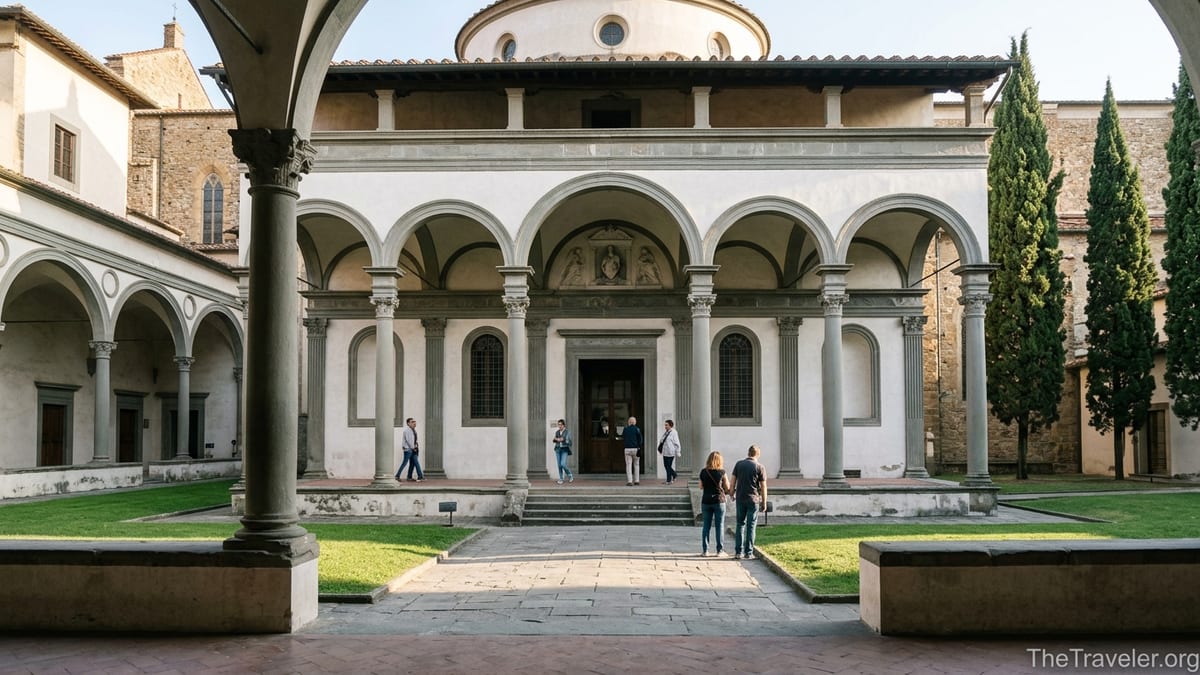
The Pazzi Chapel in the Shadow of Santa Croce
The Pazzi Chapel stands inside the first cloister on the south side of the Basilica di Santa Croce, a few minutes’ walk from Florence’s historic center. Many visitors come to Santa Croce to see the grand tombs of Michelangelo, Galileo and Machiavelli, then are surprised to find this compact, almost hidden masterpiece just off the cloister arcade. Its position inside a working Franciscan complex gives the building a quieter, more contemplative atmosphere than the crowded piazzas around the Duomo.
Architecturally, the chapel is one of the key monuments of early Renaissance design in Florence. The plan and spatial concept are attributed to Filippo Brunelleschi, the same architect behind the famous dome of Florence Cathedral. Funds were gathered in 1429 by Andrea de Pazzi, head of a banking dynasty whose fortune rivaled that of the Medici, and building work was underway by the 1440s. Behind its serene façade lies a deliberate statement: the Pazzi were asserting their status as patrons of cutting-edge architecture in a city obsessed with artistic prestige.
For modern travelers, the chapel is part of the standard Santa Croce ticket, which typically costs the equivalent of a modest restaurant meal in Florence and includes access to the basilica, cloisters and small museum. Once inside, you walk through the green cloister, with its clipped lawns and cypress trees, before reaching the low portico of the Pazzi Chapel. It is a striking contrast to the vertical, fresco-filled interior of Santa Croce itself and is often less busy, particularly in the late afternoon when tour groups thin out.
Because the chapel is enclosed within the Santa Croce complex, there is no separate queue or entrance. Visitors should check current hours before planning a visit, as opening times for the basilica and cloisters can change slightly by season and for religious services. Typically, a midweek morning or late afternoon offers the best chance to enjoy the chapel’s proportions and details without large crowds.
A Powerful Banking Clan and Their Architectural Statement
The Pazzi were one of Florence’s great banking families during the 14th and 15th centuries. Like the Medici, they built their wealth by managing deposits, extending credit and handling papal and princely finances across Europe. At their height, they operated branches in key commercial centers and their fortune was considered second only to that of the Medici. Commissioning an exquisite chapel at Santa Croce, a prestigious Franciscan church, was both a spiritual endowment and a clear display of secular power.
Andrea de Pazzi, who commissioned the chapel, intended it to serve both as a family chapel and as the chapter house for the Franciscan friars. This dual function is significant. The Pazzi were aligning themselves with a major religious order while ensuring that generations of Florentines, friars and visitors would associate the family name with beauty, piety and sophisticated taste. In a city where every leading family paid for altarpieces, chapels and palaces, such patronage was essential to maintaining social and political influence.
Walking through Florence today, travelers can still read this competition in stone. The stark, fortress-like Palazzo Medici Riccardi speaks of Medici power at the intersection of Via Cavour and Via de’ Gori, while the Pazzi invested their prestige in refined religious architecture rather than a single monumental palace. The chapel’s carefully measured interior, with its white walls and grey stone ribs, showcases the family’s embrace of humanist ideals: harmony, proportion and a return to classical forms.
Importantly, the chapel was not just an act of private devotion. As the Franciscans’ chapter house, it hosted meetings of the monastic community and was part of daily religious life at Santa Croce. Every friar who gathered under its dome for centuries did so in a space paid for by Pazzi money and marked by Pazzi heraldry. It was a constant reminder of who had the means to sponsor such an environment.
Brunelleschi’s Design: Geometry, Light and Quiet Power
The Pazzi Chapel is frequently cited in architectural history courses as a nearly textbook example of Renaissance proportional design. The central space reads as a cube surmounted by a hemispherical dome, with a short barrel-vaulted bay leading to the altar. Unlike the Old Sacristy at San Lorenzo, another Brunelleschi project that uses a strictly square plan, the Pazzi Chapel had to adapt to the pre-existing cloister walls, resulting in a subtly rectangular layout. Even so, the architect created a sense of perfect balance through repeated modules derived from simple geometrical ratios.
Inside, visitors notice the restrained palette: white plaster walls articulated by the cool blue-grey of pietra serena stone. Arches, pilasters and entablatures are drawn almost like lines on a sheet of paper, with minimal sculptural projection. This reduction of decorative clutter was radical for its time, especially in a city filled with Gothic tracery and fresco-covered surfaces. Small roundels filled with glazed terracotta reliefs by Luca della Robbia, showing the apostles and symbols of the evangelists, punctuate the upper walls and pendentives, adding touches of color without overwhelming the clarity of the architecture.
The way light enters the chapel is part of the experience. Windows are carefully placed so that natural daylight washes down the white surfaces, reinforcing the geometry rather than breaking it up. Travelers who visit in the late morning often find a soft, diffuse glow that makes the interior feel almost weightless. Unlike darker medieval chapels where candles and gilding dominate, the Pazzi Chapel gives the impression of an airy, rational volume that reflects the intellectual currents of 15th century Florence.
For those interested in photography, the chapel offers an excellent opportunity to experiment with interior shots without flash. A wide-angle lens captures the interplay of the square base, drum and dome, while a standard lens highlights the Luca della Robbia tondi and the rhythm of the gray stone ribs. Because the space is relatively small, a traveler can absorb its layout in a single glance, then start noticing more subtle alignments, such as how the door, windows and altar niches all respond to the same underlying grid.
The Pazzi Conspiracy: When Piety Met Power Politics
Only a few decades after Andrea de Pazzi funded the chapel, his descendants became the protagonists of one of the most dramatic episodes in Florentine political history. On Easter Sunday, 26 April 1478, members of the Pazzi family and their allies attempted to assassinate Lorenzo de Medici and his brother Giuliano during High Mass in the cathedral. Giuliano was killed by conspirators that included Francesco de Pazzi, but Lorenzo escaped with a minor wound and quickly rallied supporters in the city.
The plot, known as the Pazzi Conspiracy, had deep political roots. The Medici had been consolidating their control over the Florentine Republic, using their financial strength and networks of allies. The Pazzi, long-time rivals in banking and status, resented their increasing dominance. Powerful external figures, including Pope Sixtus IV and his nephew Girolamo Riario, also had reasons to weaken the Medici. The cathedral attack was intended to decapitate Medici leadership and open the way for a shift in power.
Instead, events turned against the conspirators almost immediately. Florentines loyal to the Medici rose in anger, and many of those involved in the plot were hunted down within hours. Jacopo de Pazzi, then head of the family, was seized and executed. Others were hanged from the windows of Florence’s Palazzo della Signoria. The city authorities ordered a near-complete erasure of the Pazzi name from public life: coats of arms were chiseled from buildings, inscriptions removed and surviving family members exiled or forced to change surnames.
When travelers stand in the cloister of Santa Croce today, it is striking to reflect that, while the Medici name adorns palaces and chapels across Florence, almost all public traces of the Pazzi were deliberately destroyed after 1478. The chapel that bears their name is one of the few enduring monuments to a family that dared to challenge Medici hegemony and was systematically punished for it. The refined architecture gains an added poignancy when you imagine it as part of a calculated effort at self-glorification that history abruptly turned into a silent memorial.
Reading the Chapel as a Monument to Lost Ambition
Seen in the light of the conspiracy and its brutal aftermath, the Pazzi Chapel becomes more than a chapter house or architectural showcase. It is also a lens through which to view the volatility of Renaissance power. The same wealth that allowed the Pazzi to commission Brunelleschi’s design pulled them into high-level politics and into a fatal conflict with the Medici. The chapel, completed around the same period as the conspiracy, effectively outlived the family’s prominence in Florence.
Inside, visitors can still find traces of Pazzi heraldry incorporated into the decorative scheme. In a few places, these coats of arms were damaged or removed during the post-conspiracy purge, leaving ghostly outlines where symbols once asserted dominance. While many travelers focus on the harmony of the architecture, pausing to look for these details can turn a visit into a more layered historical experience, connecting the elegance of the space with the violence that followed.
For context, consider other Florentine patronage projects that did succeed in preserving a family legacy. The Medici chapels at San Lorenzo, for example, remain richly decorated with marble and sculpture, culminating in Michelangelo’s New Sacristy. By comparison, the Pazzi Chapel is more restrained but no less significant. It proves that a family’s architectural investment could be aesthetically enduring even if their political fortunes collapsed. In this sense, the chapel stands as both achievement and cautionary tale.
Travelers with a deeper interest in history may want to combine a visit to the chapel with a walk past sites associated with the conspiracy: the cathedral, where the attack took place, and the Piazza della Signoria, where many conspirators were executed. Standing inside the chapel afterward, its quiet geometry can feel almost surreal when you recall that its patrons ended their public career on the gallows only a few hundred meters away.
Planning Your Visit: Practical Tips for Travelers
For most visitors, the Pazzi Chapel is accessed through a standard entry ticket to Santa Croce, which is widely available at the church ticket office and via authorized local vendors. Prices for Santa Croce tickets generally fall within the range of other major Florentine churches and include entry to the basilica, the Pazzi Chapel, cloisters and a small museum. Combination passes are sometimes offered that group several smaller sites, so it can be worth checking current options when you arrive in the city.
The Santa Croce complex usually operates on a daytime schedule with a midday closure on certain days, common in Italian churches that remain active religious sites. To make the most of your time, arrive shortly after opening in the morning or later in the afternoon, when tour groups have moved on to the Uffizi or the Duomo. This strategy helps you experience the Pazzi Chapel with fewer people, making it easier to appreciate its soft acoustics, subtle light and measured proportions without constant foot traffic.
Dress codes for Santa Croce are similar to other Italian churches: shoulders and knees should be covered, and hats removed inside. Travelers arriving in the warmer months who are wearing shorts or sleeveless tops may want to carry a light scarf or shawl. Photography is typically permitted without flash, although tripods may be restricted. Security checks at the entrance are routine but usually quick, comparable to those at other major Florentine churches.
Because the chapel is compact, a focused visit can be surprisingly short. Many travelers spend 10 to 20 minutes inside, but architecture enthusiasts often linger longer to sketch, photograph or simply sit on the wooden benches and absorb the space. If you are combining the visit with other Santa Croce highlights, plan at least 60 to 90 minutes for the entire complex, including time in the main church and cloisters.
The Chapel’s Atmosphere Today: From Chapter House to Quiet Refuge
Originally conceived as a working chapter house for the Franciscans, the Pazzi Chapel today functions primarily as a historical and artistic monument. Yet its atmosphere remains contemplative. When you step past the portico and into the main space, street noise drops away. The acoustics are gentle, with even a low conversation carrying clearly beneath the dome. Guides often lower their voices instinctively, and many independent travelers sit for a few minutes in silence.
Compared with more heavily visited Florentine sites like the Uffizi Galleries or the Accademia, the Pazzi Chapel rarely feels overwhelmed, especially outside peak holidays. It can be an ideal pause point on a dense day of museum visits. Travelers often combine it with a coffee break in the streets around Piazza Santa Croce, where you can find small cafes serving espresso, cappuccino and simple pastries at prices comparable to other central neighborhoods if you stand at the bar rather than sit at a table.
The chapel also offers a tangible introduction to Brunelleschi’s work for visitors who may not have the time or energy to fully explore the vast interior of Florence Cathedral. Its smaller scale makes Brunelleschi’s approach to proportion, structure and light easier to grasp in a single visit. Architecture students often sit on the floor or lower steps with notebooks, tracing the relationships between arches and columns, or sketching the circular tondi in the pendentives.
In the late afternoon, when sunlight slants into the cloister and filters through the chapel windows, the interior can take on a warm, honeyed tone. This is one of the best times for photography and for simply experiencing the space as it was meant to be used: not in isolation, but as part of the daily rhythm of a religious community and, now, of a steady stream of curious travelers.
The Takeaway
The Pazzi Chapel offers far more than a pretty example of early Renaissance architecture. It is the crystallized ambition of a banking family whose fortunes rose and fell with the turbulent politics of 15th century Florence. Commissioned by one of the city’s wealthiest clans and executed to a design closely tied to Brunelleschi, the chapel translates money and status into serene geometry and light.
For today’s traveler, visiting the chapel inside Santa Croce is a chance to step directly into this layered story. You can trace the lines of its pietra serena framework with your eyes, notice the restrained decorative program, and then recall that the same family who paid for this calm, rational space also orchestrated a violent attack in the Duomo that helped define Florence’s history. The contrast between the building’s quiet harmony and the drama of the Pazzi Conspiracy gives the site a unique emotional resonance.
Whether you come for the architecture, the history or simply a moment of calm away from Florence’s crowded streets, the Pazzi Chapel rewards unrushed attention. It is a place where aesthetic ideals, religious function and political rivalry intersect, leaving behind one of the city’s most compelling, if understated, monuments.
FAQ
Q1. Where exactly is the Pazzi Chapel located in Florence?
The Pazzi Chapel is inside the first cloister of the Basilica di Santa Croce, on the south side of the church, a short walk from Florence’s historic center.
Q2. Who commissioned the Pazzi Chapel and why?
Andrea de Pazzi, head of the wealthy Pazzi banking family, commissioned the chapel in the 15th century as both a family chapel and the Franciscans’ chapter house, showcasing his clan’s piety and status.
Q3. Did Brunelleschi really design the Pazzi Chapel?
The overall plan and spatial concept are widely attributed to Filippo Brunelleschi, although some details and the portico were likely completed by followers after his death, reflecting his style rather than his direct supervision.
Q4. How is the Pazzi Chapel connected to the Pazzi Conspiracy?
The chapel was funded by the same Pazzi family whose later members plotted to assassinate Lorenzo and Giuliano de Medici in 1478. After the conspiracy failed, the family was punished and much of its public presence in Florence was erased, but the chapel remained.
Q5. What makes the architecture of the chapel special for visitors?
The Pazzi Chapel is celebrated for its harmonious proportions, clear geometry, and restrained palette of white walls and grey pietra serena, making it an ideal place to appreciate early Renaissance design and Brunelleschi’s approach to space and light.
Q6. Is the Pazzi Chapel included in the standard Santa Croce ticket?
Yes, entry to the Pazzi Chapel is normally included with the regular Santa Croce admission, which also covers the main basilica, cloisters and a small museum. There is no separate ticket line for the chapel.
Q7. How much time should I plan for a visit to the Pazzi Chapel?
Most travelers spend around 10 to 20 minutes inside the chapel itself, but you should allow at least 60 to 90 minutes to visit the entire Santa Croce complex at an unhurried pace.
Q8. When is the best time of day to visit the Pazzi Chapel?
Late morning and late afternoon are particularly pleasant, when natural light highlights the interior and crowds are usually thinner than at peak midday hours.
Q9. Are photos allowed inside the Pazzi Chapel?
Photography without flash is typically allowed, though tripods and professional lighting gear may be restricted. Visitors should always respect any on-site instructions from staff and posted signs.
Q10. Can I see evidence of the Pazzi family inside the chapel today?
Yes, some Pazzi coats of arms and heraldic symbols remain integrated into the decorative scheme, though others were damaged or removed after the failed conspiracy, leaving subtle traces of the family’s erased public identity.