


Tucked into a cloister beside Florence’s vast Basilica of Santa Croce, the Pazzi Chapel is easy to miss. It is small, partially hidden, and tied to a disgraced banking family whose name became synonymous with treason. Yet for architects, art historians and increasingly for curious travelers, this restrained 15th century room remains one of the most important spaces in Renaissance architecture. Understanding why this chapel still matters reveals not only how we read buildings today, but also how we experience Florence itself.
Get the latest updates straight to your inbox!
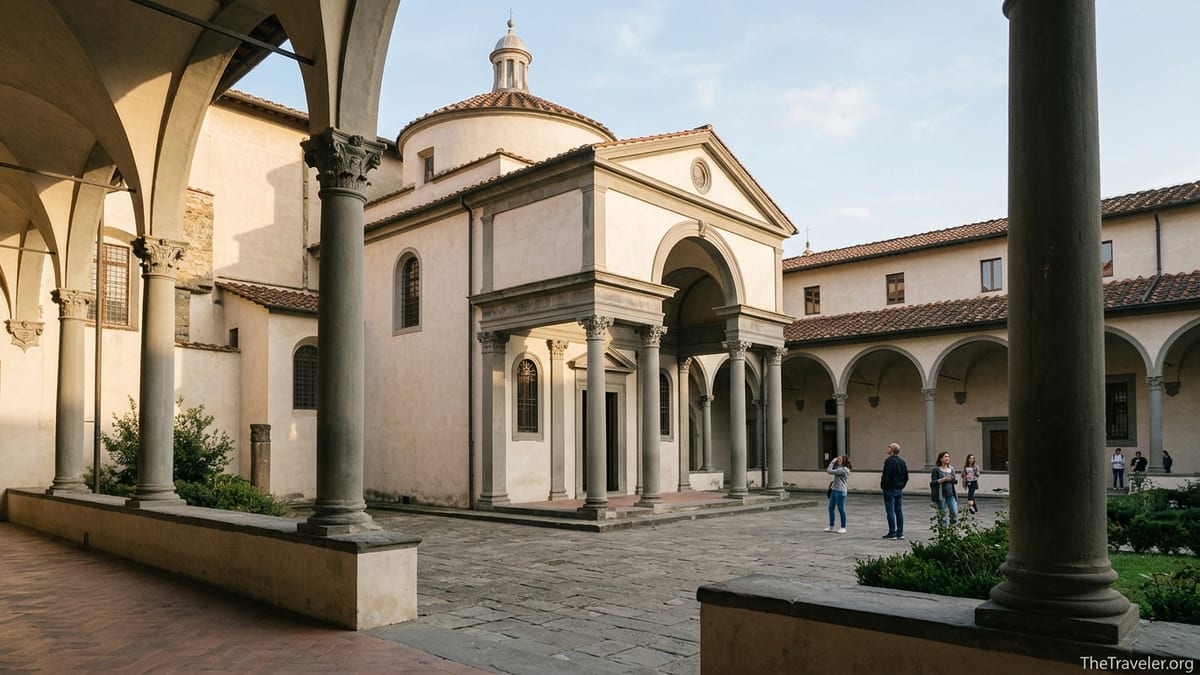
A Modest Chapel With an Outsized Legacy
The Pazzi Chapel sits in the first cloister on the south side of Santa Croce, a few minutes’ walk from Florence’s busy historic center. Commissioned around 1429 by Andrea de’ Pazzi as both a Franciscan chapter house and a family chapel, it was designed in large part by Filippo Brunelleschi, the same architect behind Florence Cathedral’s great dome. Construction seems to have started in the 1440s and continued after both patron and architect died, with the elegant front portico added later in the 1460s. For visitors today, the surprise is its scale: after the overwhelming marble facade of Santa Croce and the flood of tourists in nearby streets, the chapel feels intimate, quiet and human in proportion.
Despite its modest size, the building has long been considered a touchstone of early Renaissance architecture. Where nearby churches still show Gothic verticality and elaborate ornament, the Pazzi Chapel offers calm geometry: clear squares and circles, a low saucer dome, and walls articulated more by proportion than by decoration. Architecture students around the world learn to draw its plan by hand, and many will tell you it was the first building that made mathematical order feel almost spiritual. Standing in its cool interior on a hot Florentine afternoon, you immediately sense why.
The chapel’s story also connects directly with the turbulent politics of 15th century Florence. The Pazzi family were powerful bankers and rivals of the Medici. Their failed conspiracy against the Medici in 1478 led to executions, exile and the erasure of their name from public life. The chapel, however, survived. For travelers walking through the cloister today, it offers a rare, largely unchanged window into the precise moment when Florence was reinventing both its art and its identity.
Brunelleschi’s Revolution: Geometry, Light and Human Scale
One reason the Pazzi Chapel still matters is that it is one of the clearest statements of Filippo Brunelleschi’s architectural ideas. Brunelleschi, trained as a goldsmith and inspired by ancient Roman ruins, helped launch the Renaissance by replacing the complexity of Gothic design with an almost mathematical clarity. In the chapel, this appears in the way every dimension relates to a simple module. The central space is essentially a cube topped by a dome. Side bays extend the main square, their barrel vaults echoing the curve of the central hemisphere. Even without a ruler, you feel the order: each pilaster, arch and panel falls into a rhythm that calms the eye.
That measured geometry is paired with carefully controlled light. Entering from the shaded cloister, your eyes adjust to a soft, even illumination. Small windows ring the base of the dome and punctuate the walls, keeping the upper surfaces bright while the lower zone remains gently shadowed. On a typical sunny day in Florence, the effect is striking: architectural details emerge gradually rather than in high contrast bursts. Photographers often find that a simple late-morning shot from the doorway captures a perfect gradation of light from the dark stone floor up to the pale dome.
Brunelleschi’s use of materials reinforces this balance. The pale plaster walls are framed by a gray local sandstone known as pietra serena. This stone outlines arches, pilasters and entablatures like precise ink lines on paper. Colored decoration is limited to a few glazed terracotta medallions and the Pazzi coats of arms. Modern architects still cite this restrained palette as a model for how a building can feel rich without being ornate. When contemporary hotels in Florence advertise “Brunelleschi-inspired interiors,” what they usually mean in practice is clear proportions, neutral walls, and dark stone trim that quietly shapes the space.
A Prototype for Central-Plan Churches and Modern Design Thinking
The Pazzi Chapel also matters because it helped define a type of centralized, geometrically ordered space that would dominate Renaissance religious architecture. Although the chapel itself is slightly elongated to function as a meeting room, its core is a domed square. Architects in the late 15th and 16th centuries studied this plan when designing churches such as Santa Maria delle Carceri in Prato or San Biagio in Montepulciano, each exploring how a clear central volume could organize worship and focus sightlines on the altar. The idea that a building’s plan should reflect pure geometric forms became a powerful ideal in architectural theory.
For travelers with an interest in design, the chapel offers a tangible introduction to concepts that often sound abstract in textbooks. When guides explain that “Renaissance architects thought in modules,” they can literally point to the repetition of wall panels in the Pazzi interior. The square paving stones on the floor, the spacing of the pilasters, and the coffering in the dome all subdivide the same underlying unit. Design schools still assign students to analyze this layout before they tackle more complex projects. It is a reminder that much of modern planning, from minimal houses to art galleries, owes a debt to this fifteenth century experiment in clear, human-scaled geometry.
Even outside of religious architecture, echoes of the chapel appear in contemporary buildings. Minimalist museums and boutique hotels often seek the same balance of simple shapes, controlled light and carefully limited materials. Standing in the Pazzi Chapel, it is easy to imagine how its spirit survives in a quiet concrete gallery in Tokyo or a whitewashed villa in Portugal. For many visitors, this continuity is what makes the space feel unexpectedly contemporary, despite its frescoed dome and historical associations.
An Architectural Classroom for the World
In art and architectural history courses, the Pazzi Chapel is a staple case study. It appears in high school Advanced Placement Art History syllabi, undergraduate survey lectures and specialized seminars on Renaissance design. Professors choose it because, in one compact space, students can see how proportional systems, classical references and Christian symbolism intersect. The chapel’s dome on pendentives, for example, offers a clear introduction to a structural solution that would later appear in important European churches and civic buildings.
For travelers who have ever looked at a textbook diagram and felt nothing, visiting the chapel can be surprisingly moving. Many architecture students recall their first encounter with it as a turning point: proportions and section drawings suddenly correspond to the sensation of standing in a particular place, hearing footsteps echo off stone, and watching sunlight slide along cornices. If you visit on a quieter weekday morning, you may notice small groups sketching or measuring details. Some universities organize entire study-abroad sessions around Florence precisely so students can engage with buildings like this at full scale instead of on a projector screen.
The chapel is also a favorite subject for photographers and content creators focused on design. Because the interior is compact and symmetrical, it rewards careful framing. A common exercise for photography workshops in Florence is to compare wide shots from the entrance, close-ups of the terracotta tondi, and oblique views from the side bays looking back toward the door. In each case, participants discover how Brunelleschi’s alignment of elements naturally leads the eye through the image.
Decoration, Devotion and the Art of Restraint
While Brunelleschi’s structure often takes center stage, the chapel’s decoration helps explain broader shifts in Renaissance art. Inside, glazed terracotta roundels depict seated apostles, while larger medallions in the pendentives show the four evangelists. These works are associated with the workshop of Luca della Robbia, a sculptor who pioneered durable, vividly colored glazed clay reliefs. For modern visitors, the roundels’ cool blues and whites add just enough color to break the monochrome stone and plaster, without overwhelming the architecture.
Art historians note that this program reflects a renewed interest in harmony between structure and ornament. Instead of frescoes covering every surface, the chapel features carefully placed images that fit within predefined frames. The apostles sit in roundels that align with the wall’s geometry. The evangelists occupy the curve of the dome’s pendentives, visually anchoring its transition from square base to circular crown. This measured approach had a long afterlife: later architects and designers repeatedly turned to the Pazzi Chapel when arguing that decoration should serve, rather than compete with, a building’s form.
At the same time, the chapel remained very much a working religious space. It functioned as the chapter house for Franciscan friars, a room where they gathered to read the rule, discuss community matters and perform certain liturgical functions. The benches that historically lined the walls reflect this use. When you stand along the perimeter today, you occupy the same vantage point these friars once did, surrounded by theological symbols integrated into a clear architectural order. For many contemporary visitors, especially those interested in spirituality and mindfulness, the room’s calm proportions and subdued imagery create a sense of contemplative balance distinct from the more dramatic visual overload of major basilicas.
Continuity Amid Political Upheaval
The Pazzi Chapel’s survival also tells a story about how architecture can outlast political scandal. The Pazzi family’s 1478 conspiracy to assassinate members of the Medici clan during High Mass in Florence Cathedral ended in public hangings and the systematic destruction of Pazzi symbols across the city. In theory, their name and arms were to be erased from memory. Yet the chapter house they financed endured, in part because it served the practical needs of the Santa Croce friars and in part because it was already recognized as an exceptional work.
For visitors walking from the crowded Santa Croce nave into the cloister, this history adds a subtle charge. You move from a church lined with the tombs and monuments of celebrated figures to a courtyard where the legacy of a disgraced family quietly persists in stone. The Pazzi coat of arms, still legible in the chapel’s decoration, becomes a reminder that patronage, ambition and artistic innovation were inseparable in Renaissance Florence. In a town where guided tours often focus on Medici palaces and triumphs, the chapel offers a more ambivalent narrative about power and memory.
This layered history continues to influence how the site is presented today. The Opera di Santa Croce, which manages the complex, typically includes the chapel within standard entry tickets that cover the basilica, cloisters and museum areas. For a single admission price that is usually comparable to other major Florentine churches, travelers can move from Giotto’s frescoes to Renaissance tombs and then into this paradigmatic work of early Renaissance architecture, gaining a broader sense of how art, politics and devotion intertwined in one precinct.
Visiting Today: A Quiet Counterpoint to Florence’s Crowds
From a practical perspective, the Pazzi Chapel remains one of Florence’s most rewarding sites for visitors who crave a break from dense crowds. Access is through the Santa Croce complex, a short walk from the Arno River and about ten minutes on foot from the Duomo area. Standard tickets usually include the basilica interior, cloisters, chapel and adjacent museum spaces, and can be bought on the day at the ticket office or in advance through official channels. Compared with the queues at the Uffizi or Brunelleschi’s dome, lines here are often shorter, especially outside peak summer weeks.
Timing your visit can dramatically change your experience. Late afternoon, especially in the shoulder seasons of spring and autumn, often brings softer light and fewer tour groups. Travelers on a flexible itinerary sometimes report having the cloister and chapel almost to themselves near closing time, with only the sound of church bells and distant street noise filtering in. Morning visits can be busier with school and university groups, which has its own interest if you enjoy overhearing professors and guides unpacking Brunelleschi’s geometry in real time.
Photographers should be prepared for the challenges of low light. Tripods are generally not allowed inside, so a camera or phone that performs well at higher ISO settings is useful. A moderate wide-angle lens on a full-frame camera, somewhere around 24 to 28 millimeters, will let you capture the entire dome from the main space without excessive distortion. Even a phone camera, if held low and carefully aligned with the floor tiles, can produce striking images that emphasize the chapel’s flawless symmetry and subtle tonal shifts.
The Takeaway
For all its fame among specialists, the Pazzi Chapel remains a quietly powerful surprise for many general visitors to Florence. It has no soaring facade like the Duomo, no crowded altar like the Basilica of San Marco in Venice, no single masterpiece painting to rival Botticelli’s works at the Uffizi. Instead, its importance lies in the way every element, from plan to decoration, contributes to a coherent whole. When you stand beneath its dome, you are inside a three-dimensional argument for clarity, proportion and balance that continues to shape how we design, teach and photograph architecture today.
In this sense, the chapel is more than a historical monument. It is an active classroom, a place of quiet devotion, and a testing ground for ideas that reach far beyond Florence’s medieval walls. Travelers who take the time to step off the main tourist routes, pass through the Santa Croce cloister and linger in this measured, luminous space will encounter not just a relic of the early Renaissance, but a building that still feels startlingly relevant in an age wrestling with the same questions of order, light and human scale.
FAQ
Q1. Where exactly is the Pazzi Chapel in Florence?
The Pazzi Chapel is located inside the cloister complex of the Basilica of Santa Croce, on the south side of the church, a short walk east of Florence’s historic center.
Q2. Why is the Pazzi Chapel considered so important in architectural history?
It is regarded as a textbook example of early Renaissance architecture, showcasing Brunelleschi’s ideas about geometric proportion, clear spatial organization and harmonious use of materials.
Q3. Do I need a separate ticket to visit the Pazzi Chapel?
In most cases you do not; admission to the wider Santa Croce complex typically includes access to the cloisters and the Pazzi Chapel as part of a single combined ticket.
Q4. How much time should I plan to spend in the Pazzi Chapel?
Many visitors spend around 15 to 30 minutes, but travelers interested in architecture, photography or sketching often stay longer to absorb the light, proportions and decorative details.
Q5. What is the best time of day to visit the chapel?
Late morning and late afternoon often provide the most atmospheric light, while visits outside peak midday hours are more likely to offer a quieter, less crowded experience.
Q6. Can I take photographs inside the Pazzi Chapel?
Photography is generally allowed for personal use, though flash and tripods are usually prohibited, so plan on using available light and hand-held equipment.
Q7. Is the Pazzi Chapel suitable for visitors without a background in art history?
Yes. Even without prior study, most travelers appreciate its calm atmosphere, clear geometry and contrast with more ornate Florentine churches, especially when paired with a good guide or audio tour.
Q8. What should I look for inside the chapel if I only have a short visit?
Focus on the dome and its coffering, the contrast between pale plaster walls and gray pietra serena stone, and the glazed terracotta medallions of apostles and evangelists integrated into the architecture.
Q9. How does visiting the Pazzi Chapel complement other sights in Florence?
It offers a quiet, analytical counterpoint to the drama of the Duomo, the crowds at the Uffizi and the rich fresco cycles in Santa Croce, rounding out an understanding of Florentine Renaissance art.
Q10. Is the Pazzi Chapel accessible for travelers with limited mobility?
Because it is on the cloister level, access is generally more straightforward than in many historic sites with extensive stairs, but visitors with specific needs should confirm current arrangements with Santa Croce staff before arriving.