


Hidden behind the busy square of Santa Croce in Florence, the Pazzi Chapel is easy to miss. Yet this relatively small, serene space is one of the clearest statements of early Renaissance architecture in the city that invented the style. For travelers curious about art and design, understanding what the chapel is and why it matters can turn a short cloister stop into one of the most memorable visits in Florence.
Get the latest updates straight to your inbox!
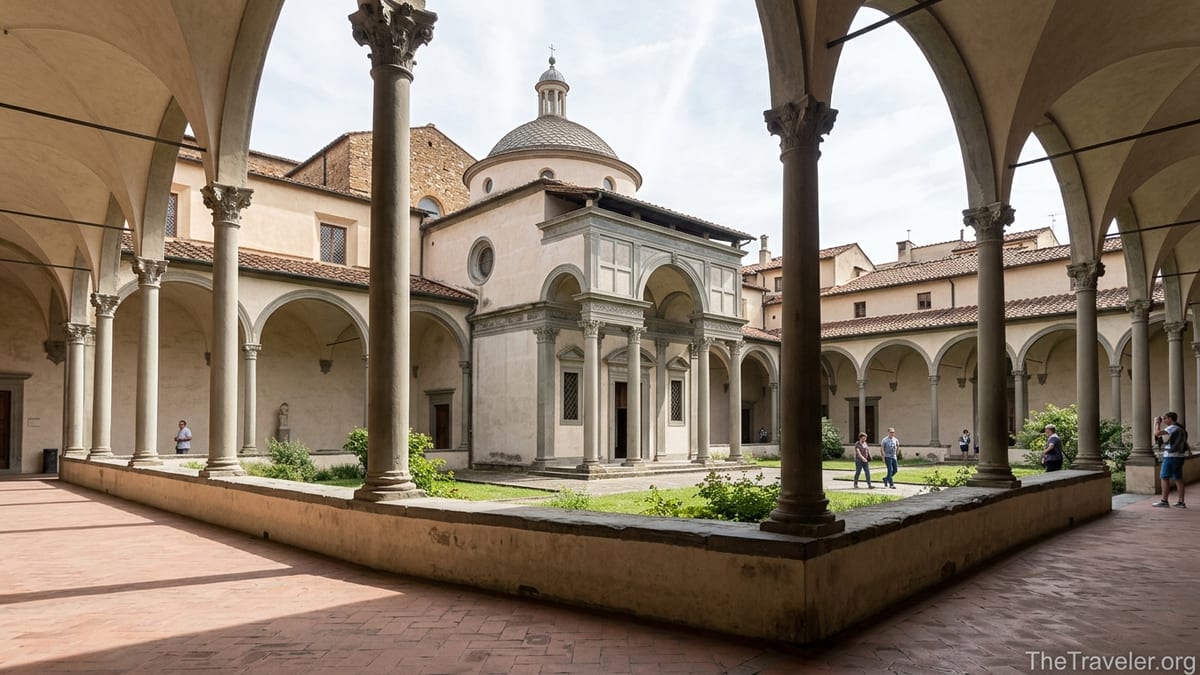
Where and What Is the Pazzi Chapel?
The Pazzi Chapel is a small Renaissance chapel and former chapter house located in the first cloister on the south side of the Basilica di Santa Croce in Florence. Visitors usually reach it after walking through the vast Gothic church where you find the tombs of Michelangelo, Galileo and Machiavelli, then exiting toward the cloister and museum spaces. Physically, the chapel is not large: from the outside it reads almost like an elegant side building attached to the quiet garden of the cloister, framed by low arcades and patches of grass where students, guides and small groups gather between visits.
The chapel was commissioned in the 1430s by Andrea de Pazzi, a member of one of Florence’s most powerful banking families, and was intended both as a family chapel and as the chapter house where the Franciscan friars of Santa Croce would meet. Construction unfolded through the mid 15th century and was never entirely finished to the original vision, but what stands today is still considered a textbook example of early Renaissance architectural thinking.
Practically speaking, if you buy a standard ticket for the Santa Croce complex, access to the Pazzi Chapel is included. As of mid 2026, tickets purchased on site typically cost in the mid teens in euros for adults, with reduced rates for children, students and some categories of visitors. Entry to the chapel itself does not require a separate reservation, though in peak season you may find a museum attendant managing the flow so the interior does not become too crowded at once.
For travelers, the chapel offers something different from Florence’s grand cathedrals or palaces: a controlled, almost meditative interior that lets you see Renaissance ideas about space, geometry and light stripped down to essentials. You can walk in, sit on the low stone bench that runs along the walls, and watch how the natural light from the dome and small round windows shifts across the gray stone and white plaster over the course of just a few minutes.
A Brief History: From Pazzi Ambition to Architectural Icon
The Pazzi Chapel belongs to a precise moment in Florentine history when wealthy families were using architecture to express status, piety and alignment with new humanist ideas. In 1429, Andrea de Pazzi assembled funds to build the chapel in the cloister of Santa Croce, choosing a location attached to an important Franciscan church but still clearly marked as Pazzi territory through coats of arms and decorative symbols. Commissioning an ambitious new chapter house in the middle of ongoing conflicts and shifting political alliances was itself a statement of confidence and prestige.
The chapel is traditionally associated with Filippo Brunelleschi, the architect of Florence Cathedral’s famous dome and a central figure in the birth of Renaissance architecture. Documents from the time are not crystal clear, and some modern scholars debate how directly Brunelleschi was involved, arguing that parts may have been completed by followers or adapted after his death. Nonetheless, the building’s proportional system, use of classical vocabulary and emphasis on clear geometry are so close to his other projects that most art historians still treat it as a key “Brunelleschian” work.
The Pazzi family’s fortunes changed dramatically after the failed Pazzi Conspiracy of 1478, when some family members attempted to assassinate members of the Medici clan inside Florence Cathedral. The plot failed, the Medici retaliated, and the Pazzi were largely exiled. Their coat of arms was removed from many buildings, and work on the chapel effectively stopped. That political shock partly explains why the exterior feels unresolved in places, while the interior proportions and decoration look strikingly complete and coherent.
In the following centuries, the chapel shifted from being mainly a monastic meeting room to a historical and artistic monument. Today, conservation teams in Florence treat the Pazzi Chapel as a fragile but essential artifact of the city’s early 15th century ambitions. Recent interventions have focused on stabilizing its pietra serena stone elements, cleaning the white plaster surfaces and protecting the glazed terracotta decorations from humidity fluctuations that come with modern visitor numbers.
Why the Pazzi Chapel Matters in Renaissance Architecture
To understand why architects, art historians and students make a point of studying the Pazzi Chapel, it helps to compare it with what came before. Medieval churches across Europe tended to emphasize verticality, complex ribbed vaults, and dense surface decoration. In contrast, early Renaissance architects in Florence began to look back to ancient Roman buildings and to focus on clarity of structure, simple geometric forms and mathematically proportioned spaces. The Pazzi Chapel is one of the most concentrated examples of that shift.
When you walk inside, you immediately notice the sense of order. The main space is based on a clear module: a central square room topped by a low “umbrella” dome, flanked by barrel-vaulted side bays. The walls are articulated by pilasters, arches and entablatures picked out in cool grey pietra serena stone against white plaster. Rather than stacking ornament everywhere, the architect uses a limited vocabulary of elements, repeated and carefully proportioned, so your eye follows a continuous rhythm around the room.
This search for harmony and balance was central to Renaissance architectural theory. Thinkers like Leon Battista Alberti argued that good buildings should be based on whole-number ratios, such as 1:2 or 2:3, in the same way that musical harmony depends on simple relationships between notes. The Pazzi Chapel’s interior translates this idea into three dimensions: the height of the dome relates to the width of the space, the size of the arches echoes the spacing of the pilasters, and even the steps and benches feel calibrated rather than arbitrary.
For travelers, one practical way to sense this is to stand under the exact center of the dome and slowly turn 360 degrees. As you rotate, the architectural elements align and realign with each other in a predictable rhythm, unlike in many Gothic chapels where the eye is pulled in competing directions by clustered columns and intersecting ribs. This is one reason architecture students often sketch here: the clear structure makes it easy to read how the space is put together.
Inside the Chapel: Light, Materials and Decoration
One of the most striking aspects of the Pazzi Chapel is the dialogue between its materials. The structural and framing elements are in grey pietra serena stone, a sandstone typical of Florentine Renaissance interiors, while the main wall surfaces are finished in plain white plaster. The contrast is deliberate: the stone visually “draws” the architectural skeleton, and the white areas recede, preventing decoration from overwhelming the geometry.
Look up toward the dome and the pendentives: here you see round medallions with the symbols of the four Evangelists, executed in glazed terracotta with rich blues, whites and softer hues. These works are attributed to Luca della Robbia and his workshop, famous in Florence for durable, vividly colored ceramic reliefs that could withstand church humidity much better than fresco alone. Around the upper perimeter of the room, another frieze of medallions alternates the Lamb of God with pairs of cherubim and seraphim, again in glazed ceramic. The overall effect is refined and controlled rather than exuberant.
Light enters primarily from small windows and the oculus at the top of the dome, producing soft, diffuse illumination rather than sharp beams. On a bright spring morning, for example, you may notice the grey stone taking on a slightly warmer tone, while on a rainy winter afternoon the room can feel cooler and more introspective. Because the interior is modest in size, even small changes in weather and time of day become perceptible in the way shadows move across coffers, arches and roundels.
At ground level, a continuous stone bench runs around much of the perimeter, underlining the chapel’s original function as a meeting space where friars could sit during chapter discussions. From a visitor’s perspective, this also provides a natural vantage point: taking a seat lets you appreciate how the dome seems to hover above without feeling heavy and how the proportions hold together from eye level, not just in plan or elevation drawings.
The Pazzi Chapel in the Context of Brunelleschi’s Work
Even if scholars still debate exactly how much of the Pazzi Chapel can be directly attributed to Brunelleschi, the building clearly speaks the same architectural language as his other Florentine projects. If you have time in the city, you can see this by comparing three sites within a short walk or bus ride of each other: the hospital portico of the Ospedale degli Innocenti on Piazza Santissima Annunziata, the Old Sacristy of San Lorenzo, and the Pazzi Chapel at Santa Croce.
At the Ospedale degli Innocenti, the long street-facing loggia is composed of evenly spaced columns and semicircular arches, with roundels by the della Robbia workshop punctuating the spandrels. The rhythm and clarity there find an echo in the Pazzi Chapel’s porch, where a sequence of arches precedes the interior and creates a threshold from the open cloister to the more enclosed sacred space. Travelers who pass first under the hospital’s arches and then under those of the Pazzi Chapel often notice the family resemblance in height, proportion and the quiet confidence of the design.
Inside San Lorenzo’s Old Sacristy, another early Brunelleschian interior, you encounter a cubical space topped by a dome, articulated with pietra serena frames on white walls and accented with sculptural tombs by Donatello. The Pazzi Chapel clearly develops this model, but shifts the layout to respond to the existing walls of the Santa Croce cloister. Instead of being perfectly square, the chapel becomes a rectangular, transept-like space, with the central dome flanked by side bays. The architect’s challenge was to maintain a sense of unity despite this constraint, and the result demonstrates how Renaissance designers adapted ideal geometries to real-world conditions.
Finally, if you climb the terraces of Florence Cathedral to see Brunelleschi’s great brick dome up close, you can connect the structural daring of that project with the more intimate, cerebral approach of the Pazzi Chapel. Where the cathedral dome showcases engineering innovation on a citywide scale, the chapel distills many of the same concerns with proportion, clarity and measured light into a room you can take in almost at a glance. Together they illustrate the range of problems Renaissance architects were trying to solve, from massive public monuments to finely tuned interior spaces.
Visiting the Pazzi Chapel Today: Practical Tips
The Pazzi Chapel is visited as part of the broader Santa Croce monumental complex, which includes the basilica, cloisters, refectory and small museum areas. As of summer 2026, general admission tickets for adults tend to be priced around what you would expect for a major Florentine church, with discounts for youths, students and certain visitor categories. Tickets can be purchased at the ticket office on the left side of the basilica facade, where you will also pass through security checks similar to those at other major monuments in the city.
Opening hours for Santa Croce usually run from late morning into late afternoon, with reduced hours on Sundays and religious holidays, and occasional closures for liturgical events or restoration work. Because schedules can shift seasonally or in response to conservation projects, it is wise to check the basilica’s official communications shortly before your visit or confirm details with your accommodation host. Many travelers plan one to two hours for the entire complex; within that, a focused visit to the Pazzi Chapel typically takes 15 to 30 minutes, depending on how long you wish to sit and observe the space.
The best time to experience the chapel with fewer crowds is generally right after opening on weekdays, when groups are still arriving and the nave of the basilica absorbs much of the initial flow. Midday in high season can bring more tour groups into the cloister, especially when weather drives visitors indoors. Photography is usually permitted without flash, but tripods are not, so expect to hand-hold your camera or smartphone. If you want quieter conditions for sketching, late afternoon visits outside peak months like May and June often work well.
Accessibility is an ongoing concern for the Santa Croce complex. Entry to the basilica and access to the cloisters, including the Pazzi Chapel, are generally possible via ramps and accessible doors, though routes can be slightly indirect and may require guidance from staff. If step-free access is essential for you or someone in your group, it is advisable to ask at the ticket office about the current route to the first cloister and to allow extra time to navigate between spaces.
How to Read the Chapel Like an Architecture Insider
One of the pleasures of visiting the Pazzi Chapel is that you do not need formal training to appreciate its design. A few simple observations can help you see the building in the way architects do. Start by noticing the “grammar” of elements used: columns, pilasters, semicircular arches, entablatures and coffered vaults. These are borrowed from ancient Roman architecture but simplified and arranged with a new precision. As you stand in the center, try to trace with your eyes how each arch springs from a pilaster, how the entablature runs unbroken around the room, and how these lines define a clear base, middle and top to the interior.
Next, think about geometry. Imagine the central space as a cube whose height equals its width, then picture the dome as a hemisphere resting on that cube via four curved triangular sections called pendentives. The side bays extend the space but do not disrupt this basic figure. Even if you never draw it, visualizing the underlying square-and-circle composition can make the chapel’s calm feel more understandable. Many guidebooks in Florence include small diagrams of the plan and section; having one open while you are inside can be a surprisingly effective way to connect abstraction with experience.
Pay attention too to the relationship between architecture and ornament. Unlike Baroque churches where sculptural decoration often dominates, here the glazed terracotta roundels, friezes and subtle sculpted details are carefully sized and placed so they reinforce the architecture instead of competing with it. For instance, the Apostles in the lower tondos sit at a scale that feels proportionate to the human viewer and the wall height, while the Lamb of God medallions higher up emphasize the continuous line of the entablature.
Finally, consider how the space might have functioned in daily life for the Franciscans of Santa Croce. Chapter meetings would have brought a group of friars together to discuss community matters, discipline and practical affairs, all sitting along the perimeter bench. The central floor area would have remained open, allowing movement and a shared focus toward the altar. Standing in the same spot, you can imagine the sound of voices rising into the dome and the silence returning after decisions were made, with the measured architecture acting as a visual reminder of order and balance.
The Takeaway
For a traveler moving quickly through Florence, the Pazzi Chapel might at first appear as just another small side room in a sprawling church complex. Yet this quiet space in the Santa Croce cloister is one of the purest surviving expressions of early Renaissance architectural ideals: clear geometry, controlled ornament, classical vocabulary and carefully managed light. It condenses ideas that transformed European architecture into a room you can cross in a few steps but contemplate for much longer.
Whether you are an architecture enthusiast following Brunelleschi’s trail across the city, a student preparing for exams in Renaissance art, or simply a curious visitor seeking a moment of calm, taking time to sit under the Pazzi Chapel’s dome can deepen your understanding of Florence. It shows how a wealthy family’s ambition, a religious community’s needs and a new way of thinking about space came together in a single project. In a city full of grand facades and crowded viewpoints, this modest cloister chapel offers something rarer: a chance to experience the Renaissance not as spectacle, but as a quietly radical reordering of space.
FAQ
Q1. Where exactly is the Pazzi Chapel located in Florence?
The Pazzi Chapel is inside the Santa Croce complex, in the first cloister on the south side of the basilica, a short walk from Piazza Santa Croce in central Florence.
Q2. Do I need a separate ticket to visit the Pazzi Chapel?
No, entry to the Pazzi Chapel is included in the standard admission ticket for the Basilica di Santa Croce and its cloisters and museum areas.
Q3. Who designed the Pazzi Chapel?
The chapel is traditionally attributed to Filippo Brunelleschi, although modern scholars debate the extent of his direct involvement and suggest that followers may have completed parts of the design.
Q4. Why is the Pazzi Chapel important in Renaissance architecture?
It is considered one of the clearest examples of early Renaissance architectural principles, with its geometric plan, harmonious proportions, classical vocabulary and restrained decoration.
Q5. How long should I plan to spend in the Pazzi Chapel?
Most visitors spend around 15 to 30 minutes inside the chapel itself, often as part of a broader 1 to 2 hour visit to the entire Santa Croce complex.
Q6. What should I look for inside the chapel to appreciate its design?
Notice the central domed space flanked by barrel vaults, the grey pietra serena stone against white plaster, the glazed terracotta roundels by the della Robbia workshop, and the clear rhythm of arches and pilasters.
Q7. Is the Pazzi Chapel accessible for visitors with reduced mobility?
Access is generally possible via ramps and accessible routes through the Santa Croce complex, but pathways can change, so it is best to check the current route with staff at the ticket office.
Q8. Can I take photos inside the Pazzi Chapel?
Photography without flash is typically allowed for personal use, though tripods are usually prohibited; always respect posted signs and staff instructions during your visit.
Q9. When is the best time of day to visit for fewer crowds?
Weekday mornings soon after opening tend to be the quietest, offering a calmer atmosphere in both the church and the cloister where the Pazzi Chapel is located.
Q10. Is the Pazzi Chapel suitable for travelers who are not architecture experts?
Yes. Even without technical knowledge, visitors usually appreciate its serene atmosphere, balanced proportions and subtle decoration, and a short explanation or guide can make the experience even richer.