


Perched on a 37 meter cliff above the Adriatic, Fort Lovrijenac looks every bit the stone guardian of Dubrovnik. Most visitors climb up for the famous postcard view of the Old Town walls and quickly hurry back down to the Game of Thrones crowds below. Yet linger inside the fortress for more than a few minutes and a different place emerges: a quiet maze of stairways, stone corridors and wind carved battlements that reveal centuries of Dubrovnik’s history, as well as some of the most peaceful corners left near the Old Town. This is the side of Fort Lovrijenac that most visitors never see.
Get the latest updates straight to your inbox!
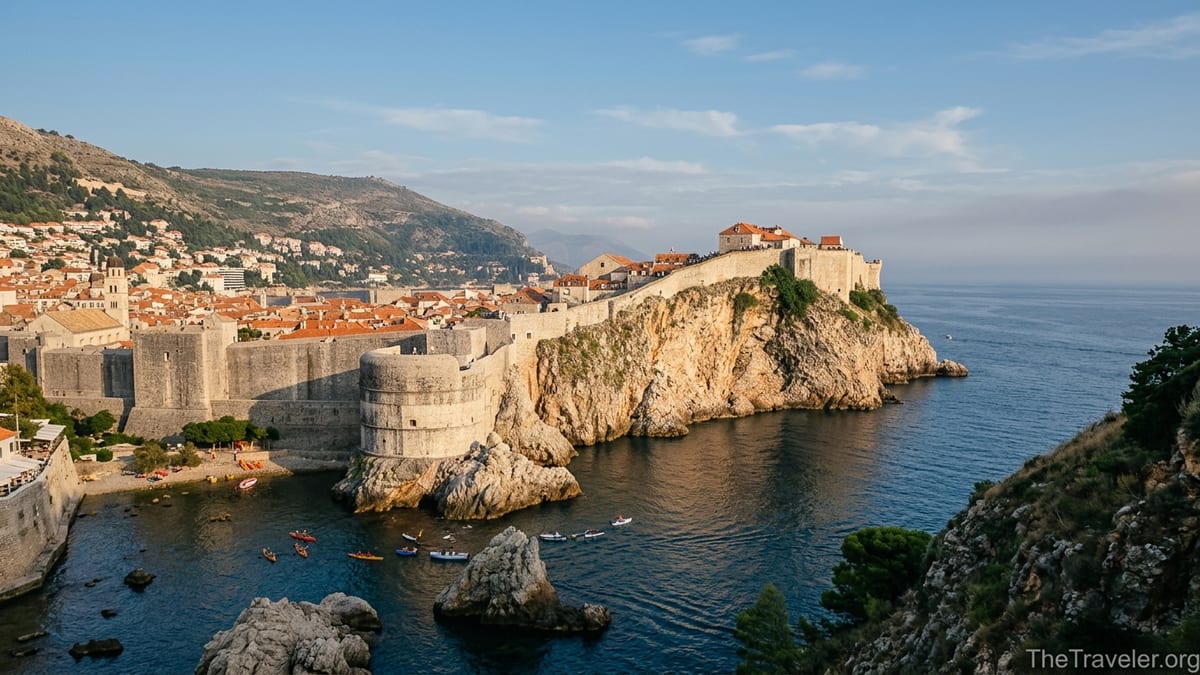
A Fortress With a Story Most Visitors Never Hear
Fort Lovrijenac is often introduced simply as “the Red Keep” from Game of Thrones, but its real history is more compelling than any fantasy script. Built on a rocky promontory at the western entrance to Dubrovnik, it guarded the city from both the sea and land approaches. Local guides like to point out the inscription carved over the main gate that roughly translates as “Freedom is not to be sold for all the gold in the world,” a reminder that the fort was as much a symbol of the city republic’s independence as a military structure.
Most visitors rush straight to the top terrace without pausing in the lower courtyard, yet this is where you can best imagine the fort in use. The thick walls, which reach up to around 12 meters on the landward side, were designed to withstand cannon fire from any hostile force approaching from the interior. On the seaward side, the walls are noticeably thinner, reflecting the fact that the real threat historically came from land based powers rather than from the open Adriatic.
If you walk to the far seaward edge of the lower level and look back at the city, you will find one of the quieter and more atmospheric perspectives of Dubrovnik. In the late afternoon, the stone glows a warm honey color, and you can often hear little more than the crash of waves on the rocks below and the occasional call of a kayak guide shepherding paddlers back to nearby Pile Bay.
Another detail most visitors overlook is the way the fort is angled. From the outside, it looks like a simple block of stone, but inside you see how the walls step and twist to give artillery and archers overlapping fields of fire. Pausing at the small embrasures, you get a strong sense that this was a lived military space, not just a scenic viewpoint.
Practical Details Visitors Get Wrong
Because many people arrive only thinking of the views, they are often caught out by some very practical aspects of visiting Fort Lovrijenac. The approach alone surprises many: from Pile Gate, you walk down to the tiny cove of Kolorina and then climb a steep flight of stone steps that can feel brutal in the midday heat. Locals will tell you it is far better to come early in the morning, when the stone is still cool and the cruise ship groups have not yet arrived, or in the last hour before closing, when the light softens over the Adriatic.
Ticketing is another area where visitors miss an opportunity. At the time of writing, entry to Fort Lovrijenac is included in the ticket for the Dubrovnik city walls if you buy it at the official walls kiosk on the same day. Travelers often pay separately at the fort entrance without realizing that a combined ticket would give them access both to the fortress and the full circuit of walls, which is usually better value than paying for individual admissions. Checking the current pricing in advance and buying the walls ticket first can save both money and time in line.
Footwear also matters far more than many people assume. Inside the fort, staircases are uneven, floors can be polished smooth by centuries of use, and some areas are exposed to sudden gusts of wind funneling up from the sea. Lightweight trainers or walking shoes with some grip are much more sensible than beach sandals. On busy summer days, you can always spot the visitors who underestimated the climb by the way they cling to the inner walls on the descent.
Finally, plan for the basics. There are no cafes or shops inside the fortress, and only limited shade. A refillable water bottle and a hat can make the difference between a rushed, uncomfortable visit and a relaxed hour of exploring. Many travelers choose to pick up a takeaway coffee or pastry at one of the small bakeries near Pile Gate before making the climb, turning the upper terrace into an impromptu breakfast spot with a world class view.
Hidden Corners and Quiet Viewpoints Inside the Walls
The upper terrace of Fort Lovrijenac, with its classic view back to the Old Town and the rounded Bokar Fortress, is deservedly famous. Yet if you walk only a few steps away from where everyone gathers for photos, the atmosphere shifts dramatically. On the far southern side of the terrace, a low parapet opens onto uninterrupted sea and sky. Here, especially in the shoulder seasons, you may find only a couple of other visitors leaning quietly over the edge, watching sailboats tack between Lokrum Island and the mainland.
Another overlooked corner lies halfway up the internal staircase that climbs from the entrance to the main level. As you turn one of the landward corners, a small arched window frames the city walls and terracotta roofs beyond. It is a perfect natural frame for photography, but because it is not signposted, most people continue straight upward. If you step aside for a moment, you can watch the continuous flow of visitors while enjoying a nearly private vignette of Dubrovnik.
On the lowest level of the fortress, behind a heavy wooden door that is sometimes left ajar during visiting hours, a short corridor leads to a side platform jutting over the cliff. It is used occasionally for small performances during festivals, but for most of the year it sits empty. From here you can look straight down on the kayaks lining up in the cove below and across to the base of the city walls, where swimmers slip into the water from natural rock platforms.
Even in the main courtyard, there are subtle details that reward a slower pace. The stone blocks show faint chisel marks, cannonball impacts have left shallow scars, and carved coats of arms of the Ragusan Republic are set into the walls. Taking ten minutes to simply walk the perimeter of the courtyard without a camera in hand can reveal these textures in a way no quick snapshot ever will.
From Shakespeare to Set‑Jetting: The Cultural Life of the Fort
Lovrijenac is not a museum frozen in time. For decades, it has been one of the most atmospheric venues of the Dubrovnik Summer Festival, particularly for open air performances of Shakespeare’s Hamlet. During festival evenings, temporary lighting casts long shadows across the stone, and the natural acoustics of the inner courtyard make a spoken whisper carry to the back rows. Tickets for these performances, which usually take place in July and August, are typically more expensive than regular theater seats in the city but sell out fast because of the unique setting.
Even outside the festival, you can sometimes see technicians testing sound equipment or rigging lighting on the upper terraces in preparation for an upcoming show. If you happen to visit during a rehearsal period, you may hear fragments of dialogue or music drifting through the stairways, lending the fortress an almost surreal, theatrical atmosphere that contrasts with its martial past.
The other major cultural storyline today is, of course, television. From the second season of Game of Thrones onward, Dubrovnik doubled for King’s Landing, and Fort Lovrijenac became the on screen Red Keep in several key scenes. Travel agencies now offer dedicated set‑jetting tours that bring groups up to the fortress with stills from the series, pointing out where Joffrey’s name day tournament was filmed or where characters looked out over Blackwater Bay.
What many casual visitors do not realize is that the same stone walls have also appeared in other productions, including historical dramas that use the fortress to evoke medieval Europe. Guides sometimes share anecdotes about crews working around the tight space during filming or about local extras who spent long days in costume on the terraces. If you are interested in film, asking a guide about non fantasy productions can lead to stories that reach well beyond the usual Game of Thrones talking points.
Reading the Landscape: Views That Tell a Story
The view from Fort Lovrijenac is famous, but few travelers take the time to truly read what they are looking at. From the highest terrace, turn your back on the Old Town for a moment and face the open sea. The low outline of Lokrum Island sits just offshore, covered in dense pine and cypress. For centuries it was a monastic retreat, later briefly an imperial summer residence, and today it serves as a nature reserve and popular swimming spot reachable by regular boats from the Old Port. The channel between the fort and Lokrum has always been an approach route for merchant vessels and, in times of war, for enemy fleets.
Now turn slowly clockwise. The rounded tower of Fort Bokar appears directly across the narrow bay, built into the curve of the city walls. Between Bokar and Lovrijenac lies the tiny pebble beach and boat harbor of Kolorina. In the morning, diving schools often run beginner sessions here, meaning that from the terrace you can watch neoprene clad swimmers lowering themselves nervously into the water while instructors shout encouragement from small motorboats.
Continuing the arc, you see the full line of Dubrovnik’s walls marching around the Old Town, punctuated by towers and bastions. The elevated Minčeta Tower dominates the landward side. In the heat of summer, you can pick out the slow moving line of visitors walking the walls, colorful dots against the pale limestone. This gives a concrete sense of scale: the walls form a complete loop of roughly two kilometers, wrapping the compact medieval core.
Look down once more, this time at the base of the fort itself. The jagged rocks that seem merely picturesque from below are, from above, revealed as a natural defense system. There is almost nowhere a large vessel could land safely. In the late afternoon, waves crash and send up bursts of spray that briefly catch the sun, a reminder that nature has always been one of Dubrovnik’s strongest defensive allies.
How to Time Your Visit for Atmosphere Instead of Crowds
Because Fort Lovrijenac is close to Pile Gate and features in many organized walking tours, it can feel crowded at certain times of day, especially when several cruise ships are in port. However, with a bit of timing strategy, you can experience the fortress in near silence. The first hour after opening is usually the quietest. On many days outside peak July and August, you might share the upper terrace with only a handful of other early risers, most of them photographers chasing the soft morning light.
Late afternoon and early evening offer a different but equally rewarding ambiance. As the sun lowers behind the Elaphiti Islands, the light becomes warmer and the contrast softens, making the stone textures on the walls particularly beautiful for close up photography. The guided groups start to thin out, and independent travelers linger, often sitting on the parapets to watch the kayaks returning in lines across the bay. If you plan ahead, you can combine a late visit to the fort with a sunset drink at one of the cliffside bars tucked into the rocks below the city walls, turning the whole western side of Dubrovnik into a slow, scenic circuit.
Season also matters. In high summer, mid day visits can be uncomfortably hot, with little shade and intense glare off the pale stone. Spring and autumn usually bring milder temperatures and clearer air. In October, for example, you may find dramatic shifting clouds over the Adriatic that add depth and mood to photos, while still enjoying comfortable short sleeve weather on most days.
If your schedule is flexible, consider checking the arrival times of major cruise ships into Dubrovnik’s port and avoiding the hours when thousands of day trippers are funneled into the Old Town. Tourist information offices and many local hotels can provide this information, and it can make a significant difference to the quality of your time at Fort Lovrijenac and around the city in general.
Connecting the Fort With the Rest of Dubrovnik
Many visitors treat Fort Lovrijenac as a standalone viewpoint, walking up, taking photos and heading back down to Pile Gate. In practice, the fortress makes most sense as part of a wider loop that connects several of Dubrovnik’s most atmospheric spots. Starting at the small cove of Kolorina, you can watch kayak groups depart for half day paddles along the city walls before climbing the steps to the fort. After exploring Lovrijenac, walk back down and follow the road a short distance uphill to Gradac Park, a pine shaded terrace overlooking both the fortress and the Old Town.
From Gradac Park, you gain a more distant, elevated perspective on Fort Lovrijenac itself, seeing clearly how it dominates the rocky headland. The park is popular with local families in the late afternoon, and informal snack trucks sometimes set up near the viewpoints. This is a good place to sit on a bench with a takeaway gelato or sandwich and watch the changing light over the fortress you have just explored up close.
Back at Pile Gate, you can then continue your visit by walking the city walls, which puts Fort Lovrijenac into yet another relationship with the Old Town. From the seaward sections of the walls, the fortress appears almost like an island, separated from the main fortifications by a ribbon of deep blue sea. This interplay of different viewing angles is one of Dubrovnik’s great pleasures and helps you appreciate how carefully its defenses were planned.
For travelers staying overnight in the city, a final connection worth making is at night. Illuminated floodlights pick out the key features of both the walls and Lovrijenac, creating a dramatic silhouette against the dark sea. A simple evening stroll from Pile along the waterfront road toward the Park Gradac viewpoint provides one of the most memorable nocturnal scenes in Dubrovnik, yet relatively few daytime visitors return to see the fort after dark.
The Takeaway
Fort Lovrijenac rewards the traveler who slows down. The majority of visitors climb the steps, snap a quick shot of the Old Town and head on to the next landmark. Those who linger an extra half hour discover a layered place: a proud symbol of a once independent republic, an open air theater, a film set and a rare pocket of quiet just outside one of the Mediterranean’s busiest old towns.
By learning a little of the fort’s history, using the combined ticket wisely, seeking out hidden corners and reading the landscape from the terraces, you can turn a routine stop into one of the most meaningful experiences of your time in Dubrovnik. The famous view is only the beginning; what most visitors miss is everything that happens when you put the camera down, lean on the ancient stone and simply watch this remarkable setting come to life around you.
FAQ
Q1. How long should I plan to spend at Fort Lovrijenac?
Most visitors spend around 30 to 45 minutes, but allowing a full hour lets you explore the quieter corners, read the signage and enjoy the views without rushing.
Q2. Is Fort Lovrijenac included in the Dubrovnik city walls ticket?
At present, entry to Fort Lovrijenac is typically included with a valid city walls ticket purchased the same day, but it is wise to check current details locally as conditions may change.
Q3. How difficult is the climb up to the fortress?
The staircase from Kolorina Bay to the entrance is steep and can be tiring, especially in summer heat. Most reasonably fit visitors manage it without trouble, but those with mobility issues may find it challenging.
Q4. When is the best time of day to visit Fort Lovrijenac?
Early morning and late afternoon generally offer the most pleasant conditions, with softer light, fewer tour groups and cooler temperatures than the middle of the day.
Q5. Are there facilities such as toilets or cafes inside Fort Lovrijenac?
Basic restroom facilities are sometimes available, but there are no cafes or shops inside, so it is best to bring water and any snacks you might want with you.
Q6. Can I visit Fort Lovrijenac independently or do I need a guided tour?
You can visit independently using a regular admission or walls ticket, and many travelers do. Guided tours, including Game of Thrones themed walks, add historical and filming context but are entirely optional.
Q7. Is Fort Lovrijenac suitable for children?
Many families visit and children often enjoy exploring the staircases and battlements, but parents should keep a close eye on younger kids near exposed walls and higher terraces.
Q8. Are there any events or performances held at Fort Lovrijenac?
During the Dubrovnik Summer Festival and other special occasions, the fortress hosts open air theater and cultural events. Dates and programs vary each year and are usually advertised locally.
Q9. What should I wear and bring for a visit?
Comfortable walking shoes with good grip, a hat, sunscreen and a refillable water bottle are strongly recommended, especially in warmer months when shade is limited.
Q10. Can I take photographs and videos inside Fort Lovrijenac?
Personal photography and video are generally allowed and very popular due to the views. Commercial shoots usually require prior permission from the relevant local authorities.