


Fort Lovrijenac is one of Dubrovnik’s defining silhouettes, a compact stone fortress perched on a 37 meter cliff just outside the medieval walls. Whether you are drawn by its military history, the sweeping Adriatic views, or the Game of Thrones connection, a little planning will help you experience the fort at its best without missing the moments that most visitors remember long after they have left Croatia.
Get the latest updates straight to your inbox!
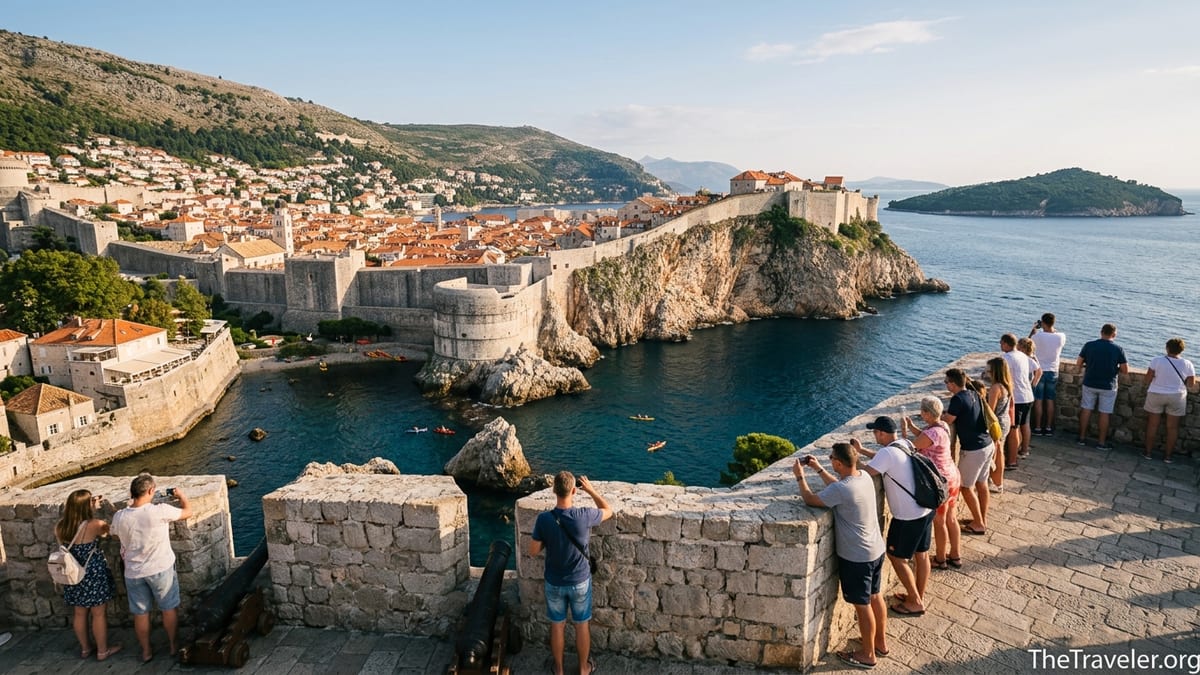
Why Fort Lovrijenac Belongs on Your Dubrovnik Itinerary
Seen from Pile Gate or the city walls, Fort Lovrijenac looks almost theatrical, rising out of a rocky headland above the waves. Historically, it was anything but decorative. Built to guard Dubrovnik’s western approach, it once housed heavy cannons pointed toward potential Venetian invaders and could reportedly hold a garrison of several dozen soldiers in times of danger. Today, those defenses translate into spectacular lookouts over the Old Town’s red roofs and the open Adriatic.
The fort’s compact size is deceptive. Inside you find multiple terraces, a small inner courtyard, and thick stone corridors that frame the sea in unexpected ways. It rarely feels as crowded as the main city walls circuit, so many travelers use a visit here as a quieter counterpoint to the loop around the ramparts. A couple who visited in early May, for example, reported that after a busy morning on the walls, they found only a handful of people roaming Lovrijenac’s upper platform and could take photos without jostling for space.
For many visitors, Lovrijenac is also a physical way to understand Dubrovnik’s strategic geography. From the highest terrace you can see how the Old Town sits on a rocky peninsula, with the walls encircling it and forts like Lovrijenac and Bokar covering blind spots and harbors. If you arrive by cruise ship and only have a few hours ashore, combining a short Old Town walk with Lovrijenac gives a surprisingly complete introduction to the city.
Then there is the pop culture element. Fans of HBO’s Game of Thrones know Fort Lovrijenac as the main stand-in for the Red Keep in King’s Landing. Guides point out where scenes like Joffrey’s name-day tournament or various courtyard confrontations were filmed. Even if you have never watched the series, seeing how the real fortress lines up with the fictional one adds an extra layer of interest to the visit.
Tickets, Passes, and Opening Hours: How to Get In
The most important practical detail is how Fort Lovrijenac ties into Dubrovnik’s ticketing system. In recent seasons, a standard Dubrovnik City Walls ticket, priced around 35 to 40 euros in high season, has included one visit to Fort Lovrijenac within roughly 72 hours of your first scan. This means that if you buy a walls ticket on Monday afternoon and walk a short section then, you can climb Lovrijenac on Tuesday or Wednesday without paying extra, as long as you keep the same ticket.
If you know you want to see both the walls and Lovrijenac, it usually makes sense to start with the walls ticket rather than a standalone ticket at the fort. Travelers who buy only the fort ticket and later change their mind about the walls often find themselves paying the difference at the walls entrance, which may not save much money or time. By contrast, arriving at the main walls entrance near Pile Gate, buying or presenting your prebooked walls ticket, and then using that same entitlement at Lovrijenac within a couple of days keeps things simple.
The Dubrovnik Pass is another option that quietly solves the ticket puzzle. Available in formats such as a 1, 3, or 7 day pass, it generally includes entrance to the city walls, selected museums, and city buses. Because the pass covers the walls, it also covers Fort Lovrijenac within its validity. A practical example: a solo traveler staying three nights in July might opt for the 3 day Dubrovnik Pass, use city buses to reach the cable car station one day, visit museums like the Cultural History Museum the next, and slot Fort Lovrijenac between walls and beach time, all on the same pass.
Opening hours vary seasonally and can change for events, especially in summer when the Dubrovnik Summer Festival occasionally stages theater productions inside the fort. During peak months, typical hours run from morning into late afternoon or early evening, while in shoulder seasons the fort may close earlier. Because local authorities sometimes publish special notices when performances are scheduled, it is sensible to check the tourist board’s latest updates shortly before your visit, particularly if you are aiming for a late entry or visiting in the evening.
Timing Your Visit for Views, Light, and Crowds
Timing can be the difference between a rushed climb in full sun and a memorable visit with soft light and space to explore. Fort Lovrijenac faces broadly west, which means late afternoon and golden hour can be especially beautiful. Around an hour before sunset in June or September, the sun often grazes the Old Town walls and terracotta roofs at a low angle, while the fort itself catches warm side light. Many photographers try to arrive at Lovrijenac roughly 60 to 90 minutes before sunset to have time to work through the viewpoints before the light peaks.
Mornings have their own advantages. If you are visiting on a day when several large cruise ships are in port, you may find that mid-morning to midday brings a surge of guided groups up the steep steps to the fort. Starting very early, soon after the fort opens, is one way to stay ahead of those groups. Summer temperatures can climb quickly, so being on the upper terrace at 9 am rather than noon can feel noticeably more comfortable, especially in July and August when daytime highs often push past 30 degrees Celsius.
Travelers with just one day in Dubrovnik often try to pair the city walls and Fort Lovrijenac in a single block of time. A workable pattern is to walk the walls in the early morning, take a short break for coffee near Pile Gate, then climb to Lovrijenac mid-morning while your walls ticket is still fresh and before the heat of the day sets in. Another approach, especially for photographers, is to do the walls in late afternoon, then use the same ticket at Lovrijenac the following evening within the 72 hour window, giving yourself two different sets of lighting conditions.
Whatever timing you choose, allow at least 45 minutes inside the fort itself. Many visitors who expected a quick walk-through find themselves spending longer than planned, pausing on each level to photograph the walls from above or watch kayakers drifting across the cove below. If you are on a cruise stop with a tight return time, build in extra buffer for the climb up and down the stairs and potential queues at the small ticket kiosk near the entrance path.
Finding and Enjoying the Best Viewpoints
One reason Fort Lovrijenac is so photogenic is that it offers several layered vantage points in quick succession. After climbing the stone staircase from sea level, you first reach the fort’s lower courtyard. From here, shallow steps lead to a terrace that opens toward the old harbor and the city walls. Many visitors snap their first panoramic shots here, capturing the full curve of the walls around the Old Town and the round Bokar Fortress directly opposite.
Continuing upward, the most famous viewpoint is the upper platform facing east toward the Old Town and south toward Lokrum Island. On clear days, the contrast between the orange roofs, pale stone, and deep blue sea is striking. Photographers often use a moderate wide-angle lens or smartphone in panorama mode here to fit the full Old Town skyline into one frame. On windy days the sound of waves crashing against the rocks below can give this terrace a surprisingly wild, coastal feel despite being minutes from the city center.
Do not overlook the smaller side openings and gun ports along the way. Looking back through narrow embrasures, you can frame the Pile Gate bridge, kayaks leaving tiny Pile Bay, or local swimmers on the rocks below. Couples sometimes find quiet corners at these windows to sit for a moment away from the main flow of visitors. If you are visiting with children, these lower apertures can be an engaging way to talk through how cannons once lined up with particular approach routes to the city.
Finally, remember to turn around and look out to sea. From certain angles, particularly on the seaward side of the upper levels, you can see cruise ships anchored offshore and the greener coastline stretching toward the Elafiti Islands. This outward-looking view helps balance all the Old Town panoramas and reminds you that Dubrovnik was as much a maritime republic as a walled city.
Game of Thrones Angles Without Missing the Real History
For Game of Thrones fans, Fort Lovrijenac is non-negotiable. Several memorable King’s Landing scenes were filmed here, with the fortress standing in for the Red Keep courtyard and battlements. Guides on themed walking tours pause at specific corners to re-create camera angles, showing how relatively modest spaces were transformed on screen through careful framing and digital extensions. One popular spot is a small courtyard where Joffrey watches a tournament; another is the seaward-facing wall used for scenes of characters looking out over Blackwater Bay.
It is tempting to spend your entire visit hunting for familiar scenes, but the most rewarding experiences at Lovrijenac blend those references with an appreciation of the real structure. The fort predates modern pop culture by centuries, carrying layers of local history in Latin inscriptions and carved coats of arms. Above the entrance, you can see a famous motto about liberty carved into stone. Inside, the thickness of the walls and the narrow access points remind you how seriously Dubrovnik’s leaders took the defense of their independence.
If you prefer to explore independently, you can still follow a practical route that takes in most of the screen-famous angles. Start on the mid-level terrace facing the Old Town, then climb to the upper platform for the wide “Red Keep” view over the harbor. From there, loop back through inner corridors to find the smaller courtyard and sea-facing battlements. Travelers who are not especially interested in television often mention that they still enjoy listening in as a guided group passes, picking up context about how the production used the fortress.
On the other hand, dedicated fans may want to bundle Fort Lovrijenac into a longer themed tour, some of which also include sites like the Jesuit Staircase, St Dominic Street, and nearby Trsteno Arboretum outside the city. A half-day tour might spend 30 to 45 minutes inside Lovrijenac itself, enough time to cover the main filming locations without feeling rushed. If you book one of these tours, check carefully whether the tour price includes your walls and fort tickets or expects you to buy them separately on the day.
Practical Tips: Getting There, Stairs, and What to Bring
Reaching Fort Lovrijenac is easier than it looks from afar, but it does involve a substantial climb. The approach starts near Pile Gate, on the western side of Dubrovnik’s Old Town. From the main bus stop and taxi rank outside the gate, you walk a short distance downhill toward Pile Bay, then turn onto a stone staircase that zigzags up the rocky headland. The steps are uneven in places and can be slippery when wet, so comfortable walking shoes are strongly recommended over flip-flops or smooth-soled sandals.
The staircase itself usually takes 5 to 10 minutes to climb at a steady pace, with a stone bench partway up where you can pause and catch your breath. Visitors with limited mobility or knee problems may find this section challenging, particularly in hot weather. There are no elevators or ramps to the interior levels of the fort, so if you or someone in your group uses a stroller or mobility aid, it is worth honestly assessing whether the climb will be manageable.
Once inside, the interior surfaces are mostly stone, with some areas lacking railings along open drops. Families with small children often choose to keep a close handhold on the upper terraces, especially when excited kids are distracted by the views. In summer, pack water and consider a hat and sunscreen; shade can be limited on the top levels, and there is usually no cafe or shop inside the fort itself. Many travelers bring a reusable water bottle and refill at public fountains inside the Old Town before climbing.
Photography equipment is a common question. Smartphones handle most scenes well, but if you are carrying a camera, a moderate wide-angle lens in the 24 to 35 millimeter range on a full-frame body is ideal for capturing the whole Old Town from the upper terrace. Tripods can be awkward in narrow passageways and are sometimes discouraged during busy periods, so a light, handheld setup is usually best. On breezy days, keep a firm grip on hats and loose accessories, as sudden gusts funnel through the courtyard and along the cliff edge.
Combining Fort Lovrijenac With the Rest of Dubrovnik
Seeing Fort Lovrijenac in isolation can be rewarding, but many visitors find it even more meaningful as part of a broader loop around Dubrovnik. A classic route starts at Pile Gate, walks briefly through the Stradun (the main street), then returns to the gate and exits to climb Lovrijenac. After exploring the fort, you can descend to small Pile Bay, where local operators rent kayaks for short paddles around the base of the cliffs. Looking up at Lovrijenac from sea level, having just been on top, gives a dramatic sense of scale.
Another efficient combination is to pair Lovrijenac with a full circuit of the city walls. For example, you might climb to the walls from the entrance near Pile Gate, walk to the seaward section overlooking Fort Lovrijenac, descend at the eastern Ploče Gate, then weave back through side streets to Pile. After a short break, use the same ticket to climb Lovrijenac and see the walls from the opposite side. Travelers who have done this circuit often comment that it helps them understand the fort and the walls not as separate attractions, but as interlocking parts of a single defensive system.
If you hold a Dubrovnik Pass and are trying to make the most of a 24 hour window, consider starting your pass in the late afternoon with a museum visit and a gentle walk on the walls, then climbing Lovrijenac the following morning before the pass expires. A practical example: activate your pass at 4 pm on day one by visiting the Franciscan Monastery and walking part of the walls in cooler light. The next morning, ride a city bus covered by the pass if you wish to the cable car station or Lapad beach, then return to Pile Gate in time to climb Lovrijenac shortly before noon.
For those on longer stays, Lovrijenac can anchor a slower day of exploration. You might wander the Old Town in the morning, find a shaded cafe near the Pile area for an early lunch, then climb the fort in mid-afternoon before heading to one of the nearby swimming spots such as the rocks by Pile Bay or the small beach at Šulići below the fort. Watching the fort glow in late light while you swim a few meters offshore is one of those simple Dubrovnik experiences that rarely appears in guidebooks but lingers in memory.
The Takeaway
Planning a visit to Fort Lovrijenac is mostly about making smart use of your existing Dubrovnik tickets and your limited time in the city. By anchoring your visit around a city walls ticket or Dubrovnik Pass, watching for any special closures, and matching your timing to the light and the weather, you avoid the common pitfalls of rushed climbs and missed viewpoints.
If you give the fortress at least 45 minutes, wear decent shoes for the stairs, and remember to explore both the Old Town-facing and seaward sides, you will come away with a clear sense of why this compact stronghold has guarded Dubrovnik’s approaches for centuries and captivated modern travelers and filmmakers alike. In a city filled with iconic vantage points, Fort Lovrijenac rewards those who arrive prepared with some of the most memorable perspectives of all.
FAQ
Q1. How much time should I plan for a visit to Fort Lovrijenac?
Most travelers are satisfied with 45 to 60 minutes inside the fort itself. If you enjoy photography or want time to sit and take in the views, plan for up to 90 minutes, especially at sunset when people tend to linger on the upper terrace.
Q2. Is Fort Lovrijenac included in the Dubrovnik City Walls ticket?
In recent years, a standard Dubrovnik City Walls ticket has typically included one visit to Fort Lovrijenac within about 72 hours of first use. Policies can change, so check the current conditions when you buy your ticket, but in practice most visitors use a single walls ticket to cover both attractions.
Q3. Do I need a separate ticket if I have the Dubrovnik Pass?
Generally, you do not. The Dubrovnik Pass usually includes entrance to the city walls, and that entitlement extends to a visit to Fort Lovrijenac within the pass validity. When you arrive at the fort, you show the same pass or confirmation you used at the walls, and staff scan it as your included visit.
Q4. When is the best time of day to visit Fort Lovrijenac?
The most popular times are early morning to avoid heat and crowds, and late afternoon or golden hour for soft, warm light on the Old Town. If you are visiting in peak summer, an early start can make the staircase climb much more comfortable, while photographers often favor the last 60 to 90 minutes before sunset.
Q5. How difficult is the climb up to the fortress?
The approach involves a fairly steep stone staircase that takes 5 to 10 minutes to climb. Most reasonably fit visitors manage it without problems, but the steps can be a challenge for people with knee issues, heart conditions, or limited mobility. There are no elevators, so anyone who cannot handle stairs may find the ascent impractical.
Q6. Is Fort Lovrijenac suitable for children and families?
Yes, many families visit and children often enjoy exploring the courtyards and battlements. However, there are areas with low walls or open drops, particularly on the upper terraces, so close supervision is important. A baby carrier is usually more convenient than a stroller because of the stairs and uneven stone surfaces.
Q7. Can I visit Fort Lovrijenac if I am not interested in Game of Thrones?
Absolutely. While the fort features prominently in Game of Thrones tours, its core appeal lies in its views, history, and setting. Many visitors who have never seen the series name Lovrijenac as a highlight of Dubrovnik simply for the panoramas over the Old Town and the sense of standing on a cliff above the Adriatic.
Q8. Are there facilities such as toilets or cafes inside the fort?
Facilities are limited. Depending on the season, you may find basic restrooms, but there is generally no permanent cafe or restaurant inside the walls. It is wise to use facilities in the Pile area before climbing and to bring water with you, especially on hot days.
Q9. Do I need a guided tour to appreciate Fort Lovrijenac?
A guided tour is not essential, and many visitors enjoy exploring independently. However, a guide can add context about the fort’s defensive role, its inscription about liberty, and its use in Game of Thrones. If you are already considering a walking tour of Dubrovnik’s Old Town, choosing one that includes Lovrijenac can be an efficient way to see it.
Q10. What should I wear and bring for a comfortable visit?
Wear comfortable, sturdy shoes suited to climbing uneven stone steps, and consider a hat and sunscreen in summer. Bring a small bottle of water, your camera or smartphone, and your city walls ticket or Dubrovnik Pass if you plan to use it for entry. In cooler months, a light jacket is useful on the exposed upper terraces where the wind can be stronger than inside the Old Town streets.