


Perched on a 37 meter cliff just outside Dubrovnik’s medieval walls, Fort Lovrijenac looks dramatic from almost every postcard of the city. But when time is tight and Dubrovnik is crowded, many travelers wonder if the climb up to this fortress is really worth the effort. The short answer is that it usually is, especially if you care about views, history or Game of Thrones filming locations. The longer answer depends on when you visit, how fit you are and what kind of experiences you value most. This guide breaks down exactly what Fort Lovrijenac offers so you can decide if it deserves a place on your itinerary.
Get the latest updates straight to your inbox!
What Exactly Is Fort Lovrijenac?
Fort Lovrijenac, often called St Lawrence Fortress, is a standalone stronghold that guards the western approach to Dubrovnik’s Old Town. It sits about 37 meters above sea level on a rocky outcrop, sometimes nicknamed Dubrovnik’s Gibraltar because of its imposing position above the Adriatic. The fortress has thick sea facing walls, some up to around 12 meters wide, while the inner walls facing the city are deliberately much thinner, a clever defensive feature from the time when Dubrovnik feared attack both from foreign enemies and potential internal coups.
Historically, the fort protected the city state of Dubrovnik from Venetian expansion and other maritime threats. The first mentions of a structure here date back to around the 11th century, although much of what you see today reflects later medieval and early modern modifications. Above the entrance you can still read the Latin inscription “Non bene pro toto libertas venditur auro,” which means “Freedom cannot be sold for all the gold in the world,” a phrase that captures the fiercely independent spirit of the former Republic of Ragusa.
In more recent decades, Fort Lovrijenac has become one of the city’s main cultural stages. During the Dubrovnik Summer Festival, it hosts open air performances, most famously Shakespeare’s Hamlet, using the fortress walls and courtyard as a natural set. It is also a key point for panoramic photographs of the UNESCO listed Old Town and the nearby cove of Pile Bay, recognizable to many as a Game of Thrones backdrop.
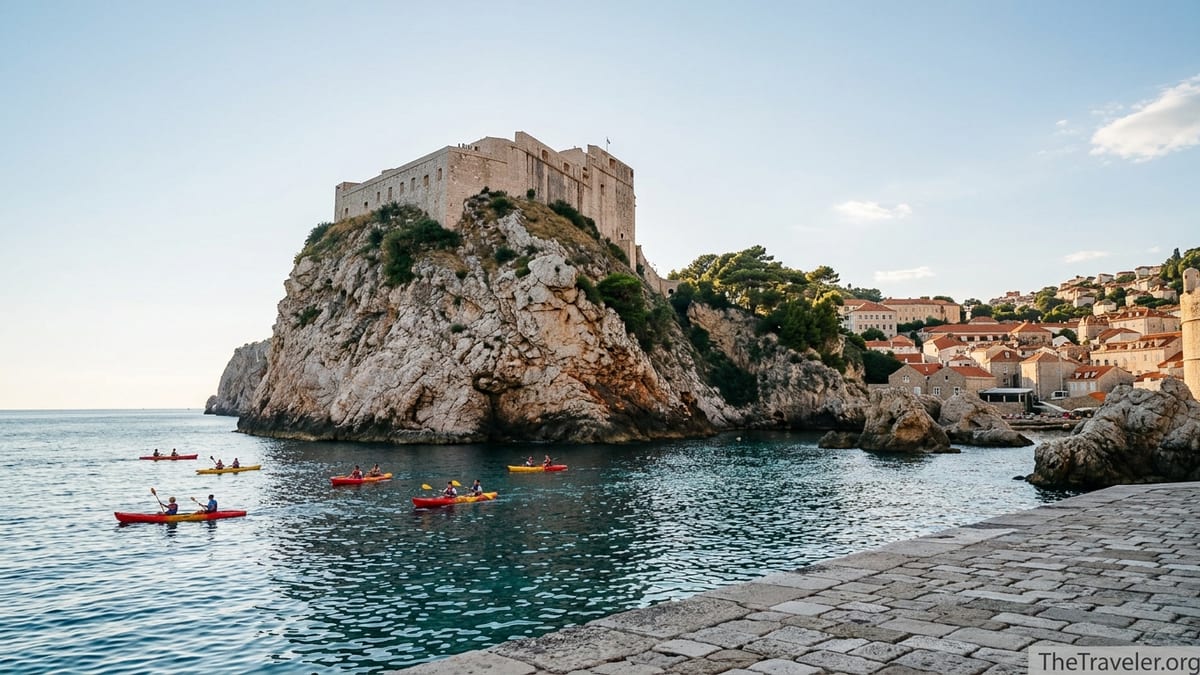
Visually, Fort Lovrijenac is hard to miss. If you walk through Pile Gate and stand on the small bridge looking back out toward the sea, the triangular fortress appears perfectly framed against the cliffs and the open water. From this same spot, many visitors decide whether to detour up to the fort or simply admire it from below.
Tickets, Opening Hours and Practical Details
Before deciding if Fort Lovrijenac is worth visiting, it helps to understand how access works in practice. Most visitors enter using a combined ticket rather than paying a separate fee at the gate. A standard Dubrovnik City Walls ticket typically includes one entry to Fort Lovrijenac within a limited time window, often 24 to 72 hours from first use, depending on the exact ticket type you purchase. As of mid 2026, the walls ticket for adults is a significant outlay in local terms, so using the Lovrijenac inclusion can help you get better value from that expense.
You can buy the city walls ticket at the official booths next to Pile Gate, at other wall entrances or online through the city’s authorized ticketing platforms. Payment by card is widely accepted. There is also the Dubrovnik Pass, a city card that bundles walls entry, Fort Lovrijenac access and several museums with local public transport for a fixed price over one, three or seven days. If you plan on riding buses and visiting multiple attractions, this pass is often more cost effective than buying each ticket separately.
Opening hours for Fort Lovrijenac typically follow a similar pattern to the city walls, with longer hours in peak summer and reduced hours in winter. In July and August, it is usually open from morning through late afternoon or early evening, while in shoulder seasons closing times come earlier. Exact times can change from year to year, and occasionally the fort closes temporarily for performances, maintenance or private events. For that reason, it is worth checking the latest information on Dubrovnik’s official tourism channels or at the ticket office on the day you plan to visit.
There is no vehicle access up to Fort Lovrijenac, so you will approach on foot from Pile Gate or from the small harbor at Pile Bay. Expect a short but steep climb via stone steps. The path is well maintained, but it can be hot and exposed to the sun, especially in midsummer afternoons when temperatures commonly climb above 30 degrees Celsius. Comfortable footwear, water and sun protection make the walk much more pleasant.
The Climb and Accessibility: Is It Manageable?
The main hesitation many travelers have about visiting Fort Lovrijenac is the number of stairs. From sea level near Pile Bay, you climb a relatively compact but steep series of stone steps that may take five to ten minutes at a steady pace. There are places to pause on the way up, but there is no elevator or ramp, and the incline is not suitable for wheelchairs or strollers. Inside the fortress, the floors are mostly uneven stone with additional staircases leading up to the ramparts.
If you are reasonably fit and used to walking, the climb is challenging but manageable, similar to ascending several flights of stairs in an old European apartment building. Many families with older children and active seniors complete it without issue, particularly if they take it slowly. However, travelers with knee problems, serious mobility limitations or heart conditions should think carefully before attempting the ascent, especially in summer heat.
An example from a typical summer visit: a traveler staying just outside Pile Gate decides to head up at 8:30 in the morning in July. The steps are still partially shaded by the surrounding cliffs, and the air is cooler than it will be later in the day. They reach the entrance in under ten minutes, pausing twice to catch their breath and take photos back toward Pile Harbor. By contrast, another visitor attempting the climb at 2 p.m. in August, with the sun directly overhead, might find the combination of heat and exertion substantially more tiring, needing more pauses and arriving quite sweaty at the ticket checkpoint.
For those who know stairs will be an issue but still want the famous views, there are alternatives. Walking a section of the western city walls provides a very similar perspective over the Old Town and Fort Lovrijenac without the steeper standalone climb, though the walls themselves also involve numerous stairs. The viewpoint from the low stone pier in Pile Bay, near the kayak rental area, delivers an excellent postcard style view of the fortress against the cliff from close to sea level, with only a few steps involved.
Views, Photography and Atmosphere Inside the Fortress
The main reward for climbing to Fort Lovrijenac is the view. From the upper ramparts, you get a sweeping panorama of Dubrovnik’s terracotta rooftops, the full arc of the western city walls and the turquoise Adriatic below. Many photographers consider this vantage point one of the best in the city, particularly for capturing the Old Town in profile with the walls and towers completely in frame.
If you walk all the way around the ramparts inside the fortress, you will find multiple angles that are well suited for wide shots and close up details. On the seaward side, the drop is dramatic, with waves breaking against the base of the cliff and small tour boats or sea kayaks passing below. Inside the courtyard, you can photograph the stone staircases, arches and cannons that evoke the fort’s defensive history. In the right light, textures of the weathered stone walls appear almost golden against the deep blue sea.
Light conditions change markedly over the course of the day, which affects both photographs and the feel of the visit. In the early morning, soft side light can create long shadows over the rooftops and cooler tones in the sea, while the air is clearer and the site quieter. By late afternoon, especially in summer, the sun begins to sink behind the fort and the city, bathing everything in warm, low angle light that is ideal for more atmospheric images. Midday tends to be the harshest, with strong glare on the water and deeper contrasts on the stone, though on slightly overcast days this can be less of an issue.
Atmosphere also depends on the time of your visit. In July and August, there can be a steady flow of group tours, many focused on Game of Thrones, which briefly gather in the courtyard to explain the filming locations and then disperse. Even so, it rarely feels as crowded as the city walls or the main streets inside Old Town. In shoulder seasons like May, June, September and early October, you may find entire sections of the ramparts almost empty, making it easier to appreciate the fortress quietly, imagine its past or simply sit on a stone bench and watch the kayaks circle below.
Game of Thrones Connection: How Big a Draw Is It?
For many visitors, a key reason to visit Fort Lovrijenac is its role as the Red Keep in the television series Game of Thrones. Filming for several important scenes took place in the fortress courtyard and on its walls, with Dubrovnik standing in for King’s Landing from season 2 onward. Famous moments include King Joffrey’s name day tournament, where he watches combat from the walls, and various political confrontations set against the dramatic stone backdrop and sea views.
In practice, this connection shapes how you experience the fort. Guided Game of Thrones walking tours that start near Pile Gate often stop at Fort Lovrijenac, using still photos from the show to match real locations with on screen scenes. A guide may point out where Cersei walked along the parapets or where crowd scenes were staged, highlighting how set designers dressed the existing medieval architecture with banners, props and temporary structures. For fans, these comparisons can be a highlight, bringing familiar sequences to life and revealing the blending of real history with fantasy.
Even if you are not especially interested in the series, the Game of Thrones influence can still be useful because it has encouraged better access and interpretation. Some tours combine the fortress with nearby locations like Pile Bay, Gradac Park and certain sections of the walls, giving a cohesive overview of the city’s layout. However, if crowds of fans posing for throne inspired photos are likely to diminish your enjoyment, consider visiting independently early in the day or during the off season when the fort is quieter.
It is worth noting that Fort Lovrijenac is only one of several Game of Thrones locations in Dubrovnik. Others include the Jesuit Staircase near St Ignatius Church, used for the Walk of Shame sequence, and various corners of the city walls and harbor. If your interest is mostly in the television series, a dedicated themed tour may help you make the most of limited time, using Fort Lovrijenac as one stop in a broader route rather than the sole focus.
History, Culture and Events at the Fort
Beyond screen fame, Fort Lovrijenac is significant in its own right as part of Dubrovnik’s defensive system and its cultural life. The fort’s very existence is linked to a story of rivalry with Venice. Local legends describe how Dubrovnik’s leaders rushed to build the fortress in the 11th century to prevent Venice from establishing a stronghold on the same rock. Whether every detail of the story is accurate or not, it reflects the strategic importance of this position and the determination of the historic republic to control its own defenses.
Walking through the fort, you pass through a main gate and emerge into an inner courtyard where cannons once stood ready to fire on approaching ships. From the terraces, you can see how Fort Lovrijenac formed a crossfire with the outer towers of the city walls and with nearby Fort Bokar, creating layered defense lines at the entrance to the harbor. When you look down at the relatively narrow channel between the fortress and the walls, it is easy to imagine how difficult it would have been for enemy fleets to force their way into the city.
Today, the cannon fire has been replaced by theater and music. Since the early 1950s, the Dubrovnik Summer Festival has used Fort Lovrijenac as a stage for plays, particularly Shakespeare’s Hamlet, which has become an emblem of the festival. During these nights, the courtyard transforms into an open air theater with seating, stage lighting and sound equipment, while the stone walls and arches provide a dramatic natural set. Locals and visitors alike attend, often dressing a little more smartly than for daytime sightseeing and arriving early to enjoy the sunset views before the performance begins.
If you happen to be in Dubrovnik during the festival period, which usually runs from mid July to mid August, checking whether a performance is scheduled at the fortress can add a memorable cultural experience to your trip. Tickets for festival shows are sold separately from tourist entry and can be purchased through official festival outlets. Even if you do not attend a performance, knowing that Fort Lovrijenac serves this dual role, both as a historical monument and a living cultural venue, can add depth to your visit.
Is It Worth Your Time? Different Traveler Profiles
Whether Fort Lovrijenac is worth visiting depends on your interests, fitness level, time in Dubrovnik and the season of your trip. For travelers who value viewpoints and photography, the answer is almost always yes. The perspective from the fortress over the Old Town, the walls and Pile Bay is unique, and many visitors rank it among their favorite images from Croatia. If you have already decided to buy a city walls ticket, the marginal cost is only the time and energy to climb the stairs, which makes the decision even easier.
For history and architecture enthusiasts, Fort Lovrijenac offers insight into how the maritime republic defended itself. You can clearly see the layered system of fortifications and appreciate the engineering behind the massively thick sea facing walls. The carved motto about freedom, the cannon placements and the strategic views all help bring Dubrovnik’s political and military story into focus in a way that complement museum exhibits and walking the walls.
For Game of Thrones fans, the fortress is one of the central real world locations associated with the show. Standing in the courtyard where the Red Keep scenes were filmed or looking out from the same walls where key characters schemed can be a highlight. Many fans report that seeing the site in person feels surprisingly familiar because so many aerial shots of King’s Landing prominently feature this very fortress against the sea.
Where the calculation is less clear is for travelers with very limited time, significant mobility limitations or little interest in either views or history. If you only have a few hours in Dubrovnik during a cruise stop, you might decide that wandering the Old Town streets, walking a short stretch of the walls and swimming at a nearby beach like Banje or Sulic offers a better balance than adding another climb. Likewise, if your knees or hips struggle with stairs, you might instead choose accessible viewpoints such as the cable car ride to Mount Srd, which delivers panoramic views with minimal walking.
The Takeaway
Fort Lovrijenac is more than just a photogenic backdrop to Dubrovnik’s skyline. It is a historic fortress that once helped protect an independent republic, a cultural stage where Shakespeare echoes off stone walls in the summer nights and a key point for understanding how the city relates to the sea. For many visitors, it is also the real life Red Keep, the place where fantasy politics from Game of Thrones meet the very real history of the Adriatic coast.
If you are already purchasing a city walls ticket or a Dubrovnik Pass, visiting the fortress usually adds only an hour or so to your itinerary, yet rewards you with some of the best views in town. Go early in the morning or late afternoon to avoid the worst of the heat, wear good shoes and bring water. If stairs are manageable for you and you care about landscapes, photography, history or the series, then Fort Lovrijenac is very likely worth the climb.
If your time is extremely short or steep steps are a serious barrier, you can still enjoy impressive views of the fortress from Pile Bay, the western walls or a sea kayak tour, and you will not feel that you have missed Dubrovnik entirely. But for most travelers spending at least a day in the city, including Fort Lovrijenac turns an already memorable skyline into a lived experience and helps you see Dubrovnik from the vantage point that protected it for centuries.
FAQ
Q1. Is entry to Fort Lovrijenac included in the Dubrovnik city walls ticket?
The standard Dubrovnik city walls ticket usually includes one visit to Fort Lovrijenac within a limited time window. Check the details on your specific ticket or Dubrovnik Pass to confirm the validity period before planning your visit.
Q2. How long does a visit to Fort Lovrijenac typically take?
Most visitors spend around 45 minutes to one hour at the fortress, allowing time for the climb, walking the ramparts, taking photos and briefly exploring the courtyard and interior areas.
Q3. When is the best time of day to visit Fort Lovrijenac?
Early morning and late afternoon are generally the most pleasant times. Temperatures are cooler, light is better for photography and there tend to be fewer large tour groups than at midday in peak season.
Q4. How difficult is the climb up to the fortress?
The climb involves a fairly steep set of stone steps that can feel strenuous in hot weather, but it is short. Most reasonably fit travelers manage it by taking a few breaks, though it is not suitable for wheelchairs, strollers or those with significant mobility issues.
Q5. Can I visit Fort Lovrijenac without doing a Game of Thrones tour?
Yes. You can visit independently using your city walls ticket or Dubrovnik Pass and explore at your own pace. Information boards are limited, but the main draw is the view, and you do not need a themed tour to appreciate it.
Q6. Are there facilities such as toilets or a café inside Fort Lovrijenac?
Facilities are minimal. There are usually basic restrooms, but no full café inside the fortress. It is best to bring water with you, especially in summer, and plan to eat or have coffee back in the Old Town or near Pile Gate.
Q7. Is Fort Lovrijenac suitable for children?
Many families visit with school age children who enjoy the climb, cannons and views. Parents should keep a close eye on younger kids, as some areas have low walls or drops, and the stone surfaces can be uneven.
Q8. What should I wear and bring for a visit?
Sturdy, comfortable shoes are important because of the stairs and uneven stone. In summer, bring water, a hat and sunscreen. In cooler months, a light jacket is useful as the exposed ramparts can be windy.
Q9. Can I attend a performance at Fort Lovrijenac during the Dubrovnik Summer Festival?
Yes, when scheduled, plays and other performances are held in the fortress courtyard as part of the Dubrovnik Summer Festival. Tickets must be purchased separately from sightseeing entry, and dates vary each year, so check the festival program in advance.
Q10. Is Fort Lovrijenac still worth it if I am not a Game of Thrones fan?
Absolutely. The fortress offers some of the best panoramic views of Dubrovnik, a tangible sense of its defensive history and a quieter atmosphere than many parts of the Old Town, making it rewarding even if you have never watched the series.