


Internet performance is a critical factor for remote workers evaluating Thailand as a base. The country has invested heavily in fixed broadband and mobile networks, but service quality varies by location, technology, and provider. This briefing assesses Thailand’s internet speed, reliability, and connectivity characteristics to support relocation decisions for remote professionals.
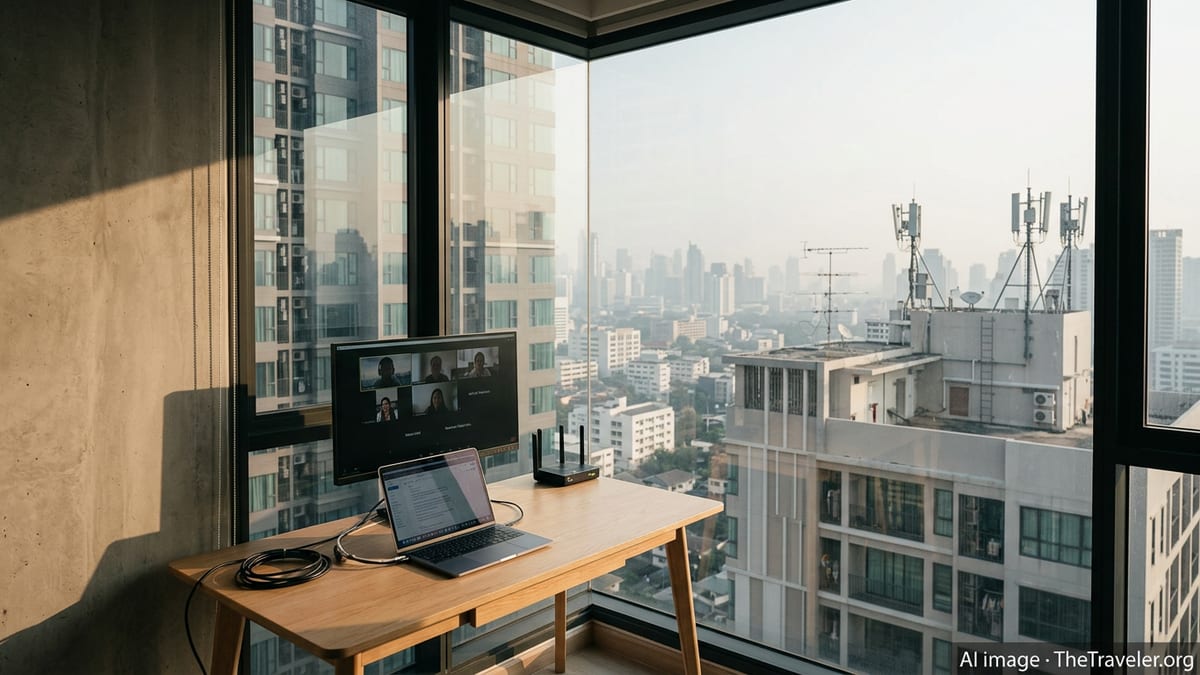
Overview of Thailand’s Internet Performance
Thailand has progressed from a regional laggard to a high-performing market in fixed broadband, now ranking within the top tier globally for median download speeds. Recent benchmark data indicate national median fixed broadband download speeds in the low- to mid-200 Mbps range, placing Thailand roughly within the global top 15 countries for fixed-line performance. This level of bandwidth is generally more than sufficient for video conferencing, cloud-based workflows, and large file transfers for most remote workers.
Mobile internet performance is weaker than fixed broadband but still competitive by regional standards. Median mobile download speeds are typically around 80 to 120 Mbps in major cities, though Thailand ranks notably lower globally on mobile than on fixed broadband. Remote workers who rely primarily on mobile data should be aware of this gap and treat 4G and 5G service as a complement or backup to fixed fiber rather than a full substitute in most cases.
The telecom market is dominated by three national operators for both fixed and mobile services, which helps ensure broad coverage but also reduces price competition over time. For remote workers, the key implication is that fixed-fiber connectivity is widely accessible and fast in urbanized areas, while mobile connectivity is serviceable and often strong, but more variable across geography and time of day.
Overall, Thailand offers an internet environment that is technically capable of supporting demanding remote work, particularly where fixed fiber is available. The primary considerations for relocation decisions are not raw speed, but coverage consistency, last‑mile quality, and the practical realities of installation and service management at specific addresses.
Fixed Broadband Infrastructure and Speeds
Thailand has invested significantly in fiber-to-the-home (FTTH) and fiber-to-the-building networks over the last decade. In dense urban areas, especially Bangkok and large provincial cities, fiber is the default technology for residential and small-office connections. Entry-level consumer plans commonly start at several hundred Mbps symmetric or near-symmetric speeds, with 500 Mbps and 1 Gbps packages widely marketed at relatively low price points compared with many Western markets.
Recent international speed indices place Thailand’s median fixed broadband download speeds around or above 200 Mbps, with some 2025 rankings listing the country in the global top 10 to 15 range. City-level data for Bangkok show even higher performance, with median downloads in the mid-200 Mbps range. These figures reflect the prevalence of gigabit-capable fiber plans in urban areas and relatively modern access networks.
Upload speeds on fixed lines are generally strong, though often somewhat lower than download speeds on mass-market packages. For typical remote work activities such as HD video conferencing, collaborative document editing, and routine uploads to cloud storage, this does not present a constraint. However, professions requiring very large upstream transfers (for example, video production or data-intensive research) should confirm advertised upload speeds before contract, as symmetrical plans are available but not universal.
In secondary cities and more developed regional hubs, fixed broadband is still predominately fiber-based, although legacy copper or hybrid networks may appear in older buildings. In these locations, speeds are often marginally lower than in Bangkok but still well above 100 Mbps for standard plans. The main differentiator becomes the building’s internal wiring and the responsiveness of local installers rather than national network capacity.
Geographic Variations and Urban vs Non-Urban Connectivity
Connectivity conditions in Bangkok and major metropolitan areas differ substantially from smaller towns and rural regions. In Bangkok, Chiang Mai, Phuket Town, and other large centers, fiber penetration is high and competition among major fixed-line providers is active. Remote workers can typically choose between at least two fiber operators at a given urban address, and service activation times are often measured in days rather than weeks, provided building management cooperates.
In medium-sized towns and peri-urban zones, fiber coverage is still relatively strong along main roads and in newer housing developments, but there may be fewer provider options. Bandwidth levels are usually lower than in central Bangkok but remain sufficient for one or more remote professionals sharing a household. Latency to regional data centers in Asia is generally reasonable, supporting real-time collaboration and voice-over-IP without noticeable issues in typical conditions.
Rural connectivity remains more uneven. Many villages along transport corridors now have fiber or high-speed fixed wireless access, but coverage can drop sharply away from main population centers. In these areas, residents may rely on 4G or early 5G mobile data as the primary internet access. For remote workers contemplating non-urban locations, it is essential to verify both fixed and mobile coverage at the exact property, ideally through recent speed tests taken on-site, because performance can vary block by block.
For fully remote, countryside, or island locations, redundancy becomes critical. Even where fiber is technically available, maintenance practices and local infrastructure robustness can lag urban standards. Remote workers in such areas often maintain a dual setup combining home fiber with an unlimited or high-cap mobile data plan and, in some cases, a secondary SIM on another operator to protect against localized outages.
Mobile Data, 4G and 5G Performance
Thailand operates mature 4G LTE networks and an expanding 5G footprint, particularly in Bangkok and major provincial capitals. All three national mobile operators advertise 5G services, and independent benchmarks show significant 5G coverage along major transport arteries and in dense urban cores. Typical user reports and field studies indicate 5G download speeds ranging from roughly 200 Mbps under good conditions in major cities to lower double-digit Mbps in constrained or congested cells.
Median mobile download speeds across all technologies tend to be in the 80 to 120 Mbps range depending on the measurement period and methodology. This places Thailand mid-pack in global mobile rankings but more competitive within Southeast Asia. For most remote work tasks, including multi-party HD video calls, this level of performance is adequate when signal quality is strong and congestion is moderate.
However, mobile networks exhibit far greater variability than fixed fiber. Signal strength indoors can be highly building-specific, and speeds may drop significantly during peak hours. Package structures also introduce complexity: many “unlimited” data plans include speed throttling after fixed data thresholds or cap maximum speeds for lower-priced tiers. Remote workers relying on mobile connectivity should read plan conditions carefully, confirm whether tethering is allowed at full speed, and test performance at home and at secondary work locations.
5G coverage in non-urban areas remains patchy and is often limited to town centers or specific administrative zones. Outside these pockets, users will mostly experience 4G LTE, which typically delivers tens of Mbps in download speed under reasonable signal conditions. For critical work that depends on low latency or sustained high throughput, mobile networks in Thailand are best treated as a backup or supplementary channel to fixed broadband, rather than as the sole primary connection.
Reliability, Latency, and Network Resilience
Beyond raw speed, reliability and latency are central for remote work. Thailand’s fixed networks generally deliver stable connections in urban areas, with typical latencies to regional hubs in neighboring countries often in the 20 to 40 millisecond range. This supports smooth video conferencing and remote desktop usage. Interruptions at the local access level do occur, especially in older buildings or areas with exposed aerial cabling, but these interruptions are usually short and localized.
At the international level, Thailand benefits from multiple submarine cable systems linking the country to regional and global internet backbones. Systems such as the Asia-America Gateway, Asia Pacific Gateway, and regional cables connecting Thailand to Hong Kong, Singapore, Vietnam, and Indonesia help diversify international routes and mitigate the impact of single-cable failures. Nonetheless, large-scale regional cable incidents can still cause temporary latency spikes or throughput degradation, as in other coastal countries heavily dependent on undersea infrastructure.
Power reliability is a further factor in network continuity. Urban centers in Thailand generally experience stable electricity supply, with outages more common but still episodic in rural or peripheral areas. For remote workers, the practical implication is that a battery-backed router, uninterruptible power supply for key equipment, and a fully charged mobile data hotspot are prudent safeguards, especially outside central city districts.
For latency-sensitive tasks such as online trading or real-time collaboration with teams on other continents, end-to-end performance will also depend heavily on foreign data center locations. While Thailand is decently connected to regional hubs in Singapore and Hong Kong, latency to North America and Europe will naturally be higher. Remote workers whose employers host critical services in distant regions should test actual end-to-end latency from their intended Thai location before fully committing.
Practical Considerations for Remote Work Setups
From a relocation-planning perspective, the feasibility of a robust remote work setup in Thailand depends on aligning housing choice with telecom capabilities. In major cities, many condominiums and serviced apartments already have building-level agreements with one or more fiber providers. This can simplify activation but also limit provider choice. Prospective tenants should confirm which ISPs serve the building, the maximum available speeds, and whether installation of additional lines or routers is permitted in individual units.
Installation lead times in urban areas are usually short, often within several days of contract signing, although this can extend during peak seasons or in buildings that require prior management approval. In houses and low-rise properties, external cabling or new drops may be necessary, which can add time and require someone on-site. Remote workers on tight timelines should factor in a buffer period between arrival and the start of critical work commitments to allow for any unexpected installation delays.
Connection quality inside the dwelling is also influenced by internal Wi-Fi design. Many standard-issue routers from Thai ISPs are adequate for small apartments, but performance can degrade in large units or multi-story houses. Remote workers with heavy bandwidth needs or multiple concurrent users may benefit from bringing or buying their own mesh Wi-Fi system and positioning access points carefully to overcome thick walls or complex layouts.
Redundancy planning is advisable even in well-served neighborhoods. A practical approach is to combine a primary fixed-fiber link with a secondary mobile hotspot, ideally on a different operator. This dual-homing model can insulate remote workers from local outages, scheduled maintenance, or unexpected building-level issues. For mission-critical roles, some workers also maintain two fixed lines from different providers where building infrastructure allows.
The Takeaway
Thailand offers a generally favorable environment for remote workers in terms of internet speed and connectivity, especially in Bangkok and other major urban centers. Fixed broadband speeds are globally competitive, frequently exceeding 200 Mbps on median measures and reaching higher levels in specific cities and buildings. Mobile networks provide solid supplementary connectivity, with expanding 5G coverage and 4G services that are sufficient for most work tasks in areas with good signal.
However, performance is not uniform nationwide. Rural and remote locations may rely more heavily on mobile data and can experience lower speeds, higher latency, or more frequent service interruptions. Even in well-connected cities, building infrastructure, provider policies, and plan structures introduce variability that must be assessed on a property-by-property basis.
For relocation decisions, the critical success factors are early verification of fixed-fiber availability at the intended address, careful selection of data plans that avoid restrictive throttling, and the design of a redundant connectivity setup using both fixed and mobile channels. With these measures in place, Thailand can support demanding remote work profiles, from software development and consulting to content creation and online education.
FAQ
Q1. Is Thailand’s internet fast enough for full-time remote work?
Yes, in major cities fixed broadband speeds are typically well above 100 Mbps and often exceed 200 Mbps, which is more than sufficient for video conferencing, cloud workflows, and most professional remote activities.
Q2. How reliable is home internet in Bangkok for remote workers?
Home fiber connections in Bangkok are generally stable with reasonable latency, though short local outages can occur. Many remote workers mitigate risk by combining a primary fiber line with a mobile-data hotspot as backup.
Q3. Can remote workers rely on mobile data alone in Thailand?
Mobile networks can support remote work in well-covered areas, but speeds and stability are more variable than fiber, and some plans throttle speeds. For long-term work, mobile is best used as a backup or supplementary connection.
Q4. How different is connectivity between Bangkok and smaller towns?
Bangkok and large cities usually have multiple fiber providers and very high speeds. Smaller towns often still have good coverage but with fewer provider options and somewhat lower typical speeds, though still adequate for most remote work.
Q5. What should be checked at a property before committing to a lease?
Prospective tenants should confirm which ISPs serve the building, the maximum available speeds, whether fiber is installed to the unit, and how long new installations typically take. On-site speed tests are strongly recommended.
Q6. Is 5G widely available in Thailand?
5G is well established in Bangkok and major provincial centers, with coverage expanding along main transport corridors. Outside these areas coverage becomes patchy, and users are more likely to rely on 4G LTE.
Q7. Are upload speeds sufficient for activities like video uploading or large file transfers?
Upload speeds on fixed fiber in cities are generally strong and often in the tens or hundreds of Mbps, which is adequate for video uploads, cloud backups, and collaborative work. Symmetrical gigabit plans are available in some areas.
Q8. How common are internet outages in Thailand?
Short, localized outages can occur due to maintenance, weather, or infrastructure issues, particularly in older neighborhoods or rural areas. Long-duration nationwide disruptions are less common, thanks to multiple backbone and submarine cable connections.
Q9. Is it feasible to work remotely from rural or island locations?
It can be feasible but requires careful verification. Some rural and island areas have excellent connectivity, while others depend on variable mobile signals. Redundant solutions, including multiple SIMs and offline work strategies, are advisable.
Q10. What redundancy strategies are recommended for critical remote roles?
Common strategies include maintaining one primary fiber connection plus a mobile hotspot on a different operator, using an uninterruptible power supply for essential equipment, and in some cases installing two independent fixed lines where building infrastructure permits.