


The United Arab Emirates has positioned itself as a global connectivity hub, with some of the fastest consumer internet speeds in the world. For remote workers considering relocation, the critical questions are not only how fast the internet is, but how reliable, widely available, and suitable it is for sustained professional use such as video conferencing, cloud collaboration, and large file transfers. This briefing assesses the current state of internet speed and connectivity in the UAE and its practical implications for remote work.
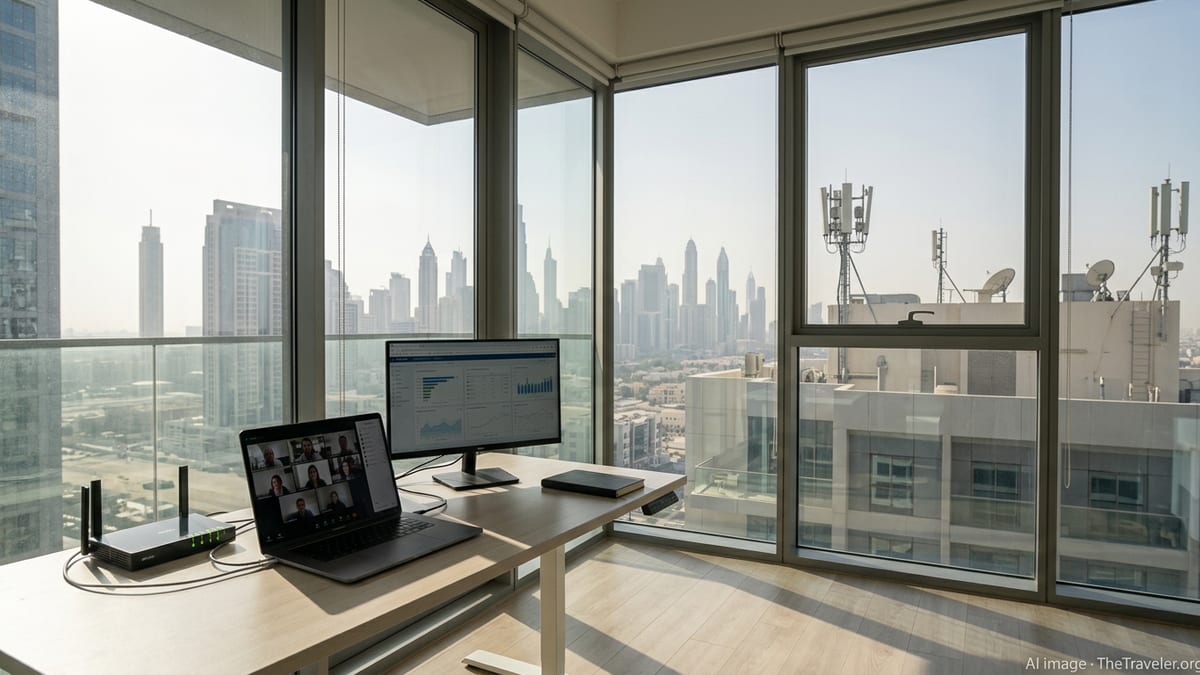
Overall Internet Performance Benchmarks
International benchmarking places the UAE at or near the top globally for both mobile and fixed broadband speeds. Recent comparative studies of internet speed by country indicate that the UAE ranks first worldwide for median mobile download speed and within the top three for fixed broadband, with mobile median speeds reported in the several hundred Mbps range and fixed broadband medians above 300 Mbps. These figures are far above global and OECD averages, reflecting sustained investment in fiber and 5G infrastructure.
Third party performance aggregators that compile millions of user tests report average fixed broadband download speeds in the UAE in the low- to mid‑hundreds of Mbps, with some providers averaging around 150 Mbps or higher on consumer plans and significantly higher speeds available on premium tiers. Upload speeds are lower but still materially better than in many countries, often in the tens of Mbps range for mainstream packages. Such performance is generally adequate for multiple simultaneous HD or 4K video calls, cloud backups, and real‑time collaboration for a typical household of remote workers.
On mobile connections, the UAE consistently appears in the global top tier for download and upload performance. Research published in 2025 highlighted that the UAE had the fastest mobile internet speeds globally, with median download speeds above 500 Mbps and strong upload performance as well. This makes mobile and 5G home wireless connections a viable primary or backup option for remote work in many locations.
These headline statistics do not mean that every building or neighborhood achieves top‑ranked speeds in practice. However, they indicate that, as a baseline, the UAE offers internet performance levels that are fully compatible with demanding remote work profiles, and often substantially better than those in many traditional expat destinations.
Fixed Broadband Options and Typical Speeds
Fixed broadband is the mainstay for serious remote work in the UAE, especially for those running bandwidth‑intensive workflows or needing predictable performance. The residential fixed market is dominated by two operators that provide fiber‑to‑the‑home (FTTH) or high‑speed broadband: e& (often still referred to by its legacy brand Etisalat) and du. Wholesale infrastructure sharing and municipal planning mean that fiber coverage is very high in major urban centers and large residential developments.
Publicly available speed statistics for 2025 show average download speeds around 150 Mbps for some leading broadband providers, with average upload speeds often above 50 Mbps on higher tiers. Entry‑level fiber plans in practice tend to offer downstream speeds from roughly 100 Mbps, scaling up to 500 Mbps or 1 Gbps in premium packages. Latency on fiber connections is typically low enough to support real‑time collaboration, with round‑trip times to regional and European hubs that are broadly comparable to other advanced markets.
For remote workers, the practical implication is that a standard modern fiber plan will generally be sufficient for: multiple concurrent HD video calls; cloud‑based development or design tools; large file transfers; and remote desktop sessions. For households with more than one heavy user, or for workflows like regular large media uploads, choosing mid‑ to high‑tier plans can provide more comfortable headroom, especially on upload capacity.
In some buildings or lower‑density areas, fixed fiber may not be available, or internal building wiring may limit achievable speeds. In such cases, providers often propose 5G or LTE home wireless products as alternatives. These can deliver high peak speeds, but their consistency can be more sensitive to signal quality and cell congestion, so they should be evaluated carefully where fixed fiber is not present.
Mobile Networks, 5G Coverage, and Home Wireless
Mobile networks in the UAE are among the most advanced globally, with both major operators running extensive 5G deployments. One operator reported 98.5 percent 5G population coverage by late 2023, and both continue to expand and upgrade their networks. Official materials from the incumbent operator confirm 5G availability across selected zones nationwide, particularly in major cities and transport corridors. Independent mobile experience reports for early 2025 also show very high mobile data speeds and strong user experience scores, including for 5G services.
For remote workers, this environment enables two important use cases. First, 5G mobile connections provide a robust backup when fixed broadband fails, allowing tethering from a smartphone or use of a dedicated 5G router. Second, in areas with strong 5G signal but no fiber, 5G home wireless plans can effectively replace fixed broadband. Recent technical announcements show that one major operator has begun commercial deployment of advanced 5.5G features, such as four‑carrier aggregation, which are designed to improve speed consistency and capacity, with wider rollout planned through 2026.
However, coverage maps and marketing claims do not fully capture on‑the‑ground variability. User reports on public forums indicate that 5G coverage can differ noticeably between operators in specific neighborhoods, with one provider performing better in certain downtown areas and the other in different districts. Indoors penetration can also vary by building design and materials. Remote workers who plan to rely on 5G as a primary or critical backup connection should, where possible, test both major networks at their intended residence, preferably at different times of day, before committing.
It is also important to note that some 5G home wireless plans may indirectly limit international throughput or deprioritize certain traffic types such as VPNs or high‑bandwidth streaming. While not always disclosed in detail, anecdotal reports suggest that traffic management and prioritization policies can affect perceived performance for remote workers whose tools and platforms are hosted outside the UAE.
Reliability, Outages, and Environmental Factors
In addition to raw speed, remote workers need to assess reliability under normal conditions and resilience under stress. The UAE’s telecommunications infrastructure is generally robust, with dense fiber backbones and modern data center facilities. Routine outages at the access level are relatively infrequent in major urban centers compared with many emerging markets, and operators have established processes for fault resolution and customer support.
However, recent events highlight that the region is still exposed to environmental and geopolitical risks that can have connectivity implications. In April 2024, severe storms and floods across the UAE caused widespread power and internet outages, as documented in subsequent analyses of the event. Some residents temporarily lost power, water, and connectivity, and both public and private sectors shifted to remote‑work modes where service remained available. More recently, in March 2026, drone strikes damaged several cloud data centers in the UAE and Bahrain, briefly disrupting regional cloud services hosted on those platforms.
These incidents were exceptional rather than routine, and recovery efforts restored most connectivity within a relatively short period. Nonetheless, they illustrate that even highly advanced networks in politically significant hubs can experience short‑term service degradation during extreme weather or regional tensions. For location‑independent professionals running critical workloads, this underlines the value of redundancy strategies such as maintaining both a fixed and a mobile connection, keeping key data synchronized across multiple global cloud regions, and planning for short windows of reduced quality of service.
On day‑to‑day reliability, independent technical studies of global internet outage patterns show that the UAE’s infrastructure experiences far fewer large‑scale routing outages than many less developed markets. Small, localized issues at the last‑mile or building level remain possible, particularly in older properties or those with complex internal wiring. Prospective residents should not assume uniform reliability across all buildings, even within the same neighborhood.
Latency, International Routing, and Remote Collaboration
For many remote workers, latency and international routing matter as much as raw throughput. The UAE’s geographic location between Europe, Asia, and Africa has allowed it to develop into a significant regional connectivity hub, with multiple subsea cable landings and strong links to major global internet exchanges. This typically results in competitive latency to European and Asian cloud regions compared with more remote destinations.
Latency from the UAE to major European cloud hubs is often in the range that supports real‑time collaborative work, including video conferencing and remote desktop usage, with limited perceptible lag. Connections to North American servers tend to exhibit higher latency due to distance and routing, but remain adequate for most professional collaboration tools that are designed to cope with global round‑trip times. For latency‑sensitive activities such as high‑frequency trading or competitive online gaming, optimization and provider choice can make a noticeable difference.
One practical consideration for remote workers is the way some consumer broadband and mobile plans handle VPN traffic and cross‑border streaming. There are user reports of throttling or reduced performance on certain VPN protocols or international media services, particularly on some wireless plans. While enterprise‑grade VPNs and major collaboration platforms usually maintain acceptable performance, professionals who depend heavily on VPN‑tunneled traffic should test their corporate tools on a local connection, ideally during a trial period, and be prepared to adjust protocol settings or provider choice if performance proves inconsistent.
From a reliability perspective, the presence of local points‑of‑presence for major cloud providers and content delivery networks can improve responsiveness for commonly used tools and services, even when their core infrastructure is hosted in other regions. This is especially beneficial for software development, content production, and data‑intensive workflows that leverage distributed cloud architectures.
Provider Choice, Building Constraints, and Setup Considerations
In most UAE emirates, consumers do not have the same level of retail competition seen in some liberalized markets, but they do typically have at least two major providers to choose from for mobile services and, in many areas, for fixed broadband. In some developments, infrastructure agreements mean that only one fixed provider serves the building, limiting short‑term choice. Remote workers should clarify which provider serves their prospective building and what technologies are available: true FTTH, VDSL over copper, or wireless‑based home internet.
Building‑level constraints can materially affect realized speeds. Older properties may have legacy internal cabling that cannot sustain advertised gigabit speeds to every room without additional equipment. Wi‑Fi performance inside large apartments or villas can also be a limiting factor, especially in reinforced concrete constructions. In practice, professionals who depend on high‑quality video calls should plan for a wired Ethernet connection to their primary workstation where possible, and consider mesh Wi‑Fi or additional access points to ensure stable coverage in home offices.
Prospective remote workers should also consider installation lead times and contractual terms. In many cases, fixed broadband installation in major cities can be completed within a few days to a couple of weeks, but this can vary by building and by whether new internal cabling is required. Contracts may involve minimum terms and early termination fees. Where timelines are tight, using 5G mobile data or a temporary wireless home internet device can bridge the gap until fixed fiber is installed.
Finally, equipment compatibility merits attention. Some imported devices, particularly 5G smartphones or routers designed for other markets, may not fully support the local 5G bands or may require software updates to enable 5G and VoLTE features on UAE networks. Remote workers planning to bring their own hardware should verify band support and be prepared to update firmware or use locally supplied routers where necessary.
The Takeaway
From an internet speed and connectivity perspective, the UAE is broadly well suited to remote work, offering world‑leading mobile speeds and top‑tier fixed broadband performance in major urban centers. Typical fiber connections provide ample bandwidth for modern professional use, and dense 5G coverage offers both high‑performance mobile data and a realistic backup option where fixed lines are disrupted.
At the same time, conditions are not uniform. Variations between neighborhoods, buildings, and operators, as well as occasional disruptions due to extreme weather or regional events, mean that individual remote workers should still conduct targeted due diligence. Testing both major mobile networks at the intended residence, confirming availability of true fiber, and planning for redundancy between fixed and mobile connections can significantly reduce operational risk.
For location‑independent professionals, the UAE’s connectivity profile is a strong positive factor in relocation decisions. With appropriate provider selection, hardware setup, and contingency planning, most remote work scenarios can be supported reliably, including bandwidth‑intensive and latency‑sensitive roles.
FAQ
Q1. Is the internet in the UAE fast enough for full‑time remote work?
The UAE’s fixed and mobile networks provide speeds well above global averages, and in most urban locations they are more than sufficient for full‑time remote work.
Q2. How reliable is home internet in the UAE for daily video meetings?
In major cities, fiber connections are generally stable and reliable for daily video conferencing, though occasional local outages or building‑specific issues can still occur.
Q3. Can I rely on 5G instead of fixed broadband for remote work?
In areas with strong signal, 5G home wireless can support remote work, but performance is more sensitive to location and network load, so a fixed fiber line is usually preferable where available.
Q4. Are upload speeds in the UAE adequate for large file transfers?
Many fiber plans offer upload speeds in the tens of Mbps or higher, which are generally sufficient for large file transfers, cloud backups, and frequent screen sharing.
Q5. Will my VPN and corporate tools work properly from the UAE?
Most major VPNs and collaboration platforms work, but some consumer plans may deprioritize certain traffic types, so it is advisable to test your specific tools on a local connection.
Q6. How is latency from the UAE to Europe and North America?
Latency to European hubs is typically low enough for smooth real‑time collaboration, while latency to North America is higher but still workable for standard remote work applications.
Q7. Do all buildings in Dubai and Abu Dhabi have fiber internet?
Fiber coverage is extensive but not universal; some buildings still rely on older wiring or wireless solutions, so availability should be checked for each specific property.
Q8. Should I have both fixed broadband and mobile data for redundancy?
Professionals with critical uptime needs often maintain a fiber line plus a 5G or 4G backup, improving resilience against localized outages or maintenance work.
Q9. Are there frequent large‑scale outages affecting the whole country?
Large‑scale outages are unusual; most disruptions tend to be localized, although extreme weather or regional events have occasionally caused broader but temporary impacts.
Q10. How quickly can I get internet installed after moving to the UAE?
In many urban areas installation can be completed within days to a couple of weeks, but timelines depend on building readiness and provider processes, so early coordination is recommended.