


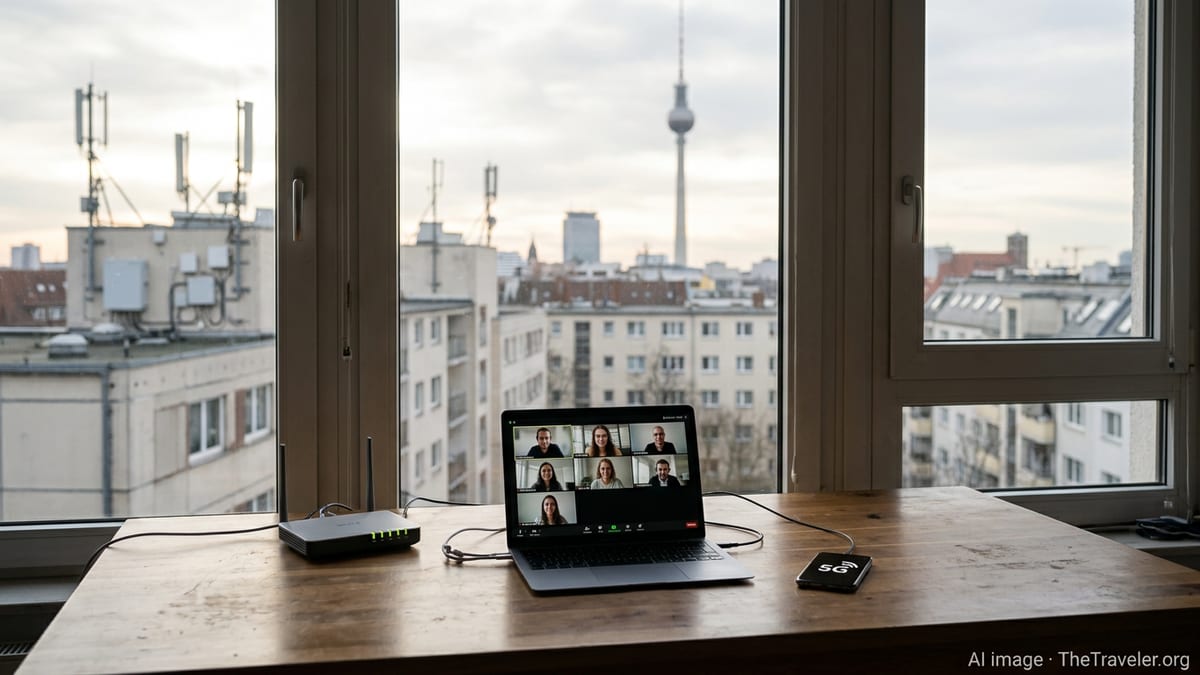
Internet speed and connectivity in Germany are central considerations for professionals, remote workers, and companies assessing a relocation. Germany is a mature digital market with widespread mobile coverage and rapidly expanding high-capacity fixed networks, but performance and availability still vary markedly by region and technology. Understanding these differences is critical for evaluating whether Germany can support demanding digital workloads and always-on connectivity requirements.
National Connectivity Landscape and Regulatory Context
Germany operates a liberalized telecommunications market with several competing fixed and mobile operators. The sector is regulated by the Federal Network Agency, which sets coverage obligations and monitors service quality. For relocation planning, this results in a relatively transparent view of where services are available and how they perform, although local realities can differ substantially from national averages.
On fixed broadband, Germany has moved from a legacy copper and cable environment toward high-speed fiber and other very high capacity networks. Recent European digital progress reports indicate that around three-quarters of households now have access to very high capacity networks, with national targets aiming for essentially universal gigabit-capable coverage by 2030. This transition is ongoing, which means that while many urban and suburban locations already enjoy high-performance connections, some rural or peripheral areas still rely on slower technologies.
In mobile communications, Germany has achieved near-universal 4G coverage and very extensive 5G rollout. Official monitoring data show mobile broadband coverage of well above 95 percent of the country’s territory, and 5G availability for the vast majority of the population, reflecting sustained investment by the main operators. For most relocation scenarios, this ensures basic mobile data access almost everywhere, with higher speeds in towns, cities, and transport corridors.
From a policy perspective, Germany links broadband expansion to its broader economic and digitalization strategy. Ambitious coverage and performance targets have been set for both fiber and 5G, and public funding programs support infrastructure roll-out in commercially less attractive rural regions. For relocating organizations or individuals, this policy environment suggests that connectivity in currently weaker regions is likely to improve, but not always on a timeframe aligned with short-term relocation decisions.
Fixed Broadband Speeds and Technology Mix
Measured fixed broadband performance in Germany is generally adequate or strong for typical professional workloads, but still lags the best-performing European countries in terms of median speed and fiber penetration. Aggregated performance data for late 2024 and early 2025 indicate average download speeds for fixed lines above 100 Mbps, with median values around the 60 Mbps range and a sizeable share of connections delivering between roughly 80 Mbps and 300 Mbps. This is sufficient for high-quality video conferencing, cloud collaboration, and most remote work applications, though upload speeds may be more modest on legacy technologies.
Speed tests and independent benchmarking show notable variation by provider and technology. Fiber-to-the-home lines and modern DOCSIS cable networks can routinely exceed several hundred megabits per second, with top consumer offers reaching into multi-gigabit territory in some cities. Cable operators, in particular, report average download speeds that are several hundred megabits per second, reflecting aggressive upgrades and capacity expansion. By contrast, connections delivered over older copper-based DSL infrastructure may still operate at tens of megabits per second or less, especially in rural or edge locations.
Service quality and consistency are also important. Monitoring by the national regulator indicates that the majority of fixed broadband customers receive at least half of their contractually agreed maximum download speed during measurement periods, indicating a reasonably robust relationship between advertised and actual performance. However, this also implies that a minority of users experience significant underperformance relative to their contract. For relocation planning, this makes it essential to evaluate specific, address-level offers rather than relying solely on national statistics or nominal speeds.
For home offices and small corporate branches, a practical benchmark is that connections above 100 Mbps down and 20 Mbps up, with stable latency, are increasingly common in urban and many suburban postcodes, but cannot yet be assumed in all rural municipalities. In locations with only basic DSL, relocation stakeholders may need to consider business-grade leased lines or fixed wireless alternatives if mission-critical workloads depend on consistently high throughput and low latency.
Coverage, Urban–Rural Disparities, and Regional Patterns
Germany’s connectivity map exhibits clear regional differences that can materially affect relocation suitability. Major metropolitan areas such as Berlin, Hamburg, Munich, Frankfurt, Cologne, Düsseldorf, and Stuttgart, as well as many mid-sized cities, typically enjoy dense fixed broadband infrastructure with multiple competing providers and growing fiber availability. In these urban centers, gigabit-capable connections are increasingly standard for both residential and business users.
In contrast, rural districts, smaller towns, and some peripheral industrial zones may still depend primarily on upgraded DSL lines or limited cable coverage. European digital progress reporting places Germany’s very high capacity network coverage below that of some leading EU peers, reflecting the difficulty of extending fiber and gigabit-capable cable across a geographically large country with dispersed settlements. For relocation to small villages or isolated properties, it cannot be assumed that high-speed fixed broadband will be immediately available.
The federal and state governments operate subsidy programs to incentivize build-out in underserved rural zones, and there is evidence of rapid progress toward intermediate targets such as fiber coverage for approximately half of all households by the mid-2020s. Nonetheless, fiber deployment follows a phased, multi-year trajectory, and gaps can persist for some time. For companies placing data-intensive operations in secondary regions, site selection should incorporate a detailed review of local broadband plans, including any scheduled upgrades.
Within cities, connectivity can also vary by neighborhood and building. Older multi-unit buildings may have constraints on in-building wiring upgrades, and some business parks built before the current fiber push may not yet be served by high-capacity lines despite otherwise favorable locations. As a result, professional due diligence at the street or building level is crucial for data centers, media production facilities, and other bandwidth-heavy operations considering a German base.
Mobile Internet, 5G Expansion, and Performance
Mobile connectivity in Germany has improved markedly in recent years and now represents a strong complement to fixed broadband for relocation scenarios. National monitoring figures for 2024 and 2025 show that 5G networks reach roughly the entire population and the vast majority of the country’s land area, with 4G long established as essentially ubiquitous for both population and territory. Individual operators report 5G population coverage at or near 99 percent, and overall mobile broadband coverage above the high nineties in percentage terms.
In performance terms, 4G networks provide baseline mobile broadband speeds that are generally sufficient for email, standard-definition streaming, and basic remote work. 5G, particularly in mid-band spectrum around 3.5 GHz, delivers substantially higher throughput and lower latency in urban and high-traffic areas. Practical user speeds in major cities often reach hundreds of megabits per second under favorable conditions, although real-world performance depends on network load, device capability, and indoor signal quality.
5G standalone networks, which operate on dedicated 5G cores rather than relying on 4G anchors, are being rolled out and already cover a substantial majority of the population. This enhances latency and reliability for advanced use cases such as real-time collaboration, AR/VR, or industrial applications. For most relocating professionals, the immediate benefit is more consistent high-speed mobile data in cities, major towns, and along key transport routes such as autobahns and intercity rail lines.
There remain coverage limitations in sparsely populated rural areas, forests, and some interior buildings with heavy construction materials. In such locations, the connection may fall back from 5G to 4G or even 2G for voice and basic data. However, for the vast majority of residential and office environments, particularly in and around urban centers, mobile broadband in Germany can be considered reliable and fast enough for backup connectivity, tethering, and on-the-go remote work.
Reliability, Service Quality, and Network Resilience
Beyond headline speeds and coverage, reliability is a critical factor for relocation decisions. Germany’s telecommunications networks are generally stable, with relatively few large-scale outages. National monitoring focuses on issues such as the ratio of actual to advertised speeds, latency profiles, and the frequency of disruptions. Overall, the quality of service metrics point to a mature infrastructure that usually delivers close to expected performance, especially on modern fixed and 5G connections.
Power supply stability and physical network resilience are also relevant. Germany’s electricity grid is considered reliable by international standards, reducing the risk of connectivity loss due to power outages, although localized interruptions are always possible. Major operators invest in redundancy and diverse routing, particularly for business services, and offer service level agreements for enterprise-grade products that go beyond consumer offerings.
Customer experience varies by operator. Independent benchmarking and consumer speed-testing reports identify different leaders for aspects such as download speed, upload speed, latency, and customer satisfaction. Some providers excel in cable-based gigabit services, while others focus on fiber builds or premium business connectivity. For relocation stakeholders, it is advisable to compare provider-level performance data for the specific city or region in question rather than relying solely on national rankings.
From a risk management perspective, many organizations in Germany adopt hybrid strategies combining fixed and mobile connectivity. Typical approaches include using 5G routers as failover for fixed lines, procuring dual redundant fixed connections from different providers, or deploying SD-WAN solutions that dynamically route traffic over multiple networks. These options can mitigate the impact of sporadic local outages and may be particularly important for operations with stringent uptime requirements.
Digital Readiness for Remote Work and Data-Intensive Professions
For remote workers, digital nomads, and data-driven professionals, Germany offers a generally supportive connectivity environment, especially in urban and technology-focused regions. Typical office or residential connections in cities can comfortably support multiple simultaneous high-definition video calls, cloud-based productivity suites, and large file transfers. Latency on fixed and 5G networks is usually low enough for real-time collaboration tools, online trading platforms, and most professional-grade communication services.
However, Germany is not uniformly ideal for all digital use cases. Some creative industries, such as video post-production or game development, which rely on frequent multi-gigabyte or terabyte-scale data transfers, may find copper-based DSL or older cable connections in certain areas to be a bottleneck. In these cases, selecting a location with proven fiber availability, or contracting dedicated business lines, becomes essential. Cloud-heavy organizations may also prefer cities with data center clusters to minimize latency to hosted services.
Public and semi-public connectivity options, such as coworking spaces and serviced offices, are widespread in larger cities and increasingly common in regional centers. These facilities typically advertise high-speed connections and redundant links, making them attractive for professionals who require robust connectivity but do not wish to manage infrastructure themselves. For individuals relocating without an employer-managed office, verifying the local availability and bandwidth offerings of such spaces can be a key part of relocation due diligence.
For households with multiple remote workers or intensive streaming needs, future-proofing is recommended. Selecting properties with access to at least one gigabit-capable provider, or where fiber roll-out is already completed or firmly scheduled, reduces the risk of capacity constraints as digital demands grow. As Germany continues its transition toward a fully gigabit-capable fixed network, these considerations will gradually diminish, but they remain highly relevant in the mid-2020s.
The Takeaway
Internet speed and connectivity in Germany are generally strong and improving, but they are not homogeneous across the country. On average, fixed broadband offers speeds that are more than adequate for typical professional and personal use, with gigabit-class services widely available in cities and spreading outward. Mobile networks deliver near-universal 4G and extensive 5G coverage, enabling high-speed connectivity for most on-the-go and backup scenarios.
For relocation decisions, the main risk lies in local variability. Rural areas, some smaller towns, and specific buildings may still depend on older infrastructure and deliver significantly lower speeds than national averages suggest. As a consequence, due diligence at the address level is essential, particularly for bandwidth-intensive operations, multi-person remote-working households, or businesses with strict uptime requirements.
Overall, Germany can be regarded as a viable location for connectivity-dependent professionals and organizations, provided that site selection explicitly accounts for local fixed and mobile infrastructure. As ongoing investment in fiber and 5G continues, the connectivity environment is expected to become more uniformly high-performance, further strengthening Germany’s position as a digital work location.
FAQ
Q1: Is internet speed in Germany generally sufficient for remote work?
Yes, in most urban and suburban areas fixed and mobile internet speeds are sufficient for remote work, including video conferencing and cloud-based tools, though rural areas require closer scrutiny.
Q2: How reliable is home internet in Germany for business use?
Home internet connections are generally stable, but reliability varies by provider and technology; business users often add mobile or second-line backup for critical operations.
Q3: Are gigabit connections widely available in Germany?
Gigabit-capable connections via fiber or upgraded cable are widely available in major cities and many towns, but are not yet universal in rural or remote regions.
Q4: How good is 5G coverage in Germany?
5G covers the vast majority of the population and a large share of the country’s territory, with particularly strong coverage in cities, transport corridors, and industrial regions.
Q5: Can mobile internet alone support full-time remote work in Germany?
In many locations, 4G and 5G speeds can support full-time remote work, but capacity limits, data plans, and indoor coverage mean that a fixed line is usually recommended as the primary connection.
Q6: Are there big differences in internet quality between German cities and rural areas?
Yes, cities typically have multiple high-speed options including fiber, while rural areas may rely on slower DSL or limited cable, leading to lower speeds and fewer provider choices.
Q7: What internet speeds can a typical household expect in a German city?
A typical urban household can often access packages from 100 Mbps up to 1 Gbps download, with practical speeds that comfortably handle multiple simultaneous video calls and streaming.
Q8: How important is provider choice for connectivity quality in Germany?
Provider choice is important, as performance, customer service, and technology used differ; in many locations, comparing several providers can significantly improve speed and reliability outcomes.
Q9: Is it easy to upgrade to fiber internet after moving to Germany?
In areas where fiber is already deployed, upgrading is usually straightforward, but in locations without existing fiber, upgrades depend on local roll-out schedules that may take several years.
Q10: Should companies in Germany invest in redundant internet connections?
Companies with critical digital operations often invest in redundant fixed lines or fixed-plus-5G setups to ensure continuity during outages or maintenance, especially in bandwidth-intensive sectors.