


More news on this day
As regional conflict triggered mass flight cancellations across Gulf hubs, an Indian passenger stranded in the United Arab Emirates drew widespread attention by praising the country’s swift, coordinated support, sharpening debate over what truly separates world-class nations from the rest.
Get the latest news straight to your inbox!
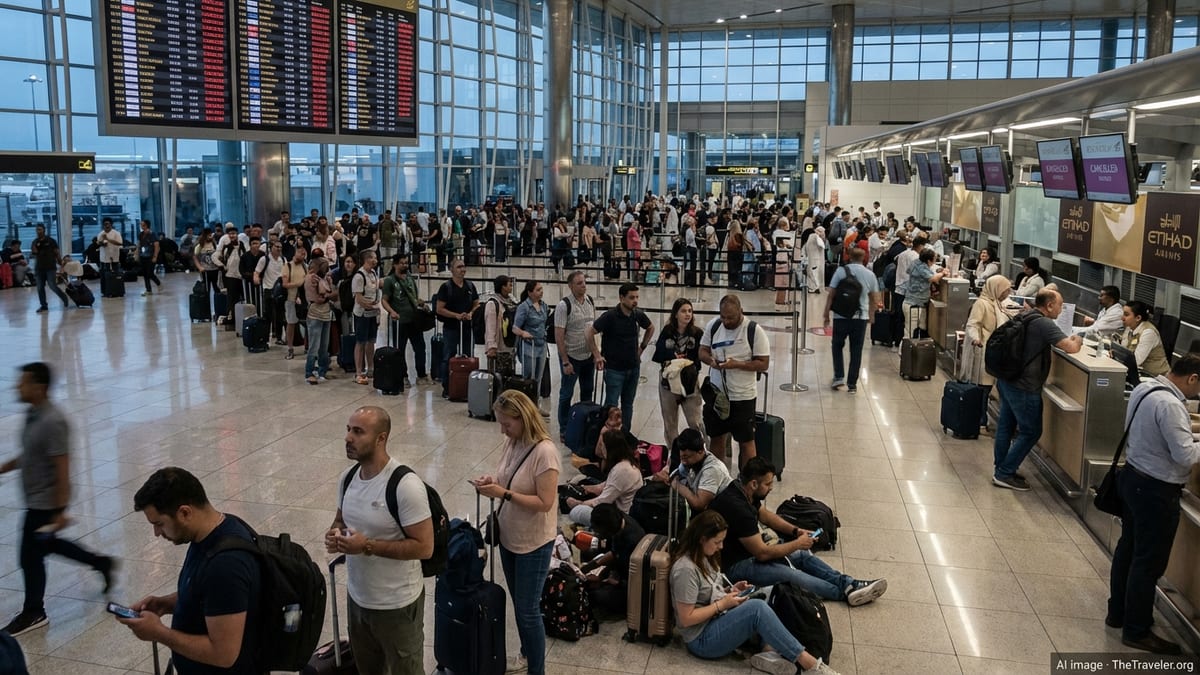
Flight chaos turns into a real-time stress test
The latest wave of airspace closures over parts of West Asia since late February 2026 has disrupted hundreds of flights linking India, the Gulf and Europe. Reports indicate that Dubai International and Abu Dhabi’s Zayed International Airport saw days of rolling delays and cancellations as airlines rerouted or grounded aircraft for safety.
Travel industry trackers and passenger advocacy groups describe the situation as an unplanned stress test for global aviation systems. Airports in the UAE, which function as major transit hubs for Indian travellers, were suddenly managing thousands of stranded passengers, visa issues and hotel bottlenecks, often with limited advance warning.
While many travellers reported long queues, uncertainty and last-minute cancellations, a contrasting narrative began circulating online. Among the most widely discussed accounts was that of an Indian passenger who had been transiting through Abu Dhabi and publicly praised how swiftly UAE authorities and local systems stepped in to provide food, hotel stays and onward travel arrangements.
The post, coming at a time when passengers elsewhere reported confusion over refunds and rebooking, has become a reference point in conversations about which countries handle crises in a way that feels humane, predictable and efficient.
‘Instant humanity’ and the power of visible systems
According to published coverage of the episode, the stranded Indian traveller highlighted what he described as an absence of chaos at Abu Dhabi airport, pointing instead to on-the-spot emergency visas, meal vouchers and hotel transfers that were communicated clearly to passengers stuck in transit. Other reports from Dubai and Sharjah described volunteers, airport staff and hotel partners working extended shifts to handle waves of unexpected arrivals.
Observers note that these measures went beyond basic customer service. The rapid issuance of short-term visas, coordination with hotels and organisation of shuttle buses illustrated how immigration, civil aviation and tourism stakeholders can act in concert when crisis protocols are rehearsed in advance.
Publicly available information shows that major UAE-based carriers simultaneously rolled out temporary policies that allowed free rebooking within specified windows, expanded access to refunds and created dedicated channels for stranded travellers. While implementation was uneven in the earliest hours, these steps helped stabilise the situation after the most intense disruption passed.
For passengers watching departures boards fill with red “cancelled” notices, the immediate visibility of such systems mattered as much as the policies themselves. Analysts argue that the perception of “instant humanity,” even in a high-tech hub airport, stems from a mix of clear loudspeaker announcements, multilingual staff and rapid, on-the-ground decisions that acknowledge travellers’ basic needs for shelter, food and information.
Indian flyers caught between domestic bottlenecks and Gulf efficiency
The episode has also thrown a spotlight on the complex relationship between Indian travellers, Indian carriers and Gulf hubs. Indian nationals make up one of the largest passenger segments through UAE airports, and disruptions in West Asian airspace quickly cascade into crowded terminals from Kochi and Mumbai to Dubai and Abu Dhabi.
Recent history has already left many Indian passengers sensitive to airline reliability. A separate wave of domestic cancellations and delays in India, linked to crew scheduling issues at a major low-cost carrier, disrupted thousands of journeys between late 2025 and early 2026. Against that backdrop, travellers now compare how different jurisdictions treat them when things go wrong.
In accounts emerging from the UAE, some Indian passengers stranded by cancellations reported that local systems provided hotel stays, meal vouchers and assistance with rescheduling, even when the operating carrier was not based in the Emirates. At the same time, other travellers described difficulties securing timely updates or clarity from individual airlines, underscoring that airline-level customer care still varies widely.
Travel analysts say the contrast is telling: when state-level infrastructure and policy frameworks are strong, even airline missteps can be cushioned by airports, immigration authorities and tourism bodies acting together. For many Indian passengers affected by the recent crisis, the UAE’s ability to mobilise that broader machinery reinforced its reputation as a world-class hub.
What separates ‘world-class’ nations in a crisis
The Indian passenger’s viral praise has sparked a broader discussion about what defines a world-class nation when flights fail, systems falter and travellers are vulnerable. Experts in aviation and crisis management point to a cluster of factors rather than a single silver bullet.
First, preparedness plays a central role. Publicly available information from UAE aviation authorities and airports indicates that contingency plans for regional airspace closures existed long before this latest crisis, including frameworks for rerouting traffic, staging repatriation flights and coordinating with hotels near major hubs. When conflict escalated, those blueprints could be activated rather than improvised.
Second, the ability to take cross-sector decisions at speed appears to be a differentiator. Emergency visa measures, rapid hotel contracting and the deployment of ground transport for stranded passengers suggest that immigration, tourism and aviation stakeholders were empowered to act within hours, not weeks. This contrasts with situations in some countries where conflicting regulations can slow even basic steps such as extending visitor stays or honouring airline-issued vouchers.
Third, communication is increasingly seen as a marker of quality. Reports from the recent disruption show that passengers responded positively when they received regular app notifications, airport announcements and printed guidance in multiple languages, even if exact departure times remained uncertain. Where communication lagged, frustration mounted, regardless of the actual scale of disruption.
Lessons for global travel hubs and emerging markets
For other countries aspiring to expand their aviation sectors, the events in the UAE offer clear lessons. Travel policy commentators note that world-class status is not defined only by gleaming terminals or high passenger volumes, but by how quickly a system can pivot from normal operations to emergency mode without losing sight of travellers’ basic needs.
Emerging markets building new airports or courting long-haul carriers are watching closely. The combination of prepared contingency plans, flexible visa regimes and strong public-private coordination seen in the UAE is increasingly viewed as a competitive advantage in attracting transit traffic from regions like South Asia and Africa.
For India, where outbound travel is surging and domestic infrastructure is under pressure, the experience of stranded passengers in Gulf hubs is feeding into debates over aviation reform. Policy discussions now frequently reference international best practices that prioritise passenger welfare in crises, from mandatory care standards at airports to clearer compensation rules for cancellations.
As memories of the latest disruption slowly fade, the stranded Indian traveller’s praise of the UAE’s response remains a powerful narrative. It highlights a simple but demanding benchmark for nations that aspire to be world-class: when unforeseen shocks hit, the real measure is how quickly systems translate capacity and resources into tangible support that ordinary passengers can see, feel and trust.