


More news on this day
Iran and Turkey are moving closer to construction of a new cross-border railway connection that planners position as a strategic trade artery between Asia and Europe, complementing existing regional corridors and signaling a more rail-focused era for freight across the Middle East.
Get the latest news straight to your inbox!
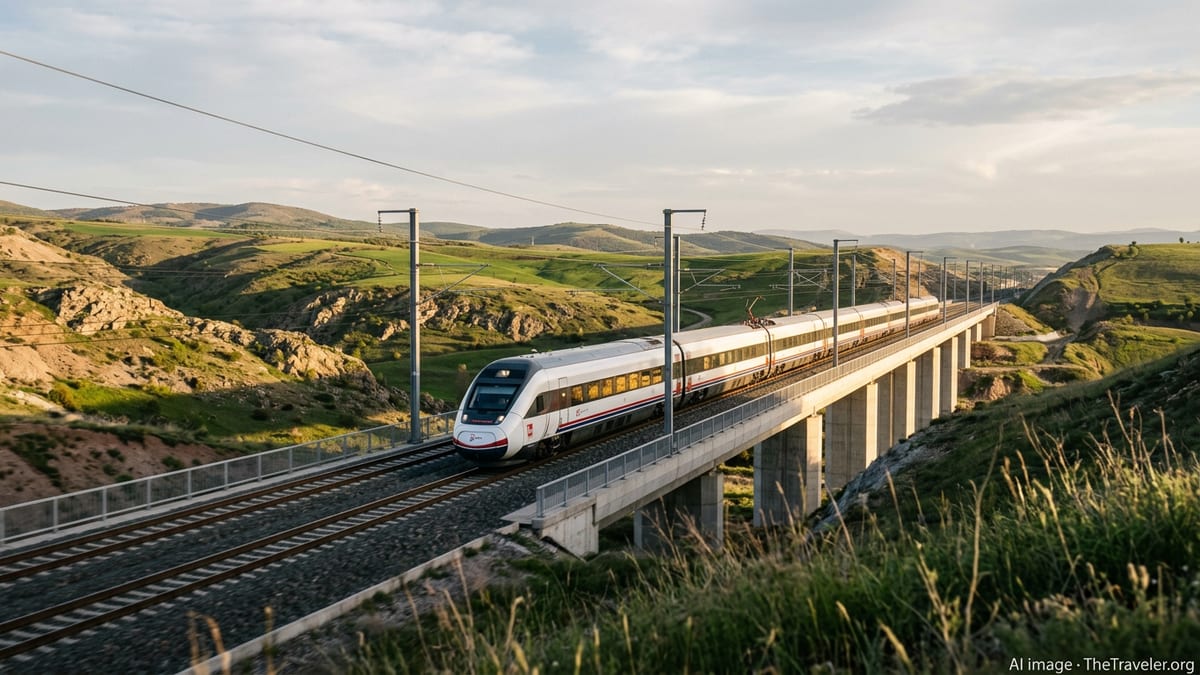
A Strategic Rail Link at the Iran–Turkey Frontier
Publicly available information indicates that Tehran and Ankara agreed in late 2025 to develop a new joint railway linking their domestic networks at the border, with an estimated cost of around 1.6 billion dollars. The line is framed as a priority project intended to create a continuous rail corridor from China and Central Asia through Iran and Turkey to European markets, offering an alternative to congested maritime routes and sanction-sensitive chokepoints.
According to published coverage, discussions between the two countries focus on upgrading and extending existing infrastructure near the main border crossings so that long-distance freight trains can move with fewer breaks of gauge and shorter customs procedures. The planned link is presented as part of a broader effort to turn the southern stretch of the historic Silk Road into an all-rail corridor that could host regular container traffic and energy-related cargo.
Reports also connect the planned Iran–Turkey line to ongoing work on Iran’s domestic rail grid, including the Chabahar–Zahedan and Rasht–Astara lines that form key sections of the International North–South Transport Corridor and Iran’s east–west spine. Improved connectivity at Iran’s western frontier would give these north–south and east–west routes more direct access to Turkey’s network and, by extension, to the European Union rail system via Bulgaria and Greece.
While exact technical parameters, such as electrification, speed, and routing, have yet to be fully disclosed in open sources, the stated ambition is to carry both bulk and intermodal freight. Analysts note that the project would require significant investment in signalling, border facilities, and potentially double tracking on busy approach segments to handle forecast demand.
Turkey’s Rail Push toward the South Caucasus and Iran
The emerging Iran–Turkey cross-border project comes as Ankara accelerates a series of rail schemes intended to cement its role as a major hub on the so-called Middle Corridor between East Asia and Europe. Turkish and Azerbaijani plans for the Kars–Nakhchivan railway, where construction began in 2025 with a projected completion around 2030, are central to this strategy and intersect closely with Iranian transit ambitions.
Project documents and official summaries describe the Kars–Nakhchivan line as a new international railway connecting eastern Turkey to Azerbaijan’s Nakhchivan exclave, running along the Aras River near the Iranian border. With an investment value of about 2.4 billion euros, the route is planned with tunnels, bridges, viaducts and modern signalling, and is expected to handle substantial freight flows once it links up with Azerbaijan’s internal rail upgrades toward Nakhchivan and the wider Caspian region.
Analytical studies on the South Caucasus note that Nakhchivan’s geography, bordered by Turkey, Armenia and Iran, makes it a pivotal junction for future east–west and north–south routes. Azerbaijan has already agreed with Iran to build road and railway connections along the Aras Corridor to reach Nakhchivan via Iranian territory, creating options to tie the Kars–Nakhchivan line to Iranian networks and onward to the Persian Gulf.
From Turkey’s perspective, multiple rail initiatives are converging. Modernisation of the Divriği–Kars corridor and projects such as the Istanbul–Kapıkule high-speed freight and passenger line are backed by international lenders as part of a broader effort to shift cargo from road to rail, reduce emissions and strengthen links to both the South Caucasus and the EU. The prospective Iran–Turkey border link would plug directly into this evolving mesh of routes.
Iran’s Rail Network as a Eurasian Transit Backbone
For Iran, closer rail integration with Turkey complements an expansive agenda to position the country as a land bridge between the Persian Gulf, Central Asia, the South Caucasus and Russia. Agreements with Russia to finance the Rasht–Astara railway, a missing section of the International North–South Transport Corridor, have pushed that project forward, while progress on the Chabahar–Zahedan line on Iran’s eastern flank is intended to give Central Asian states shorter access to a deep-sea port.
Regional transport organizations such as the UN Economic Commission for Europe and the Economic Cooperation Organization highlight the Almaty–Tehran–Istanbul and Trans-Caspian corridors as increasingly important inland routes. Recent assessments point to double-digit growth in cargo volumes on these tracks as shippers look for diversified options amid geopolitical uncertainty and disruptions to traditional sea lanes in the Red Sea and Black Sea.
Within this framework, the new Iran–Turkey border railway is portrayed as an essential western outlet. By providing a more direct, higher-capacity path into Turkey’s upgraded network, the line would help integrate existing north–south flows through Iran with the east–west Middle Corridor and the Istanbul–Tehran–Islamabad freight service. This could significantly shorten end-to-end travel times between South Asia, the Gulf and European markets compared with purely maritime routes.
Analysts caution that realizing this potential will require not only hard infrastructure but also coordinated tariffs, digital documentation, harmonized customs procedures and predictable schedules. Regional coordination committees, established in recent years to tackle these issues, are expected to treat the Iran–Turkey railway as a priority test case once construction starts.
Economic Stakes for Trade, Energy and Logistics
The economic implications of a modern rail link between Iran and Turkey extend beyond bilateral trade. Both countries are positioning the project as part of a web of corridors designed to capture a share of Eurasian freight that might otherwise move by sea through the Suez Canal or overland via Russia. Studies on rail competitiveness suggest that improved infrastructure between Europe and East Asia can shift additional volumes from air and maritime transport, particularly for time-sensitive and higher-value goods.
For Turkey, enhanced rail access to Iran and, indirectly, to the Gulf and South Asia dovetails with the separate Development Road initiative, which aims to connect the Turkish border with Iraq’s Grand Faw Port through 1,200 kilometers of new rail and highway. If both the Development Road and the Iran–Turkey railway advance on schedule, logistics operators could eventually offer multiple parallel land bridges linking the Mediterranean, the Gulf and the Indian Ocean.
Iran, meanwhile, views transit fees and related services as a growing revenue stream, especially as it completes core segments of its north–south and east–west network. A reliable western outlet into Turkey would allow the country to market itself more credibly as a hub for containerized trade between India, Russia, Central Asia and Europe, potentially attracting investment in dry ports, logistics parks and industrial zones along the route.
Energy transit is another angle. While pipelines will continue to carry most oil and gas, rail offers flexibility for refined products, petrochemicals and equipment needed for energy projects. The proximity of the planned line to existing energy corridors in eastern Turkey and northwestern Iran suggests opportunities for integrated planning, though environmental assessments emphasize the need to limit impacts on sensitive river valleys and cross-border ecosystems.
Challenges, Timelines and Regional Geopolitics
Despite growing political support, the Iran–Turkey railway faces familiar obstacles. Securing full financing for border sections and associated terminals, finalizing technical designs, and navigating sanctions-related constraints on procurement can all slow implementation. Experience with other regional megaprojects, such as the International North–South Transport Corridor, shows that even well-publicized initiatives often take years to move from agreement to operation.
Geopolitical dynamics in the South Caucasus add another layer of complexity. Alternative routes, including the Zangezur and Aras corridors linking Azerbaijan, Armenia, Iran and Turkey, are evolving in parallel and may compete or interlock with the Iran–Turkey cross-border line. Policy papers note that each new rail link in the region reshapes bargaining power among states, influencing how customs revenues, transit rights and security responsibilities are distributed.
At the same time, there are signs of growing coordination. Regional forums and multilateral lenders increasingly promote interoperability standards, climate-aligned financing and shared digital platforms for freight documentation. The Iran–Turkey railway is frequently cited in these discussions as a candidate project that could demonstrate how cross-border rail can proceed even in a fragmented political environment, provided that its design aligns with established technical parameters and environmental safeguards.
Timelines for construction and commissioning remain subject to revision, but available project descriptions point to a phased approach in which border infrastructure is upgraded in tandem with domestic capacity enhancements on both sides. If those elements move in parallel, observers expect the first freight services on the new route later in the decade, heralding a new phase in rail-based connectivity between Iran, Turkey and the wider Eurasian space.
Iran International: Iran and Turkey agree new cross-border railway
Hürriyet Daily News: Green financing for Kars–Nakhchivan railway
UNECE: Advancing transport connectivity across Europe and Asia
AIIB: Eastern Türkiye Middle Corridor Railway Development Project