


If you only have one day in Great Smoky Mountains National Park, every stop has to earn its place. Between iconic viewpoints, waterfalls, and scenic drives, it can be hard to decide whether to invest precious hours in the 3.6 mile hike to Andrews Bald. This grassy mountaintop meadow, reached from the busy Clingmans Dome area, is often described as one of the Smokies’ best views. But is it really worth hiking if you are trying to make the most of a single day in the park?
Get the latest updates straight to your inbox!
What Makes Andrews Bald Special
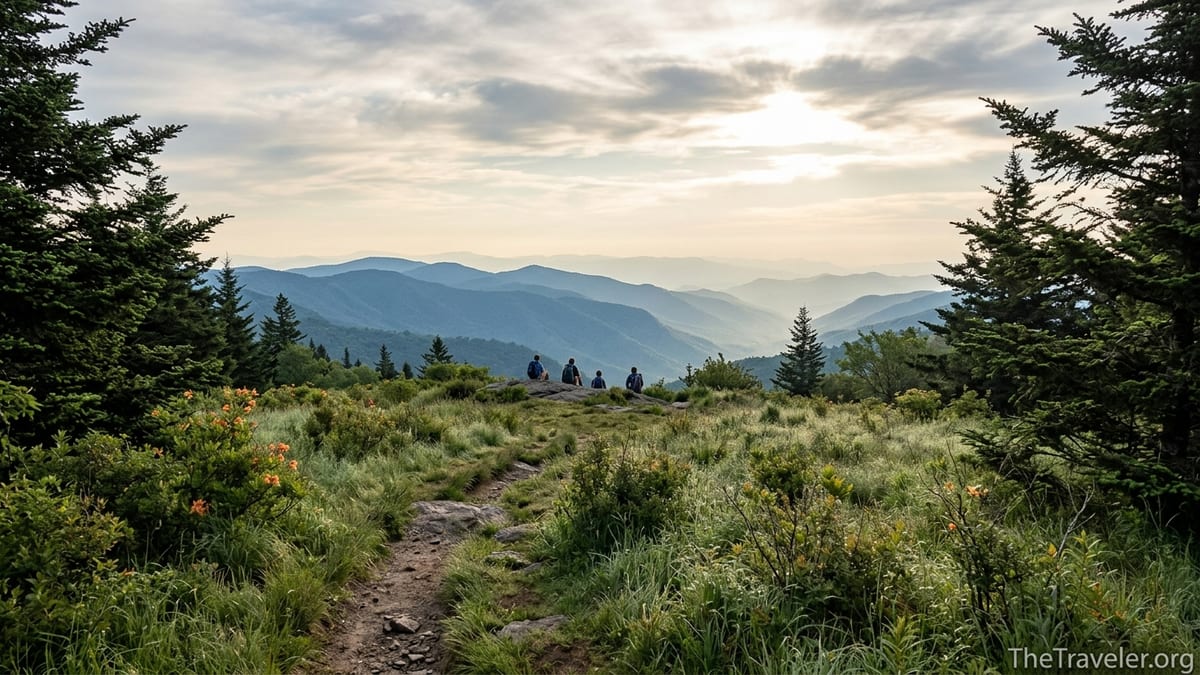
Andrews Bald is a high-elevation grassy meadow perched around 5,920 feet on Forney Ridge, just south of Clingmans Dome in Great Smoky Mountains National Park. It is one of only two grassy balds that the National Park Service actively maintains in the Smokies, the other being Gregory Bald. That alone makes it a rare experience in a park otherwise dominated by dense, closed-in forest. From the open meadow, you look out across a sea of blue ridges rolling into North Carolina, with a wide sky overhead that feels dramatically different from most tree-lined trails in the region.
The bald itself is reached by hiking the Forney Ridge Trail from the Clingmans Dome parking area. The national park lists the route as about 1.8 miles each way, or roughly 3.6 miles round trip, though some hikers’ GPS tracks come in slightly longer. The setting is classic high Smokies: spruce fir forest, mossy rocks, and cool mountain air that can be 10 to 15 degrees colder than low-elevation spots like Gatlinburg or Cherokee. On a July afternoon when the valley hits the mid-80s Fahrenheit, it can feel closer to the upper 60s at the trailhead.
What turns Andrews Bald from a pleasant walk in the woods into a potential highlight of a one-day visit are its views and sense of space. Unlike the concrete observation tower on Clingmans Dome, which can feel crowded and exposed, the bald offers grassy slopes where you can spread out on a picnic blanket, sit on a rock ledge, and linger without jostling shoulders with bus tour crowds. On clear days, you see ridgelines stacking to the horizon and, in late June, bright orange flame azaleas that have made the bald famous among photographers.
Because the hike starts from near the highest point in the park, the elevation gain is moderate compared with other summit-style hikes. The climb back from the bald is noticeable but far less punishing than long, steep routes like Alum Cave to Mount LeConte or the Gregory Bald Trail. That combination of big views, rare high-country meadow, and reasonable effort is why Andrews Bald appears on many “best day hikes in the Smokies” lists and in up-to-date park hiking brochures.
Trail Details: Difficulty, Time, and What the Hike Feels Like
For most visitors with average fitness, Andrews Bald is a moderate half-day outing. The round trip distance is roughly 3.5 to 4 miles, with around 800 to 900 feet of total elevation gain. Many hikers complete it in about two hours of moving time, but if you stop for photos, a snack, or a picnic at the bald, it is more realistic to plan on three hours door to door from the trailhead.
The hike begins at the far end of the Clingmans Dome parking lot, just below 6,600 feet in elevation. Almost immediately, the Forney Ridge Trail descends over rock steps and rooty sections. A trail reconstruction project completed in the early 2010s significantly improved footing, adding stone staircases and drainage features, but parts of the trail remain rocky and uneven. It is not a groomed path like the paved half-mile up to the Clingmans Dome tower. Closed-toe hiking shoes or trail runners with decent traction are strongly recommended, especially after rain when rocks and roots become slick.
The outward leg to Andrews Bald feels mostly downhill or rolling, which can give a false sense of ease. The real work comes on the return climb back to the parking lot, when you gain most of that 800 or so feet. Expect a series of moderate grades rather than one long, lung-busting hill. Younger kids who are used to walking and active adults generally handle it well; those not accustomed to uneven ground or higher elevations may need to take it slower and build in breaks on the way back.
Season can change the feel of the hike dramatically. From April through early June, patches of lingering snow or ice are still possible in the shaded forest, even when wildflowers bloom in the valleys. In late June, the bald’s flame azaleas and other shrubs burst into color, drawing photographers and experienced hikers willing to time their visit. By October, fall color often blazes in the middle elevations below while spruce and fir around the trail remain dark green, providing contrast in the views. In winter and early spring, access depends on whether the seasonal road to Clingmans Dome is open, so most one-day visitors in colder months end up choosing lower-elevation hikes instead.
How Andrews Bald Fits into a One-Day Smokies Itinerary
Whether Andrews Bald is “worth it” depends on what kind of one-day experience you want in the Smokies. For many travelers entering from Gatlinburg, a typical loop day might include driving Newfound Gap Road, stopping at Newfound Gap overlook, visiting Clingmans Dome, then choosing either a waterfall hike like Laurel Falls or a scenic drive such as Roaring Fork Motor Nature Trail. Adding Andrews Bald works best if Clingmans Dome is already on your plan, because the trailhead sits in the same parking area.
In practice, that means you might drive up Newfound Gap Road in the morning, enjoy the roadside overlooks, and reach the Clingmans Dome parking lot by 8:30 or 9:00 a.m. On busy summer and fall weekends, the lot can begin filling around that time, and arriving later can mean circling for a spot or being turned back by rangers when it is full. Once parked, you could hike out to Andrews Bald first, enjoy the quieter meadow, and then, if you still have energy, walk the steep half-mile paved path up to the Dome tower afterward. This approach uses a single parking effort to capture both a short backcountry hike and the highest drive-up viewpoint in the park.
Time-wise, hikers who start the trail to Andrews Bald by 9:00 a.m. often find themselves back at the car around 11:30 a.m., leaving the afternoon free for a picnic lunch, a stop at Newfound Gap, and perhaps a short waterfall hike closer to Gatlinburg. It is not unusual for visitors based in Pigeon Forge or Sevierville to combine Andrews Bald with a late-afternoon stroll to Cataract Falls near the Sugarlands Visitor Center or the paved section of Laurel Falls, provided they are comfortable with a full, active day.
Andrews Bald tends to make less sense if you are entering from the North Carolina side near Cherokee and your priorities are primarily historic sites or family-friendly roadside stops. In that scenario, you might choose to spend more time in Oconaluftee, Mingus Mill, and lower-elevation nature trails instead of committing three hours of your only day to a single hike off Clingmans Dome Road. The drive up and back adds time, and if clouds sock in the high peaks, the reward views from the bald can vanish into fog.
Who Will Love Andrews Bald and Who Might Skip It
Andrews Bald is a strong candidate if you want at least one true hike on your short Smokies visit but do not have the time, fitness, or gear for a longer, steeper objective. Compared with all-day efforts like Alum Cave to Mount LeConte, Gregory Bald, or Ramsey Cascades, Andrews Bald offers a satisfying trail experience that still leaves room in your schedule for scenic driving and other highlights. Travelers who already know they prefer big vistas over waterfalls often rank it above shorter, forested waterfall walks.
Families with school-age kids, couples who enjoy hiking at home, and photographers chasing golden-hour light often come away calling Andrews Bald the surprise favorite of their trip. The ability to spread out on the grass, snap wide-angle shots of layered ridges, and enjoy relative quiet just a few miles from a crowded parking lot gives the hike an off-the-beaten-path feel without long travel times. Several recent trip reports from hikers who combined Andrews Bald with the Clingmans Dome tower mention that they preferred the bald’s more natural, less built-up atmosphere over the concrete ramp and clusters of people at the summit tower.
On the other hand, Andrews Bald may not be the best use of your limited time if mobility is an issue or if you are primarily interested in accessible viewpoints. The trail is rocky and uneven, with frequent steps; it is not stroller-friendly, and it is significantly more demanding than the paved but steep walkway to the Clingmans Dome observation tower. Visitors who have only a few hours, are traveling with small children who cannot yet walk long distances, or who are sensitive to uneven footing might get more out of short roadside walks and overlooks.
You should also think carefully about your weather window. If forecasts call for steady rain, thunderstorms, or a completely overcast, foggy day in the high elevations, the main payoff of Andrews Bald, its long-range views, will be limited. On such days, low-elevation creekside hikes and waterfall trails often provide a better experience, with mist and flowing water adding atmosphere rather than obscuring the scenery. For a single precious day in the park, choosing a hike that matches the conditions may matter more than any one destination’s reputation.
Comparing Andrews Bald to Other Top Smokies Hikes
To decide if Andrews Bald belongs on your one-day itinerary, it helps to compare it directly to other popular hikes you might be considering. For sheer panoramic drama, Mount LeConte via Alum Cave is often held up as the Smokies classic. However, that route typically runs 11 miles round trip with more than 2,500 feet of elevation gain and commonly takes six to eight hours for day hikers. In contrast, Andrews Bald usually fits comfortably into a three-hour window and still delivers wide ridge views and high-country forest.
Gregory Bald, the other maintained grassy bald in the park, is renowned for its late-June flame azalea display, with shrubs in various shades of orange, red, and yellow. The standard day hike, though, is usually around 9 to 11 miles round trip with roughly 3,000 feet of climbing from trailheads near Cades Cove. For many first-time visitors with only one day, making that commitment means sacrificing almost all other activities. If you like the idea of a grassy bald but need something shorter and easier to slot into a full day of sightseeing, Andrews Bald is the more practical choice.
If waterfalls are a higher priority, hikes like Laurel Falls, Grotto Falls, and Abrams Falls each offer different experiences. Laurel Falls is paved for much of its 2.6-mile round trip and is extremely popular with families and tour groups, often resulting in heavy crowds and tight parking conditions. Abrams Falls near Cades Cove combines a scenic river walk with a powerful 20-foot waterfall, but it sits far from Clingmans Dome and cannot easily be combined with high-elevation stops in one efficient loop. By comparison, Andrews Bald pairs naturally with driving Newfound Gap Road and visiting Clingmans Dome, creating a varied day that includes both forest and open high-country meadow.
Finally, consider the famous but challenging Chimney Tops trail, which climbs steeply over a short distance to rocky viewpoints. After a wildfire and subsequent trail work, access to the very summit has changed over the years, and the route’s steepness makes it demanding for some visitors. Andrews Bald’s grades are more forgiving, and while the view is not a knife-edge pinnacle, the layered Blue Ridge panorama from the meadow is arguably more relaxing if you want to linger with a picnic or a book.
Logistics: Getting There, Parking, and Practical Tips
Reaching the Andrews Bald trailhead requires driving the seven-mile Clingmans Dome Road, which branches off Newfound Gap Road near the Tennessee–North Carolina border. The road is typically open from spring through late fall but closes in winter and during icy conditions, so anyone planning a one-day visit outside the main season should check the National Park Service’s current road status before committing. Once the road is open, the main constraint becomes parking. The Clingmans Dome lot is sizable, but on peak foliage weekends in October and on summer holidays, it regularly fills by mid-morning. When this happens, rangers sometimes control access, and backup traffic can stretch along the approach road.
To tilt the odds in your favor, aim to arrive early, ideally before 9:00 a.m. on busy days, or visit on a weekday outside holiday periods. The park now requires a paid parking tag for vehicles that remain longer than 15 minutes anywhere inside the park, including Clingmans Dome. Day tags are relatively inexpensive and can be purchased at visitor centers or from machines at some high-traffic areas. While the tag does not guarantee a space, it is essential for parking legally, and rangers do issue tickets for vehicles without one or for cars parked outside designated spaces along the roadside.
From the far end of the parking lot, signs mark the Forney Ridge Trail to Andrews Bald. There are no services on the hike itself, so bring water, snacks, and layers. Because temperatures at the trailhead can be substantially cooler and windier than in Gatlinburg or Cherokee, even summer visitors should pack a light jacket or fleece. In shoulder seasons like April or November, hats and gloves are often appreciated while resting at the bald, especially if clouds and wind move in.
Cell service is spotty to nonexistent on the trail, so do not count on streaming maps or calling for help. Download an offline map from a hiking app beforehand or take a photo of the park’s posted trail map near the parking lot. The route to Andrews Bald is straightforward, but fog can move in quickly at high elevations, and having at least a basic map reduces stress. Trekking poles are optional but helpful on the rocky descent and climb back out, particularly for anyone with sensitive knees or ankles.
When Is Andrews Bald Absolutely Worth It?
There are certain scenarios where Andrews Bald is almost certainly worth including in your single day in the Smokies. The first is when you already plan to drive to Clingmans Dome and conditions are clear or partly sunny. In this case, adding three hours to loop in the bald gives you both the highest automobile-accessible point in the park and a quieter, more natural vantage point just a couple of miles away. Many visitors who follow this plan later say the bald, not the concrete tower, was the moment they most remember from the high country.
A second ideal scenario is when you are visiting in late June during the flame azalea bloom. While the exact week varies each year based on weather and elevation, the last half of June is often prime. During this period, the shrubs around Andrews Bald ignite with orange and red blossoms that stand out against the green meadow and blue ridges. Photographers willing to start early or stay late can capture sunrise or evening light over the azaleas, an experience that is hard to replicate on easier roadside walks.
Andrews Bald also shines as a sunrise or early-morning hike for travelers staying near Gatlinburg or in the Newfound Gap corridor. Leaving town at first light allows you to reach the trailhead around sunrise, often before the biggest crowds arrive. The slanting light over the ridges, long shadows in the meadow, and relative quiet make the bald feel more remote than it really is. Finishing the hike by mid-morning leaves plenty of time for a leisurely day exploring lower-elevation sites, grabbing lunch in town, or adding a shorter waterfall walk.
If your single day in the Smokies falls in the heart of busy season and you still want a taste of the backcountry without committing to an all-day push, Andrews Bald’s combination of moderate distance, big payoff, and convenient starting point near Clingmans Dome makes a compelling case. It is not the most adventurous route in the park, but for many first-time visitors, it strikes the right balance between accessibility and genuine mountain experience.
The Takeaway
Is Andrews Bald worth hiking if you only have one day in the Smokies? For many travelers, the answer is yes, provided the weather cooperates and Clingmans Dome already fits into their route. The bald delivers something relatively rare in Great Smoky Mountains National Park: an open, grassy mountaintop meadow with wide, layered views that you can reasonably reach and return from in a few hours. It lets you step away from the crowds without needing the stamina or gear required for the park’s longer, steeper classics.
However, it is not a one-size-fits-all recommendation. If you are traveling with very young children, have limited mobility, or are visiting on a day when high peaks are fogged in, your precious hours may be better spent on lower-elevation waterfalls, historic sites, and scenic drives. In the end, Andrews Bald earns its reputation as one of the Smokies’ best moderate hikes, but like any great trail, it rewards the visitors who choose it at the right time and for the right reasons. Think about your priorities, check the forecast, arrive early for parking, and you will know whether this high-country meadow deserves a place in your one perfect Smokies day.
FAQ
Q1. How long does it take to hike to Andrews Bald and back?
Most visitors spend about two hours of actual hiking time to cover the roughly 3.6 mile round trip, plus extra time for breaks and enjoying the views. Planning on about three hours total from leaving the parking lot to returning gives you a comfortable cushion.
Q2. Is Andrews Bald suitable for beginners or kids?
The trail is considered moderate. The distance is manageable for many school-age children and first-time hikers, but the path is rocky and uneven in places, and the climb back to the parking lot can feel tiring. Sturdy shoes, snacks, and a willingness to take breaks make the experience much more enjoyable.
Q3. Do I need a special permit or reservation to hike Andrews Bald?
No special hiking permit is required for day use on Andrews Bald. However, you do need a valid paid parking tag if your vehicle will be parked anywhere in the park, including Clingmans Dome, for more than 15 minutes. The tag is separate from the free park entrance and can be purchased at visitor centers or self-service machines.
Q4. When is the best time of year to hike Andrews Bald?
The main hiking season runs from roughly April through November, when the Clingmans Dome Road is typically open. Late June is especially popular for the flame azalea bloom around the bald, while early fall often offers clear views and cooler temperatures. In winter, the access road usually closes, making the trail impractical for most one-day visitors.
Q5. How does Andrews Bald compare to Laurel Falls or other short hikes?
Laurel Falls and some other short hikes focus on waterfalls and are closer to Gatlinburg, but they can be extremely crowded and often feel enclosed by forest. Andrews Bald requires a longer drive and a bit more effort but rewards you with an open mountaintop meadow and broad views that many visitors find more memorable than a single waterfall.
Q6. Can I combine Andrews Bald with visiting the Clingmans Dome observation tower?
Yes, and many travelers do. Both start from the same general parking area. A common strategy is to hike to Andrews Bald first while energy levels are high, then walk the steep paved half-mile up to the Clingmans Dome tower afterward. This lets you enjoy both a quieter natural viewpoint and the park’s highest drive-up overlook in a single stop.
Q7. What should I wear and bring on the Andrews Bald hike?
Wear closed-toe hiking shoes or trail runners with good traction, as the trail is rocky and can be muddy. Pack water, snacks, a light jacket or fleece even in summer, and rain gear if the forecast calls for showers. Trekking poles are optional but helpful for stability on the descent and climb back out.
Q8. Is the trail crowded?
The trail is popular, especially on weekends when Clingmans Dome is busy, but it is generally less congested than the paved path to the observation tower or extremely popular waterfall hikes. Starting early in the morning or later in the afternoon helps avoid the peak of the crowds, and the open meadow at the bald has enough space for people to spread out.
Q9. What happens if the weather turns foggy or stormy?
Fog is common at high elevations, and if the bald is socked in, you may lose the long-range views that are the main reward of the hike. If thunderstorms are forecast, it is safer to choose a lower-elevation hike and avoid being in open, exposed areas. Always check the most recent forecast and be prepared to adjust plans if conditions look unfavorable.
Q10. Is Andrews Bald worth it if I am only in the Smokies for a few hours?
If you truly have only a few hours, a shorter stop such as the Clingmans Dome tower, Newfound Gap overlook, or a brief waterfall walk may fit better. Andrews Bald is most worthwhile when you can dedicate at least half a day to the high country, combining the hike with scenic driving and other viewpoints. With that time available, many visitors feel the grassy bald and its views are a highlight of their brief Smokies visit.