


High on the spine of the Great Smoky Mountains, Andrews Bald turns into a low, windswept garden each early summer when rhododendron and flame azalea burst into bloom. Because the hike starts from the busy Kuwohi (Clingmans Dome) area, many travelers assume it will be packed. With a bit of planning, though, you can hit the bald when the shrubs are glowing in late June and still enjoy relatively quiet meadows, clear views, and an unrushed walk through spruce fir forest.
Get the latest updates straight to your inbox!
Why Andrews Bald Is Worth Planning Around
Andrews Bald is one of the highest grassy balds in Great Smoky Mountains National Park, sitting at roughly 5,900 feet in elevation. The 3.6 mile round trip hike follows the Forney Ridge Trail from the Kuwohi (formerly Clingmans Dome) parking area, losing and regaining about 875 feet of elevation. For most reasonably fit hikers, it is a half day outing, but the scenery feels like something from a longer backcountry trek.
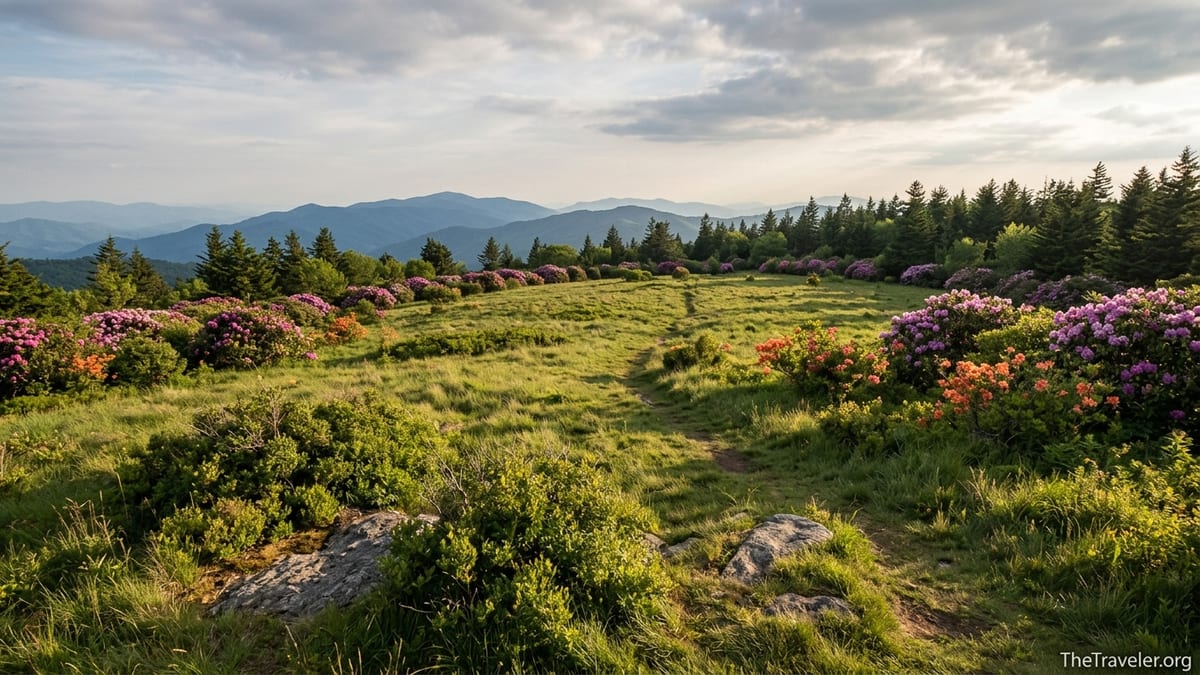
What makes Andrews Bald special in early summer is the way its open meadows frame the surrounding ridges. Stands of catawba rhododendron and flame azalea line the edges of the bald, so when they are in bloom you get pinks, purples, oranges, and yellows against distant blue mountains. On a clear afternoon, you can sit on the rocks at the far end of the bald and look down into North Carolina’s deep valleys while swallows skim the tall grass.
Another draw is that you get this pay‑off without a punishing climb. Compared with Gregory Bald, which requires a much longer, steeper hike for its famous azaleas, Andrews Bald offers a more accessible option for families, newer hikers, and anyone trying to fit a memorable walk into a short Great Smoky Mountains visit. That combination of relatively easy access plus a big scenic reward is exactly why timing and crowd strategy matter.
Because the bald is reached from the Kuwohi parking lot, which also serves the concrete path to the observation tower, the area can feel overwhelmed between late morning and mid‑afternoon in peak season. Visitor traffic includes bus tours, large families, and travelers in flip‑flops shuttling from their cars to the tower. The good news is that many of them never step onto the Forney Ridge Trail, and with some smart choices you can be on a comparatively quiet path in minutes.
Best Time to See Rhododendron Blooms on Andrews Bald
In the Smokies, rhododendron bloom time slides later as you go higher in elevation. Low elevation shrubs can pop as early as late April, but up above 5,000 feet you are generally looking at June and early July for peak color. Park naturalists and local hiking groups consistently describe Andrews Bald’s best display as falling in late June, with some variation year to year depending on spring temperatures and rainfall.
For trip planning, think in ranges rather than exact dates. If you want your best shot at both catawba rhododendron and flame azalea on Andrews Bald itself, aim for roughly the second to fourth week of June. Travelers who visited around June 20 to June 30 in recent years often report both species blooming together on the bald, with lingering color into early July in cooler summers. By mid‑July, most of the show on the bald is usually fading, though you may still see patches of flowers in shady pockets.
If your travel window is flexible, pair bloom timing with road access. Kuwohi Road, which leads to the trailhead, normally reopens for the season around April 1, but late snow or maintenance can push that date back in some years. Early June visits have slightly cooler hiking temperatures and fewer families on summer break, while late June offers more reliable high‑elevation blooms but also more overall park visitation. When you book lodging in nearby towns like Gatlinburg, Pigeon Forge, Cherokee, or Bryson City, plan at least two possible Andrews Bald days so you can adjust for weather and any last minute park advisories.
Remember that rhododendron and azalea timing can differ between famous bloom spots. Gregory Bald’s celebrated azalea display often peaks mid to late June, while Andrew’s Bald can run slightly earlier or later depending on conditions. If you are keen on flowers and have several days in the area, it can be rewarding to hike Gregory Bald early in your trip, then target Andrews Bald toward the tail end of your stay to increase your chances of catching at least one location in full color.
How to Avoid Crowds: Dates, Days, and Times of Day
The easiest way to enjoy Andrews Bald with fewer people is to hike when the Kuwohi area is quietest. On a typical June day, the large parking lot starts to fill between 9 and 10 a.m., stays busy into late afternoon, and then gradually empties as casual visitors head back toward Gatlinburg or Cherokee for dinner. If you can start your hike before 8 a.m. or after 4 p.m., you will usually have a calmer experience on the trail and more open space on the bald.
Weekday timing matters too. Midweek days in June, such as Tuesday through Thursday, are noticeably less hectic than Saturdays when regional visitors and bus tours converge on the park. If you only have a weekend, consider a Sunday afternoon start rather than a Saturday mid‑morning slot, particularly if your trip coincides with school holidays. Many park visitors check out of cabins or hotels on Sundays and are already driving home by late afternoon.
Season can also be used strategically. If you are willing to accept a slightly lower chance of peak bloom, the first half of June can provide a sweet spot with rising wildflower color but fewer crowds than the last week of June or early July. Likewise, a visit in late May can reward you with fresh green forest, cool temperatures, and a quieter trail, even if the rhododendron on the bald has not yet fully popped. Some travelers intentionally time their hike to catch the second wave of rosebay rhododendron along road corridors like Newfound Gap Road while accepting a more subtle display at the bald itself.
Finally, consider how long you plan to linger. It is common for visitors to spend 30 to 60 minutes relaxing on the bald if the weather is pleasant. Starting your hike during a quieter window not only gives you more breathing room on the way in and out, it also makes it more likely that you will find a rock outcrop or patch of grass to yourself for photos and a snack. If you arrive at the bald and find it busy, walking just a bit farther across the open meadow often leads to quieter corners that many first‑time visitors overlook.
Route Overview: From Kuwohi Parking Lot to the Bald
The Andrews Bald hike begins from the signed Forney Ridge Trail at the lower end of the Kuwohi parking lot. Unlike the paved ramp to the observation tower, the Forney Ridge Trail is a traditional dirt and rock path. The national park has installed stone steps and some trail reinforcement in steeper spots, but you should still expect muddy sections after rain and scattered roots and rocks that require attention.
From the trailhead, you will hike roughly 1.8 miles to the edge of the bald, losing and regaining elevation along the way. Although the net change is modest, several short climbs feel steeper than the numbers suggest, especially on the hike back when you are gaining elevation toward the parking lot. Most hikers take 45 minutes to 1 hour to reach the bald at a casual pace, and a similar amount of time to return. Families with young children or frequent photography stops should budget 3 to 4 hours total for the outing, including time spent enjoying the views.
The first part of the route winds through classic high‑elevation spruce fir forest. In June the understory can be lush with ferns and mosses, with cool, damp air under the trees even on hot days in Gatlinburg. After passing through a few rocky sections and small clearings, the trail begins to open and you will see more sky as you approach the bald. The transition is gradual at first, then suddenly you step into a large open meadow with low shrubs and scattered clumps of trees marking its boundary.
Wayfinding is straightforward: you simply follow the main trail until you reach the bald, where several side paths spread out into the grass. To minimize erosion, try to stick to existing footpaths rather than cutting your own track through the vegetation. If fog rolls in, which is common in the Smokies, visibility across the bald can drop quickly. In those conditions, keep the main trail in sight and avoid wandering too far from it, especially if you are not carrying a map or GPS device.
Gear, Weather, and Safety at High Elevation
Because the Andrews Bald hike starts around 6,300 feet, the weather can feel very different from nearby towns. On a June afternoon when Gatlinburg is in the high 80s Fahrenheit, Kuwohi may hover in the low 60s with a stiff breeze. Bring a light insulating layer such as a fleece or synthetic jacket, even if you start the day in a T‑shirt, and pack a windproof shell if rain is in the forecast. Sudden thunderstorms are common on summer afternoons, and the open bald offers little shelter from lightning.
Footwear is another place where choices matter. The Forney Ridge Trail is often damp, and roots and rocks can be slick. Lightweight hiking shoes or boots with good traction make the walk more comfortable and reduce the risk of slips, especially on the descent back toward the parking lot. Travelers who attempt the hike in smooth‑soled sneakers or sandals are more likely to turn around before reaching the bald, particularly after a heavy rain.
Always carry water and snacks, even though the mileage is short. At high elevation you may not feel yourself sweating as much, but the cool air can hide dehydration. A one liter bottle per person is a reasonable minimum for June hikes; bring more if you plan to linger on the bald or combine this outing with the short but steep walk to the Kuwohi observation tower. There are usually restrooms and a small information center at the parking area during the main season, but there is no potable water available at the trailhead, so fill your bottles before driving up.
Finally, treat wildlife and fragile vegetation with care. Black bears do roam the area, though sightings are less frequent along this short, heavily used trail than in more remote corners of the park. Store food securely in your pack, give bears plenty of space if you see one, and never leave trash or food scraps on the bald. To protect the grasses and shrubs that make the bald special, avoid trampling young plants, especially near the edges where the forest is slowly encroaching and the National Park Service actively maintains the open habitat.
Logistics: Getting There, Parking, and Nearby Bases
Most visitors reach Andrews Bald by driving Newfound Gap Road to Kuwohi Road, then following that twisting, high‑elevation spur to the large parking area near the summit. From Gatlinburg, plan on about an hour’s drive under normal traffic conditions. From Cherokee, expect a similar travel time. In June, both routes can be busy in the middle of the day, so build in extra time if you are targeting an early‑morning or late‑afternoon hiking window.
Parking at Kuwohi is limited, and when the lot fills the park service may direct incoming vehicles to wait or turn around. Arriving before 8 a.m. is usually enough to secure a space, even on popular June Saturdays. If you arrive at noon, you may circle the lot repeatedly or have to wait for someone to leave. Because the paved path to the observation tower draws many short‑stay visitors, turnover can be fairly quick, but it is still wise to avoid the peak midday window if possible.
For lodging, consider staying in smaller gateway communities such as Bryson City or Townsend if your main goal is early starts and quieter evenings. Bryson City on the North Carolina side gives relatively easy access to Kuwohi Road via Cherokee and often has less traffic than Gatlinburg, where entertainment attractions compete with national park access. Many cabin rentals and small motels in these towns advertise “Smokies views” and can be good bases for multiple early‑morning hikes, including Andrews Bald, Alum Cave, or Chimney Tops.
Fuel, groceries, and gear are all more easily found in the towns than inside the park. Stock up on picnic supplies before driving in. Simple lunches like tortillas, cheese, and trail mix travel well and make it easy to enjoy a meal on the bald without generating trash that might blow away. On the way out, you can stop at visitor centers near Sugarlands or Oconaluftee to learn more about the park’s ecology and pick up detailed maps for future hikes.
Combining Andrews Bald With Other Smokies Highlights
Because the Andrews Bald hike begins at Kuwohi, it pairs naturally with the short but steep paved walk to the observation tower. One popular strategy in June is to start at dawn for sunrise views from the tower, when skies are often clearest, then descend to the parking area and immediately set out for Andrews Bald while the air is still cool. By the time you return from the bald late in the morning, you will have seen two of the park’s most iconic high‑elevation viewpoints before the heaviest crowds arrive.
Another option is to turn the day into a “high and low” sampler of Great Smoky Mountains ecosystems. After your morning hike to Andrews Bald, drive back down Newfound Gap Road and choose a lower elevation trail such as the Chimneys Picnic Area river paths, the Kephart Prong Trail, or the quiet forest walks near the Oconaluftee Visitor Center. In June these lower areas can be rich with wildflowers, butterflies, and songbirds, giving you a sharp contrast with the evergreen forest and open bald you experienced earlier in the day.
Travelers staying several days in the region often build an entire trip around bloom chasing. A common itinerary is to hike Gregory Bald for its flame azaleas on one day, Andrews Bald on another, and perhaps an accessible wildflower trail like Porters Creek or Little River Trail in between. Each offers a slightly different mix of species, elevation, and crowd levels. When planning these outings, keep in mind the drive times between trailheads, as some combinations can turn into long car days if you try to fit too much into a single afternoon.
Photography enthusiasts may want to schedule their Andrews Bald hike for late‑day golden light instead of pairing it with a morning tower visit. As the sun drops, the angle of light across the grasses and rhododendron can create rich textures and long shadows, especially after a clearing afternoon storm. Just remember that fog and fast‑moving clouds are common at these elevations; give yourself extra time to navigate back through the forest if visibility drops and carry a headlamp so you are not caught out after dark.
The Takeaway
Planning an Andrews Bald hike around rhododendron blooms and fewer crowds is mostly about stacking the odds in your favor. Focus on late June for the most reliable high‑elevation color, but build flexibility into your schedule in case of early or late seasons. Pair that timing with a weekday visit and a dawn or late afternoon start, and you dramatically increase your chances of walking through blooming shrubs in relative quiet, even during one of the Smokies’ busiest periods.
On the practical side, treat this as a real mountain hike despite the modest mileage. Bring layers for Kuwohi’s cool, changeable weather, wear shoes that grip on wet rock, and pack enough water and snacks to enjoy lingering on the bald. Make your base in a nearby town that allows early starts, fill up on fuel and groceries before driving into the park, and watch for updates on road openings as your trip approaches.
Most of all, give yourself time on the bald itself. It is tempting to frame a quick photo and head back to beat traffic, but some of the best moments on Andrews Bald come after you sit for a while: low clouds lifting to reveal new ridges, swallows diving over the grass, or late sun catching the edge of a rhododendron bloom. With thoughtful planning, you can be there for those quiet intervals, surrounded by color but far from the crowds.
FAQ
Q1. When is the best time of year to hike Andrews Bald for rhododendron blooms?
The most reliable window for high elevation rhododendron and flame azalea on Andrews Bald is generally from mid to late June, though exact timing shifts with spring weather.
Q2. How difficult is the Andrews Bald hike?
The hike is considered moderate. It is about 3.6 miles round trip with roughly 875 feet of total elevation change, including some rocky, rooty sections and short, steeper pitches.
Q3. How do I get to the Andrews Bald trailhead?
You drive Newfound Gap Road to Kuwohi Road and follow it to the main Kuwohi parking area. The signed Forney Ridge Trail to Andrews Bald begins at the lower end of this lot.
Q4. Do I need special permits or fees to hike Andrews Bald?
There is no separate hiking permit for Andrews Bald, but Great Smoky Mountains National Park uses a parking pass system. Check current park rules before your trip and purchase any required pass.
Q5. How can I avoid crowds on the Andrews Bald trail?
Start early in the morning or late in the afternoon, avoid Saturdays if possible, and aim for weekdays in early to mid June rather than peak holiday periods.
Q6. What should I wear and bring for a June hike to Andrews Bald?
Wear sturdy hiking shoes with good traction, pack a light insulating layer and rain shell, carry at least one liter of water per person, bring snacks, sun protection, and a small first aid kit.
Q7. Is Andrews Bald suitable for children and less experienced hikers?
Yes, many families hike to Andrews Bald, but the trail is uneven and sometimes muddy. Children and beginners should be comfortable with moderate hills and hiking 3 to 4 miles.
Q8. Can I combine Andrews Bald with other sights in one day?
Many visitors combine Andrews Bald with the short paved walk to the Kuwohi observation tower, or pair it with a lower elevation trail later in the day, such as a river walk near Chimneys Picnic Area.
Q9. What is the weather like on Andrews Bald in June?
Expect cooler temperatures than in nearby towns, often in the 50s or 60s Fahrenheit, with frequent clouds, breezes, and an increased chance of afternoon thunderstorms.
Q10. Are there facilities near the Andrews Bald trailhead?
Seasonally, there are restrooms and a small information center at the Kuwohi parking area, but no food or water. Plan to bring everything you need with you from nearby towns.