


Most visitors who make the short trek to Andrews Bald in Great Smoky Mountains National Park come for one thing: the view. From this high-elevation meadow just south of Kuwohi, the peak long known as Clingmans Dome, layers of blue ridges roll toward the horizon in every direction. On a clear autumn afternoon, it is one of the most photographed vistas in the Smokies. Yet those fall panoramas hide a secret. For a few short weeks in early summer, Andrews Bald becomes something else entirely, when its open grassy slopes erupt in bright flame azaleas and rhododendrons. Time your visit for this fleeting bloom, and the hike feels less like a scenic overlook and more like walking into a living, high-country garden.
Get the latest updates straight to your inbox!
Why Andrews Bald Is More Than Just a Viewpoint
Andrews Bald sits around 5,900 feet on the southern side of the Smokies’ main crest, reached by a 1.8-mile hike on the Forney Ridge Trail from the Kuwohi parking area. The National Park Service lists the round-trip distance at 3.6 miles, with rolling elevation changes that most reasonably fit hikers handle in half a day. The payoff most people talk about is the panorama: Thunderhead Mountain to the west, Fontana Lake far below, and ridge after ridge fading into blue mist. On a typical October weekend, hikers step into the meadow, take a few photos, spread out a picnic blanket, and then head back to their cars satisfied that they have “done” Andrews Bald.
That conventional wisdom misses the real character of the place. Andrews Bald is one of only two grassy balds that the park service still actively maintains, the other being Gregory Bald above Cades Cove. Research suggests that balds like these may have originated from grazing by now-vanished large animals, then were kept open by settlers who drove cattle and sheep to these cool summer pastures. Today the forest would quickly reclaim the opening if rangers did not periodically mow and cut back encroaching shrubs. The result is a rare, human-maintained window where high-elevation plants, big sky, and cultural history all meet.
Walk the trail on a gray November weekday and you feel that layered history underfoot. The path leaves the bustle of the Kuwohi parking lot, dips through spruce-fir forest, and emerges onto a windswept clearing that exists only because people decided it should. The view is lovely in any season, but it is the living meadow itself, and what it does in early summer, that makes Andrews Bald special.
The Short, Spectacular Bloom That Most Hikers Miss
The secret season on Andrews Bald is late spring into early summer, when deciduous flame azaleas and high-elevation rhododendrons burst into bloom. The exact timing varies year to year with weather, but regulars look to late May and especially June as the sweet spot. In cooler springs, peak color can linger into late June at this elevation, while warmer years may shift the show earlier. Unlike some lower-elevation gardens that bloom for weeks on end, the floral peak on the bald often comes and goes in roughly a two to three week window.
Local hikers trade reports in early June, watching social media photos and park updates for hints that “the bald is lit up.” One season, visitors reported on community forums that flame azaleas on nearby trails were already glowing orange while Andrews Bald was “about a week to 10 days away” from its best color. A week later, those same users described the azaleas on the bald as “beautiful” and “worth planning a trip around,” suggesting that the crest area tends to lag a bit behind lower slopes. Taken together, those firsthand accounts point to an early-to-mid June peak in a typical year, with some variation either way.
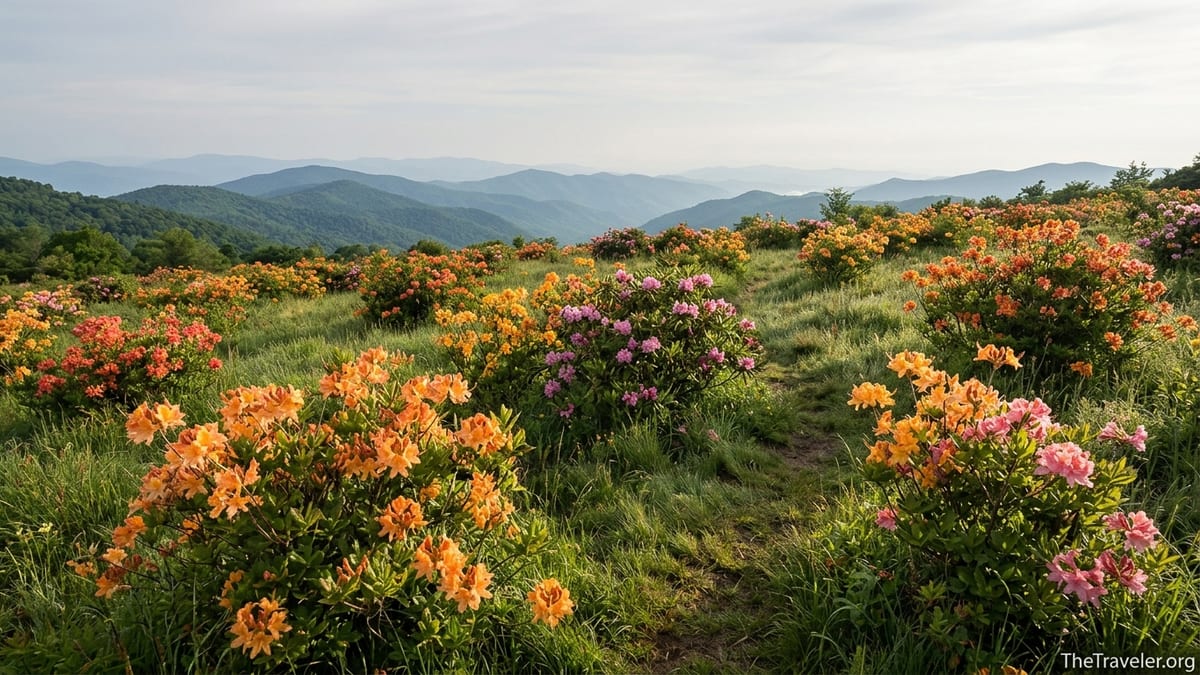
When the timing lines up, the transformation is dramatic. Instead of a mostly green meadow with scattered shrubs, you arrive to find waist-high azaleas splashed with orange, gold, and red, threaded with pink and magenta rhododendron blooms. On clear mornings, the flowers glow against a deep blue sky; on misty days the colors stand out even more intensely against the pale, drifting fog that so often gives the Smokies their name. It is not a subtle shift. Hikers who have visited only in fall often describe their first bloom-season visit as feeling like a different trail entirely.
What the Bloom on Andrews Bald Actually Looks and Feels Like
Imagine stepping out of the dark spruce-fir tunnel near the end of the Forney Ridge Trail and onto the soft turf of the bald. Instead of muted grasses, your first impression is of color: clusters of flame azalea blossoms ranging from pale yellow to saturated tangerine and almost scarlet. Mixed among them, catawba rhododendrons add broad trusses of purple-pink flowers, while low wild blueberries and blackberries leaf out beneath. The bloom is not arranged like a manicured garden. It spills and meanders, following small rises and hollows, leaving pockets of open grass where families drop their daypacks and children run between shrubs.
The air often carries a faint sweetness when the shrubs are at full flower, particularly on calm mornings after rain. Underfoot the ground can be damp and springy, a reminder that this meadow collects moisture from the frequent clouds and storms that brush the high ridge. On clear days, the bright petals frame distant ridges; on hazy afternoons, they provide a splash of foreground color against the characteristic blue-gray layers of the Smokies. Photographers who usually debate whether to shoot the panorama toward Fontana Lake or back toward the crest suddenly find themselves crouching low to capture blossoms with the ridgeline blurred in the background.
Because Andrews Bald is maintained as a natural meadow, there are no fences or boardwalks channeling you through the bloom as there might be at an urban botanical garden. Instead, there are subtle social paths and well-used tent-circle clearings where people sit, always with the unspoken understanding that the shrubs themselves are fragile. The feeling is closer to being invited into a high-country pasture than touring a formal display. In that sense, catching the bald in bloom is as much an experience of atmosphere as of scenery.
Timing Your Trip: How to Aim for the Best Season
There is no guaranteed formula for catching the bloom on Andrews Bald, but a few patterns can nudge the odds in your favor. First is the calendar. Since the access road to Kuwohi typically opens around April 1 each year and closes by the end of November, the key window for flowers falls comfortably within the open season. Visitors planning a dedicated bloom trip tend to target the first three weeks of June, building in flexibility of a few days on either side. Booking lodging in nearby Gatlinburg, Pigeon Forge, or Cherokee for a three-night stay in that period gives you several mornings to adjust for rain and fog.
Weather in the high Smokies also influences bloom timing. A late cold snap can slow development, pushing peak color toward mid or even late June, while a warm March and April can move things earlier. Travelers who live within a day’s drive sometimes wait for recent photos from the park’s social media channels or regional hiking groups before committing to a weekend. If you are flying in from farther away, consider framing your trip as a broader Smokies visit and treating the Andrews Bald bloom as the hoped-for highlight rather than the sole purpose.
Day-of timing matters too. Early morning hikes often provide the calmest conditions and the softest light on the flowers, especially on clear days when the midday sun can feel surprisingly strong at nearly 6,000 feet. Arriving at Kuwohi’s parking area by 8:00 a.m. in peak season not only makes photography easier but also greatly improves your chances of finding a space without circling. The lot has well over a hundred marked spots, yet on blue-sky June weekends it can still fill by mid-morning, particularly when visitors combine the Andrews Bald hike with a trip to the Kuwohi observation tower.
Practical Details: Trail, Effort, and What to Expect
The hike to Andrews Bald begins at the Forney Ridge Trailhead at the lower end of the Kuwohi parking area. While the distance is modest, visitors should not confuse it with a level stroll. The trail descends and climbs over rocky, sometimes rooty terrain, with total elevation change that many hikers estimate in the several-hundred-foot range each way. Sections were improved with rock steps during National Park Service trail work a little over a decade ago, but rain and heavy use still leave some uneven spots and muddy patches, especially after early-summer storms.
Most reasonably fit adults allow 45 minutes to an hour to reach the bald at a relaxed pace, longer if hiking with young children or stopping frequently for photos. Families often carry daypacks with rain jackets, water, and snacks; temperatures at the trailhead can be ten or more degrees cooler than in Gatlinburg, and breezes across the open meadow can feel surprisingly chilly if clouds roll in. Footwear can be simple but sturdy: many hikers are comfortable in trail running shoes or light hiking boots. Sandals that strap securely to the foot can work in dry conditions, but basic flip-flops are a poor choice for the wet rock and roots that are common along the route.
Parking logistics are a key part of the experience. Because Great Smoky Mountains National Park now requires a parking tag for most visitors who plan to park longer than a brief stop, travelers should purchase a daily or multi-day tag in advance or at designated sales points in gateway towns. These tags are modestly priced, but failure to display one can result in a citation. In practice, many visitors pick up a seven-day tag if they plan to spend a long weekend exploring the Smokies, then use it for multiple trailheads including Andrews Bald, Alum Cave, and popular waterfall hikes.
How Andrews Bald Compares to Other Smokies Bloom Destinations
Part of what makes Andrews Bald’s bloom so special is how it stacks up against other floral destinations in the Smokies. Gregory Bald, the park’s other maintained grassy bald, is justly renowned for its extraordinary diversity of flame azaleas. In mid to late June, that summit above Cades Cove often explodes with mixed hues of orange, red, peach, and even near-white flowers, drawing photographers and wildflower enthusiasts from across the Southeast. The tradeoff is effort: reaching Gregory Bald typically requires a significantly longer and steeper hike than Andrews Bald, often eight to eleven miles round-trip depending on the chosen trail.
Roan Mountain, farther northeast on the Tennessee–North Carolina border, offers another famed rhododendron and azalea display atop its high balds. However, it sits outside Great Smoky Mountains National Park and generally involves a longer drive from Gatlinburg or Cherokee. For visitors anchored in Smokies gateway towns, Andrews Bald delivers a remarkably high reward-to-effort ratio: a relatively short hike, easy parking access when timed right, and views that rival more strenuous objectives.
Within the park itself, several lower-elevation trails showcase rhododendrons and mountain laurel along wooded paths and streams. Hikes such as the Ramsey Cascades Trail or portions of the Little River Trail offer lush tunnel-like corridors of bloom in May and June. These experiences, while beautiful, are quite different from standing in an open high-country meadow with 360-degree views. Travelers with two or three days in the area often combine one such streamside rhododendron hike with a bloom-season visit to Andrews Bald to appreciate the range of habitats that make the Smokies famous for plant diversity.
Making the Most of a Bloom-Season Visit
To fully appreciate Andrews Bald during its best season, it helps to slow down and treat the site as more than a quick lookout. After the climb, many hikers wander gently across the meadow, seeking a quiet spot that balances views, flowers, and a bit of space from other groups. Bringing a simple picnic—perhaps a deli sandwich picked up in Gatlinburg or Cherokee and some fruit that travels well—can turn the outing into a leisurely high-country lunch. A light ground cloth or compact camp chair keeps you off damp grass and encourages lingering.
For photographers, a bloom-day visit is best approached with both wide-angle and close-up perspectives in mind. A smartphone camera can absolutely capture striking images if you remember to move around: step back to frame a sweep of flowers with blue ridges stacked behind, then crouch low for detail shots of individual azalea clusters with drops of mist on the petals. Serious hobbyists often carry a DSLR or mirrorless camera with a mid-range zoom lens, favoring early morning when soft light reveals both blossom color and distant ridgeline texture.
Respect for the meadow is essential to protecting the experience for future visitors. Staying on durable surfaces, avoiding trampling low shrubs, and resisting the temptation to pick flowers all help the bald remain healthy. Parents can model this behavior for children by pointing out where roots are visible or where seedlings are trying to establish. In a park that welcomes millions of visitors each year, small choices by individual hikers make a noticeable difference in how delicate places like Andrews Bald hold up over time.
The Takeaway
Andrews Bald will always be known for its views, and rightly so. On a crisp autumn afternoon, few places in Great Smoky Mountains National Park offer such an accessible, sweeping look at the layered ridges that define the Smokies. Yet to focus only on those vistas is to miss the short, spectacular season when the bald’s meadow comes alive with flame azaleas and rhododendrons, turning a good hike into a truly memorable one.
If your travel dates are flexible, planning a visit for the first half of June and arriving early in the day tilts the odds toward seeing the bald at its best. Even if the timing is not perfect, you will still find a high-country meadow rich in history, plant life, and views worth the modest effort. In a park famous for waterfalls and crowded auto loops, Andrews Bald in bloom offers something rarer: a sense of open sky, color, and quiet that lingers long after you step back into the spruce-fir forest and return to the world of parking lots and parkway traffic.
FAQ
Q1. How long is the hike to Andrews Bald and how difficult is it?
The hike to Andrews Bald is roughly 3.6 miles round-trip on the Forney Ridge Trail from the Kuwohi (Clingmans Dome) parking area. Most visitors describe it as moderately strenuous because of uneven, rocky sections and rolling elevation changes, but many families and casual hikers complete it comfortably with proper footwear and a relaxed pace.
Q2. When is the best time of year to see flame azaleas and rhododendrons on Andrews Bald?
The bloom typically peaks from late May into June, with many local hikers aiming for the first three weeks of June. Exact timing varies year to year with spring temperatures and rainfall, so consider this a flexible window rather than fixed dates.
Q3. What time of day should I start my hike to avoid crowds and heat?
Starting between 7:30 and 9:00 a.m. usually offers cooler temperatures, softer light for photography, and a much better chance of finding parking without delays. Midday and early afternoon are often the busiest and warmest times on clear days.
Q4. Do I need any permits or passes to hike to Andrews Bald?
You do not need a special hiking permit for Andrews Bald, but Great Smoky Mountains National Park requires a parking tag if you plan to leave your vehicle for more than a brief stop. Day and multi-day tags are available at modest cost in park gateway communities and visitor centers.
Q5. Is Andrews Bald suitable for young children or older hikers?
Many families hike to Andrews Bald with school-age children, and active older adults often enjoy the trail as well. The key is to allow enough time, bring water and snacks, and be prepared for rocks, roots, and occasional mud. Lightweight trekking poles can make the route more comfortable for anyone with knee or balance concerns.
Q6. What should I pack for a bloom-season hike to Andrews Bald?
Essentials include sturdy walking shoes, a light jacket or fleece, rain protection, at least a liter of water per person, snacks or a simple lunch, sunscreen, and a hat. Even in June, temperatures and wind at nearly 6,000 feet can feel surprisingly cool, especially if clouds or showers move in.
Q7. Can I combine Andrews Bald with a visit to the Kuwohi (Clingmans Dome) observation tower?
Yes, many visitors hike to Andrews Bald and also walk the paved half-mile path to the Kuwohi observation tower on the same outing. Both share the same parking area, so it is straightforward to visit the tower either before or after your hike, depending on crowds and weather.
Q8. Are dogs allowed on the Andrews Bald trail?
Dogs are not allowed on most trails in Great Smoky Mountains National Park, including the Forney Ridge Trail to Andrews Bald. Pets are generally limited to campgrounds, picnic areas, and a few paved paths, so plan to leave dogs with a trusted sitter or boarding facility while you hike.
Q9. What happens if I arrive during bloom season but the flowers are past peak?
Even if the flame azaleas and rhododendrons are past their prime, Andrews Bald still offers expansive views, cool high-elevation air, and a chance to experience one of the park’s few maintained grassy balds. You may also see other wildflowers, berry bushes, and interesting alpine-like plants that make the hike worthwhile.
Q10. How does Andrews Bald compare with Gregory Bald for wildflower displays?
Gregory Bald is famous for an exceptional diversity of flame azaleas and often has a slightly longer or more intense bloom, but it requires a significantly longer, steeper hike. Andrews Bald offers a shorter, more accessible trail with beautiful, if somewhat less extensive, bloom displays and outstanding panoramic views, making it an excellent choice for many visitors.