


Bacoli, a small coastal town about 15 kilometers west of Naples, sits inside the volcanic landscape of the Phlegraean Fields and hides a surprising mix of peaceful lagoons, photogenic Bourbon-era architecture, and evocative Roman ruins. For travelers choosing carefully how to spend limited days in southern Italy, the question is simple: is Bacoli actually worth a full day trip from Naples, or should you stick to headline names like Pompeii, Capri, and the Amalfi Coast? This guide weighs the pros and cons with concrete examples so you can decide confidently.
Get the latest updates straight to your inbox!
Where Is Bacoli and Why Travelers Are Starting to Notice It
Bacoli lies on a peninsula west of Naples, within the Phlegraean Fields, a volcanic caldera that also includes Pozzuoli and several crater lakes. The town itself is relatively compact, with a historic center near the sea and a string of attractions spread between the coast and the inland lakes of Fusaro and Miseno. From Naples, you are typically looking at 45 to 70 minutes of travel door to door, depending on your starting point and transport choice.
Unlike more famous day trips such as Pompeii or Sorrento, Bacoli still feels largely residential. You will see families doing school runs, fishermen repairing boats along the small harbor, and locals crowding bakeries for sfogliatelle in the late afternoon. English is spoken less widely than in the Amalfi Coast towns, which many visitors find refreshing but which can also feel more challenging if you are used to heavily tourist-oriented destinations.
The main reason Bacoli is appearing more often in itinerary discussions is its combination of quiet natural settings and dense archaeological remains. Within a short radius, you can visit Roman bath complexes at Baia, the partly sunken ancient harbor known as Portus Julius, crater lakes, and the graceful Casina Vanvitelliana hunting lodge suspended over Lake Fusaro. For travelers who enjoy pairing easy walks and water views with history, it offers a more relaxed alternative to the crowds of Pompeii.
At the same time, Bacoli is not a polished resort town. Public transport signage can be confusing, opening hours for smaller sites may be irregular, and lunch options lean heavily local, with restaurants sometimes closing midafternoon. Whether it is a good day trip for you depends on how comfortable you are with a slightly untidy but authentic coastal town where tourism is important but not dominant.
Getting From Naples to Bacoli in Practice
Most independent travelers reach Bacoli from central Naples using the Cumana railway, run by the regional operator EAV. A common route is to take Line 2 of the metro or a regional Trenitalia train to Montesanto station, then board a Cumana train toward Torregaveta and get off at either Fusaro or Baia-Bacoli. The ride from Montesanto to Baia-Bacoli typically takes around 40 minutes, so including transfers you should expect roughly one hour from the historic center.
As of 2026, a single Cumana ticket usually costs only a few euros, making this one of the cheaper excursions from Naples. Trains can, however, be crowded and somewhat dated, especially at rush hours. Seats are often taken by commuters, and air conditioning is not guaranteed on older rolling stock, so if you are sensitive to heat, aim for an early start before the day warms up. The payoff is that the line runs along the coast for stretches, giving brief glances of the bay, shipyards, and residential neighborhoods that most visitors never see.
From Fusaro station, it is a short walk to Casina Vanvitelliana and Lake Fusaro. From Baia-Bacoli station, you can walk down to the port of Baia and the large archaeological park on the hillside above. To connect to Bacoli’s town center, local buses and small urban lines operate, but timetables may be irregular outside commuting hours. In practice, many visitors use a mix of walking and occasional short taxi hops booked by phone or ride-hailing, especially to save time between more distant sites like Lake Fusaro and the beaches near Capo Miseno.
Hiring a private driver from Naples is another option, often chosen by small groups or travelers with mobility issues. Prices fluctuate, but a full-day car and driver for the Phlegraean area commonly costs in the range of what you might pay for a small-group Amalfi Coast tour. This arrangement allows you to link Bacoli with Pozzuoli’s Solfatara crater area or the Cumae archaeological park in a single day and also makes it easier to reach less accessible viewpoints and beaches without worrying about local bus schedules.
Nature in Bacoli: Lakes, Craters and Coastline
Bacoli’s biggest draw for nature lovers is its setting among the lakes of the Phlegraean Fields. Lake Fusaro, a shallow coastal lagoon surrounded by reeds and low vegetation, is the best known. The lake occupies an ancient volcanic depression and is separated from the sea by a narrow sandy strip. Walking paths circle segments of its shore, and you can watch herons and other waterbirds, especially in the quieter early morning and late afternoon hours when the light is soft and golden.
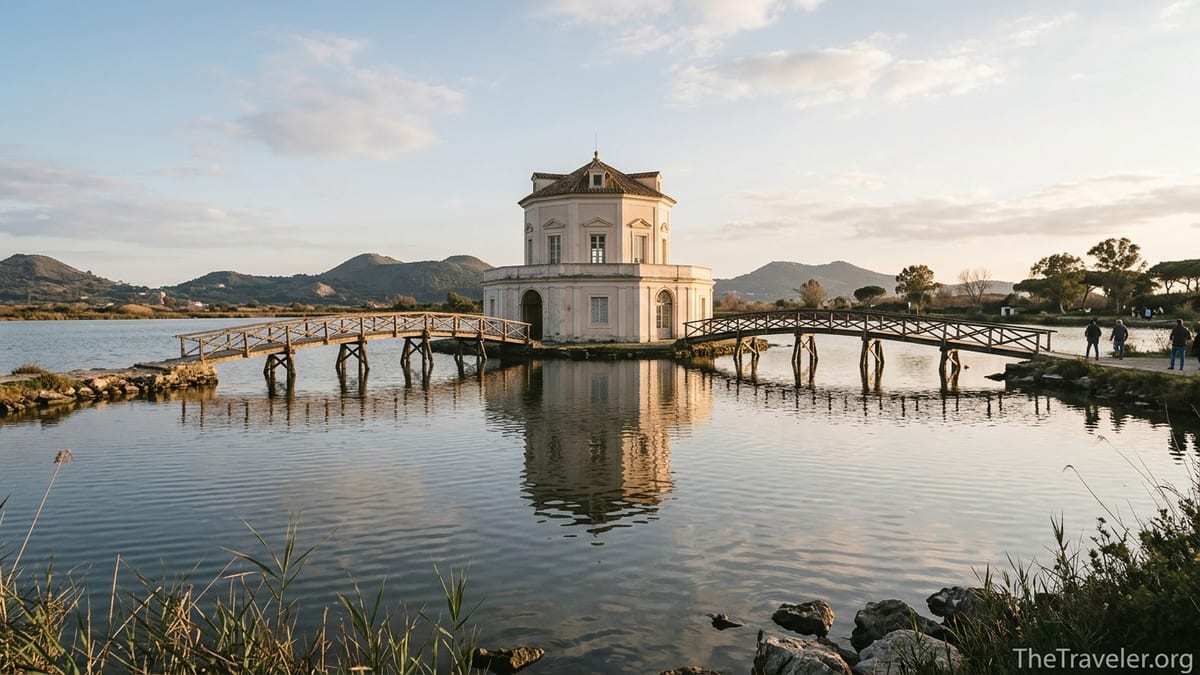
At the center of Lake Fusaro sits the Casina Vanvitelliana, an 18th-century Bourbon hunting and fishing lodge designed by Carlo Vanvitelli. The small octagonal building stands on a tiny island connected to the shore by a wooden pedestrian bridge. From a distance, it appears to float on the water, and photographers often time their visit for sunset when the building and bridge reflect in the still surface of the lake. Even if you choose not to tour the interior, simply strolling the shoreline park and watching local families cycle, jog, and walk dogs gives you a sense of the area as a living neighborhood rather than a museum piece.
Further along the peninsula, Lake Miseno offers a different landscape. This former volcanic crater, now open to the sea, forms a sheltered internal harbor lined with small fishing boats and low houses. The surrounding slopes provide short, manageable walks with panoramic views toward Capri, Ischia, and the Bay of Naples. On clear days, you can see the outline of Vesuvius in the distance, which makes the geological story of the Phlegraean Fields easier to visualize. Between the lake and the outer coast, sandy beaches such as those near Miliscola and Capo Miseno become popular with locals from late spring through early autumn.
For those interested in low-key outdoor time rather than strenuous hiking, Bacoli is well suited to easy half-hour walks between viewpoints, lakefront benches, and seaside cafes. There are no wilderness-style trails comparable to the Path of the Gods on the Amalfi Coast, and most routes remain close to roads and houses. However, the mix of water, volcanic hills, and working harbors offers a more intimate, everyday landscape that many visitors end up preferring to the more theatrical but crowded coastal resorts.
Ancient Ruins: From Sunken Cities to Imperial Leisure Villas
What distinguishes Bacoli from many other coastal towns is the sheer density of Roman sites integrated into its modern fabric. The wider area around Bacoli once formed part of Baiae, the elite resort zone of the Roman Empire, and Portus Julius, an important naval base. Today, remnants of this past are visible in hillsides, along the shore, and even under the sea.
The most prominent archaeological attraction is the Parco Archeologico delle Terme di Baia, the hillside complex of Roman baths and villas overlooking the port of Baia. Visitors walk through terraced levels of brick arches, mosaic fragments, and circular bath chambers that once held hot and cold pools. Because Baia was a luxury retreat for senators and emperors, the structures feel less like utilitarian infrastructure and more like a series of private spas stacked into the slope. On a practical level, surfaces can be uneven and there are staircases, so comfortable shoes are useful, but the site is compact enough to explore in one to two hours.
Equally fascinating, though experienced differently, is the underwater archaeological park often described as the submerged city of Baiae. Due to volcanic activity and gradual subsidence, parts of the ancient shoreline lie several meters below sea level. Local dive centers and glass-bottom boat operators based around the port offer trips over submerged mosaics, statues, and villa foundations. Prices vary by season and operator, but a guided snorkel or boat excursion typically costs closer to what you might pay for a half-day group tour elsewhere in Italy rather than a premium diving safari.
Within Bacoli itself and nearby, there are smaller but evocative remains such as fragments of the ancient port at Portus Julius, sections of Roman aqueduct, and villa ruins integrated into modern streets. Many visitors combine Baia’s main park with a brief stop at the Archaeological Museum of the Phlegraean Fields in the Aragonese Castle at Baia, where statues and artifacts recovered from the area provide context for the ruins scattered around the coastline.
Compared with Pompeii, the archaeological story here is less about a single catastrophic event and more about slow geological change. Over centuries, parts of the coast have risen and fallen, burying and revealing structures. Travelers interested in volcanology often pair a day in Bacoli and Baia with another day on Vesuvius or in the crater landscapes around Pozzuoli to get a fuller sense of how this part of Campania sits on a living volcanic system.
How a Typical Day Trip to Bacoli Might Look
To assess whether Bacoli is a good fit, it helps to imagine a realistic one-day itinerary from central Naples using public transport. Many travelers start with a morning Cumana train from Montesanto around 8:30 or 9:00, arriving at Fusaro roughly 40 minutes later. From the station, it is a short walk to Lake Fusaro and the Casina Vanvitelliana park. You might spend an hour or so wandering the lakefront, photographing the pavilion from different angles, and stopping for a coffee at a nearby bar while watching locals commute past on bicycles.
Late in the morning, you could then continue either by local bus or a pre-booked taxi toward Baia. The ride is short, and you are usually at the archaeological park entrance before noon. A slow visit through the terraces, stopping at viewpoints over the harbor and reading the interpretive panels, comfortably fills one to two hours. If you are particularly interested in the submerged city, you might reserve an early afternoon slot on a glass-bottom boat tour from the port, which typically lasts around an hour and allows you to see mosaic floors and villa outlines without getting into the water.
Lunch in Baia or Bacoli tends to focus on seafood: plates of fried anchovies, spaghetti with clams, or grilled catch of the day. Prices are often a bit lower than along the Amalfi Coast, although waterfront locations still command a premium compared with side-street trattorias. Allow time for a traditional Italian lunch pace; in smaller family-run places, dishes arrive slowly, and locals linger with coffee and digestifs. After lunch, many visitors either relax on a nearby beach, such as those on the Miseno side of the peninsula, or walk along Lake Miseno’s waterfront for views back toward Naples and Capri.
By mid to late afternoon, you can make your way back toward Baia-Bacoli or Fusaro station for a return Cumana train to Naples, arriving back in the city in time for an evening aperitivo. In total, this kind of itinerary includes around four to five hours in the Bacoli and Baia area, two to three hours spent on ruins and short excursions, and time set aside simply to sit beside the water. For many travelers, that combination of low-key nature and tangible Roman history makes the day feel rich without being exhausting.
Pros and Cons: Is Bacoli the Right Choice for You?
Whether Bacoli is a good day trip from Naples depends heavily on your interests and what else is on your itinerary. If you are passionate about Roman history, but have already planned a full day at Pompeii and perhaps Herculaneum, Baia and Bacoli can feel like an advanced chapter, adding the dimension of imperial leisure villas, thermal baths, and underwater ruins. The sites are less crowded, you are more likely to hear Italian than English around you, and ticket prices are generally modest.
Nature-focused travelers who prefer calm water views and easy walks over demanding hikes also tend to appreciate Bacoli. The lakes of Fusaro and Miseno, the sandy local beaches, and the quiet harbor scenes provide a sense of exhale after the intensity of Naples. This is particularly appealing for visitors spending a week or more in the city who want at least one day that mixes light sightseeing with unstructured time outdoors.
On the other hand, if you are visiting Naples for only two or three days and have not yet seen the major UNESCO sites or iconic coastal scenery, Bacoli might not be the top priority. The ruins and landscapes, while atmospheric, lack the immediate wow factor of walking down a Roman street in Pompeii or looking back at Positano from a boat. Public transport to Bacoli is workable but requires a bit more confidence than simply boarding a high-frequency Circumvesuviana train to Pompeii or a well-marked ferry to Capri.
Practical realities also matter. Opening hours for smaller museums and for the interior of Casina Vanvitelliana can vary by season and day of the week, and some sites close for lengthy lunch breaks. It is wise to check schedules shortly before your visit and to have a backup plan, such as spending more time at the lakes or beaches, in case a particular attraction is closed unexpectedly. Travelers who prefer fully predictable, turn-key outings may prefer to book an organized tour that includes Bacoli and Baia rather than navigating independently.
Tips to Make the Most of Your Bacoli Day Trip
A little preparation goes a long way in Bacoli. Starting early from Naples helps you avoid the busiest commuter period on the Cumana while leaving plenty of time for delays or spontaneous stops. In summer, an early morning departure also means you reach Lake Fusaro and the archaeological park before the midday heat builds on exposed slopes. Carrying water, a hat, and sunscreen is important, as many paths within the ruins and around the lakes offer limited shade.
Footwear should be chosen with uneven terrain in mind. While the town streets are paved, archaeological sites like the baths of Baia include stone steps, worn brick surfaces, and gravel paths. Closed shoes or sturdy sandals are more comfortable than flip-flops, especially if you decide to tack on a short walk up to viewpoints above Lake Miseno or down to less developed sections of the coastline.
Because Bacoli’s tourism infrastructure is still evolving, it is useful to have at least a few Italian phrases ready. Simple requests for tickets, directions, or the next bus timetable are usually understood, but electronic displays and announcements are not always tourist-oriented. Offline maps on your phone help when signage is sparse. If you plan to take a boat trip over the submerged ruins or join a dive, reserving the day before is sensible, particularly on summer weekends when Neapolitans themselves head to the coast.
Finally, keep your expectations calibrated. Bacoli is best enjoyed as a patchwork of small pleasures rather than a single showpiece attraction: the reflection of Casina Vanvitelliana in still water, a view from a Roman terrace over the bay, a plate of seafood beside a harbor, or a quiet fifteen minutes watching fishermen mend nets at Lake Miseno. If that sounds like your ideal escape from Naples, the town will likely reward your time.
The Takeaway
In the end, Bacoli is an excellent day trip from Naples for travelers who value a blend of nature and archaeology in a setting that still feels primarily local. Its crater lakes, understated beaches, and Roman thermal complexes offer a very different experience from the more famous but busier destinations that dominate most Campania itineraries. Reaching it involves slightly more logistical effort, but the rewards include quieter sites, lower prices, and the feeling of having discovered a corner of the Bay of Naples that many visitors overlook.
If your schedule includes at least four full days in Naples and you have already penciled in marquee sights like Pompeii or a classic coastal excursion, dedicating one day to Bacoli and Baia can round out your understanding of the region’s volcanic landscape and Roman heritage. With realistic expectations and a bit of planning around transport and opening hours, Bacoli is not only a good day trip from Naples, it can be one of the most memorable.
FAQ
Q1. How long does it take to get from Naples to Bacoli?
Travel time from central Naples to Bacoli is typically between 45 minutes and 1 hour 15 minutes each way, depending on your exact starting point, train connections, and whether you need to walk or take a local bus from the station to specific sights.
Q2. Is Bacoli worth visiting if I am already going to Pompeii?
Yes, if you have enough days. Pompeii shows everyday city life frozen in time, while Bacoli and Baia focus on Roman leisure villas, thermal baths, and ruins affected by slow volcanic subsidence, including underwater remains, so the experiences complement rather than duplicate each other.
Q3. Can I visit Bacoli and Baia without a guided tour?
Independent visits are entirely feasible using the Cumana railway and local transport, as long as you are comfortable with basic Italian signage and less structured schedules. On-site information panels and small museums provide context, and you can add a local guide or boat tour for the submerged ruins if you want deeper explanation.
Q4. What is the best time of year to do a Bacoli day trip?
Spring and early autumn are generally ideal, with mild temperatures suitable for walking among ruins and along the lakes. Summer offers warm water and busy beaches but can be hot and crowded on weekends, while winter is quieter and atmospheric, though some seasonal services and boat excursions may run less frequently.
Q5. Are there good swimming beaches in Bacoli?
Yes, the coastline near Capo Miseno and Miliscola has sandy beaches popular with locals, with both free stretches and areas with rented loungers and umbrellas. Water conditions are usually calm enough for casual swimming, especially in sheltered spots, though you should always follow local advice about currents and water quality.
Q6. Is Bacoli suitable for travelers with limited mobility?
The town itself is mostly level, and lakeside promenades are relatively easy to navigate, but major archaeological sites like the baths of Baia include uneven surfaces and stairs. Travelers with limited mobility may still enjoy the lakefronts, harbor areas, and viewpoints reachable by car, but should check specific accessibility information for archaeological parks and boat operators in advance.
Q7. How much money should I budget for a day in Bacoli?
Using public transport, a typical day might include a few euros each way for train tickets, modest entry fees for archaeological sites, and around the same cost as a mid-range lunch in Naples for a seafood meal. Adding a boat trip over the submerged ruins or a taxi between more distant points will increase costs but usually keeps the day below what many full-day organized tours from Naples charge.
Q8. Is English widely spoken in Bacoli?
English is understood in some restaurants, hotels, and tour operators, particularly those used to working with visitors from Naples, but it is less ubiquitous than in heavily touristed places like Sorrento. Learning a few basic Italian phrases and carrying written addresses or map screenshots helps smooth over communication gaps.
Q9. Can I combine Bacoli with other nearby sights in one day?
Yes, many travelers combine Bacoli and Baia in a single outing, and some add a short stop in Pozzuoli or at another crater lake in the Phlegraean Fields if using a car or private driver. With public transport alone, it is usually best to focus on the Bacoli and Baia area to avoid spending too much time in transit.
Q10. Is Bacoli safe for solo travelers?
Bacoli is generally considered as safe as other residential areas around Naples, with the usual caveats about petty theft and attention to belongings in crowded spaces. Solo travelers commonly visit during daylight hours using public transport, and standard precautions such as avoiding unlit backstreets late at night and keeping valuables secure are usually sufficient.