


Towering over Siena’s shell-shaped Piazza del Campo, the Torre del Mangia is one of Tuscany’s great viewpoints and most crowded attractions. The medieval brick tower rewards visitors with sweeping views after a climb of more than 300 narrow steps, but many travelers discover too late that they misunderstood the ticket system, misjudged the physical effort, or simply picked the wrong time of day. Learning from the most frequent mistakes can turn a stressful scramble into a highlight of your time in Siena.
Get the latest updates straight to your inbox!
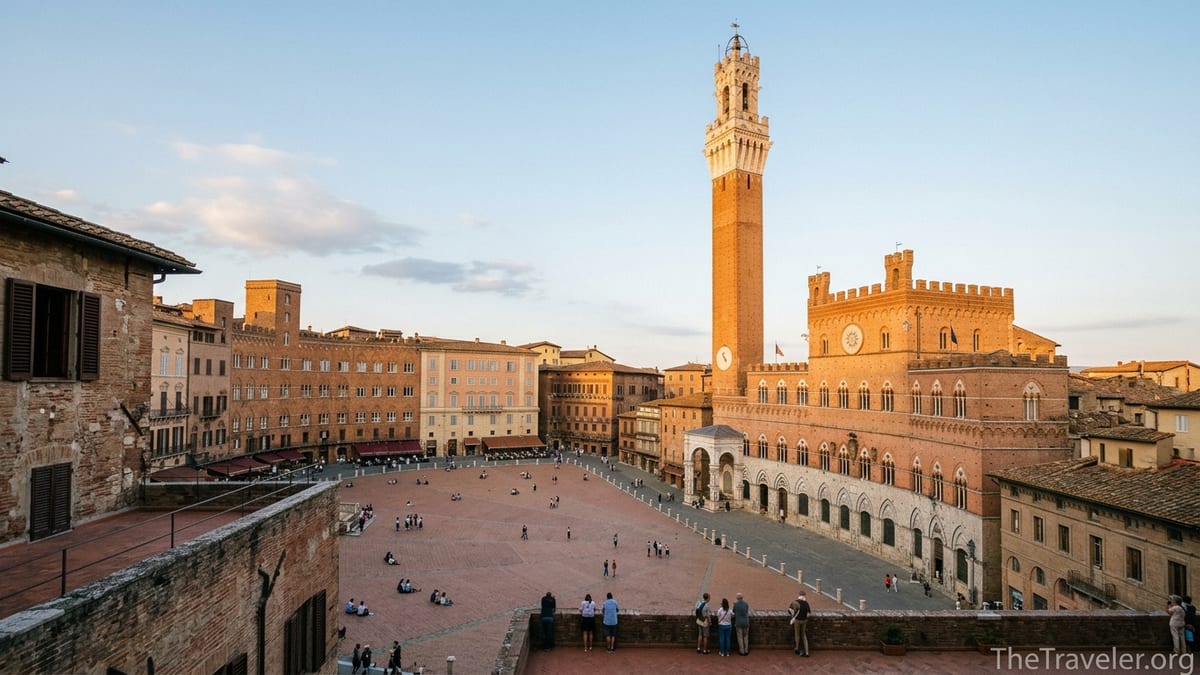
Misunderstanding How Tickets Work
One of the most common surprises at the Torre del Mangia is discovering that tickets for the climb cannot usually be booked online in advance. Unlike many Italian monuments that use timed online reservations, tower tickets are typically sold only in person at the Palazzo Pubblico ticket office in Piazza del Campo on the day of your visit. Travelers who arrive expecting to show a QR code on their phone can find themselves confused when the staff directs them to a physical counter instead.
Another frequent mistake is assuming you can walk up, buy a ticket, and enter immediately. On busy days the staff often sells tickets for fixed time slots later the same day, so you might buy your ticket at 10:30 and be assigned an entry time around 12:00 or 12:30. Reviews from recent visitors mention having to wait up to 90 minutes between purchase and their climb, something that can derail a tightly planned day trip if you have a train back to Florence or Rome.
Visitors also underestimate the value of combined tickets. A standard tower ticket costs around 10 euros for adults, but many people only discover at the counter that there is a combined option for roughly 13 to 15 euros that also includes entry to the adjacent Museo Civico in the Palazzo Pubblico. If you are already committed to walking into the building and queueing for the ticket office, it is often worth paying a few extra euros to see the famous frescoes such as the Allegory of Good and Bad Government, which you can visit before or after your tower climb.
Finally, some travelers do not realize that there is a family ticket for the Torre del Mangia, which is financially advantageous if you are visiting with children over 11. Younger children are often free or heavily discounted, so parents who ask about the family tariff at the counter can reduce costs. Turning up with a family of four and automatically buying separate adult and teen tickets, without asking about the family option, is an easy way to overpay.
Poor Timing: Queues, Weather, and Light
Another major mistake is assuming that because Siena is a smaller city, you can visit the Torre del Mangia at any time without worrying about crowds. In reality, the tower is one of the top attractions in Tuscany, and during peak months from May to September it can involve lengthy queues and sold-out time slots by mid-afternoon. Day trippers who arrive on a late-morning bus from Florence often all converge around the same time, creating a bottleneck for the midday entry slots.
Travelers also underestimate the impact of heat and weather. The tower’s staircase is enclosed, steep, and unventilated in long stretches. Climbing during a July afternoon heatwave, when temperatures in Piazza del Campo can be well above 30 degrees Celsius, can feel stifling once you are inside the narrow stairwell. A better approach is to buy a morning slot around opening time or a late afternoon slot when the sun is lower and the brick walls inside the tower have had time to cool slightly.
Photographers sometimes choose their time poorly. Many visitors instinctively aim for midday, thinking that the city will be brightest. In practice, the most atmospheric views from the top are usually in the late afternoon or early evening, when warm light grazes the terracotta roofs and the outline of the Duomo stands in gentle contrast against the hills. On hazy days, morning can offer clearer long-distance views toward the Chianti countryside and Monte Amiata. Planning your climb around these conditions leads to more memorable photos than simply going up whenever you happen to walk past.
Another subtle timing mistake is failing to account for how long the full visit can take. Even if the climb itself lasts only around 15 to 20 minutes in each direction and you spend 10 minutes enjoying the panorama, you should also factor in buying tickets, waiting for your time slot, and possibly exploring the Museo Civico with a combined ticket. For many visitors, this adds up to between 90 minutes and 2.5 hours, which can become a problem if you mistakenly schedule another guided tour or a train departure immediately afterward.
Underestimating the Physical Challenge
At first glance, the Torre del Mangia does not look especially intimidating, and some visitors incorrectly assume it will be a short, casual climb similar to a few flights of stairs in a modern building. In reality, the tower has more than 300 narrow, uneven steps in a confined staircase that spirals upward without any elevator. People who are not used to climbing, or who have had a large lunch in nearby trattorie around Piazza del Campo, may find themselves out of breath halfway up.
One recurring issue mentioned by travelers is underestimating how claustrophobic the stairwell can feel. The walls are close together, there are limited passing points, and visibility is restricted, especially when another small group is coming back down while you are going up. Visitors with even mild claustrophobia sometimes do not realize what the space will feel like until they are already partway up, at which point turning back requires coordination with the rest of the group.
Medical and mobility considerations are another area where visitors can misjudge their limits. People with heart conditions, respiratory issues such as asthma, or serious knee problems sometimes start the climb because they do not want to miss the experience, only to find that the combination of effort and enclosed space is too much. Since there is no elevator and no easy resting spot beyond a few small landings, you should honestly assess your fitness before buying a ticket. The staff at the ticket office and entrance can explain the conditions if you ask in advance.
Families also occasionally misjudge how children will handle the effort and confinement. Younger kids might initially be excited about climbing a medieval tower but then become frightened in the narrow staircase. Some parents report having to carry tired or scared children for parts of the ascent or descent, which is awkward and potentially unsafe on steep steps. A realistic conversation with older children beforehand about the length of the climb and the enclosed environment helps, while very young children may be better off enjoying the piazza from ground level with another adult.
Ignoring Safety and Practical Restrictions
Several common mistakes involve overlooking the tower’s safety rules. Visitor numbers are tightly controlled, and staff usually allow only small groups at a time to climb. This can frustrate travelers who show up shortly before closing time expecting to rush in. If the last time slot of the day is already full, you will be turned away even if you are willing to climb quickly. Checking the current opening hours in Siena and aiming to arrive well before the last admission time helps avoid this disappointment.
Loose items are another issue. There are periods when the staff restricts what you can bring up the staircase, such as large backpacks, bulky handbags, or tripods, because they can cause bottlenecks and accidents in the narrow space. Visitors who arrive with heavy camera gear or large shopping bags from boutiques along Via di Città may find themselves asked to leave these items behind temporarily or told they cannot climb. Planning to bring only essentials like a compact camera or phone, a small bottle of water, and perhaps a light jacket is more practical.
Footwear is an easily forgotten detail. The stone steps are worn and can be slightly slippery after rain. People who come in smooth-soled sandals, wedge heels, or dress shoes can find the climb more nerve-racking than necessary. Opting for comfortable walking shoes or sneakers with good grip makes a real difference, especially when navigating the tighter, steeper upper sections near the top of the tower.
Visitors also sometimes assume that the top of the tower will have extensive safety barriers and wide space for moving around. In reality, while there is a protective parapet and railing, the viewing platform is compact, and you will likely be sharing it with a small group. Travelers who expect to set up tripods or let children move freely along the edge quickly discover that space is limited. Keeping a firm grip on phones and cameras is vital, as dropping anything from the platform is both dangerous and irretrievable.
Rushing the Experience and Skipping the Context
Because many people visit Siena on a half-day or day trip, another common mistake is to treat the Torre del Mangia as a quick selfie stop rather than part of a broader historical complex. The tower is attached to the Palazzo Pubblico, which houses the Museo Civico, one of Italy’s most important collections of civic frescoes. Travelers who only climb the tower without exploring the museum miss an opportunity to understand Siena’s medieval politics and the symbolism behind the very square they have just photographed from above.
For instance, inside the Palazzo Pubblico you can see the famous cycle of frescoes depicting the Allegory of Good and Bad Government, which offers a visual explanation of how Sienese citizens once imagined the ideal ordering of their city. When you later look down from the tower onto the fan-shaped Piazza del Campo, those frescoes add a layer of meaning to your view of the radiating streets and the district flags flying below. Without that context, the climb can feel like just another set of scenic photos, rather than a window into the city’s story.
Another rushed behavior is racing straight back down as soon as you reach the top, either because you are worried about holding up the group or anxious about the height. While the time you can spend at the summit is limited, most groups are allowed several minutes to walk around the perimeter and look in every direction. Taking the time to spot specific landmarks such as the Duomo’s striped bell tower or the countryside stretching towards the Crete Senesi will leave a stronger memory than hastily taking one or two wide shots and hurrying back to the stairs.
Some visitors also skip reading any information panels or asking questions of the staff. Even a short conversation at the entrance can give you small insights, such as why the tower was built to rival the Duomo’s bell tower in height or how the tower’s name comes from a nickname given to its first bell-ringer. These anecdotes, picked up in a few seconds while waiting for your group to be called, can make the experience more vivid than relying solely on a guidebook or generic audio tour.
Overlooking Alternative Views and Crowding Out Your Itinerary
A subtler mistake is assuming that the Torre del Mangia is the only or even the best viewpoint in Siena. It is certainly the most iconic, especially for views directly over Piazza del Campo, but there are other excellent vantage points that may suit some travelers better. For example, the panoramic terrace reached through the Museo dell’Opera del Duomo, sometimes called the facciatone, offers a striking view across the rooftops toward the tower itself and the rolling Tuscan hills. Visitors who are afraid of very enclosed staircases or who cannot secure a tower time slot might find that alternative just as satisfying.
By fixating solely on the Torre del Mangia, some tourists end up crowding their schedule and missing other experiences. It is common to see itineraries where a couple only has four or five hours in Siena but spends most of that time waiting for their tower slot, climbing, and recovering afterward. This can leave little room for wandering through quieter contrade (neighborhoods), tasting local specialties like pici pasta or panforte, or exploring the Duomo complex. Balancing your time between the tower and other highlights allows Siena to feel like a living city rather than just a backdrop for one famous climb.
Travelers also sometimes overlook how the tower visit fits into the broader rhythm of Siena’s events. During the days surrounding the Palio horse races in July and August, Piazza del Campo transforms with temporary structures and intense local activity. While the tower view during this period is unforgettable, ticket demand and security measures can be higher than usual. Visitors who arrive unaware of the Palio schedule may find that accessing the tower is more complicated, and they might be better off planning the climb on a different day of their trip or at a quieter time.
Thinking strategically about your viewpoints can also help with photography. Some people climb the Torre del Mangia for a midday view of the Duomo, then later realize that an evening visit to the Duomo’s own panoramic points would have given more dramatic lighting. By pairing the tower with another viewpoint at a different time of day, you can better capture the changing colors of Siena’s brick and stone, instead of returning home with a set of nearly identical overhead shots.
Language, Expectations, and Cultural Missteps
While the Torre del Mangia is well set up for international visitors, small cultural missteps are common. Some travelers become frustrated if staff appear brisk or direct when managing queues or enforcing time slots, interpreting it as rudeness. In reality, the team must keep visitors moving safely through a very tight space with limited capacity, and clear instructions are essential. Taking a moment to learn basic Italian words for entrance, exit, and time, and approaching staff with patience, makes the interaction smoother.
Another expectation issue involves the condition of the staircase and facilities. The tower is a centuries-old structure, and there is no air conditioning inside the stairs. Lighting can be dim in places, and there are no restrooms along the climb. Visitors who assume modern comforts at every stage can be unsettled when they encounter worn stone steps, occasional low ceilings, or slightly dusty corners. Understanding that you are entering a historic building, not a polished theme-park attraction, helps align your expectations with reality.
Some travelers also neglect to consider local customs related to photography. While you are free to take pictures at the top of the tower, the Museo Civico below has specific rules for photographing the frescoes, and flash may be prohibited. Visitors who ignore signage and use flash or loud camera shutters can disturb others and attract a warning from staff. Being discreet with your photography equipment and respecting any posted restrictions contributes to a more pleasant atmosphere for everyone.
Finally, visitors sometimes forget that the Palazzo Pubblico also functions as Siena’s town hall. Parts of the building are used for municipal offices and official events, and occasional closures or restricted access can occur. Planning some flexibility in your itinerary means that if an area is temporarily closed due to a civic ceremony or maintenance, you can adjust without feeling that your entire visit has been ruined.
The Takeaway
A visit to the Torre del Mangia can be one of the most rewarding moments of a trip to Tuscany, but the experience depends heavily on preparation. Misunderstanding the ticket system, underestimating queues and the physical effort, or arriving with unrealistic expectations can turn the climb into an ordeal. On the other hand, arriving early or late in the day, traveling light, wearing sensible shoes, and allowing enough time to pair the tower with the Museo Civico will make your time at the Palazzo Pubblico far more enjoyable.
By considering alternatives like the Duomo’s panoramic terrace, respecting safety guidelines, and treating the tower as part of Siena’s living civic center rather than just a photo opportunity, you will come away with more than just a spectacular view. You will have a deeper appreciation of how this medieval structure still anchors the daily life of the city, from the lined-up tourists in Piazza del Campo to the flags of the contrade fluttering far below.
FAQ
Q1. Do I need to book tickets for the Torre del Mangia in advance?
In most cases tickets for the Torre del Mangia are sold only in person at the Palazzo Pubblico ticket office on the day of your visit, with timed entry slots assigned at purchase.
Q2. How many steps are there and how difficult is the climb?
The climb involves more than 300 narrow, steep steps in an enclosed staircase. It is manageable for reasonably fit visitors but can be challenging if you have mobility or heart issues.
Q3. What does a ticket to the Torre del Mangia cost?
Standard adult tickets cost around 10 euros, with combined options that include the Museo Civico typically costing a few euros more. Family tickets are available for visitors with children over 11.
Q4. When is the best time of day to climb the tower?
Early morning and late afternoon generally offer the most comfortable temperatures and the best light for photography, while also avoiding the heaviest midday crowds in peak season.
Q5. Can children climb the Torre del Mangia?
Children are allowed, but very young kids may find the staircase tiring or claustrophobic. Families should carefully assess their children’s comfort with heights and enclosed spaces before buying tickets.
Q6. Is the Torre del Mangia accessible for people with limited mobility?
No, the tower does not have an elevator and the only way up is via the staircase. Visitors with significant mobility impairments are better off enjoying views from accessible points elsewhere in Siena.
Q7. How long should I plan for a visit to the tower?
If you include ticket purchase, waiting for your time slot, the climb itself, time at the top, and a visit to the Museo Civico with a combined ticket, you should allow between 90 minutes and 2.5 hours.
Q8. What should I wear and bring for the climb?
Comfortable walking shoes with good grip, light clothing in warm months, and a small bottle of water are recommended. Avoid large bags, tripods, or bulky camera gear that might be restricted.
Q9. Are there good alternatives if I cannot or do not want to climb the tower?
Yes. The panoramic terrace accessed through the Museo dell’Opera del Duomo offers excellent views over Siena and the Torre del Mangia itself, with a different style of climb and outlook.
Q10. Is visiting the Torre del Mangia worth it if I only have a few hours in Siena?
It can be, but you should weigh the potential waiting time and effort of the climb against other priorities such as exploring the Duomo, the Museo Civico, and Siena’s historic streets and neighborhoods.