


Few experiences capture Siena quite like the slow, breathless climb up the Torre del Mangia. Rising above Piazza del Campo and the rolling Tuscan hills, this 14th century civic tower offers one of Italy’s most memorable viewpoints. To make the most of it, though, you need to understand how tickets work, what the climb is really like, and how to time your visit around crowds, heat, and the city’s famous Palio horse race. Here is what to know before you tackle the stairs.
Get the latest updates straight to your inbox!
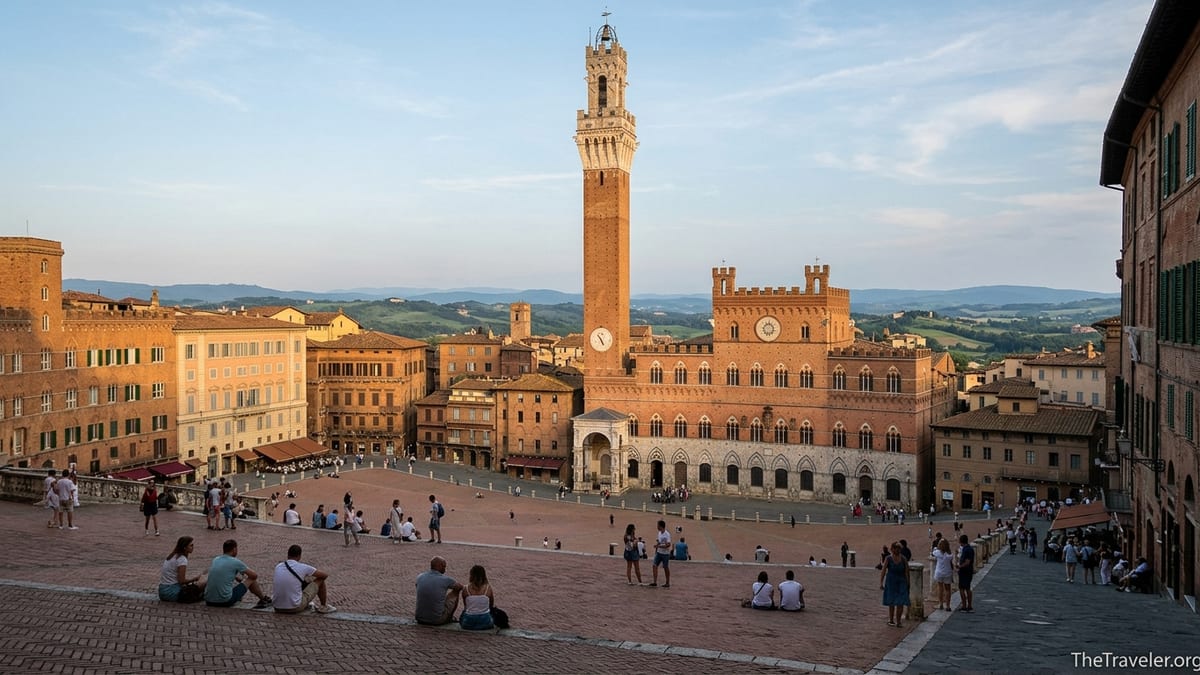
Understanding the Torre del Mangia and Its Setting
The Torre del Mangia is the slender brick bell tower rising from Siena’s Palazzo Pubblico on the edge of Piazza del Campo, the city’s shell shaped main square. Built in the 14th century and reaching roughly 88 meters in height, it was designed to rival the towers of nearby rival Florence. Today, it is one of the tallest historic civic towers in Italy and a centerpiece of the city skyline.
Climbing the tower is not just about the view. On the way up you are literally moving through Siena’s medieval fabric. The stairs are contained within thick brick walls, and small windows occasionally open to glimpses of terracotta rooftops and the curve of the Campo below. At the top, visitors step onto a small open platform just beneath the clock and bells, with 360 degree views over Siena’s contrade neighborhoods and out toward the Chianti hills and, on a clear day, the distant bulk of Monte Amiata.
The tower forms part of a wider civic complex that also includes the fresco filled Museo Civico inside Palazzo Pubblico. Many travelers pair a tower climb with a visit to the museum’s famous “Good Government” frescoes. In practical terms, this means you will often be moving through a mix of day trippers, school groups, and tour groups who are visiting the palace as well as the tower. Building your schedule to avoid the biggest waves of groups can significantly improve your experience.
Because the tower stands in the very heart of the city, you can easily fit a climb into a Siena day trip. Trains from Florence, for example, take about 1.5 hours, followed by a short bus or taxi ride up to the historic center. Many visitors arrive late morning, walk into Piazza del Campo, and head straight to the ticket office under the arches of Palazzo Pubblico. Knowing in advance how that process works can save time and frustration when the square is crowded.
Tickets, Prices, and Daily Visitor Limits
Access to the Torre del Mangia is controlled and ticketed, with limited spots per entry time. As of 2025, the standard tower ticket has been reported at about 10 euros for adults, with a combined ticket for the Museo Civico and the tower around 15 euros and a family ticket around 25 euros for two adults plus older children. These figures can change, so treat them as a ballpark range rather than a guarantee, and check the most current information with the Siena civic museum service shortly before your trip.
Tickets are generally sold on the day at the Palazzo Pubblico ticket office at the edge of Piazza del Campo. At the time of writing, online booking for regular climbs is often not available or limited, which means independent travelers should plan to purchase in person. A typical routine might be to arrive at the ticket counter at opening time, for example shortly after 10:00 in the morning, and request the first available time slot for that day. During busier months, morning slots can sell out by late morning, especially on weekends and during the Palio period.
Entry is timed and capacity controlled for safety. Groups are usually capped at a modest number of people per ascent, and you are assigned a specific departure time, much like a timed slot to climb Florence’s Duomo dome. In practice, this means you cannot just wander up to the base of the tower at 15:00 and expect to climb immediately. On a peak summer day in July, for instance, you might buy tickets at 11:00 and be given a climbing time of 13:00 or later, which you can then plan the rest of your visit around.
For travelers trying to budget a day in Siena, treating the tower as one of your headline paid visits is sensible. A common pattern for a couple on a day trip from Florence might be two tower tickets plus the combined museum ticket, adding perhaps 30 to 40 euros to the day’s expenses, on top of coffee in Piazza del Campo and a long lunch on a nearby side street. If you are traveling as a family, ask at the ticket window about family pricing, as families sometimes find the combined ticket for the Museo Civico and tower better value than separate purchases.
Opening Hours, Closures, and Palio Season Complications
Opening hours for the Torre del Mangia vary by season and can change for maintenance or special events. In recent years, typical schedules have seen the tower opening around mid morning and closing in the late afternoon or early evening, with extended hours in the peak summer season. Winter hours can be shorter, which means fewer daily time slots. Before you travel, check the latest details from the official Siena civic museum information to be sure the tower is open on your chosen day.
One of the most important considerations is the Palio, Siena’s world famous bareback horse race held in Piazza del Campo twice each summer, traditionally on July 2 and August 16. In the days leading up to the race, the Campo fills with bleachers, barriers, sand and crowds. The city often adjusts opening hours or restricts access to the tower during trials, rehearsals and on the race days themselves. It is common for visitors who show up on the morning of a Palio day to find that tower tickets are limited, times are reduced, or access is suspended.
Even outside the exact race days, the weeks around the Palio are exceptionally busy throughout Siena. Tour groups and independent travelers flock to the city, and many want to climb the tower for a view of the race preparations. If you are visiting in late June, early July, early to mid August, or on Italian public holidays, you should expect more competition for time slots and allow extra margin. An example might be a traveler arriving on June 30 who finds that morning slots are already taken by organized groups and that their first available option is mid afternoon, when the square is packed and the heat intense.
Short term closures for maintenance are also possible. In recent seasons, the tower has occasionally closed completely for restoration or safety inspections, sometimes for weeks or months at a time. Secondary sources such as hotel blogs and ticket aggregators periodically note when the tower is temporarily closed or when only limited access is available. If your main reason to visit Siena is the climb itself, it is worth verifying that the tower is open in the weeks before you travel, either through the official museum channels or by asking your accommodation in Siena to check locally.
How Demanding Is the Climb and Who Should Think Twice
Visitors often underestimate how physical the Torre del Mangia climb can be. The ascent involves around 300 narrow stone and brick steps enclosed within the tower. There are no elevators for the general public. The staircases are steep in places, with occasional small landings where groups can pause. Handrails are present, but the combination of height, effort and confined space can be tiring, especially in summer when temperatures soar.
If you are reasonably fit and comfortable with stairs, you will likely manage the climb without serious difficulty, although you may arrive at the top breathing hard. Many visitors in their 60s or 70s report completing the climb at a slow, steady pace. On a hot July afternoon, however, even fit travelers can find the effort demanding. A typical example is a visitor spending the morning at the Duomo complex, then tackling the tower after lunch when the sun is high, only to find themselves overheated and rushing to keep up with the group in a confined stairwell.
Certain travelers should think carefully before attempting the ascent. The interior staircase is tight, with low ceilings and occasional two way traffic when one group is descending as another is ascending. Anyone with severe claustrophobia, vertigo, significant heart or respiratory conditions, serious knee problems, or balance issues may be better off skipping the climb or at least discussing it with a doctor before their trip. Pregnant travelers and very young children are sometimes discouraged or restricted; staff at the ticket office can advise about current policies.
For families, it is worth considering how your children handle heights and enclosed spaces. Some parents report that school age children enjoy the adventure, darting up the steps with little difficulty, while parents struggle to keep pace. Others describe children who freeze halfway up when they realize how far they have climbed and how tight the stairwell is, leading to slow, anxious descents. If your child is nervous with stairs or towers, it may be better to divide your group so that only those enthusiastic about the climb go up.
Timing Your Visit for Views, Light, and Comfort
Time of day has a major impact on the comfort of your climb and the quality of your photos. In high season, the middle of the day can be both the hottest and the busiest. Morning climbs, especially the first one or two time slots of the day, tend to be cooler and a little quieter. A traveler arriving on a June weekday at ticket opening time might secure a mid morning ascent when the air is still relatively fresh and the light is softer on the surrounding hills.
Late afternoon climbs can also be beautiful, particularly in spring and early autumn when the sun sets earlier and casts a warm glow across Siena’s rooftops. However, these times are popular and can sell out rapidly. The tower platform is relatively small, so if several people are taking photos at once, you will need patience to move to the edge for a clear shot. Photographers often aim for a slot that puts them at the top about an hour before sunset, though in practice the available timed entries set by staff will determine how close you can get to this ideal moment.
Weather matters as well. On clear days, you can see far into the Tuscan countryside, tracing the ridgelines out towards Chianti and the Crete Senesi. On hazy or rainy days, the view is more muted but still atmospheric, with the red roofs and wet flagstones of Piazza del Campo below. In case of thunderstorms or strong winds, tower access may be suspended temporarily for safety. This can happen with little notice, so a traveler with only one afternoon in Siena should allow some flexibility in case their chosen time slot is delayed.
Lighting inside the staircase is generally adequate, but it can be dim compared with the brilliance of the square outside. Many visitors find that moving from the bright Campo into the relatively dark stairwell and then back into sun at the top can be disorienting. Wearing sunglasses on a strap that you can remove easily, and giving your eyes a moment to adjust at landings, can make the transition more comfortable. In terms of footwear, sturdy walking shoes or trainers with good grip are preferable to smooth soled sandals or heels, especially if the stairs are damp.
Practicalities: Safety, What to Bring, and How Long to Allow
Climbing Torre del Mangia is generally well managed and feels safe, but there are a few practical points worth knowing. Group sizes are controlled, and staff usually accompany or supervise access at the base and at key points. At the top, the viewing area is surrounded by protective barriers, and you cannot lean out over the edge. This is reassuring for anyone worried about heights, but it also means you will be photographing through gaps or over the guard rail rather than with an unobstructed edge.
Backpacks are often restricted or must be carried on your front, as the stairwells are narrow. Large luggage is not allowed. Travelers coming directly from the train station with big bags should arrange to leave them at their hotel, a left luggage service, or station lockers before heading to the tower. If you are visiting in summer, bring a small bottle of water and perhaps a light scarf or hat for the top, where sun exposure can be strong. Food is not typically allowed on the climb itself, so plan your snacks before or after.
The total time required for the experience, from check in at your time slot to returning to Piazza del Campo, usually ranges from 45 minutes to just over an hour. The climb itself might take 10 to 20 minutes each way depending on your pace and the flow of people, with time at the top limited to allow turnover between groups. Visitors who want to linger over photos should be ready to move efficiently and be considerate of others who also want their moment at the parapet.
In terms of safety, wearing appropriate shoes and watching your step are the two most important points. The steps are uneven in places, worn by centuries of feet, and occasionally slightly slippery in rainy weather. Handrails are there to be used, and staff may remind you not to lean backward for selfies or rest phones on the barrier edge. As a rule of thumb, if you would not feel safe attempting a similar stair climb at home without handrails and with a small backpack, reconsider whether this is the right activity for you in Siena.
Combining the Tower With a Wider Siena Itinerary
Because the Torre del Mangia sits in Piazza del Campo, it slots naturally into any Siena walking route. Many travelers combine a morning climb with a visit to the Duomo complex, which is about a five to ten minute walk uphill from the Campo. A simple day might look like this in practice: morning coffee on Via di Città, tower climb, slow stroll through the medieval streets to the cathedral, lunch near the Duomo or in a backstreet trattoria, then an afternoon exploring side lanes and viewpoints before heading back to Florence.
For those staying overnight, it can be rewarding to time your climb to contrast with other city views. You might, for instance, catch sunset from the tower one day and then watch the following evening’s sunset from the viewpoint at the medieval city walls near the Basilica of San Domenico. Seeing Siena from multiple angles helps you understand the way its hills and contrade fit together, and how dominant the Torre del Mangia really is in the skyline.
A combined ticket with the Museo Civico is often worthwhile. After your climb, you can descend into the cool interior of Palazzo Pubblico and spend an hour among frescoes that tell the story of Siena’s medieval politics and ideals. Travelers who have done this back to back often describe a satisfying sense of context: having just surveyed the city from above, they then look at paintings created when Siena was a powerful city state and the tower itself was a bold new civic symbol.
If you are visiting as part of a broader Tuscan itinerary, it may be helpful to compare the Torre del Mangia with other towers you plan to climb. For example, travelers often climb Bologna’s Torre degli Asinelli or the leaning tower in Pisa. Knowing that Torre del Mangia has fewer steps than Bologna’s tallest tower but a tighter, more enclosed staircase can help you gauge whether it fits your comfort level. Building in rest days between major climbs is not a bad idea, especially in hot weather.
The Takeaway
Climbing Siena’s Torre del Mangia is one of those classic Italian travel moments that lives long in the memory. The combination of medieval brickwork, the curve of Piazza del Campo below, and the patchwork of Tuscan hills all around makes the effort worthwhile for most visitors who feel fit and comfortable with heights. Yet the climb is also more structured and more demanding than many travelers expect.
To enjoy it fully, you will want to think ahead about tickets, timing, and your own limits. Assume that you will buy same day, timed entry tickets, possibly queue briefly at the Palazzo Pubblico ticket office, and fit the climb into a broader day exploring Siena’s streets and churches. Choose cooler morning or late afternoon slots when you can, wear proper shoes, keep your belongings light, and be honest about whether steep, enclosed staircases suit you.
For those who prepare a little and keep expectations realistic, the reward is a view that sums up central Tuscany in a single slow spin around the platform. From the terracotta fan of Piazza del Campo to the green ridges beyond the city walls, Torre del Mangia offers a rare chance to see Siena as its medieval leaders intended: a city that announces itself proudly to the surrounding countryside.
FAQ
Q1. How many steps are there in the Torre del Mangia climb?
The climb involves roughly 300 narrow stone and brick steps inside the tower, with a few small landings where you can pause on the way up.
Q2. How long does it take to climb and descend the tower?
Most visitors spend about 45 minutes to an hour in total, including check in, climbing up, time on the viewing platform, and the descent back to Piazza del Campo.
Q3. Do I need to book Torre del Mangia tickets in advance?
In many recent seasons, regular tickets are sold in person on the day at the Palazzo Pubblico ticket office, with limited timed slots. It is wise to go early and treat advance online sales, if offered, as a bonus rather than a certainty.
Q4. What does a ticket to climb Torre del Mangia cost?
Recent reports suggest adult tower tickets around 10 euros, with combined Museo Civico and tower tickets around 15 euros and family tickets around 25 euros, but prices can change and should be checked close to your visit.
Q5. Is the Torre del Mangia climb suitable for children?
School age children who are comfortable with stairs often manage the climb well, but the staircase is steep and enclosed. Very young children, those afraid of heights or tight spaces, and anyone who may need to be carried are usually better off skipping it.
Q6. Can people with limited mobility or health issues climb the tower?
There is no elevator for the general public, and the stairs are steep and confined. Travelers with serious mobility, heart, respiratory or balance issues should usually avoid the climb or seek medical advice before deciding.
Q7. When is the best time of day to climb Torre del Mangia?
Cooler morning slots and late afternoon times often offer the most pleasant conditions and attractive light, whereas midday in summer can be hot, bright, and crowded.
Q8. Is the tower open during the Palio horse race?
Opening hours and access are often restricted or adjusted around the Palio race days on July 2 and August 16 and during rehearsals, so you should check the latest local information if visiting in that period.
Q9. What should I wear or bring for the climb?
Comfortable walking shoes with good grip, light clothing suitable for the season, and a small bottle of water are recommended. Large backpacks or luggage are not allowed inside the stairwell.
Q10. Can I take photos from the top of Torre del Mangia?
Yes, photography is generally allowed, and the views over Siena and the Tuscan hills are excellent, though you will be shooting from a relatively small platform behind protective barriers while sharing space with other visitors.