


All across the United States, toll roads and bridges are quietly phasing out cash booths and replacing them with electronic readers and license plate cameras. If you drive on the East Coast, or plan a road trip that crosses major toll facilities, you will almost certainly face a choice between using an E‑ZPass transponder or letting the system bill you by license plate. The difference is not just about technology. It affects how much you pay, how much hassle you deal with later, and even whether an occasional toll can snowball into a stack of late fees.
Get the latest updates straight to your inbox!
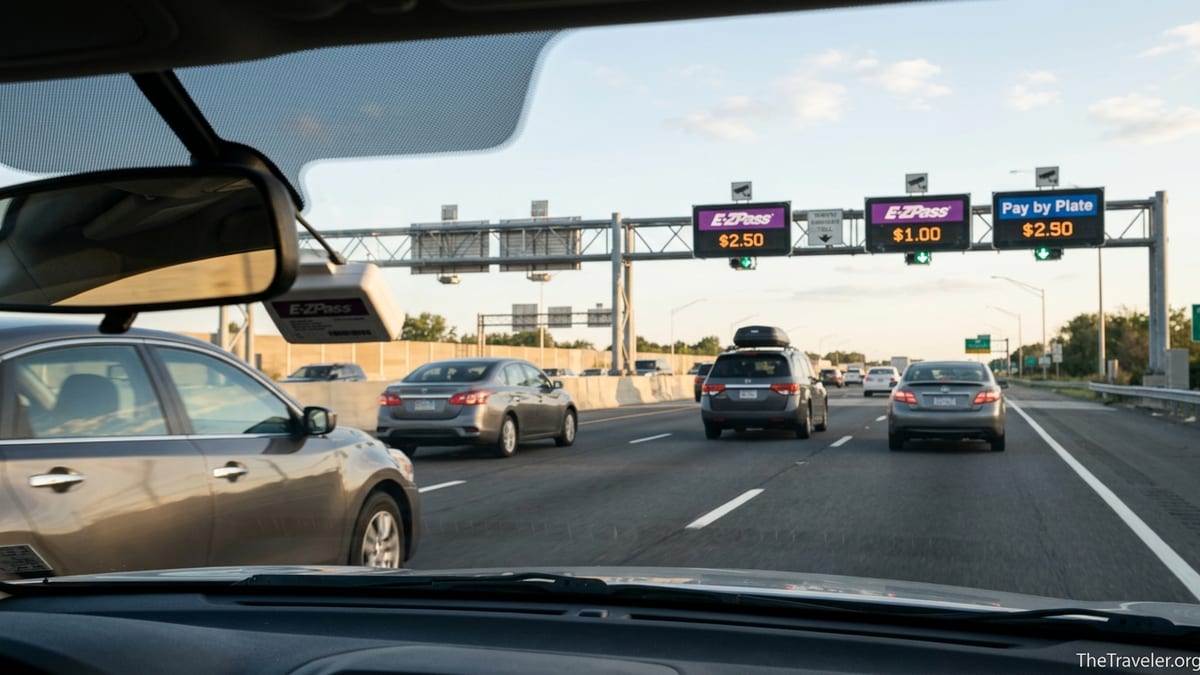
How E‑ZPass and Pay by Plate Actually Work
E‑ZPass is an electronic toll collection system used across much of the eastern United States, from Maine and New Hampshire down through Virginia and west to Illinois and Minnesota. A small transponder mounted on your windshield communicates with overhead readers when you pass a toll point, and the toll is deducted from a prepaid account linked to your credit card or bank account. One E‑ZPass tag from any member agency will generally work at toll roads and bridges operated by the others, so a device issued in Pennsylvania will function on the New Jersey Turnpike, New York State Thruway, and many Hudson River crossings.
Pay by Plate, often branded as Toll‑by‑Plate or Tolls by Mail, works very differently. Instead of a transponder, cameras photograph your license plate as you drive through. The toll agency uses state motor vehicle records to look up the registered owner, then generates an invoice and mails it to the address on file. In some regions, such as Florida’s Turnpike and Central Texas toll roads, the toll amount is the same or slightly higher than the E‑ZPass or transponder rate, but the bill also carries a small administrative fee, such as around 1 to 3 dollars per invoice, to cover lookup and mailing costs.
In practice, that means the E‑ZPass user sees the toll appear almost instantly in their account history or monthly statement. The Pay by Plate driver often does not see a bill for weeks, sometimes a month or more after the trip. If the mailing address is outdated or the notice is overlooked, that gap can turn one forgotten five‑dollar toll into a series of escalating fees and, eventually, a violation notice that is much more expensive than the original charge.
Because almost all major toll roads in the Northeast and Mid‑Atlantic have now converted to cashless collection, from the Massachusetts Turnpike to the bridges of the Delaware River Joint Toll Bridge Commission, the choice is rarely between “cash or electronic” anymore. It is typically between a transponder account like E‑ZPass or a plate‑based invoice system, whether you see it described as Pay by Plate, Toll by Mail, or similar branding at the gantry.
Cost Comparison: What You Actually Pay
The strongest argument in favor of E‑ZPass for frequent travelers is cost per trip. Many agencies now set a discounted electronic rate that is significantly lower than the Pay by Plate amount for the same crossing. For example, recent rate tables for Hudson River and Delaware River bridges show E‑ZPass passenger car tolls that are commonly a dollar or more cheaper than the corresponding cash or Toll‑by‑Plate rate. On one busy interstate bridge between Pennsylvania and New Jersey, a typical 2025 toll schedule lists about 7 to 8 dollars for E‑ZPass and roughly 10 dollars for Toll‑by‑Plate for the same car class, a spread of around 30 percent.
The New York State Thruway offers a similar pattern. Passenger vehicles with a New York‑issued E‑ZPass pay the lowest rate per mile, while out‑of‑state transponders and Tolls by Mail are charged a higher schedule. At major crossings run by the Port Authority of New York and New Jersey, drivers with a properly configured E‑ZPass issued in the region can see a toll that is several dollars lower than the Pay by Plate customer using the exact same lane. That difference adds up quickly if you are commuting daily from New Jersey into Manhattan.
E‑ZPass itself is not entirely free. Depending on the issuing agency, you may pay a small one‑time tag cost, a refundable deposit, or a modest annual fee. In Massachusetts, for instance, the E‑ZPass MA program currently offers windshield stickers at no charge and does not impose a monthly account fee; drivers simply maintain a minimum prepaid balance. In Pennsylvania, a new customer typically prepays around 35 dollars and may pay a low annual transponder fee of a few dollars. New York’s E‑ZPass program has historically charged a monthly service fee on some accounts, particularly those issued by the Port Authority, while E‑ZPass New York accounts opened through the state’s own service centers can often avoid that extra cost.
By contrast, Pay by Plate has no sign‑up cost, but the per‑trip price is higher and is frequently paired with administrative fees built into each invoice. Florida’s Turnpike system, for example, adds an administrative charge of a few dollars to each Toll‑by‑Plate statement. In Central Texas, the regional mobility authority adds around 1 dollar per invoice for Texas plates and an additional fee for out‑of‑state registrations. Some authorities explicitly separate a “toll rate” and a “Pay by Plate fee” on their schedules, meaning that even drivers with prepaid accounts who forget their transponder can pay a surcharge if the toll is collected via license plate rather than tag. Over a week of commuting, those small per‑invoice fees can cost more than an entire year of E‑ZPass account maintenance.
Real‑World Examples Across the U.S.
Consider a practical example along the New Jersey Turnpike and Garden State Parkway. Current toll schedules distinguish between the lower E‑ZPass rate and the higher cash or plate‑billed rate. A commuter driving a passenger car from central New Jersey toward Newark Airport may pay several dollars less per trip using a New Jersey E‑ZPass, particularly during off‑peak periods when the agency offers an electronic discount. Over a typical work month with 20 round trips, the savings compared with Pay by Plate can easily reach 40 to 60 dollars.
On the Delaware River Joint Toll Bridge Commission’s facilities, such as the Scudder Falls Bridge between New Jersey and Pennsylvania, the pattern is similar. Passenger cars with E‑ZPass are charged a lower toll than those billed via TOLL BY PLATE. If a driver misses the initial Toll by Plate bill or forgets to pay by the due date, the second notice may include a 5 dollar late fee, raising the effective price even further. A motorist who uses the bridge a handful of times a year without a transponder might shrug off the extra dollar per crossing, but an everyday commuter can easily justify the effort of setting up E‑ZPass simply to avoid those higher charges and the risk of late fees.
In Texas, where the interoperability network is different but the Pay by Plate logic is similar, a driver on a Central Texas mobility authority toll road might see the same posted toll amount whether they use a TxTag or are billed by plate, but the Pay by Mail invoice will include a small administrative fee, often around a dollar, tacked on top of the toll total. For a traveler passing through once on a road trip from Dallas to Austin, that is a minor cost. For a local using the road two or three times a week, those fees quickly outstrip the small effort of acquiring and funding a transponder.
Even rental car users see dramatic differences. Many major rental companies automatically enroll their fleets in tolling programs so that if you pass through an electronic gantry without your own tag, the tolls are billed back to you along with a per‑day convenience fee. Those fees commonly range from roughly 5 to 7 dollars per calendar day on which a toll is incurred, with weekly caps often near 25 to 35 dollars. If you plan to drive toll roads in a rental car for more than a day or two, it can be far cheaper to bring your own E‑ZPass tag from home, confirm with the rental counter that you may use it, and ensure the tolls post directly to your account at the discounted E‑ZPass rate rather than through the rental agency’s costlier plate‑billing channel.
Convenience, Flexibility, and Risk
From a convenience perspective, E‑ZPass typically wins for regular users, but Pay by Plate can look attractive for occasional travelers and visitors. Once your E‑ZPass account is set up, tolls are handled automatically. You can view your trip history online, receive email alerts when your balance is low, and set your account to replenish from a stored payment method. If you live in a region like northern New Jersey, suburban Philadelphia, or Boston, where multiple tolled bridges, tunnels, and express lanes surround daily life, the speed of dedicated E‑ZPass lanes and the lack of paperwork can be hard to beat.
Pay by Plate helps in different scenarios. Someone flying into Orlando for a three‑day theme park visit may reasonably decide not to bother with a Florida SunPass transponder if they are only driving a short stretch of the Turnpike once or twice. A family driving from Ohio to the Outer Banks might cross a single toll bridge that offers TOLL BY PLATE with a relatively modest premium over the E‑ZPass rate. In these one‑off circumstances, avoiding an account sign‑up, deposit, and long‑term account management can be more convenient than the small savings per trip.
The risk profile is very different, though. With E‑ZPass, the main risks are administrative: keeping your payment method current, making sure your transponder is properly mounted and functioning, and monitoring for any misreads where your plate, vehicle class, or state network may trigger a manual review. Rarely, a dead or misaligned tag can cause the system to treat you as a plate‑billed driver and send a mailed invoice or violation notice. If you catch it and call the agency, many will adjust the charges back to the transponder rate for established customers.
With Pay by Plate, the risk shifts to the reliability of mail and recordkeeping. If your state registration address is even slightly outdated because you moved six months ago and never updated the DMV, your toll invoice might go to your old residence. It may bounce back or sit unopened until late fees accumulate. States have different escalation paths, but a common pattern is that an unpaid invoice is followed by one or two reminder notices, then a violation notice, and eventually potential registration holds or collection activity. What began as a five‑dollar toll can balloon into 50 dollars or more if several layers of fees stack up before you realize anything is wrong.
When E‑ZPass Clearly Makes More Sense
For most drivers who live in the E‑ZPass region and use toll roads at least a few times per month, a transponder is usually the better choice. The discount compared with Pay by Plate, combined with the reduced administrative fees and the ability to track tolls in real time, pays off quickly. Someone commuting from Staten Island into Manhattan, for example, crosses high‑priced bridges where an E‑ZPass discount can be several dollars per trip. Over the course of a year, even accounting for a modest monthly account fee, the savings can amount to hundreds of dollars relative to the Pay by Plate rate.
Regular regional road‑trippers are another group that strongly benefits from E‑ZPass. A family in Maryland who makes several weekend trips each year to New York City, the Jersey Shore, and New England might traverse half a dozen separate toll authorities: Maryland Transportation Authority, Delaware’s toll highway, the New Jersey Turnpike, Port Authority bridges, the New York State Thruway, and the Massachusetts Turnpike. With a single E‑ZPass tag, they can glide through each gantry, usually at the lowest available toll level. Relying on Pay by Plate in that scenario would mean a stack of separate invoices from multiple agencies with slightly higher rates and a greater risk of missing something in the mail.
E‑ZPass also makes sense when you value predictable budgeting. Because your account history shows each toll almost immediately, you can see whether a new express lane is costing what you expected, whether a changed commute pattern is adding up, or whether a household driver is using a tolled route more than planned. That is much harder to do with Pay by Plate, where you may not see a bill until weeks after the fact, and where line‑item detail is sometimes minimal on the paper statement.
Finally, for frequent travelers who occasionally rent cars, bringing your own E‑ZPass tag can sidestep high rental‑company toll fees. A business traveler who flies into Newark or LaGuardia a dozen times a year and always rents a car will almost certainly save money by using a personal transponder and declining the rental agency’s daily toll package, provided they carefully follow the agency’s rules about how to avoid double‑billing.
When Pay by Plate Can Be the Better Call
There are still situations where Pay by Plate or similar toll‑by‑mail systems make more sense. If you live in a state without toll roads and only expect to encounter a tolled bridge once or twice in the next several years, you may reasonably decide that the small premium on a single trip is not worth the time and mental overhead of opening and maintaining an E‑ZPass account. An example might be a Minnesota resident who drives to Chicago once for a weekend, uses the Illinois Tollway a couple of times, and does not expect to return soon. For that traveler, paying slightly more by license plate might be simpler than signing up for an I‑Pass or E‑ZPass account they rarely use.
Short‑term visitors flying in from abroad or other regions of the country fall into a similar category. A tourist from Europe arriving in Boston for a three‑day city stay might use a rental car only to and from Logan Airport on the Massachusetts Turnpike. If the rental company’s toll fees are reasonable or the tolls are few, the convenience of letting the existing plate‑billing arrangement handle those charges could outweigh any marginal savings from acquiring and registering an E‑ZPass for such a brief visit.
Pay by Plate can also serve as an informal safety net even for E‑ZPass users. If your transponder battery fails or you accidentally leave the tag in another vehicle, the license plate system will still capture your trip. Some agencies will allow you to log in, locate the unpaid toll based on your plate and date of travel, and link it to your account at the discounted rate within a certain grace period. Others will at least let you pay online before the invoice escalates into a violation. In that sense, plate billing can reduce the anxiety of wondering whether a single missed toll will automatically become a large fine.
Where Pay by Plate becomes less attractive is when tolling agencies pair it with very aggressive fee structures. If you live in a state where unpaid invoices quickly accrue additions of 5, 10, or even 25 dollars per notice, or where a few missed tolls can lead to registration holds, it is risky to rely on plate billing as your primary method. In those regions, even infrequent drivers may be better off keeping a small‑balance E‑ZPass account as a hedge against costly mistakes.
Practical Tips for Choosing and Using Each Option
If you decide E‑ZPass is right for you, take a few practical steps to maximize the benefit. Choose your issuing agency thoughtfully. Some, like Massachusetts, have been known to offer free transponders and no monthly maintenance fees, while others impose small account or paper statement charges. You are generally allowed to obtain an E‑ZPass tag from any participating state regardless of where you live, so it can be worth comparing fee structures and discounts before you sign up. Install the transponder exactly as directed on your windshield and periodically log into your account to confirm that recent trips are posting correctly.
Pay close attention to your payment method and contact information. If your credit card expires or your bank account changes, update it before your next major trip so that automatic replenishments do not fail. Make sure your email address and phone number are current so that you receive low‑balance alerts or notices about any suspicious activity. If you replace your vehicle or license plate, update the plate information on your E‑ZPass account promptly; otherwise, some tolls may default to plate billing and result in unexpected invoices despite your transponder.
If you prefer to rely on Pay by Plate, you can still manage the risks. First, keep your vehicle registration address completely up to date with your state motor vehicle agency so that invoices reach you in a timely way. Second, after driving through an unfamiliar toll facility, especially in another state, visit the toll authority’s website within a week or two and look for a “Pay Toll” or “Toll by Plate” tool where you can proactively search by license plate and travel date. Many systems allow payment before an official invoice is even generated, which can help you avoid late fees.
Finally, be realistic about your own habits. If you frequently misplace bills or travel for long stretches, relying on mailed toll invoices may not be wise. In that case, even a rarely used E‑ZPass account with a small balance could be a safer option, providing automatic coverage whenever you happen to encounter a toll gantry, rather than counting on a paper notice that might arrive while you are away.
The Takeaway
Choosing between E‑ZPass and Pay by Plate is really a question of your driving patterns, risk tolerance, and appetite for up‑front planning. E‑ZPass requires a bit of initial setup and, in some states, a small ongoing fee. In return, it usually gives you the lowest toll rate, the fastest trip through gantries, and the least chance that a missed invoice turns into a costly violation. For commuters, frequent interstate travelers, and anyone regularly passing through high‑priced bridges and tunnels, that trade‑off almost always works in favor of the transponder.
Pay by Plate, on the other hand, shines for truly occasional users and short‑term visitors who will encounter only a handful of tolls and do not want to maintain another account. Used carefully, with up‑to‑date registration information and a habit of checking for tolls after a trip, it can be a convenient way to comply with electronic tolling rules without committing to a long‑term program.
For most travelers in the E‑ZPass footprint, the practical sweet spot is simple. Keep an E‑ZPass account for daily life and regular road trips, and treat Pay by Plate as a useful backup rather than a primary strategy. That way you enjoy the savings and convenience of the tag while minimizing the surprises that can come from relying on a camera, a database, and the postal service to keep your toll obligations on track.
FAQ
Q1. Is E‑ZPass always cheaper than Pay by Plate?
E‑ZPass is usually cheaper on a per‑trip basis because many agencies offer a discounted electronic rate. There are exceptions, but in most busy corridors the E‑ZPass toll is noticeably lower than the plate‑billed price.
Q2. Do I need to live in an E‑ZPass state to get a transponder?
No. Most E‑ZPass agencies allow out‑of‑state residents to open accounts online and ship transponders by mail. You can live in a non‑toll state and still use an E‑ZPass tag when you visit toll roads elsewhere.
Q3. What happens if my E‑ZPass does not read and the system bills my plate?
If your tag fails to read, the toll equipment will usually capture your plate and treat the trip as a Pay by Plate transaction. Many agencies allow you to contact customer service and request that the toll be reclassified to your E‑ZPass account, especially if your tag and vehicle are already registered.
Q4. How long does it take to receive a Pay by Plate bill?
Timing varies by agency, but many plate‑billed tolls generate an invoice within a few weeks. Some systems wait until several tolls accumulate, then mail a combined statement. If you have recently driven through tolls and have not received a bill, you can often check and pay online using your license plate number.
Q5. Can unpaid Pay by Plate tolls affect my vehicle registration?
In several states, repeated unpaid tolls and violations can lead to registration holds or renewal blocks. Agencies typically escalate from invoices to violation notices before taking that step, but ignoring plate‑billed tolls can eventually create problems at renewal time.
Q6. Is there a single transponder that works everywhere in the U.S.?
Not yet. E‑ZPass covers much of the East and Midwest, while other networks like SunPass in Florida, TxTag in Texas, and FasTrak in California operate in their own regions, although interoperability between some systems has been expanding.
Q7. Are there fees just to keep an E‑ZPass account open?
Some agencies charge small monthly or annual account fees, or fees for paper statements; others, like Massachusetts’ E‑ZPass program, do not. Checking a few different issuing agencies before you sign up can help you minimize ongoing costs.
Q8. Should I use my own E‑ZPass in a rental car?
Often yes, because rental car toll programs can add daily convenience fees on top of each toll. If you bring your own tag, add the rental’s license plate to your account when permitted and follow the rental company’s rules to avoid double‑billing.
Q9. What if I rarely drive on toll roads?
If you use toll roads once every few years, Pay by Plate may be simpler. The slightly higher tolls and small administrative fees on an occasional invoice are often cheaper than maintaining a transponder account you almost never use.
Q10. How can I avoid late fees with Pay by Plate?
Keep your registration address current, watch your mail after driving through toll gantries, and check the toll authority’s website within a couple of weeks of your trip. Many systems let you pay online before an invoice escalates into a violation with added fees.