


E‑ZPass is one of the easiest ways to glide through toll plazas across much of the eastern United States. Used correctly, it can save time in traffic and often a few dollars on every bridge or tunnel. Used carelessly, it can quietly generate late fees, violation notices, and rental car surcharges that dwarf the original tolls. For road‑trippers, commuters, and out‑of‑state visitors, understanding the most common E‑ZPass mistakes is the best protection against those unpleasant surprise charges that show up weeks or even months after the drive is over.
Get the latest updates straight to your inbox!
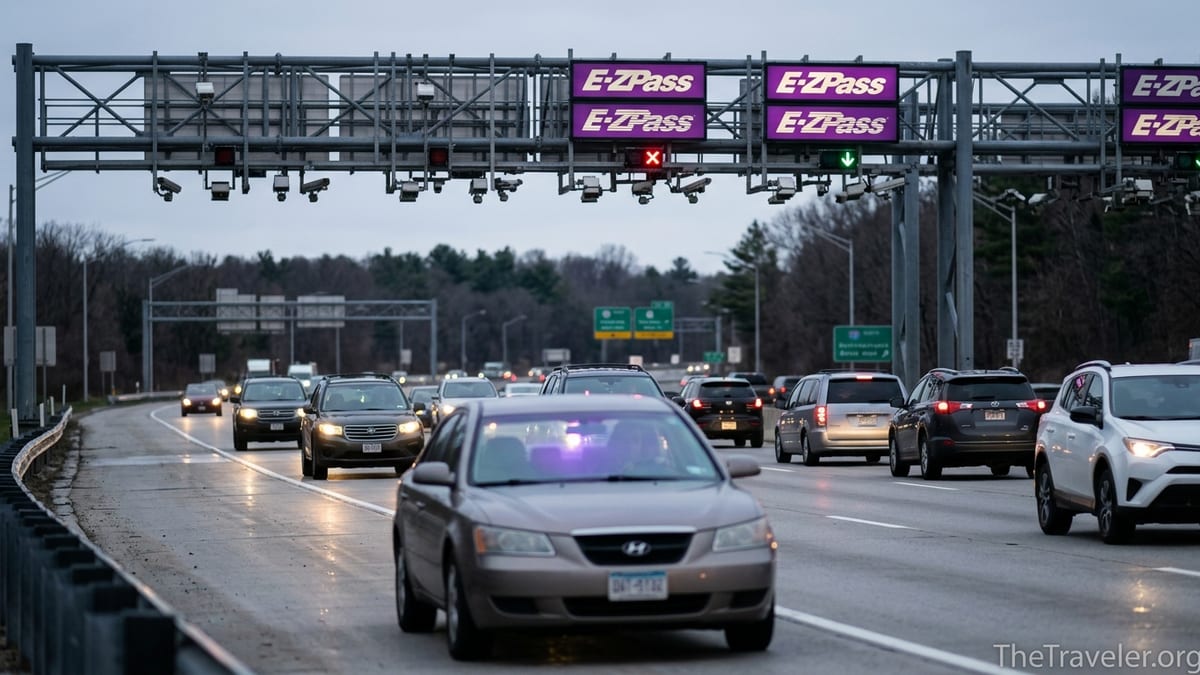
How E‑ZPass Works and Why Mistakes Get Expensive
E‑ZPass is an electronic toll collection system used by agencies in roughly 20 states, from Maine and New York to Virginia, Illinois, and Minnesota. Drivers open an account, prepay a balance, and receive a small transponder, usually a white or purple tag that sticks to the windshield. As you pass under a toll gantry, an antenna reads the tag and deducts the correct toll from your account. Where cashless tolling is in place, cameras also photograph license plates to back up the tag read or bill drivers by mail when no account is found.
Problems begin when the system cannot match the vehicle, plate, and E‑ZPass account cleanly. A low balance, expired card, or mis‑mounted tag can cause the toll system to switch a trip from discounted E‑ZPass pricing to a higher pay‑by‑plate rate. If the bill by mail is ignored or sent to an old address, many agencies add administrative fees that are often a flat amount per crossing. In New York, for example, drivers who do not resolve toll bills on bridges and tunnels can face a $50 violation fee per unpaid toll after a set period, easily turning a few missed $7 or $10 tolls into hundreds of dollars in penalties.
These charges add up fast in busy corridors like the New Jersey Turnpike, the New York State Thruway, or the Port Authority crossings into Manhattan. A traveler who crosses the Lincoln Tunnel daily for a week with an unfunded E‑ZPass or an outdated license plate could generate a chain of unpaid toll notices and violation fees before realizing anything is wrong. By the time the first letter lands in the mailbox, the original tolls may be a fraction of what is now owed in administrative costs.
Tag and Account Mistakes at the Toll Gantry
One of the simplest yet most costly mistakes is failing to mount the E‑ZPass tag correctly. Tolling agencies stress that tags should be placed on the inside of the windshield in the designated area, with the correct side facing out. If it is tossed on the dashboard, tucked in the glove box, or obscured by a metal‑tinted sunshade, the gantry may not read it. The system then falls back on the license plate image. If the plate is not linked to your account, the trip may become a toll‑by‑mail transaction with a higher rate than the discounted E‑ZPass price.
This is becoming more important as agencies introduce more granular pricing. The Port Authority of New York and New Jersey, for example, has approved a mid‑tier toll rate that will apply starting in 2025 for vehicles with a New York or New Jersey E‑ZPass whose tags do not read cleanly because they are not properly positioned. In practice, that means drivers who casually toss their tag on the seat could pay more for every crossing than neighbors who took a minute to mount their transponder as instructed.
A second common mistake involves vehicle class. E‑ZPass accounts include a class designation that tells the system whether the tag is mounted in a standard passenger car, a small RV, or a large commercial truck. If a traveler moves a tag from a compact sedan to a rented cargo van or a motorhome without updating the vehicle class, the gantry may see mismatched data and automatically charge a higher toll or treat the trip as a violation. Some agencies have reported system glitches where license plate images miscount axles and bill a car as a three‑axle vehicle, which results in a higher toll until the driver challenges the charge.
A third mistake is simply speeding through the lane. Modern cashless systems are built for highway speeds, but some legacy toll plazas still have posted speed limits in the E‑ZPass lanes. Racing through or changing lanes abruptly under the gantry can produce a bad read, especially if the tag is not firmly mounted. Travelers often only discover the error weeks later, when notices appear for unpaid tolls that they assumed were deducted automatically.
Account Management Errors: Low Balances, Old Cards, Wrong Plates
Many of the most expensive E‑ZPass problems trace back to account housekeeping. Because most plans draw from a prepaid balance that automatically replenishes from a stored debit or credit card, it is easy to assume everything runs on autopilot. The trouble begins when the card on file expires, is replaced after fraud, or is declined. If the replenishment fails and the balance drops below zero, some agencies will still let a few trips go through, then begin sending toll bills by mail to the address linked to the plate instead of deducting directly from the account.
Real‑world complaints show how quickly this can snowball. In one recent television report from New York City, a Staten Island driver discovered he owed thousands of dollars in late fees and penalties after a series of small tolls went unpaid. The original toll amounts were only a fraction of the total. The rest consisted of per‑transaction fees that kicked in after the E‑ZPass account stopped funding properly and mailed notices went unanswered for months. The driver believed his automatic replenishment was working, but the card on file had changed.
Another frequent oversight is failing to update license plates. When a traveler sells a car, moves to a new state, or picks up temporary tags for a new vehicle, the E‑ZPass account may still be tied to the old plate. If the toll gantry cannot match the new plate to an account, it creates a toll‑by‑mail transaction and sends a bill to the registered owner address instead. For full‑time travelers or students who split time between states, those paper bills can easily sit unopened or arrive at an address they no longer check regularly, triggering successive rounds of late fees.
States handle fee structures differently, but the pattern is similar. For example, guidance from northeastern agencies shows that a small initial late fee, sometimes around five dollars, can escalate to a $50 violation fee per transaction if a bill remains unpaid for 60 days or more. That means a single month of daily commuting on a toll road with a plate mismatch could generate dozens of $50 charges on top of the underlying tolls. Even if an administrative hearing later reduces the total, the time and effort required to straighten it out can be significant.
Rental Cars: The Perfect Storm for Double Billing and Surcharges
Rental cars are one of the biggest sources of E‑ZPass confusion and extra charges, especially for visitors flying into hubs like Newark, LaGuardia, or Boston. Many rental companies work with toll management firms that install their own transponders in each vehicle. These services often charge a daily fee for the convenience, which can run anywhere from roughly $5 to more than $15 per rental day, sometimes plus the tolls themselves. Travelers may be automatically enrolled at the counter, or through fine print in the rental agreement, even if they intend to use their own personal E‑ZPass tag instead.
Real‑life complaints from renters show how this plays out. A traveler at Denver International Airport recently reported being told that the toll device was “usage‑based” and would only incur charges if she drove on a toll road. After returning the car, she found a large “non‑package items” charge of more than two hundred dollars on her credit card. Only after requesting a detailed invoice did she discover she had been enrolled in an unlimited toll package at a flat daily rate, even though she recalls not agreeing to it clearly. Similar stories out of the New York and New Jersey area describe renters being billed daily fees for toll services even when they paid individual tolls separately with their own E‑ZPass.
Another common scenario involves plate registration. A traveler might add the rental car’s license plate to a personal E‑ZPass account, planning to let plate‑based billing pick up any crossings where the tag fails to read. If the traveler forgets to remove that plate after returning the car, future tolls taken by subsequent renters can continue to debit the original traveler’s E‑ZPass account. There are online reports of drivers discovering hundreds of dollars in tolls weeks after a trip because their account was still linked to a plate now being driven by a stranger several states away.
Double billing can occur when both the rental car’s embedded toll system and the traveler’s own tag are active. For example, someone renting at Newark may place their personal Virginia E‑ZPass on the windshield while an embedded rental company transponder sits hidden near the rear‑view mirror. If the rental device is automatically activated the first time the car hits a toll, the rental firm’s toll processor may bill all crossings, while the traveler also sees some of the same trips on their personal account. Untangling which charges belong to which system later can be challenging, especially because rental toll providers are often separate third‑party companies with their own customer service channels and fine print.
Toll Bills, Violations, and How Small Debts Turn Large
When an E‑ZPass trip does not match a valid, funded account, it usually becomes a toll bill by mail. That bill is sent to the address where the license plate is registered. If you are on an extended road trip, staying with friends, or between addresses, it is easy for those envelopes to stack up. Most agencies provide a grace window, often several weeks, during which you can pay only the toll amount or a modest late fee. After that, additional administrative violation fees apply.
Consider a traveler driving a rental car over a New York City bridge or tunnel several times without a functioning E‑ZPass. If the toll by mail bill for each trip goes unpaid for 60 days, the agency may add a violation fee of about $50 per crossing. Ten crossings at an original toll of around $12 each could turn into more than $600 in violation fees alone, plus the base tolls. Similar patterns appear in Pennsylvania and New Jersey, where separate tolling authorities layer administrative fees on top of unpaid tolls and may eventually refer large debts to collections.
Some states have also linked chronic toll violations to vehicle registration consequences. Under rules adopted in New Jersey, for instance, drivers with multiple unpaid violations who ignore payment plans can face notices of pending registration suspension. While the threshold for such penalties is relatively high and geared toward repeat toll evaders, travelers who accumulate a surprising backlog of unpaid E‑ZPass bills while moving or living abroad sometimes find themselves suddenly blocked from renewing a registration until they resolve the debt.
Technology issues can add to the confusion. In Virginia, the private operator of tunnels under the Elizabeth River previously suffered a large backlog of unprocessed transactions that delayed toll postings to E‑Pass accounts by months. Some drivers reported receiving clusters of old tolls all at once, long after they had forgotten the trips, and in some cases discovered errors where cars were misread as larger vehicles. While agencies often adjust obvious mistakes if they are documented quickly, the burden typically falls on the driver to review statements, spot anomalies, and request corrections.
Common Traveler Scams, Texts, and Misunderstandings
Beyond honest mistakes, travelers also need to watch for fraudulent charges and scams that misuse the E‑ZPass name. Several state toll agencies have warned in recent years about text messages that claim to be from “E‑ZPass Toll Services,” urging recipients to click a link to pay a supposed overdue toll. These messages often target drivers in states where E‑ZPass operates, use vague language, and demand quick payment. In reality, legitimate E‑ZPass agencies generally send bills by mail or through secure online portals, not by random text messages with unfamiliar web addresses.
Credit card bills can also reveal mysteries. Frequent travelers who rent cars often complain about toll‑related line items that only appear as “toll services,” “plate pass,” or “e‑toll” with no trip details. In one widely shared complaint involving a national rental company, a driver was charged tolls on a day and at times when the car was still recorded as being parked at the airport. The renter suspected that a toll device or plate had been cloned or used by another vehicle. Sorting out such cases usually requires gathering rental contracts, flight records, and any screenshots of E‑ZPass account activity, then disputing the charge with both the rental company and the credit card issuer.
Even when no fraud is involved, misunderstandings at the rental counter are common. Some agents describe toll packages as a simple daily convenience fee, but travelers later realize that the package charged for every day of the rental, not just the days they used toll roads. In urban areas adding congestion pricing zones, like Manhattan’s new congestion fee district, drivers sometimes assume those charges will be handled through their E‑ZPass tag. Instead, the charge might be processed separately as a camera‑based fee billed to the vehicle owner. For renters, that means the congestion charge goes to the rental company, which then adds its own administrative fee on top.
Because E‑ZPass is interoperable across many states and agencies, one trip can involve multiple toll operators. A single road journey from Washington, D.C., to Boston might involve tolls from the Maryland Transportation Authority, Delaware River agencies, the New Jersey Turnpike Authority, and New York and Massachusetts systems. If anything goes wrong with your account or plate data, you might end up dealing with several different entities to resolve violations, each with its own deadlines and documentation rules.
Practical Ways to Avoid Surprise E‑ZPass Charges
The good news is that most of these headaches are avoidable with a bit of planning. Before a major road trip, log in to your E‑ZPass account and confirm that your contact information, license plate numbers, and payment card are all current. Check that the plate on the car you will actually drive appears in the account, and remove any plates you no longer use, especially old rentals. If your bank recently reissued your card, make sure the toll account uses the new expiration date so automatic replenishments do not fail on the road.
Physically inspect your tag. Mount it where your issuing agency recommends, typically just below the rear‑view mirror on the inside of the windshield, with the logo facing outward. Avoid placing it behind window stickers, toll receipts, or metallic sunshades that can interfere with the signal. If you drive multiple vehicles, consider getting a separate tag for each one instead of constantly moving a single transponder, which increases the risk of forgetting it or placing it incorrectly.
With rental cars, decide in advance how you will handle tolls. If you prefer to use your own E‑ZPass, ask at the counter whether the vehicle has a built‑in toll device and how to opt out of the rental company’s toll plan. Some agencies let you keep the rental device closed in a shielded box so it does not activate. Research typical daily fees for the company’s toll program so you can recognize them later on your bill. As soon as you return the car, log into your E‑ZPass account and remove the rental plate if you added it, then review your statement over the next month to catch any unexpected cross‑state tolls.
Finally, open your mail promptly after a trip, especially envelopes from state transportation or tolling authorities. Many travelers who racked up large violation balances say they simply did not realize early notices had arrived. Agencies often provide an early period to pay the toll only or a reduced fee if you respond quickly. The same advice applies online: look through your E‑ZPass statements every few months, just as you would a credit card bill, to spot errors or technical glitches before they become a tangle of violations and collection notices.
The Takeaway
E‑ZPass is a powerful tool for friction‑free road travel in much of the United States, but it is not a set‑and‑forget system. From mis‑mounted tags at Port Authority bridges and tunnels to forgotten rental car plates on personal accounts, seemingly minor oversights can trigger a chain reaction of toll‑by‑mail bills, late fees, and violation notices that far exceed the original cost of driving through the gantry. The travelers who suffer the worst outcomes are often those who assume everything is running smoothly in the background and do not notice warning signs until debts have ballooned.
By treating your E‑ZPass account with the same attention you give to a credit card or airline mileage account, you can avoid most problems. That means keeping your payment methods and plates current, mounting tags correctly, clarifying toll arrangements on rentals, and reacting quickly to any bills or notices. For frequent turnpike commuters, this diligence can mean the difference between years of seamless, discounted toll travel and a sudden, stressful confrontation with a stack of violation letters. For vacationers and international visitors, it can be the key to ensuring a memorable road trip does not come with an expensive postscript months later.
FAQ
Q1. Will I get extra charges if my E‑ZPass balance goes negative for just one trip?
If your balance dips below zero, some agencies will let a few trips pass and then convert later crossings to toll‑by‑mail. You may not be fined immediately, but if mailed bills go unpaid, late fees and violation charges can be added to each toll.
Q2. What happens if my E‑ZPass tag does not read in a rental car?
If the rental company has its own toll device or plate‑based billing service, it may pick up the tolls and add daily service fees or processing charges to your rental invoice, even if you tried to use your personal tag. You could also see separate charges on your E‑ZPass account if some reads did go through.
Q3. How can I avoid double billing when I use my own E‑ZPass in a rental?
Ask the rental counter how to opt out of their toll program and confirm whether the in‑car device can be disabled or kept in a shielded box. Add the rental plate to your E‑ZPass account only if your issuing agency recommends it, and remove it immediately after returning the car.
Q4. I sold my car and forgot to remove the plate from my E‑ZPass account. Can the new owner trigger charges?
If that plate remains linked, any tolls taken by the new owner may initially route to your E‑ZPass account. Once you notice unexpected trips on your statement, remove the plate and contact your issuing agency to explain the sale and dispute charges that occurred after you no longer owned the vehicle.
Q5. Are E‑ZPass late fees the same in every state?
No. Each tolling authority sets its own schedule for late fees and violation charges. Some impose a small initial late fee, then escalate to a flat violation amount per unpaid toll after a number of days. Always check the rules for the state where you traveled.
Q6. How quickly do toll‑by‑mail bills arrive after I drive through a gantry?
Timing varies by agency and traffic volume. Many bills arrive within a few weeks, but system backlogs can delay them for months. This is why it is important to monitor your E‑ZPass account and open mail from toll authorities even long after a trip.
Q7. Can my vehicle registration be affected by unpaid E‑ZPass tolls?
In some states, multiple unpaid toll violations can eventually lead to registration holds or suspension notices. These measures are generally aimed at chronic non‑payers, but letting large balances sit unresolved can bring your registration into the dispute.
Q8. How can I tell if a text claiming to be from E‑ZPass is a scam?
Be suspicious of unsolicited texts demanding quick payment through a link, especially if they do not include your agency name or account details. Legitimate toll agencies usually communicate by mail or through secure online portals, not through generic text links.
Q9. Is it worth getting E‑ZPass if I only drive through tolls a few times a year?
For occasional travelers, E‑ZPass can still offer discounts compared with pay‑by‑plate rates and reduce the risk of missed bills, but it requires some upkeep. If you rarely use toll roads, consider whether a low‑fee plan is available and set calendar reminders to review your account a few times a year.
Q10. What should I do if I think an E‑ZPass toll or violation is wrong?
Gather supporting evidence such as statements, photos of your car, rental contracts, or travel records. Then contact the tolling authority listed on the notice and use its dispute or administrative review process. Acting quickly improves your chances of getting incorrect fees reduced or removed.