


Germany is frequently discussed as a base for remote professionals within Europe, yet digital nomads face specific operational requirements that differ from those of traditional expatriates. Evaluating Germany as a destination for digital nomads therefore depends primarily on the reliability of digital infrastructure, the availability of professional work environments, and the legal and practical framework for sustained remote work. This briefing focuses on these factors to assess how well Germany functions as a country for digital nomads who need to work productively and reliably online.
Connectivity and Internet Reliability for Remote Work
Germany offers generally reliable connectivity for remote work, but quality can vary significantly between major urban centers and smaller towns or rural regions. According to recent regulatory monitoring, combined mobile coverage using all technologies covers essentially the entire population, with only a very small proportion of the land area remaining without any mobile data signal. In practice, digital nomads who remain in large cities and well-developed regional hubs can usually expect stable 4G and 5G connectivity for standard remote work tasks such as video conferencing, cloud collaboration, and large file transfers.
5G coverage has expanded rapidly and now reaches well over 90 percent of the population, with official measurements for 2023 and 2024 indicating that Germany slightly exceeds the EU average for 5G availability. However, the proportion of traffic actually carried over 5G networks is still comparatively low, and many users rely predominantly on mature 4G networks. This means that headline 5G coverage figures do not always translate into consistently high real-world speeds, particularly indoors or in dense urban areas where building materials can weaken signals.
Fixed broadband infrastructure is improving as fiber-to-the-home connections grow, but legacy technologies such as DSL still account for a significant share of subscriptions. Regulators report that a substantial minority of fixed broadband lines now provide at least 100 Mbps download speeds, yet performance can be highly location-dependent. For digital nomads, this implies that long-term rentals in modern buildings or central districts are more likely to offer robust fixed-line connections, while older properties or peripheral neighborhoods may still have moderate speeds and higher latency. Careful verification of the actual line technology and advertised speeds before committing to accommodation is advisable for bandwidth-intensive work.
Overall, Germany provides a broadly dependable connectivity environment that satisfies the needs of most remote professionals. At the same time, it lags behind certain digital-nomad hotspots where gigabit fiber and very high mobile speeds are widely available even in secondary cities. Digital nomads whose work involves heavy real-time media production or frequent large data transfers should therefore treat connectivity checks as a core part of their location selection within the country.
Mobile Networks, Data Coverage, and Work-on-the-Go
For digital nomads who rely on mobile data to work from various locations, Germany offers extensive but somewhat uneven mobile network performance. Regulatory data for 2024 indicates that virtually all inhabited areas are covered by at least one mobile network with 4G data service, and a growing share of the territory now has 5G service as well. Multi-operator statistics show that total mobile data usage continues to grow, although at a slower rate than in some other OECD markets, suggesting that Germany remains more conservative in mobile data consumption than many peer countries.
In practice, urban zones and transport corridors often provide strong LTE and usable 5G signals, while some rural and forested regions can still suffer from lower throughput or sporadic dead spots, especially indoors. For digital nomads who plan to work while traveling across the country by train or from remote areas, this patchiness can be material. Long-distance trains may have sections with weak reception, which can disrupt live video calls or large uploads unless backed up by pre-downloaded materials or offline workflows.
From a cost and practicality perspective, mobile tariffs generally include data allowances that are adequate for email, messaging, browsing, and moderate video use. However, truly unlimited high-speed mobile data is less common and often more expensive than in some other popular digital-nomad destinations. As a result, many nomads combine a fixed broadband line at their primary base with a mobile data plan used mainly for redundancy and short-term work on the move, rather than relying solely on tethering for full-time work.
For location-independent professionals who prioritize continuous mobility over a city-based hub, Germany’s mobile environment is functional but not exceptional. It supports a hybrid work pattern that alternates between stable fixed connections in cities and acceptable mobile coverage in transit, but it may not be optimal for those who expect consistently high bandwidth in remote landscapes or during long overland journeys.
Coworking Ecosystem and Professional Workspaces
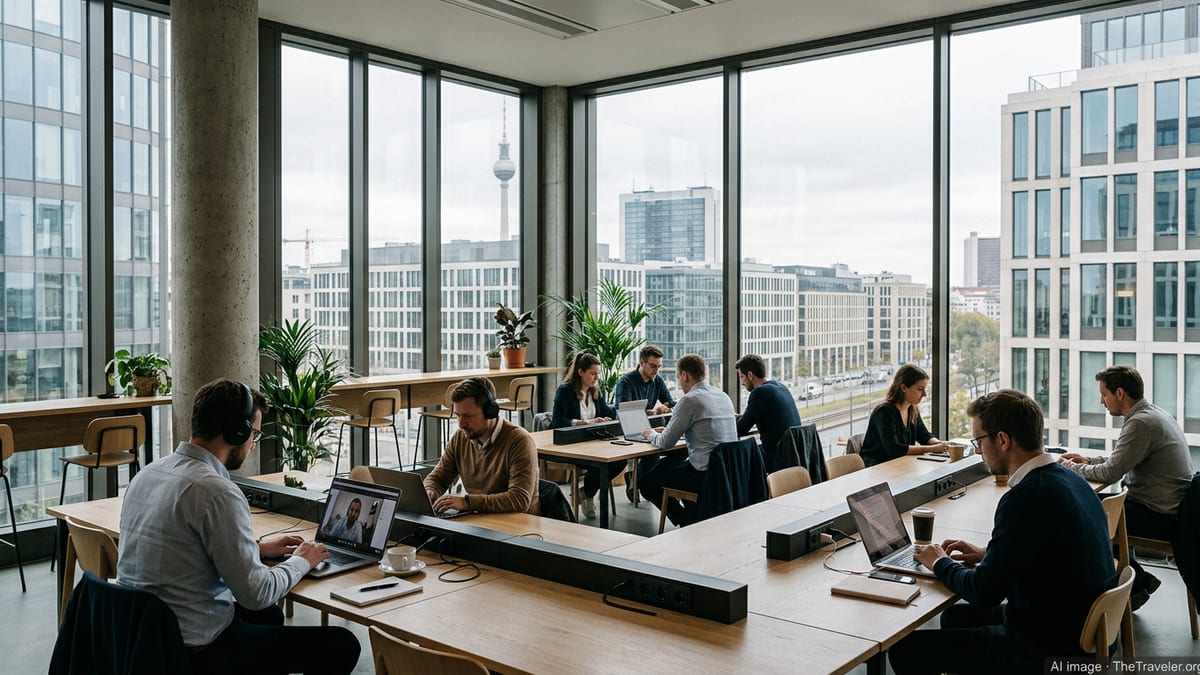
Germany has developed a broad coworking ecosystem, particularly in large cities such as Berlin, Munich, Hamburg, and Cologne. These cities host a dense network of coworking providers ranging from international brands to local independent spaces and niche hubs focused on technology, creative industries, or sustainability. While exact national counts fluctuate, major urban regions typically offer dozens of coworking options, and Berlin alone supports a significant number of shared workspaces distributed across central and emerging districts.
Most urban coworking spaces provide standard amenities expected by digital nomads: high-speed wired and wireless internet, focus areas, phone booths, meeting rooms, and communal areas. Many also provide printing, event spaces, and flexible day passes or short-term memberships that accommodate itinerant professionals who may not wish to commit to long contracts. In technology-focused cities, it is common to find bilingual staff and international communities, which can reduce barriers for English-speaking digital nomads.
Beyond the main metropolitan centers, coworking availability becomes more varied. Regional capitals and university towns typically offer at least a handful of coworking spaces, often supported by local economic development initiatives aimed at fostering startups and remote work. Smaller towns may rely on a single community-oriented space or municipal innovation hub, and some rural regions promote coworking in repurposed buildings as part of digitalization strategies. For digital nomads seeking quieter, non-urban environments, it may still require deliberate research to identify suitable professional workspaces with dependable connectivity.
Pricing for coworking in Germany generally reflects Western European cost levels. Day passes are often positioned in the mid-range compared with other EU capitals, while monthly flex-desk memberships in prime locations can be comparatively expensive. For digital nomads on extended stays, combining a reliable home setup with occasional coworking use can optimize both budget and access to networking opportunities. Overall, the coworking ecosystem is sufficiently mature to support most digital nomad needs in urban Germany, but it is less ubiquitous and sometimes less price-competitive than in certain emerging remote-work hubs.
Legal and Regulatory Context of Remote Work
Germany’s legal framework for remote work has evolved gradually and is primarily oriented toward employees of German companies rather than globally mobile freelancers. There is no single overarching “right to remote work” that guarantees employees the ability to work from any location, and decisions about home office or telework are generally governed by individual contracts, internal policies, or collective agreements. For digital nomads employed by foreign companies or operating as independent contractors, the regulatory environment is influenced more by labor, social security, and tax rules than by specific digital-nomad legislation.
Recent policy developments within Europe illustrate how Germany is adapting to cross-border telework for commuters, for example through bilateral arrangements that allow a certain number of remote work days from a neighboring country without changing tax allocation. These changes are primarily aimed at cross-border employees who live in one country and work for an employer in another, but they signal an increasing recognition of remote work patterns. However, they do not in themselves create a broad legal framework for third-country digital nomads who choose Germany as a temporary base while working for clients or employers abroad.
For digital nomads, important practical implications arise from rules on the place of work defined in employment contracts and from occupational health and safety standards that can extend to home offices. Employers with a presence in Germany may need to consider ergonomic and health regulations when formalizing telework arrangements, and some remain cautious about long-term work from abroad due to complex compliance requirements. As a result, fully location-independent work arrangements may still face internal corporate constraints, even where the technical ability to work from anywhere exists.
From a regulatory perspective, Germany is not yet a specialized digital-nomad jurisdiction. It does not provide targeted remote-work incentives or dedicated frameworks explicitly designed for globally mobile knowledge workers. Digital nomads who use Germany mainly as a base for global work therefore operate within general labor and regulatory norms that were designed primarily for traditional residents and commuters, rather than a transient, internationally distributed workforce.
Work Culture, Language, and Daily Operational Friction
Germany’s work culture places high value on reliability, structure, and clear documentation, which can be advantageous for digital nomads collaborating with German clients or teams. Meeting schedules are taken seriously, and expectations regarding availability, deliverables, and data security are typically explicit. For remote professionals who prioritize predictable processes and clear communication, this environment can support efficient collaboration and long-term project relationships.
At the same time, German business practices remain more formal than in some common digital-nomad hotspots. Response times outside agreed working hours can be limited, and there is often less tolerance for highly flexible or last-minute schedule changes. Digital nomads who operate across multiple time zones must factor in the importance placed on defined core working hours and may need to adjust communication habits to align with German norms regarding punctuality and professional boundaries.
Language is another operational consideration. In large cities and in internationally oriented sectors such as technology, consulting, and creative industries, English is widely used in professional contexts, including at coworking spaces and startup events. However, administrative interactions, local business services, and many small enterprises continue to operate primarily in German. Digital nomads who plan to stay longer or who need to interact frequently with local institutions will benefit from at least basic German language skills or access to translation support, especially when reviewing contracts or service terms related to work infrastructure.
Daily operational friction can also arise from the relative complexity and formalization of procedures around communications contracts, registrations for services, and changes in address. These processes are manageable with planning, but they contrast with the streamlined, app-based service environments that characterize several popular digital-nomad destinations. Professionals who value stability and order may view this structure as a positive feature, while those prioritizing maximum flexibility and minimal paperwork may find it constraining.
Comparative Position Among Global Digital-Nomad Hubs
When compared with leading global digital-nomad hubs, Germany presents a mixed profile. In terms of fundamental reliability of power, connectivity, and physical infrastructure, it scores strongly. The risk of prolonged power outages is low, core urban networks are resilient, and both mobile and fixed broadband services are supported by established, regulated providers. This underpins a stable environment for long-term remote work.
However, Germany does not consistently match the top-tier connectivity speeds and simplified user experiences available in some newer remote-work destinations. While 5G and fiber deployment are progressing, legacy technologies remain prevalent, and average consumer internet speeds can trail behind those in countries that have aggressively rolled out high-capacity networks nationwide. Anecdotal comparisons from remote workers often highlight that everyday internet performance in Germany, particularly upload speeds and latency-sensitive services, may feel less responsive than in certain Asian or Nordic markets.
On the non-technical side, Germany’s regulatory environment and administrative culture are oriented more toward resident workers and long-term residents than toward continuously mobile individuals. Lack of a dedicated digital-nomad policy framework and relatively formal procedures in areas such as registrations and contracts can create more friction than in jurisdictions that have tailored their systems to attract short- to medium-term remote professionals.
As a result, Germany can be considered a strong, stable base for digital nomads who prioritize professional reliability, access to large corporate markets, and integration into European time zones, while it is less competitive for those whose main criteria are streamlined digital processes, ultra-fast ubiquitous connectivity, and minimal bureaucracy.
The Takeaway
Germany is a viable country for digital nomads, but its strengths and weaknesses are specific. It offers robust baseline infrastructure, broad mobile and fixed connectivity, and a mature coworking ecosystem in major cities. These elements support sustained remote work for most knowledge-based professions and provide access to a large European market and time zone alignment for collaboration.
At the same time, Germany does not function as a specialized digital-nomad destination. Connectivity quality can be uneven outside major centers, mobile data conditions are adequate rather than outstanding, and legal and administrative frameworks are primarily designed for traditional residents and employees. Digital nomads who expect ultra-high-speed internet everywhere, fully app-based bureaucracy, and highly flexible work norms may find the environment comparatively rigid.
For digital professionals who value stability, predictable systems, and a structured work culture, and who are prepared to navigate some administrative formality and location-dependent internet performance, Germany can serve as a solid and reliable base. For those whose priority is maximum flexibility, frictionless setup, and top-tier connectivity in every corner of the country, Germany will feel functional but not optimally optimized for the digital-nomad lifestyle.
FAQ
Q1. Is internet speed in Germany sufficient for full-time remote work?
For most digital nomads, typical German broadband and 4G or 5G connections are sufficient for video calls, cloud tools, and large downloads, although speeds vary by location.
Q2. How reliable is mobile data for working while traveling within Germany?
Mobile coverage is extensive along main routes and in cities, but there can still be weaker zones in rural areas and on some train segments, so full reliance on tethering is not always advisable.
Q3. Are coworking spaces easy to find in German cities?
Yes. Large cities such as Berlin, Munich, and Hamburg have a dense network of coworking spaces, while regional towns typically offer a smaller but growing selection.
Q4. Can digital nomads expect strong 5G connectivity across the country?
5G coverage now reaches most of the population, especially in urban areas, but actual user experience may still rely heavily on 4G and can be inconsistent indoors or in remote regions.
Q5. Is Germany’s work culture compatible with highly flexible digital-nomad schedules?
German work culture values structure and clear hours, which supports reliability but may feel less flexible than in some informal digital-nomad hubs.
Q6. Do coworking spaces in Germany typically offer day passes?
Many urban coworking operators offer day passes or short-term memberships, allowing digital nomads to access professional workspaces without long commitments.
Q7. How does Germany’s digital infrastructure compare with leading remote-work destinations?
Germany provides strong baseline reliability but often lags top performers on average speeds and user experience, particularly outside major cities.
Q8. Is it easy to handle work-related administration in English?
In major cities and tech-focused environments, English is widely used, but administrative processes and service contracts often remain primarily in German.
Q9. Are there good options for combining home office and coworking in Germany?
Yes. Many digital nomads establish a home office with fixed broadband and supplement it with occasional coworking use for meetings, networking, or focused work.
Q10. Overall, is Germany recommended as a base for digital nomads?
Germany is recommended for digital nomads who prioritize stability, professional infrastructure, and European market access, and who are comfortable navigating some administrative complexity.