


Mala Osojnica, the forested hill that looks down over Slovenia’s Lake Bled, has become an almost obligatory stop on Central European itineraries. The classic postcard photo of the island church, Bled Castle on its cliff and the Julian Alps behind is usually taken from this small summit. But is the steep climb really worth carving out precious time from a short stay in Bled? Recent travelers are surprisingly candid about what the hike is like in practice, from muddy switchbacks to sunrise solitude and summer crowds. Here is what to expect, what other hikers actually say about it, and how to decide if Mala Osojnica deserves a place in your plans.
Get the latest updates straight to your inbox!
Where Exactly Is Mala Osojnica and What Is the Hike Like?
Mala Osojnica is a low wooded hill on the western shore of Lake Bled in northwestern Slovenia. The main trail starts near the Velika Zaka area, close to Camping Bled and the small pay-and-display car park by the lake. From there it rises through beech and spruce forest to about 685 meters above sea level, with the lake lying roughly 200 meters below. Local tourism boards and recent hiking brochures describe it as a short but steep outing, somewhere between 30 and 45 minutes of uphill walking depending on fitness and conditions.
Several route descriptions and GPS tracks put the total loop via Mala Osojnica and neighboring viewpoints at roughly 3.5 to 4 kilometers, with about 200 to 250 meters of elevation gain. That makes it shorter and less committing than most mountain hikes in the Julian Alps, but considerably more strenuous than a simple stroll along Bled’s lakeside promenade. The path is mostly forest soil and roots, with a few rocky sections. A distinctive feature near the top is a slanted metal staircase that helps hikers up the steepest slope to the main lookout platform.
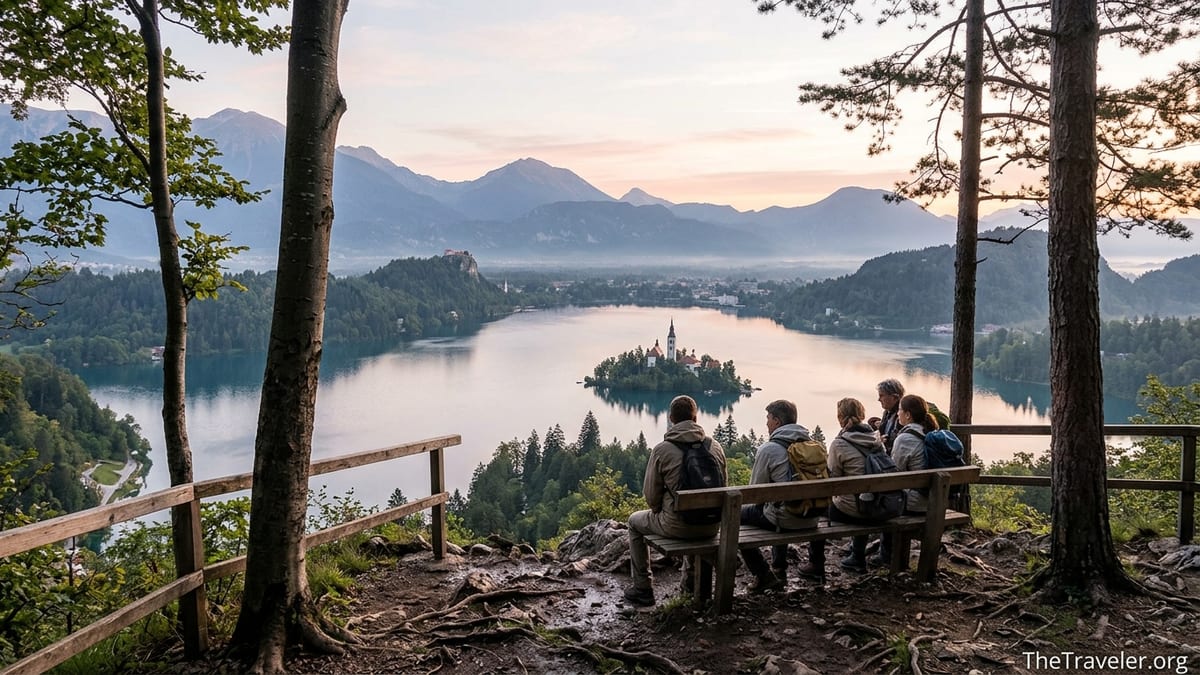
The viewpoint itself is a modest clearing with a wooden bench and a small metal barrier. From here, visitors get an elevated angle over almost the entire lake, including the island church, the cliff-top castle, the Karawanks and Kamnik-Savinja Alps on the horizon, and the town of Bled spread along the opposite shore. Many of the calendar and coffee-table book images of Lake Bled match this perspective almost exactly, which is why many travelers specifically seek out Mala Osojnica over other hills.
Trail information on local and international hiking sites consistently classifies Mala Osojnica as a moderate hike. For most reasonably active travelers it is accessible without special gear, but the combination of gradient, roots and occasional mud means it is not a casual flip-flop walk from the lakeside cafe. That gap between the postcard image and the reality of the path is where opinions about whether it is “worth it” start to diverge.
How Hard Is the Climb in Real Life?
On paper, 200 or so meters of elevation gain and a 30 to 45‑minute climb do not sound severe. In practice, travelers report that the feeling of effort depends heavily on weather, footwear and general fitness. Many describe the first section through the forest as steady but manageable, something like climbing several long flights of stairs. Families with school‑age children often report making it to the top with a few rest stops and some encouragement, while older visitors who are unused to hills can find themselves breathing hard and needing breaks every few minutes.
One element that repeatedly appears in recent trip reports is how slippery the route becomes after rain. Because much of the surface is bare soil and roots, heavy showers turn sections into slick mud. Hikers who went up in these conditions describe grabbing tree trunks for balance and inching down carefully on the descent. For them, sturdy walking shoes or lightweight hiking boots with good tread made a noticeable difference compared with smooth-soled sneakers, especially on the way down from the metal stairs where loose gravel can roll underfoot.
Another factor is the psychological perception of steepness. Unlike more gradual alpine trails that zigzag across open slopes, Mala Osojnica’s path is largely enclosed by forest and climbs directly. Travelers who are used to city walking but not to hills sometimes report that it feels steeper than the statistics suggest, especially near the upper staircase. Several hiking blogs and local guides specifically recommend doing the loop clockwise and ascending the stairs rather than descending them, as the ladder-like steps can feel exposed on the way down.
For fit hikers, trail runners and people accustomed to mountain walking, Mala Osojnica tends to be described as an easy morning warm‑up, often combined with the nearby viewpoints of Velika Osojnica and Ojstrica on the same outing. For others the climb is right at the edge of their comfort zone. That split is important when deciding whether it is worth attempting if you have mobility issues, knee problems or are traveling with very young children who may need to be carried.
What Do Travelers Actually Say About the Views?
Traveler reviews across hiking apps, travel forums and recent social media posts are strikingly consistent on one point: the views from Mala Osojnica are among the best in Bled. Many describe the moment they step out at the lookout and see the lake from above as “postcard perfect,” “surreal” or “one of the best panoramas” of their trip. Typical comments mention seeing the island framed by deep blue water, the white church tower standing out against the forested hills, and the mountains forming a layered backdrop in clear weather.
Visitors who timed their hike for sunrise often speak about the experience in emotional terms. People who set off from Camping Bled around 4:30 or 5:00 in summer mention reaching the top as the first light catches the castle walls and the sky turns pink behind the Karawanks. On calm mornings the lake surface can be glassy, reflecting the island and clouds below, and photography enthusiasts like to shoot long exposures as low mist drifts across the water. These sunrise accounts usually emphasize both the quality of the light and the relative quiet compared with midday.
By contrast, afternoon hikers in July and August sometimes describe the viewpoint as crowded, with a queue developing at the main bench for people who want to recreate the classic framed photo. Some note drones buzzing and influencers setting up tripods, particularly when weather is clear. Even so, most reviewers still rate the experience highly, often calling it the highlight of their day at Bled. The occasional negative or lukewarm comment tends to come from visitors who arrived in hazy or rainy weather and could barely see the mountains, or from those who expected a larger, more dramatic summit area.
An interesting comparison appears in discussions that weigh Mala Osojnica against other viewpoints. Some travelers prefer Ojstrica, a nearby lower hill reached by a shorter but still steep trail, because it can feel more intimate and offers large rocks to sit on. Others favor Velika Osojnica, slightly higher than Mala Osojnica, for its more expansive panorama of the wider valley. However, when the question is specifically about the most recognizable Lake Bled photo angle, Mala Osojnica is frequently singled out as the spot where what you see most closely matches the images on postcards and tourism posters.
Timing Your Hike: Crowds, Seasons and Light
Whether Mala Osojnica feels worth the effort often comes down to when you go. In high summer, Bled receives a heavy flow of day‑trippers from Ljubljana and other parts of Europe, and that pressure shows on the short trails around the lake. Late morning and early afternoon are usually the busiest times, particularly on weekends and during school holidays. Hikers who go up then tend to share the viewpoint with several dozen others, sometimes including tour groups and people playing music from their phones.
In contrast, early morning and late evening hikes are frequently described as much more peaceful. Sunrise in June and July can be around 5:00, so those staying in town or at lakeside campsites who set off by about 4:30 often report having the hill almost to themselves, maybe sharing the bench with a handful of locals or fellow photographers. In September and early October, when the larches and beech trees begin to turn golden, sunrise arrives later and the hills are cooler, making dawn hikes more manageable for non‑early‑birds while still beating the main crowds.
Seasonal conditions also shape the experience. Spring can bring wet ground, patches of old snow in the forest and very slippery mud on shaded slopes, particularly in April and early May. Summer offers the best chance of clear skies and long views, but also higher temperatures on the climb and thicker crowds. Autumn is widely praised by recent travelers for a balance of stable weather, less congestion and striking foliage. Winter hikes are possible for experienced walkers, but snow and ice frequently cover the trail, and locals strongly recommend microspikes or similar traction; for many visitors, the risk is not worth it compared with simply enjoying Bled’s winter scenery from lakeside paths.
Light quality matters if your main aim is photography. The island is roughly in the middle of the lake, and from Mala Osojnica it sits slightly to the right of center in the frame. At sunrise, soft side‑light from the east tends to illuminate the castle and church tower, while in the late afternoon the sun can fall behind the mountains, creating silhouettes and potentially blowing out the sky. Some photographers therefore hike up twice, once at dawn for soft hues and again on a clear late‑afternoon day to capture warm tones on the cliffs before the sun drops too low.
Practicalities: Access, Costs and Safety
Reaching the trailhead for Mala Osojnica is relatively straightforward. Travelers staying in Bled town can walk around the southwestern curve of the lake past the rowboat rentals and beach area at Velika Zaka in about 20 to 30 minutes. Those arriving by car usually park at the lakeside parking area near Camping Bled or slightly farther back from the shore, paying an hourly fee that varies by season. It is worth checking recent information on local boards for current prices, as peak‑season parking around Lake Bled has become more regulated, with higher rates near the shore and time limits to deter long‑term parking.
From the road, small yellow hiking signs point to Mala Osojnica, Velika Osojnica and Ojstrica. The main path runs steeply up from near the lakeside loop road, crossing a forest track and climbing into thicker woodland. There are no ticket booths or entrance fees for the hike itself, which contrasts with some other local attractions such as Bled Castle and nearby Vintgar Gorge that charge admission. This makes Mala Osojnica an appealing option for budget‑conscious travelers, especially when combined with the free lakeside walk.
Safety‑wise, the route is generally straightforward for people used to uneven ground, but it does demand attention. The metal staircase near the top can feel intimidating to anyone with a fear of heights, as it is fairly steep and can be damp or icy depending on the season. Parents bringing children often mention keeping a close hand on them in this section. In wet or muddy conditions, trekking poles can help steady the descent, although they are not strictly necessary in dry weather. In mid‑summer heat, carrying at least a liter of water per person is sensible, since there are no fountains or shops on the trail.
Solo travelers, including many who post their experiences online, generally report feeling safe on the route, even in the early morning. The path is popular and well‑trodden, and it is rare to be entirely alone for long during the main season. However, mobile signal can be patchy in pockets of forest, so offline maps or simple awareness of the few main junctions is helpful. Overall, for most visitors who are capable of basic hiking, the main risks are slips and twisted ankles rather than more serious hazards.
Is Mala Osojnica Worth It for You? Different Traveler Profiles
Whether Mala Osojnica is “worth the hike” depends heavily on your interests, time in Bled and physical comfort. For photography‑minded travelers and people who place a high value on scenic viewpoints, the answer is usually an enthusiastic yes. If your idea of a perfect morning is watching the sky change color while framing a lake and mountains through tree branches, Mala Osojnica delivers exactly what the brochures promise, especially in good weather and low‑crowd time slots.
For active travelers on tight itineraries, the key draw is how efficiently you can combine effort and reward. Many visitors staying only one full day in Bled manage a pre‑breakfast climb to Mala Osojnica, then come back down to rent a rowing boat to the island, visit the castle in the afternoon and still have time for a lakeside swim or cafe visit. The short length of the hike makes it easy to slot into a busy schedule without committing to a full‑day mountain outing in the nearby Triglav National Park.
Families and older travelers tend to give more varied feedback. Those who are reasonably mobile often say the hike felt like a challenge but a memorable shared achievement, especially when grandchildren or teenagers were along. On the other hand, people with knee, hip or heart issues sometimes regret pushing themselves for a viewpoint they feel is not drastically different from what they could see from Bled Castle or from a viewpoint reached by car. If steep descents cause pain or anxiety, it may be more sensible to enjoy the lake from the shore and reserve your energy for flatter walks, short boat trips or a gentle bike ride to nearby villages.
Finally, for travelers who have already spent significant time in alpine landscapes, the calculus can change. Some hikers who have just come from Slovenia’s higher valleys or from the Dolomites to the west appreciate Mala Osojnica mainly as a convenient stop rather than a destination in itself. They often combine it with longer walks around the lake or day trips to Bohinj and Vintgar Gorge, seeing it as a very short “bonus” viewpoint rather than the standout hike of their trip. If your schedule is packed with more substantial mountain trails, you may decide that the effort is better spent elsewhere, especially in poor weather.
The Takeaway
Looking across hundreds of recent traveler reports, a clear picture emerges. Mala Osojnica is not a casual lakeside stroll, but it is also not a serious mountain ascent. It sits in a sweet spot: short, steep and accessible, with a visual payoff that consistently impresses visitors who time their climb well. For many, especially those who hike at sunrise or in the quieter shoulder seasons, the combination of early‑morning light over the island and the relative solitude makes it one of the most memorable experiences in Slovenia.
At the same time, it is not a universal must‑do. If you are uncomfortable on steep, rooty paths, traveling with very young children, or dealing with mobility or heart issues, the risk and discomfort may outweigh the reward. In those cases, alternatives such as the castle viewpoint, lakeside cafes and gentle cycling routes still offer wonderful perspectives on Lake Bled with less strain.
For most reasonably fit travelers with a bit of hiking tolerance, the balance tilts strongly in favor of going. Wear shoes with grip, watch the weather forecast, start early or late in the day, and allow yourself time at the top to sit on the bench, watch the pletna boats cross the lake far below and absorb the scene without rushing. If you approach it with realistic expectations and a little preparation, Mala Osojnica is very likely to feel worth every step.
FAQ
Q1. How long does it take to hike to Mala Osojnica?
The climb from the lakeside near Velika Zaka usually takes about 30 to 45 minutes uphill for most reasonably fit adults, plus a little extra time for breaks and photos.
Q2. Is the Mala Osojnica trail suitable for beginners?
It is manageable for beginners who are comfortable with a short, steep walk and uneven ground, but it is not ideal for people with serious knee, hip or balance issues.
Q3. Do I need special hiking gear for Mala Osojnica?
You do not need technical gear, but closed shoes with good grip are strongly recommended, and lightweight hiking boots or trail shoes make the descent much safer, especially after rain.
Q4. Is the hike to Mala Osojnica safe for children?
Many families take school‑age children up without problems, but parents should supervise closely on the steep sections and the metal staircase; toddlers often need to be carried part of the way.
Q5. When is the best time of day to hike Mala Osojnica?
Sunrise and early morning generally offer the best light and the fewest crowds, while late afternoon can also be beautiful outside the peak summer months if the weather is clear.
Q6. Is there an entrance fee to hike Mala Osojnica?
No, there is no entrance fee for the trail itself, but you may need to pay for parking at the lakeside if you arrive by car.
Q7. Can I hike Mala Osojnica in winter?
It is possible, but snow and ice often cover the trail, so local advice and proper traction like microspikes are important; many casual visitors skip it and enjoy winter views from easier spots.
Q8. How crowded does Mala Osojnica get in peak season?
In July and August, late morning and midday can be quite busy, with groups sharing the small viewpoint; early morning or late evening hikes are usually much quieter.
Q9. How does Mala Osojnica compare to Ojstrica and Velika Osojnica?
Ojstrica is a bit lower and reached by a shorter route, Velika Osojnica is slightly higher and more expansive, while Mala Osojnica offers the most classic, postcard‑style view of Lake Bled.
Q10. Is Mala Osojnica worth the hike if I only have one day in Bled?
For most visitors with moderate fitness, yes: a quick early hike to Mala Osojnica leaves plenty of time to visit the island, the castle and enjoy the lakeside for the rest of the day.