


More news on this day
A burst of severe thunderstorms over the Chicago area triggered a ground stop at O’Hare International Airport this week, leading to more than 700 flight delays and widespread disruption for travelers across the United States.
Get the latest news straight to your inbox!
Storm Cells Bring One of Summer’s First Major Disruptions
The ground stop was issued as intense storm cells moved across northeastern Illinois, bringing heavy rain, lightning and rapidly changing wind conditions around Chicago O’Hare. Publicly available Federal Aviation Administration data and local media coverage indicate that flights bound for O’Hare were ordered to remain at their departure airports while arrivals and departures already in the system were slowed or temporarily halted.
Weather reports describe a classic early summer pattern, with warm, humid air feeding lines of fast-building thunderstorms that passed over the Chicago metropolitan area. Forecasters highlighted the potential for strong downdrafts, low cloud ceilings and reduced visibility, all conditions that can sharply limit the number of aircraft that can safely land or depart within a given period.
Because O’Hare is one of the busiest hubs in the country, even a relatively short-lived ground stop can generate significant disruption. Industry data and local reporting show that as the storms moved through, the combination of ground stop orders and reduced arrival rates quickly pushed delays into the hundreds.
More Than 700 Flights Delayed as Operations Slow
By the time conditions began to improve, over 700 flights connected to O’Hare had been delayed, according to aggregated flight-tracking figures and airport status boards. Average delays climbed beyond an hour for many departures and arrivals during the peak of the disruption, with some services pushed back several hours as airlines waited for updated traffic flow restrictions to ease.
Most impacts were recorded as delays rather than outright cancellations, but a portion of the schedule was ultimately scrubbed as the day wore on and crews and aircraft moved out of position. Airlines typically prioritize long-haul and last-bank departures when attempting to rebuild schedules after a weather-related halt, which can leave shorter regional hops subject to rolling postponements or cancellations.
The concentration of delays at a single hub magnified the effect across domestic and international networks. With O’Hare serving as a major connecting point for both United States and overseas itineraries, missed connections and rebookings extended the consequences of the thunderstorm ground stop to airports as far away as the West Coast and East Coast, as well as to transatlantic routes.
Why Thunderstorms Prompt Ground Stops
Ground stops are among the strongest traffic management measures available to air traffic regulators. Under a ground stop, certain flights that meet defined criteria are held at their departure airports and are not allowed to take off for the affected destination until the restriction is lifted or modified. Public FAA guidance notes that these programs are often used during severe weather events to prevent aircraft from queuing in the airspace near an airport that cannot safely accept normal traffic levels.
Thunderstorms pose a particular challenge because of their rapid development and localized severity. Even when conditions may appear manageable from the terminal, forecasters and air traffic managers track wind shear, lightning in the vicinity of runways and the position of storm cells relative to approach and departure paths. A strong cell near a key arrival fix or departure corridor can sharply cut the number of jets that can safely arrive or depart, requiring a temporary halt until the storm moves or weakens.
At a hub the size of O’Hare, which regularly sees hundreds of daily departures and arrivals, a drop in allowable movements can quickly produce backlogs both in the air and on the ground. Ground stops are designed to keep that congestion from building in the sky, trading airborne holding for delays at origin airports where passengers remain on the ground.
Ripple Effects for Airlines and Passengers
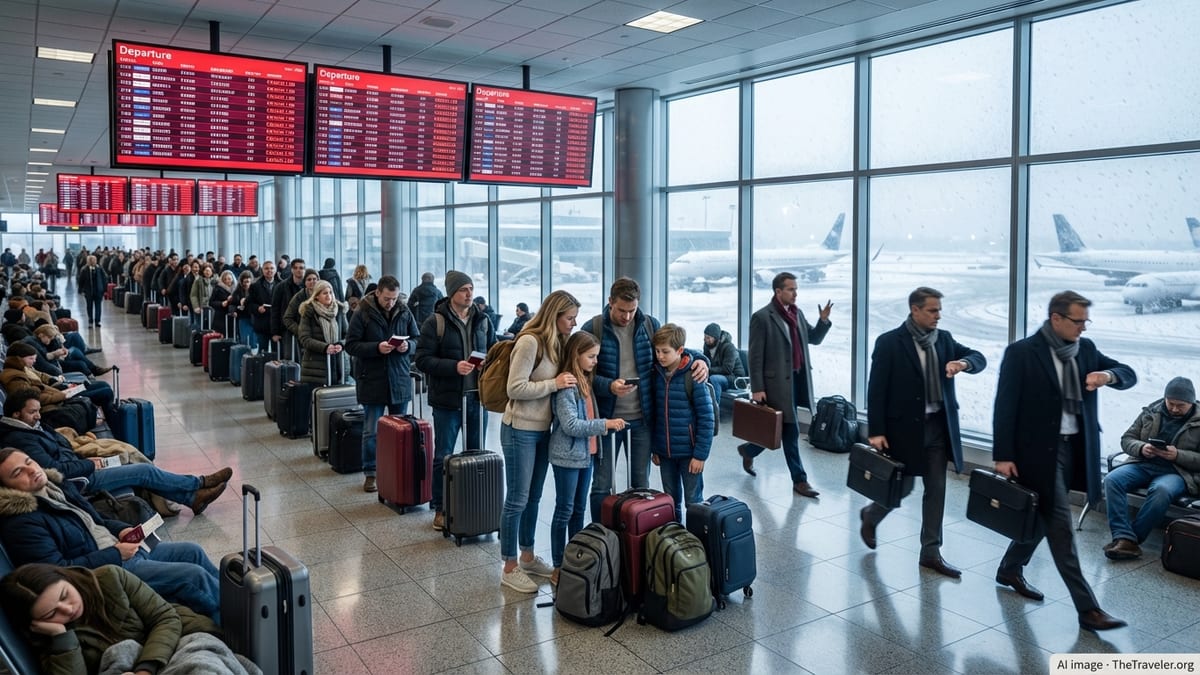
The thunderstorm ground stop at O’Hare produced familiar scenes for frequent travelers: crowded gate areas, lengthy customer service lines and aircraft waiting on taxiways as new slot times were issued. Reports from flight-tracking platforms show clusters of delayed departures from feeder cities across the Midwest, South and East Coast as carriers held flights until they were cleared to proceed to Chicago.
Operationally, airlines faced the task of reshuffling aircraft and crews to restart tightly timed hub-and-spoke schedules. Because pilot and flight attendant duty hours are governed by strict limits, long delays can cause crews to exceed their legal working windows, forcing substitutions or cancellations even after the worst of the weather has passed. This contributes to the phenomenon where delays continue into the evening or following morning, long after storms have cleared.
For passengers, impacts varied widely. Some travelers experienced modest timetable shifts of less than an hour, while others encountered missed connections and unexpected overnight stays. Travel waivers issued around the period of severe weather allowed some ticketed passengers to move trips to alternative days or routes, although same-day options were constrained once the scale of the disruption became clear.
Summer Outlook: More Weather-Driven Delays Likely
Transportation analysts note that the thunderstorm ground stop at O’Hare fits a pattern often seen in late spring and summer, when convective storms become one of the leading drivers of air travel disruption in the central United States. With O’Hare positioned near the intersection of busy east-west and north-south routes, it is particularly exposed to lines of storms that sweep across the upper Midwest.
Airlines have signaled that weather-related waivers and proactive schedule adjustments will remain key tools as the season progresses. Some carriers have already issued flexible rebooking options around days with elevated thunderstorm risk in the Chicago region, encouraging passengers with nonessential trips to shift to calmer windows.
For travelers connecting through O’Hare in the coming weeks, aviation experts often recommend allowing extra connection time, monitoring flight status closely on day of departure and considering earlier departures when possible. As the latest storm system demonstrated, a single afternoon of severe weather over one of the country’s largest hubs can quickly cascade into hundreds of delays and widespread disruption across the air travel network.