


Most first timers in Philadelphia do the same thing. They book a hotel near the Historic District, dutifully visit Independence Hall and the Liberty Bell, maybe jog up the “Rocky steps” at the Art Museum, grab a cheesesteak and leave believing they have seen the city. They have not. The soul of Philadelphia lives in the neighborhoods where people actually spend their evenings, argue about hoagies, and talk to their neighbors on the stoop. With a bit of planning, you can avoid the classic visitor mistake and experience the places locals love most.
Get the latest updates straight to your inbox!
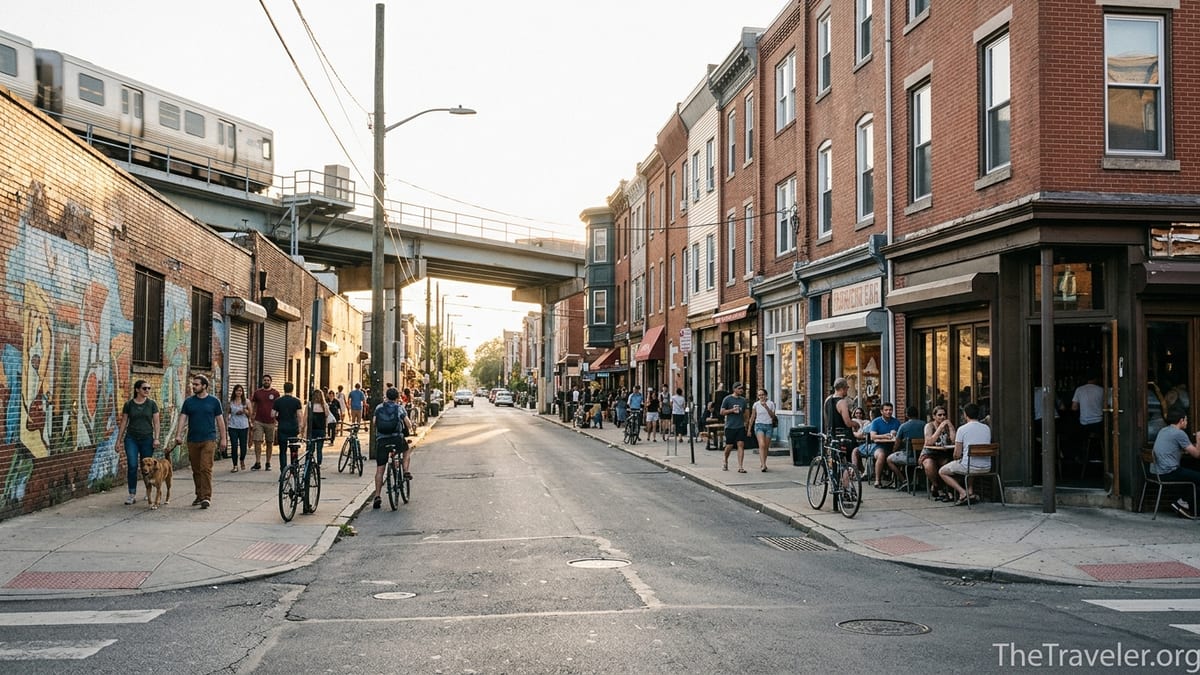
The Classic Philadelphia First Timer Mistake
Look at any standard Philadelphia weekend itinerary and you will see the same loop. Independence National Historical Park in the morning, Reading Terminal Market for lunch, then a walk along Market Street and a selfie on the Rocky steps before dinner in Center City. These places are absolutely worth seeing, but they represent only a narrow slice of a city built from dozens of distinct neighborhoods layered around the colonial core.
The mistake is not visiting the historic sites. The mistake is stopping there. Many visitors never ride the subway out to the river wards, never cross South Street, never see what happens after office workers clear out of Center City. They go home having eaten at the same national chains they could find in any American downtown, unaware that some of the country’s most talked about small restaurants and creative bars sit a fifteen minute train ride away in areas like Fishtown and East Passyunk.
It is easy to see how this happens. Hotels and convention centers cluster around the Historic District and Center City, and a lot of package tours never leave that footprint. On a short trip it feels safe to stay where the landmarks are and where everyone else seems to be. Yet the very things many travelers say they want now, like independent coffee shops, neighborhood bars, and a sense of local life, are stronger in the surrounding districts than in the business core.
To experience the Philadelphia that locals argue about in group chats and celebrate in neighborhood festivals, you need to push a few stops past the familiar. Once you do, you will find the city feels smaller, friendlier and far more textured than it looks from a double decker tour bus.
How the City Is Really Laid Out
Philadelphia is famously described as a city of neighborhoods, and that is not a marketing slogan. Center City, roughly between the Delaware and Schuylkill Rivers and from Vine Street down to South Street, is the downtown spine where you will find most offices, major hotels, the Convention Center and big institutions. Immediately beyond that rectangle, the city becomes a patchwork of residential districts that each feel like their own small town.
To the northeast of Old City, neighborhoods like Northern Liberties and Fishtown spread toward the Delaware River with renovated warehouses, rowhouses and a dense mix of bars, restaurants and music venues. South of Center City, areas such as Queen Village, Bella Vista and the East Passyunk corridor form a mostly rowhouse landscape punctuated by old-school bakeries, red-sauce Italian spots and newer natural wine bars. West across the Schuylkill rise University City and leafy neighborhoods toward West Philadelphia, while to the north you find Fairmount and Brewerytown edging the parkland of the Benjamin Franklin Parkway and the city’s vast museum district.
For visitors, the key point is that public transit and rideshares make these areas surprisingly easy to reach. The Market–Frankford Line, known locally as the El, runs above ground from Center City straight through Northern Liberties and Fishtown. A twenty minute ride from City Hall station puts you under bright murals and in front of coffee shops on Frankford Avenue. To reach East Passyunk, a ten minute walk or short bus ride south from the Broad Street Line drops you on a diagonal commercial street full of independent restaurants that rarely see tour groups.
Because distances are short, it is completely realistic on a weekend trip to split your time between the major sites and at least two distinct neighborhoods. One common strategy is to book a central hotel near City Hall or Rittenhouse Square for convenience, then treat the evenings as mini excursions into the outer districts where Philadelphians spend their free time.
Fishtown and Northern Liberties: The River Wards Reinvented
If you only add one area beyond the historic core to your trip, make it the stretch of neighborhoods usually grouped as the river wards, especially Fishtown and Northern Liberties. Once industrial and working class, these neighborhoods have spent the past decade growing into nightlife and dining hubs that regularly appear in international travel coverage as the “cool” part of Philadelphia. You will know you have arrived when the glass towers of Center City give way to brick rowhouses, bold murals and clusters of people spilling out of corner bars.
In Fishtown, Frankford Avenue and Girard Avenue work as easy touchstones. Stay near Girard Station on the El and you are surrounded by options. Breakfast might be a bagel and coffee at an independent cafe on Frankford, where locals with laptops share tables with friends debriefing last night’s show. Lunch could be at a modern Lebanese spot with a lush back garden, the sort of place where you can order mezze for two and end up lingering for hours. By evening, the area’s breweries and casual taprooms fill up, with a flight of seasonal beers typically running less than many big city cocktail bars.
Northern Liberties, just south of Fishtown, has its own personality. Anchored by a large central plaza and converted industrial buildings, it feels a bit like a compact version of a former warehouse district in Brooklyn or Chicago. Here you might spend an afternoon browsing independent boutiques and vinyl shops, then order a burger and local draft at one of the original gastropubs that helped put Philly’s craft beer scene on the map. On summer weekends, pop up markets and outdoor events often draw a largely local crowd, making it an excellent place to people watch.
What visitors often miss is that these areas are straightforward to reach and not particularly intimidating compared with the Historic District. A typical pattern for a first visit might be to spend a day with the Liberty Bell and museums, then ride the El up to Fishtown for dinner and bar-hopping, returning by late train or a ten minute rideshare back to your hotel. Even a couple of evenings like this dramatically change your impression of Philadelphia from “old buildings and monuments” to “lived-in city with a real creative energy.”
South Philly and East Passyunk: Food, Family and Old World Traditions
Where the river wards feel like the current face of trendy Philadelphia, South Philly and the East Passyunk corridor represent its deep roots. South of South Street and east of Broad Street, the grid tightens into classic Philadelphia rowhouse blocks. Laundry lines cross narrow alleys, corner stores sell soft pretzels and lottery tickets, and Sunday afternoons might smell like tomato sauce drifting out of kitchen windows.
East Passyunk Avenue cuts diagonally through this grid as a lively commercial strip. It is lined with everything from old-school red-sauce restaurants with neon signs to modern wine bars serving small plates and natural wines. On a typical evening you might see a family celebrating a birthday at a long running Italian restaurant next door to a group of friends sipping cocktails at a newer spot with a bar counter facing the street. Prices tend to be noticeably lower than comparable places in New York or Washington, which is one reason so many locals dine out frequently here.
For visitors, spending a late afternoon and evening on East Passyunk gives a sense of how embedded food is in neighborhood life. It is common to grab coffee at a small cafe tucked into a rowhouse, browse an independent bottle shop or bakery, then linger over dinner on a sidewalk table as neighbors stop to chat. Around the corner, smaller side streets hide bakeries, old churches and modest parks where kids play until dark. It is the kind of environment many travelers say they want to experience, yet it remains off the radar of those who stick close to hotel corridors.
South Philly more broadly offers a mix of traditions as well. Italian, Irish, Vietnamese, Mexican and Cambodian communities all maintain businesses and social clubs in different pockets. A visitor who plans ahead might spend a day walking from an Italian bakery near the Italian Market to a Vietnamese pho shop on Washington Avenue and a Mexican taqueria further south, covering several culinary worlds within a couple of miles. Building even a small piece of this into a weekend trip provides a richer, more accurate picture of contemporary Philadelphia than a cheesesteak line alone ever could.
Graduate Hospital, Brewerytown and Everyday Neighborhood Life
Not every neighborhood worth visiting is built around headline restaurants. Some of the most rewarding places for travelers are the ones where there is nothing in particular to “do” beyond explore, sit in a cafe and absorb what life feels like on an ordinary afternoon. Two good examples that are easy to reach from Center City are Graduate Hospital, just southwest of downtown, and Brewerytown, north of the museum district.
Graduate Hospital, often described as Southwest Center City, lies between South Street and Washington Avenue. The area is full of brick rowhouses, small pocket parks and a growing number of cafes and relaxed bars. In the warmer months, a popular seasonal beer garden operates near South Street, drawing locals from across the city for draft beers under string lights and food from rotating vendors. For a visitor, it can be a pleasant surprise to realize that a ten minute walk from the high rises around Rittenhouse Square leads to a scene of parents with strollers, people walking dogs and neighbors sharing tables at a corner pub.
Brewerytown, north of Fairmount Avenue, takes its name from the large number of breweries that operated there in the late nineteenth and early twentieth centuries. Today you can still see traces of those industrial buildings, some converted into apartments and studios, others turned into modern breweries and taprooms. The neighborhood borders on the edge of Fairmount Park, so a realistic day for an active visitor might combine a morning visit to the Philadelphia Museum of Art and the nearby Barnes Foundation with an afternoon walk up into Brewerytown for a casual lunch and a local beer. Because the area sits a bit outside typical tourist routes, prices for food and drink often feel gentler than in the central business district.
In both Graduate Hospital and Brewerytown, the appeal is subtle. You are unlikely to tick a major landmark off your list, but you will gain the sense of how Philadelphians use their own city. Parents chat on park benches, basketball games unfold in playgrounds, and regulars greet cafe owners by name. For many travelers, those are the memories that last longer than another photo of a famous statue.
Practical Tips to Actually See These Neighborhoods
The good news is that you do not need a complicated plan to incorporate Philadelphia’s neighborhoods into your itinerary. The most important decision is often where you stay. Booking centrally in Center City, near City Hall, Rittenhouse Square or the Historic District, keeps you within a ten to fifteen minute transit ride or inexpensive rideshare of nearly all the neighborhoods described here. Some visitors now opt to stay directly in Fishtown or South Philly short term rentals for an immersive experience, then use the El or buses to day trip into the Historic District.
Public transit is straightforward once you understand a few basics. The Market–Frankford Line connects Center City with Northern Liberties and Fishtown to the northeast and West Philadelphia in the opposite direction. The Broad Street Line runs north-south under Broad Street, with South Philadelphia neighborhoods a short walk from its southern stations. Buses fill in the gaps and are generally safe and heavily used by locals, especially during the day and early evening. A reloadable transit card makes hopping on and off trains and buses simple and cost effective, particularly if you plan to visit multiple neighborhoods in one day.
Timing matters too. Weekdays can be quieter in residential areas during working hours, though cafes and brunch spots often do steady business. Evenings from Thursday through Sunday are prime time for restaurant and bar scenes in Fishtown, Northern Liberties and East Passyunk, and you will feel that energy on the streets. If you prefer a more relaxed vibe, late mornings and afternoons are ideal for walking tours of Graduate Hospital, Brewerytown or South Philly, when corner stores and small parks are most active.
Finally, embrace small-scale exploring. Rather than trying to “see” an entire neighborhood in an hour, pick a key intersection or commercial strip as your anchor, then slowly work outward. In Fishtown that might mean starting near Girard Station, in East Passyunk at the intersection of Passyunk Avenue and Tasker Street, in Northern Liberties at the central plaza. Sit for a coffee, observe how people move through the space, and let your curiosity guide you down side streets. The reward is not another checklist of attractions, but the feeling that you briefly stepped into someone else’s everyday world.
The Takeaway
Philadelphia’s historic icons are powerful and easy to love, but they tell only the opening chapter of the city’s story. The real plot twists, the daily routines and the creative energy unfold in the neighborhoods that many visitors never quite reach. By hopping on the El to the river wards, walking south into East Passyunk, or wandering through Graduate Hospital and Brewerytown, you trade a purely museum and monument experience for a living, breathing city.
The change in effort is small. A fifteen minute train ride or a short detour after a day of sightseeing is usually all it takes. Yet the change in perspective is enormous. Instead of leaving with a hazy memory of marble halls and school field trips, you depart remembering conversations at a neighborhood bar, the smell of bread from a corner bakery, a mural at sunset over a row of brick houses. For travelers who value authenticity and connection, those are the details that make a trip to Philadelphia feel complete.
The most common mistake first timers make here is not a wrong turn or a bad restaurant choice. It is assuming that the Philadelphia on postcards is the only one that exists. Once you accept that the city’s best stories lie a few miles beyond the Liberty Bell, you can plan a visit that does justice to both its past and its present.
FAQ
Q1. Is it safe to visit neighborhoods like Fishtown and East Passyunk at night?
Safety can vary block by block, but these neighborhoods are popular evening destinations for locals and generally feel busy and comfortable on main streets. As in any city, stay aware of your surroundings, stick to well lit areas and use rideshares or transit if you are unsure about walking late at night.
Q2. How much time should I set aside to explore one neighborhood properly?
Plan on at least half a day for each neighborhood if you want to do more than eat a single meal. That gives you time for a walk, a coffee stop, perhaps a small shop or gallery and a relaxed lunch or dinner without rushing back downtown.
Q3. Can I see the major historic sites and still visit these neighborhoods in one weekend?
Yes, if you plan ahead. Many visitors spend their days around Independence Hall, the museums and Reading Terminal Market, then dedicate evenings to neighborhoods like Fishtown, Northern Liberties or East Passyunk. A long weekend makes it easier to add an extra district such as Graduate Hospital or Brewerytown.
Q4. Do I need a car to explore beyond Center City?
No. The combination of the subway, buses, regional rail and rideshares is usually enough. The Market–Frankford Line and Broad Street Line in particular make reaching Fishtown, Northern Liberties and South Philly straightforward. Parking can be challenging in dense residential areas, so many locals avoid driving for nights out.
Q5. Which neighborhood is best for food focused travelers?
Fishtown and East Passyunk are especially strong for dining, with a high concentration of independent restaurants, bakeries and bars. South Philly more broadly offers excellent Italian, Vietnamese and Mexican options, while Northern Liberties and Brewerytown add good casual spots and breweries.
Q6. Where should I stay if I want easy access to both the historic core and local neighborhoods?
Staying in Center City, near City Hall, Rittenhouse Square or the Historic District, keeps you within a short transit ride or walk of most areas. Some travelers choose to split their stay, spending a night or two in a neighborhood like Fishtown or South Philly to get a deeper feel for local life.
Q7. Are these neighborhoods suitable for families with children?
Yes, many of them are. Graduate Hospital, Fairmount, parts of South Philly and sections of Fishtown have playgrounds, parks and family friendly cafes. Evening bar scenes can be lively, so families often focus on daytime visits and early dinners rather than late nights.
Q8. How expensive are restaurants and bars in these areas compared with Center City?
Prices vary, but many visitors find that neighborhood spots offer good value compared with downtown. You can often find excellent casual dinners and drinks in Fishtown, East Passyunk or Brewerytown for less than comparable experiences in major coastal cities, especially if you avoid only ordering premium cocktails.
Q9. What is the best way to choose which neighborhoods to prioritize on a short trip?
Think about your interests. If you like live music and nightlife, focus on Fishtown and Northern Liberties. If you care most about food and classic rowhouse streets, try East Passyunk and South Philly. For a quieter, everyday feel near downtown, look at Graduate Hospital or Fairmount. It is better to explore two areas well than to skim five.
Q10. Are there guided tours that include these neighborhoods, or should I explore on my own?
Some small group food and street art tours operate in Fishtown, Northern Liberties and South Philly, which can be helpful on a first visit. It is also very manageable to explore independently using transit and a map, since most of the interesting spots cluster along a few main streets such as Frankford Avenue or East Passyunk Avenue.