


Travelers to Tuscany often face a pleasant dilemma: if you have limited time, should you focus on Pisa’s Piazza dei Miracoli, crowned by the famous Leaning Tower, or Florence’s Piazza del Duomo, home to Brunelleschi’s iconic dome? Both squares are UNESCO-recognized ensembles of cathedral, baptistery, and bell tower, both can be reached in about an hour by train from each other, and both leave visitors speechless for very different reasons. Deciding which one leaves a bigger impression depends not only on their architecture, but also on the atmosphere, costs, crowds, and the kind of travel story you want to bring home.
Get the latest updates straight to your inbox!
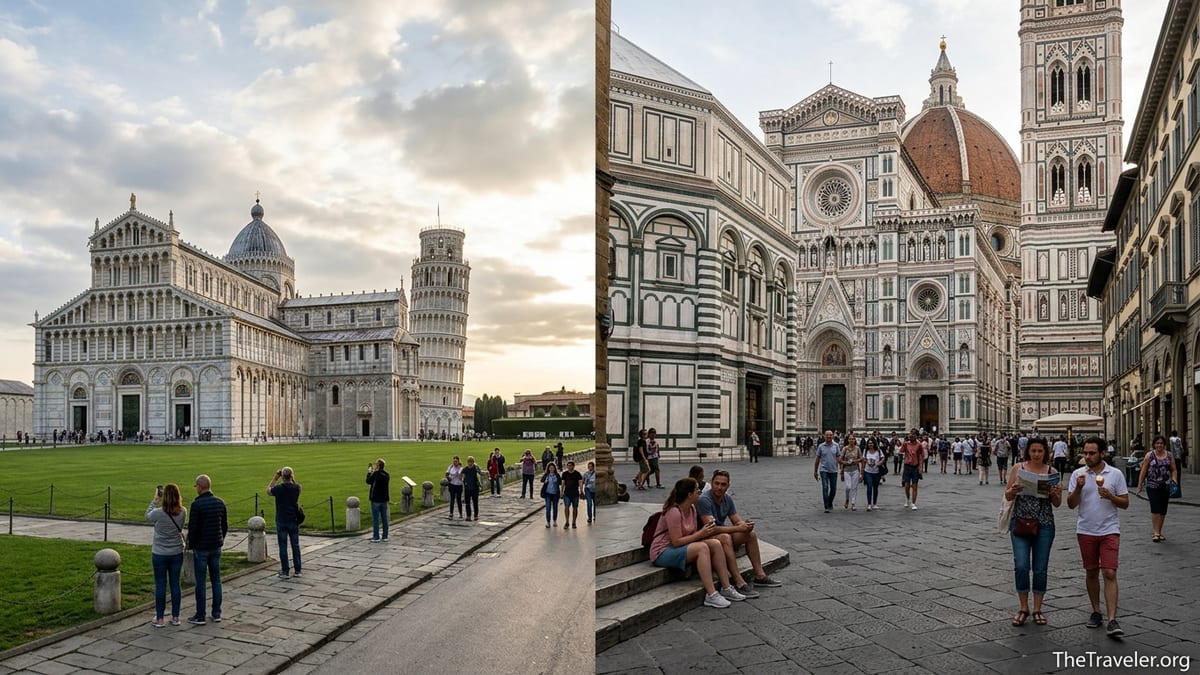
First Impressions: Drama vs Grandeur
Arriving at Pisa’s Piazza dei Miracoli, many visitors are surprised by how green and open it feels. The four main monuments the cathedral, baptistery, Leaning Tower, and monumental cemetery stand on a bright lawn ringed by medieval walls. When you step through one of the gates and suddenly see the Leaning Tower tilting against the skyline, the impact is immediate and theatrical. For many travelers, this “wow” moment is one of the most vivid memories of a trip to Italy.
Florence’s Piazza del Duomo delivers its punch more gradually. The narrow streets of the historic center funnel you between Renaissance palazzi until you suddenly emerge at the feet of Santa Maria del Fiore. The cathedral’s patterned marble facade, Giotto’s slender bell tower, the octagonal Baptistery, and above them all Brunelleschi’s immense terracotta dome create a dense, vertical impression. Instead of an open meadow, you are in a compact urban square where the buildings seem to rise almost straight from your toes.
If Pisa stuns you with the surreal sight of a tower that should not be standing, Florence impresses with sheer complexity and refinement. In practical terms, families with kids or first-time visitors to Italy often say Pisa has the bigger initial “shock,” while art and history lovers tend to feel Florence reveals more depth the longer they look.
Both places can be crowded, but the nature of the crowds is different. At Pisa, tour groups spill out of buses for a short, intense visit focused on photos. In Florence, visitors linger, circling the square again and again as they queue for different monuments or simply sit with a gelato watching the dome change color with the afternoon light.
Architecture and Atmosphere: Two Open-Air Museums
Piazza dei Miracoli is a self-contained sacred field. The white marble of the cathedral and baptistery stands out sharply against the bright grass and often deep-blue Tuscan sky. The Leaning Tower, actually the cathedral’s freestanding bell tower, leans by a little more than 4 degrees, enough that you can feel the tilt when you climb. The monumental cemetery, or Camposanto, holds medieval frescoes and Roman sarcophagi in a serene cloistered rectangle that many visitors find unexpectedly moving.
Despite its fame, the atmosphere in Pisa can still feel contemplative if you avoid the midday rush. Arrive for the first morning slots, and you can walk the perimeter wall side by side with only a handful of visitors, listening to the bells and the murmur of tour guides. Because the monuments stand in a walled space slightly detached from the rest of the city, the noise of traffic and nightlife stays largely outside.
Florence’s Piazza del Duomo, by contrast, hums constantly. Street musicians set up by evening, local office workers cut across the square at lunchtime, and processions for religious festivals occasionally pass through. The architecture is layered: the Gothic vastness of Santa Maria del Fiore, Brunelleschi’s early Renaissance engineering in the dome, and Giotto’s delicately detailed campanile. The Baptistery, with its bronze doors and gold mosaic interior, feels like an older, more intimate world tucked right into the heart of the city.
In terms of atmosphere, Pisa feels like stepping into a walled religious sanctuary, while Florence’s Duomo area is part of the everyday rhythm of a living city. If you want quiet space to absorb the architecture, Pisa often wins. If you love the feeling of being in the middle of a historic city that has never stopped moving, Florence leaves a deeper imprint.
Cost, Tickets, and Practical Logistics
From a practical perspective, Florence’s Piazza del Duomo is both more complex and more expensive to experience in full. Entry to the cathedral itself is free year-round, although there can be a long line that wraps around the building at peak hours. To visit the dome, Giotto’s bell tower, the Baptistery, the archaeological area of Santa Reparata beneath the church, and the Opera del Duomo Museum, you now need a pass, most commonly the Brunelleschi Pass, which covers all five monuments and is typically valid for three consecutive days. Prices fluctuate, but for budgeting, travelers often spend the equivalent of a substantial dinner in Florence on a full-access pass for one adult.
Climbing Brunelleschi’s dome requires a reserved time slot, and from early 2025, passes have become more personalized, with names attached to each ticket and ID checks at entry. Many visitors now book weeks in advance to secure early morning or late afternoon climbs, especially in high season. Others opt for the Giotto Pass, which skips the dome but includes the bell tower; travelers frequently note that the view from the top of Giotto’s tower has the bonus of including the dome itself in the skyline.
In Pisa’s Piazza dei Miracoli, pricing is more modular. Entry to the cathedral is free but controlled with a timed ticket that you collect on-site, often bundled with another paid monument. A combined ticket that includes the Baptistery, Camposanto, and one or two smaller museums is typically less than the multi-day pass in Florence, while the Leaning Tower climb is the premium add-on. Expect to pay a mid-range museum price for the tower alone, with strict time slots and age limits for small children.
Reaching both piazzas is straightforward without a car. Trains between Pisa and Florence take about an hour on average, with dozens of departures each day, and tickets often cost the price of a simple lunch or less if booked in advance. From Florence’s Santa Maria Novella station you can walk to the Duomo in around 10 minutes, while from Pisa Centrale it is roughly 20 to 25 minutes on foot to the Piazza dei Miracoli or a short local bus ride. For travelers staying in Florence and considering Pisa as a half-day excursion, the logistics are easy enough that some do a morning at Pisa and are back in Florence in time for an evening stroll around the Duomo.
The Climb and the View: Leaning Tower vs Domes and Campanile
One of the main reasons travelers remember these piazzas so vividly is the experience of climbing above them. In Pisa, the 294 steps of the Leaning Tower spiral around the inside of the cylinder, with small slit windows offering glimpses of the square and the surrounding city. Because the tower leans, you feel the tilt as you climb, especially on the outer side of the staircase. For many visitors, this slight disorientation is the thrill they talk about later, a reminder that they were inside one of the world’s most improbable structures.
At the top, you step out onto a ringed terrace with views over the cathedral roof, the green field, and the rooftops of Pisa stretching toward the Arno River. It is not the highest view in Tuscany, but it may be one of the most surreal, as you can look down and see the curve of the tower itself dropping steeply away on one side.
Florence offers two main climbs. Brunelleschi’s dome is the headline act, but also the more demanding one, with around 463 narrow steps. You squeeze between the inner and outer shells of the dome, emerging midway onto an interior balcony where you stand close to large frescoes, then continue up to the terrace at the top. The reward is a panoramic view over Florence’s dense red-tiled roofs, the Arno, and the surrounding hills. Many travelers say seeing the Tuscan sunset from here is a highlight of their entire trip.
Giotto’s Campanile, which is slightly shorter than the dome but still a solid climb, offers platforms at several levels and framed views through Gothic windows. Because you are not enclosed between dome shells, many visitors find the climb less claustrophobic. For photographers, the campanile often wins because the dome itself becomes the star of the skyline. If a climb that feels physically unique is more important to you, Pisa’s leaning spiral staircase is hard to beat. If you want a sweeping cityscape that captures the essence of an Italian Renaissance city, Florence’s dome or bell tower has the edge.
Art, History, and Intellectual Impact
In terms of pure art history, Florence’s Piazza del Duomo is difficult to surpass. The complex is a textbook of Italian Gothic and early Renaissance achievement: from the engineering of the dome, which was the largest of its time, to the sculptural programs of the Baptistery doors and the works now housed in the Opera del Duomo Museum. Inside that museum, you can stand inches away from the original doors known as the “Gates of Paradise,” see monumental sculptures by Donatello and others, and view a full-scale reconstruction of the cathedral’s medieval facade. Many visitors who come only for the dome climb leave saying the museum was the part that moved them most.
Pisa’s monuments tell a different story, one of a maritime republic at its peak. The cathedral’s striped marble, bronze doors, and pulpit carved by Giovanni Pisano reflect a blend of Romanesque and Gothic influences filtered through a city that traded with the eastern Mediterranean. Step into the Baptistery during one of the regular acoustic demonstrations and you hear staff sing a few notes that echo and layer on themselves for several seconds. This simple demonstration often leaves crowds hushed and is one of the most quietly spectacular experiences in the square.
The Camposanto, built around sacred soil reportedly brought back from Golgotha during the Crusades, houses fragments of medieval frescoes that were badly damaged in the Second World War. Walking through its long cloisters, many travelers report a sense of melancholy that contrasts with the cheerful crowds outside posing for photos with the tower.
If you are deeply interested in art and architecture, Florence’s Duomo area offers vastly more material, especially when combined with the city’s other museums. You could easily spend an entire day just with the dome interior, crypt, Baptistery, and museum and still have details to digest later. Pisa’s stories are fewer in number but more tightly focused, and for some visitors that makes them easier to absorb in a single, powerful afternoon.
Crowds, Season, and Traveler Types
Both piazzas are busy year-round, but how you experience them depends heavily on timing. In summer, tour buses arrive early to Pisa, and by late morning the lawn perimeter is thick with people taking perspective photos. By late afternoon, especially outside peak months, the crowds can thin noticeably, and the low sun gives the marble a honeyed glow that is very photogenic. Winter and shoulder-season mornings in Pisa can feel almost contemplative by comparison, particularly if you skip climbing the tower and wander the cloisters of the Camposanto instead.
Florence’s Piazza del Duomo feels full for much of the day from March through October. Even in the evening, when day trippers have gone, the square remains lively with locals, students, and visitors staying in the historic center. The lines to enter the free cathedral can easily stretch into an hour or more in mid-afternoon, which is one reason many travelers plan their Duomo complex visits early in the day and pair them with less crowded neighborhoods later.
Different types of travelers tend to respond differently. Families with younger children often find Pisa easier and more immediately rewarding: the open grass, the visual joke of “holding up” the tower in photos, and the short but thrilling climb. Older travelers or those with mobility challenges may find both climbs demanding; in that case, enjoying the monuments from ground level plus visiting interiors with elevators or minimal steps, such as parts of the Florence Duomo Museum, can still be very satisfying.
Couples and solo travelers with an interest in culture often say Florence leaves the deeper emotional mark, especially when the Duomo visit is combined with walks to nearby Piazza della Signoria, the Arno, and other historic sites. If your trip is short and centered on Florence, a brief detour to Pisa gives you a world-famous sight without stealing too much time from the city.
The Takeaway
So which landmark area leaves a bigger impression, Pisa’s Piazza dei Miracoli or Florence’s Piazza del Duomo? The answer depends on what kind of impact you value most. Pisa offers an almost cinematic moment: you step through the walls and see an impossible tower leaning over a gleaming cathedral field. The experience is concentrated, photogenic, and easy to digest in a few hours, especially if you climb the tower and hear the Baptistery’s echoing acoustics.
Florence’s Duomo, on the other hand, rewards time and attention. The first sight of Brunelleschi’s dome is powerful, but the longer you stay the more layers you uncover: the theological stories in the Baptistery mosaics, the engineering challenges of the dome, the sculptures preserved in the museum, and the way the cathedral anchors daily life in the city. Many travelers leave Florence feeling that the Duomo was the image they carried with them longest, more for its depth than for its initial shock.
If you want a single unforgettable snapshot and a straightforward, half-day excursion, Pisa’s Piazza dei Miracoli may be the square that lodges most firmly in your memory. If you are drawn to art, architecture, and the feeling of inhabiting a historic city rather than visiting a monument, Florence’s Piazza del Duomo will likely leave the bigger, more enduring impression. For those who can manage both, the ideal solution is to let them complement each other: experience the miracle of a leaning tower one day, then stand under a soaring dome the next and feel how Tuscany tells its story in stone.
FAQ
Q1. If I have only one day in Tuscany, should I choose Pisa or Florence’s Duomo area?
If you have only one full day, most travelers get more out of focusing on Florence’s Piazza del Duomo, because you can combine the cathedral complex with nearby sights and still enjoy the city’s atmosphere into the evening. Pisa works better as a half-day add-on from Florence or as a stop on the way to the coast.
Q2. Which climb is more memorable, the Leaning Tower of Pisa or Brunelleschi’s dome?
The Leaning Tower feels more unusual because you can sense the tilt as you climb, which many people remember vividly. Brunelleschi’s dome offers a longer, more strenuous climb with a richer sense of history and a wider city panorama. If you value a physically distinctive experience, choose Pisa; if you want the grandest view and more context, choose Florence.
Q3. Is it possible to visit both Pisa and Florence’s Piazza del Duomo in one day?
It is possible but rushed. Trains between Pisa and Florence take around an hour on average, and you need to factor in time to walk or take a bus from each station to the monuments. You could, for example, spend the morning at Pisa’s Piazza dei Miracoli, return to Florence by mid-afternoon, and finish the day with an exterior visit of the Duomo area, but you would have to be selective about climbs and museum entries.
Q4. Which square is better for travelers on a tight budget?
On a strict budget, Pisa can be slightly easier. You can enjoy the piazza and cathedral exterior for free and choose only one or two paid sites, such as the Baptistery or Camposanto, skipping the tower climb if needed. In Florence, the cathedral interior is free, but to appreciate the complex as a whole you are more likely to invest in a multi-site pass, which increases overall costs.
Q5. How far in advance should I book tickets for the Leaning Tower and the Florence dome?
In high season, it is wise to book both at least several weeks in advance, especially if you want specific times like early morning or sunset. Brunelleschi’s dome slots often sell out first due to capacity limits and personalized passes, while the Leaning Tower also operates on strict time slots and can sell out on busy days.
Q6. Which piazza is better for families with young children?
Many families prefer Pisa because of the open lawns, shorter overall visit, and the playful element of photographing the Leaning Tower. However, climbs in both cities involve steep, narrow stairs and may be unsuitable or restricted for very young children, so parents often choose ground-level visits plus interior tours instead.
Q7. Is one location more accessible for travelers with limited mobility?
Both piazzas have challenges, particularly for climbing towers or domes, which usually involve many steps and no elevators. That said, the flat open space of Piazza dei Miracoli can be easier to navigate outdoors, while Florence’s Duomo complex offers certain accessibility provisions inside the cathedral and museum. Travelers with limited mobility may find the interiors and ground-level views more rewarding than attempting any of the climbs in either city.
Q8. Which area feels less crowded in peak season?
Neither is empty in peak season, but Pisa often feels less congested once you move away from the area where people line up for tower photos, especially in the Camposanto and inner cloisters. Florence’s Piazza del Duomo is a thoroughfare at the heart of the city, so it tends to feel busy from morning until late evening, even when you are not in a queue.
Q9. If I am mainly interested in photography, should I favor Pisa or Florence?
Pisa is ideal for striking, easily composed shots, with the bright lawn and the Leaning Tower offering clear focal points. Florence rewards more patient photography, with intricate marble patterns, changing light on the dome, and urban street scenes. If you prefer quick, iconic images, Pisa might satisfy more; if you enjoy experimenting with angles and capturing city life, Florence is likely to be richer.
Q10. Which piazza leaves a stronger emotional impact for most travelers?
Reactions vary, but many visitors say Pisa provides the stronger first impact because of the tower’s unexpected tilt and the theatrical layout of the square. Over time, though, Florence’s Piazza del Duomo often leaves the deeper emotional mark, especially for those who spend several days in the city and repeatedly pass under the shadow of the dome.