


Seen on countless postcards and social feeds, Pisa’s Piazza dei Miracoli is often reduced to a single image: tourists posing with the Leaning Tower. Yet anyone who steps through the low stone walls that enclose this walled green square quickly discovers something richer and more complex. Here, four monumental buildings and a cluster of museums chart centuries of science, faith, power and art, making this compact site one of Italy’s most evocative windows into the Middle Ages and beyond.
Get the latest updates straight to your inbox!
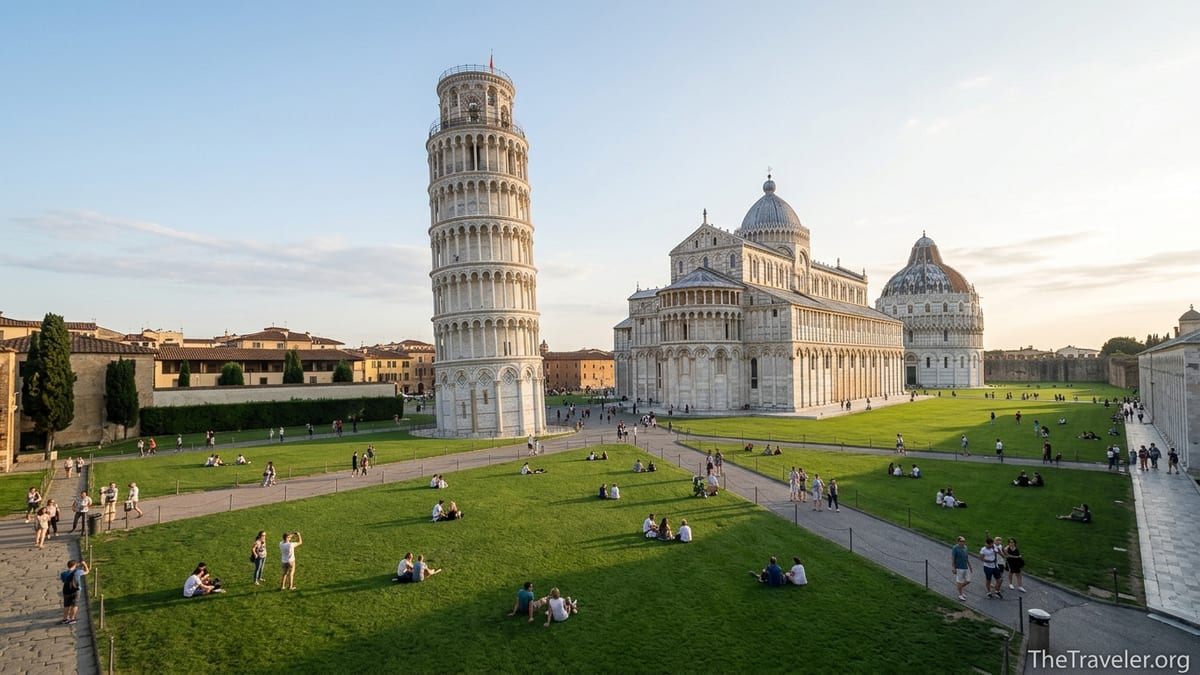
A Medieval Stage Set That Still Feels Miraculous
The formal name of the complex is Piazza del Duomo, but Italian writer Gabriele D’Annunzio’s phrase “prato dei miracoli,” or field of miracles, has stuck for more than a century. The nickname makes immediate sense the moment you step from the traffic of modern Pisa onto the manicured grass. On three sides rise the cathedral, baptistery and Leaning Tower, their white marble facades glowing against the lawn and the sky, while the long cloister of the Camposanto Cemetery closes the northern edge like a stone curtain.
The effect is theatrical yet strangely serene. Unlike many Italian squares hemmed in by cafes and shops, almost every building inside these walls is religious or civic. You will not find fashion boutiques tucked beneath the arcades. Instead, you walk along gravel paths past ticket offices run by the Opera della Primaziale Pisana, the centuries-old body that still manages the complex, and the focus remains firmly on the monuments themselves and the stories they tell.
For travelers, that concentration of masterpieces in a single, walkable space is part of the appeal. In the time it takes to stroll from one end of the lawn to the other, you can move from Romanesque architecture of the 11th century to Gothic details of the 14th, and then to 20th century engineering interventions that saved the tower from collapse. Few places in Italy compress so many layers of history into such a compact footprint.
Practical details reinforce its status as a must-see stop. The square is about a 20 minute walk from Pisa Centrale train station, or a short hop on local buses that drop you outside the medieval walls on Piazza Manin. Many visitors tackle it on a half-day detour from Florence or the Cinque Terre, fitting in a climb of the Leaning Tower, a walk through the cathedral and a circuit of the Camposanto before heading back to the coast or their Tuscan base.
The Leaning Tower: Engineering Failure Turned Global Icon
The Leaning Tower may be just the bell tower of the cathedral, but it has long overshadowed its parent church. Construction began in the 12th century on soft, waterlogged soil, and the tower started to tilt before builders had even finished the third level. Over the centuries, attempts to correct or compensate for the lean only exaggerated the problem, and by the late 20th century the tilt had reached roughly 4.5 degrees. Engineers warned it might eventually topple.
That perceived danger, combined with its visual strangeness, helped turn the Leaning Tower into one of the most instantly recognizable silhouettes on the planet. In the 1990s, an international committee of engineers launched a complex stabilization effort. Using techniques such as under-excavation, where small amounts of soil were removed from beneath the higher side, they gradually nudged the tower back to a safer tilt of just under 4 degrees. Today it is considered stable for at least a couple of centuries, and visitor access has resumed, though numbers are tightly controlled.
For travelers, the tower offers more than a photograph of a gravity-defying building. Climbing its 294 worn stone steps, you feel the tilt in your body as the spiral staircase subtly shifts underfoot. At the top, the view sweeps over the Piazza dei Miracoli and across the tiled roofs of Pisa to the Apuan Alps on the horizon. Time slots sell out quickly in high season, and a timed ticket to climb the tower is usually priced in the range that many visitors treat as a once-in-a-lifetime experience, particularly when purchased as part of a combined pass for the square’s monuments.
The tower’s story also anchors Pisa in the global imagination as a place where human miscalculation and ingenuity collide. School textbooks still reference Galileo’s (likely apocryphal) experiments dropping weights from the campanile, and science museums around the world use the tower as a case study in soil mechanics and structural engineering. That fusion of legend, science and tourism keeps Pisa’s profile high even among those who have never set foot in Italy.
The Cathedral: Power, Faith and Marble From a Maritime Republic
Step inside the cathedral itself and the narrative shifts from engineering drama to the self-confidence of a medieval maritime superpower. Begun in 1064, Pisa’s Duomo was financed by the spoils of naval victories and trade connections stretching across the Mediterranean. The architecture reflects those horizons. Its striped marble, horseshoe arches and bronze doors weave together Romanesque forms with hints of Islamic and Byzantine influence, echoing the port city’s role as a crossroads between Latin Europe and the wider world.
Visitors entering on a busy summer afternoon often pause just inside the doors as their eyes adjust from the blinding Tuscan sun to the dim, cool interior. The forest of Corinthian columns, the gilded coffered ceiling and the massive mosaic of Christ in Majesty in the apse combine to an effect that is grand yet surprisingly harmonious. The incense and flicker of candles during a mass, especially on major feast days, bring the building’s religious function sharply into focus, reminding you that this is not just a museum piece.
Small details tell bigger stories. A lamp hanging from the nave is traditionally associated with Galileo, who is said to have observed its steady swing and formulated ideas about pendulums. Carved capitals include fantastical animals and intricate foliage that reward slow looking, while medieval and Renaissance tombs dotted along the aisles recall the city’s bishops, nobles and benefactors. Even the patched areas of stone, repaired after a fire in the 16th century, speak of a living building continuously reshaped by disaster and restoration.
From a practical standpoint, entry to the cathedral is usually included with most monument tickets, and during quieter periods it is sometimes possible to visit for free by collecting a timed pass on site. Many travelers who arrive focused solely on the tower come away talking just as enthusiastically about the Duomo, surprised by its scale and the subtle interplay of light on its marble.
The Baptistery: Acoustics, Architecture and a Moment of Stillness
Directly opposite the cathedral’s main facade, the circular Baptistery of St. John rises like a freestanding marble lantern. Begun in the 12th century and completed in the 14th, it blends the solid, rounded arches of Romanesque style on the lower level with the pointier Gothic details above. The building is slightly taller than the Leaning Tower when you include the statue crowning its dome, a fact guides love to point out to visitors gathered on the grass for orientation.
Inside, the space is surprisingly bare. A central octagonal baptismal font, a pulpit carved with narrative reliefs and a ring of columns are the main features. Yet this simplicity allows one of the Baptistery’s most remarkable qualities to shine: its acoustics. Several times an hour, a staff member or guide often demonstrates a simple chant from the upper gallery. The sound climbs into the dome and cascades back down in overlapping harmonies, turning a single human voice into what feels like a small choir.
For many travelers, this acoustic demonstration becomes one of their strongest memories of Pisa. A family on a day trip from Florence, for example, might find the kids restless after waiting in line to climb the tower. Stepping into the cool, echoing interior of the Baptistery and hearing that brief performance can reset the mood, connecting even distracted visitors with the building’s original role as the site of Christian initiation.
From the upper gallery, the view down into the Baptistery and sideways toward the cathedral and tower provides a fresh sense of the piazza’s geometry. Photographers often linger here to capture oblique angles of the Duomo’s facade framed by arches, a welcome contrast to the more obvious wide shots from ground level.
The Camposanto and Museums: Where Pisa Confronts Time
Running along the northern edge of the square, the Camposanto Monumentale is a cloistered cemetery built starting in the late 13th century to provide a dignified resting place for Pisa’s elite and to house sarcophagi that had accumulated around the cathedral. According to tradition, its soil was mixed with earth from the Holy Land carried back by Pisan ships during the Crusades, giving rise to its “holy field” name. Stepping into its long, arcade-lined courtyard, the bustle of the outer lawns falls away into a hush.
The inner walls were once covered with expansive fresco cycles on themes such as the Triumph of Death and the Last Judgment. Many were badly damaged by a fire caused by Allied bombing in the Second World War, when the lead roof melted and dripped onto the paintings. Restoration has been painstaking and ongoing, and visitors today can see some of the salvaged frescoes up close, their faded pigments and scars quietly testifying to both the violence of war and the patience of conservation work.
Along the walkways, Roman sarcophagi and medieval tombs line the walls, their inscriptions softened by centuries of touch and weather. Travelers curious about daily life in medieval Pisa often find that reading these carved epitaphs and studying the relief scenes of hunts, banquets and battles can be as revealing as any textbook. It is here, more than anywhere else in the square, that the weight of time feels tangible.
Two smaller institutions deepen that sense of continuity. The Museo delle Sinopie displays the preparatory drawings for the Camposanto frescoes, pulled from beneath the damaged plaster during restoration, while the cathedral museum houses liturgical objects, sculpture and fragments removed from the monuments for protection. These museums are quieter than the tower and Duomo and can be a welcome refuge on hot afternoons, giving visitors space to absorb the site’s stories away from the crowds.
UNESCO Recognition and the Challenge of Mass Tourism
In 1987, the Piazza del Duomo in Pisa was inscribed as a UNESCO World Heritage Site in recognition of its outstanding testimony to medieval Christian architecture and its influence on later art and science. The listing highlighted not only the aesthetic harmony of the four main monuments but also their association with shifts in scientific thought, as symbolized by Galileo’s work and the later engineering feats that stabilized the tower. That stamp of global importance helped cement Pisa’s place on international itineraries.
UNESCO status, however, comes with responsibilities. City authorities and the Opera della Primaziale Pisana face the dual challenge of preserving fragile marble and frescoes while accommodating millions of visitors each year. Timed entries to the tower, controlled access to certain areas and ongoing monitoring of ground movement and structural health are all part of a quiet management strategy that most tourists barely notice but that shapes their experience.
On a practical level, this means that travelers who plan ahead tend to have a smoother visit. Booking tower climbs in advance during peak months from late spring to early autumn, arriving early in the morning before the day’s heat and tour buses, and allowing time to explore beyond the signature photo spots can transform what might otherwise be a rushed box-ticking stop into a more reflective encounter with a living heritage site.
Local businesses have adapted around this seasonal rhythm. Streets leading from Pisa’s train station to the piazza are lined with cafes offering quick espresso and panini for day trippers, souvenir stands selling miniature leaning towers, and a growing number of boutique hotels that cater to visitors choosing to stay overnight rather than rushing on. These concrete details of tourism economics are now inseparable from the historic stones of the square itself.
Experiencing the Square Today: Beyond the Classic Photo
For all its historic weight, Piazza dei Miracoli remains a place of simple, everyday pleasures. On a bright afternoon, clusters of university students and local families share the lawns with tour groups, snacking on slices of schiacciata bread from nearby bakeries. Travelers nursing jet lag stretch out under the shadow of the Baptistery, letting children run across the grass. Musicians sometimes set up just outside the walls, their sound drifting faintly into the square without overwhelming it.
Those who linger discover that the light transforms the monuments over the course of a day. In the early morning, when the first rays hit the eastern facades, the marble takes on a soft, creamy hue. By midday it gleams almost white against the deep blue sky, a stark backdrop for the columns’ shadows. Near sunset, the stone warms to honey tones, and the crowds thin as buses depart for Florence and the coast. Staying in Pisa overnight allows you to see the square again after dark, when subtle lighting traces the contours of the buildings against the night.
Real-world itineraries often weave the piazza into broader Tuscan journeys. A couple spending a week in Lucca, for example, might take a regional train for a half-day excursion to Pisa, combining the square with a walk along the Arno River and an aperitivo in one of the cafes on Piazza Garibaldi. Backpackers crisscrossing Italy by rail might break up the trip between Rome and Genoa with a night in Pisa, using the afternoon to see the monuments and the next morning to explore quieter neighborhoods before catching their next connection.
In each case, Piazza dei Miracoli acts as both magnet and mirror. It draws people in with the promise of a single, slightly absurd leaning tower, then reflects back a fuller story about how societies express faith, process death, display wealth and grapple with the unintended consequences of their building projects. That blend of spectacle and depth is what keeps travelers and scholars returning, generation after generation.
The Takeaway
Piazza dei Miracoli endures as one of Italy’s most iconic historic sites because it condenses so many of the country’s enduring themes into a single, walkable space. Here, medieval maritime ambition meets fragile subsoil, producing a global symbol of both architectural miscalculation and engineering salvation. A cathedral funded by conquest and trade becomes a canvas for evolving artistic styles and scientific ideas. A cemetery scarred by war becomes a laboratory for conservation and a meditation on time.
For travelers, the square offers an experience that can be tailored to every schedule, from a swift morning climb of the Leaning Tower between trains to an unhurried day tracing the stories carved into sarcophagi and frescoes. Concrete choices such as booking timed entries, visiting in the shoulder seasons, or staying overnight in Pisa can shift the visit from a crowded photo stop to a more intimate encounter with one of Europe’s great architectural ensembles.
Ultimately, what keeps Piazza dei Miracoli relevant is not just its postcard beauty, but its layered humanity. It is a place where pilgrims, merchants, soldiers, engineers, students and tourists have all left their mark, and where the tilt of a single tower continues to spark curiosity about how the past leans into the present. Stand on the grass, look from the tower to the cathedral to the silent cloister of the Camposanto, and it is hard not to feel that, even in a country rich with marvels, this particular field of miracles remains something special.
FAQ
Q1. What exactly is included in Pisa’s Piazza dei Miracoli?
The Piazza dei Miracoli is the walled complex that contains the cathedral, the Leaning Tower (its bell tower), the circular baptistery, the cloistered Camposanto Cemetery and several small museums.
Q2. Why is the Leaning Tower of Pisa tilted and is it safe to climb?
The tower leans because it was built on soft, unstable ground that began to give way during construction. Modern engineering work has stabilized it, and controlled numbers of visitors are allowed to climb it safely each day.
Q3. How much time should I plan for a visit to Piazza dei Miracoli?
Most travelers spend between two and four hours, which is usually enough to climb the tower on a timed ticket, walk through the cathedral and baptistery, and explore the Camposanto and at least one museum.
Q4. Do I need to book tickets for the Leaning Tower of Pisa in advance?
Advance booking is strongly recommended, especially from late spring through early autumn. Same day slots sometimes remain, but popular times can sell out quickly.
Q5. Is it possible to visit the square on a day trip from Florence or the Cinque Terre?
Yes. Regular regional trains connect Florence, Pisa and coastal towns, and many visitors visit the piazza on a half-day trip, often combining it with a short walk through Pisa’s historic center.
Q6. Can I walk on the grass inside Piazza dei Miracoli?
Access rules can vary, but visitors are often allowed to sit or walk on designated areas of the grass, especially away from the main paths. Staff may restrict access during very busy periods or wet weather to protect the lawns.
Q7. Is Piazza dei Miracoli suitable for children and people with limited mobility?
The square itself is largely flat and accessible, and children usually enjoy its open space. The tower climb involves many narrow steps and is not suitable for strollers or some mobility challenges, but the cathedral, baptistery and parts of the Camposanto can be visited more easily.
Q8. What is the best time of day to visit to avoid crowds?
Early morning and late afternoon tend to be quieter than midday, when most tour buses arrive. Visiting outside peak summer months also helps reduce waiting times and heat.
Q9. Are there dress code considerations for entering the cathedral and baptistery?
As active places of worship, they ask visitors to dress respectfully, with shoulders and knees covered. Light scarves or shawls are useful for covering up in warm weather.
Q10. Why is Piazza dei Miracoli considered one of Italy’s most iconic historic sites?
Its combination of the world famous Leaning Tower, a grand medieval cathedral, unique baptistery acoustics and a historic cemetery, all set within a harmonious walled square, offers a concentrated and visually striking insight into Italian history, art and engineering.