


Plage de la Salis in Antibes often appears in guidebooks and Instagram feeds as a classic French Riviera beach: pale sand, bright turquoise water, and views of both the old town and the snow-dusted Alps on the horizon. But if you have only one or two precious beach days on the Côte d’Azur, is Salis really the right choice for you, or would you be better off elsewhere on the coast?
Get the latest updates straight to your inbox!
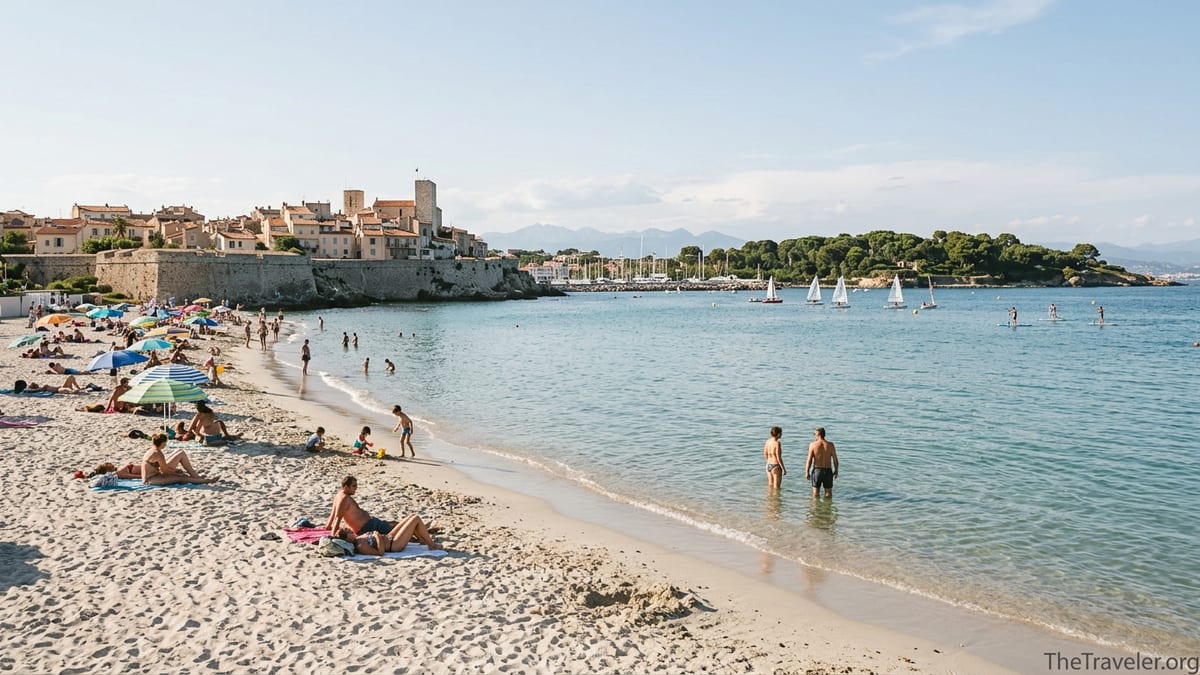
Where Plage de la Salis Fits on the French Riviera Map
Plage de la Salis sits at the eastern edge of Antibes, right where the town meets the start of the Cap d’Antibes peninsula. It is about 1 kilometre from the old town ramparts, an easy flat walk of roughly 10 to 15 minutes along the waterfront. In practice this means you can have breakfast near the Provençal market, wander past Port Vauban’s superyachts, and be spreading your towel on Salis by late morning without ever needing a taxi.
The beach itself is a long, narrow curve of sand running alongside Boulevard James Wyllie, with the small Port de la Salis at one end and Plage du Ponteil just beyond the yacht club in the other direction. The bay is sheltered compared with more exposed stretches of the Riviera, so the water here is typically calm enough for relaxed swimming and stand up paddleboarding. Local tourism offices highlight this part of the coastline for its softer, sandy seabed compared with the pebbly beaches of Nice.
For most visitors staying in Antibes, Salis is the “everyday” beach: somewhere you can walk to in flip-flops without planning or reservations. It is also an easy add-on for travellers based in Nice or Cannes who want a day trip with a more low-key atmosphere. From Nice, regional TER trains to Antibes take around 20 to 30 minutes, and from the station you can reach Salis by bus or on foot within half an hour, making it a realistic day outing.
Compared with famous Cap d’Antibes spots like Plage de la Garoupe, which leans more toward upscale beach clubs and higher prices, Salis feels more democratic. It is almost entirely public, attracts locals year-round, and combines Riviera views with a down-to-earth feel that many travellers find refreshing.
Sand, Sea and Scenery: What the Beach Actually Feels Like
One of the main reasons people choose Plage de la Salis over other Riviera beaches is the sand. Unlike the rounded stones that define much of central Nice, the shore here is made up of fine, pale sand with some small shells and occasional pebbles near the waterline. You can comfortably walk barefoot from your towel into the sea, which is a major plus for families with younger children or anyone with sensitive feet.
The sea is usually shallow for a good distance, especially nearer the centre of the beach, so swimmers can wade out gradually. In summer, lifeguards supervise the area from mid-June to around mid-September, in line with local regulations for major Antibes beaches. Independent beach guides and municipal information consistently note that Salis is among the cleanest beaches in Antibes, with regular water-quality testing and generally excellent ratings.
Scenically, Salis performs above its “everyday beach” image. Turn one way and you see the ramparts and old town of Antibes, with the outline of the Picasso Museum building clearly visible. Turn the other way and the wooded slopes of Cap d’Antibes frame the bay. On clear days, particularly in spring and early summer, you can often see the peaks of the Maritime Alps in the far distance. Many visitors find that the combination of sandy shore, pine trees, and mountain backdrop feels distinctly different from the more urban seafront of Nice.
That said, the beach is relatively narrow, and in high summer you will not have the sweeping privacy shots you might see online. Towels are often laid out close together by late morning in July and August. If you imagine something more secluded, with rock pools and dramatic cliffs, you may prefer the coves further around Cap d’Antibes, even if they require sturdier shoes and a walk along the coastal path.
Facilities, Food and Practicalities You Will Actually Notice
In terms of infrastructure, Plage de la Salis hits a middle ground that works for most casual beach days. Along the sand, you will find simple public showers spaced at intervals, which are free to use and very handy if you plan to head straight back into town afterward. Public toilets are available at or near the Antibes Yacht Club behind the beach; they are basic but functional, and you should not expect the level of comfort of a private beach club.
Unlike some Cap d’Antibes coves that have no services at all, Salis has seasonal snack kiosks and small stands that sell sandwiches, cold drinks, ice creams and simple hot food such as panini. Prices vary slightly by operator and season, but you can usually expect to pay roughly what you would for a casual café in Antibes: a simple sandwich might cost a bit more than in a supermarket, but not dramatically so for a seafront location. For a more substantial meal, a handful of informal restaurants and pizzerias sit just across the road from the beach, where you can eat at a table without losing sight of the water.
There are currently no large-scale private beach clubs occupying big sections of Salis in the way you might see in Cannes or Juan les Pins. A small portion of the beach is used by nautical activities near the yacht club, with kayaks, paddleboards and sailing lessons offered by local operators in high season. This arrangement means that almost all of the sand remains free for anyone to use with their own towel or chair, which helps keep the overall cost of a beach day low.
Accessibility is better here than at many rocky coves along the Riviera. There is level access from the pavement and from nearby parking, and in recent years Antibes has invested in making several of its beaches more welcoming to visitors with reduced mobility. Depending on the exact month and staffing, Salis may offer equipment or assistance similar to other labelled accessible beaches in the area, so travellers with specific mobility needs should check current-season information via local tourism offices before arrival.
Getting There, Parking and When to Arrive
How convenient Plage de la Salis feels depends largely on how you arrive. On foot from Antibes old town, it is straightforward: simply follow the coastal route past Plage de la Gravette and the port, or cut through town toward the sea and then follow Boulevard James Wyllie. Many visitors staying in central Antibes never need a car during their entire holiday and treat Salis as their default swimming spot.
If you are coming from farther away, local buses run from Antibes towards Cap d’Antibes, with stops near the beach. Frequency varies by season and day of the week, so it is wise to check Envibus schedules shortly before your trip. In summer, buses can be busy at peak times when beachgoers and commuters overlap, but they remain one of the easiest ways to avoid parking stress.
For those who do drive, parking is a mixed picture. There is a public car park at the eastern end of the beach and some on-street spaces along the boulevard. Outside the core summer period, many of these spots are free, but from roughly mid-June to mid-September some spaces switch to paid parking with half-day and full-day rates that are still modest by Riviera standards. The real challenge is availability rather than price: by late morning on a sunny August day, drivers can easily circle for 20 minutes before finding a space. If you plan to drive in high season, arriving before about 9:30 am significantly increases your chances of parking close to the sand.
Timing your visit can transform your experience. Morning light gives the bay a softer, pastel quality, and the beach is noticeably quieter before 10 am, especially outside school holidays. Late afternoon, from around 4 pm, brings another lull as families with small children start to leave; the sun angles lower behind the old town, creating golden reflections on the water. If you are staying nearby, many locals recommend a routine of exploring in the middle of the day and then spending two or three relaxed hours at Salis from late afternoon into early evening.
Who Will Love Plage de la Salis (and Who Might Not)
Plage de la Salis is particularly well suited to travellers who value ease, low or no entry cost, and a local atmosphere over fully serviced luxury. Families appreciate the shallow water, the presence of lifeguards in summer, and the ability to walk back to an apartment or hotel in Antibes without relying on taxis. Couples on a mid-range budget often choose Salis as their “home” beach for several days, combining towel days here with a splurge at a private beach club elsewhere along the coast.
Solo travellers tend to find Salis unintimidating. Because it is used regularly by residents, you will see people of all ages swimming before work, reading in the shade of the low pines behind the beach, or meeting friends after school. This mix helps many visitors feel less like they are in a purely tourist zone. The beach is also convenient if you want to intersperse sea time with cultural visits; the Picasso Museum, Fort Carré and the Marché Provençal are all within a reasonable stroll.
On the other hand, if your ideal French Riviera day involves table service at your lounger, elaborate cocktails, and a DJ, Salis alone will not meet your expectations. In that case, you might use it as a free morning swim spot before heading to a club in Juan les Pins or Cannes later in the day. Likewise, travellers seeking complete seclusion may be disappointed by the density of towels in high season. Even on shoulder-season weekends, Salis is rarely empty when the weather is pleasant.
For comparison, Plage de la Gravette near the old town ramparts offers a smaller, more enclosed cove, which some families prefer for its particularly calm water. Plage de la Garoupe around the cape delivers more dramatic Riviera glamour and clearer open-sea views but generally with higher prices for loungers and food. If you only have time for one beach in Antibes, Salis is often the most balanced option, but it is not the only answer.
Costs, Safety and Seasonal Considerations
One of the strongest arguments in favour of Plage de la Salis is cost control. You can bring your own towel, umbrella and picnic and spend a full day by the sea with minimal outlay, paying only for bus fare or parking. Supermarkets and bakeries in Antibes sell prepared salads, baguette sandwiches and fruit that you can easily carry down to the beach in a small cool bag. Many visitors mix purchased snacks from the kiosks with food they bring themselves to keep expenses predictable.
From a safety perspective, Salis benefits from both its sheltered position and the presence of lifeguards in the main summer period. Families should still observe the usual precautions common to all Mediterranean beaches: currents can occasionally strengthen after storms, and inflatable toys can drift if winds pick up. It is wise to check local flag systems on the day; green typically indicates normal conditions, while orange or red flags signal increased caution or a ban on swimming.
Seasonality has a noticeable impact on your experience. In July and August, especially during French school holidays, the beach is busy from mid-morning well into the evening. Water temperatures are usually comfortable for long swims by then, but shade on the sand is limited. Bringing your own lightweight beach umbrella or small sunshade is highly recommended unless you are comfortable spending long periods in direct sun. In May, June, September and early October, the atmosphere is more relaxed, with a mix of locals and travellers who prefer shoulder seasons; the sea may feel fresher but is usually swimmable for those accustomed to temperate waters.
Weather along this section of the Côte d’Azur is generally sunny from late spring through early autumn, but sudden short storms can roll in, particularly in late summer. When this happens, local authorities can temporarily close swimming at all Antibes beaches until water clarity and quality checks are complete. If your schedule is flexible, building an extra day into your plan gives you a backup option should conditions change.
Making the Most of a Beach Day at Salis
If you decide that Plage de la Salis fits your style, treating it as part of a wider Antibes day rather than an isolated destination can make the experience more rewarding. A popular pattern is to explore the old town in the morning, including the market and the Picasso Museum, pick up picnic supplies, and then walk down to Salis by late morning or early afternoon. After a few hours of swimming and sunbathing, you can either stroll back along the promenade for an ice cream in town or extend your coastal walk onto the beginning of the Sentier du Littoral around Cap d’Antibes.
Another option is to plan Salis specifically for a late-afternoon and sunset visit. Many travellers stay on the sand until the light fades, watching the sky change behind the ramparts and, on clear days, seeing the mountains turn pink in the distance. Because the beach is close to residential neighbourhoods, you can rinse off at the showers, change into dry clothes, and walk straight to a casual dinner spot without feeling you have made a big logistical shift.
To keep your day comfortable, consider bringing a thin foam mat or compact beach mattress; the sand is mostly soft, but regular visitors know that lying on a slightly padded surface makes a long session much more pleasant. A reusable water bottle is essential in summer, and many travellers carry a light, long-sleeved shirt or shawl to protect their shoulders from the strongest midday sun.
If you are staying for several days in Antibes, you might alternate Salis with other nearby beaches to see what suits you best. Spend one afternoon at Plage de la Gravette, where the curve of the bay feels more enclosed, and another at Ponteil, which has its own devoted local following. After that, you will have a clearer sense of where you want to return for your final lazy day before leaving the Riviera.
The Takeaway
So, is Plage de la Salis worth visiting for your French Riviera beach day? For many travellers, the answer is yes, particularly if you are looking for a sandy, mostly public beach with strong views, reliable water quality and easy walking access from one of the region’s most appealing old towns. Salis delivers a classic Côte d’Azur experience without requiring you to pay for a lounger, book ahead, or dress up for a beach club.
At the same time, it is important to arrive with realistic expectations. Salis is not a hidden cove; in high season it is busy, towels sit close together, and the atmosphere is more local-family than luxe-exclusive. Facilities are functional rather than glamorous, and there is only a modest amount of natural shade on the sand itself.
If you value convenience, a sense of place, and the ability to move effortlessly between historic streets and the sea, Plage de la Salis is an excellent anchor for an Antibes stay or day trip. If your heart is set on a full-service lounger experience with a party atmosphere, you may prefer to treat Salis as a free-swim stop and reserve your splurge at a private beach elsewhere. Knowing which kind of beach day you want will help you decide whether Salis is not just worth a visit, but worth building your Riviera memories around.
FAQ
Q1. Is Plage de la Salis free to use?
Yes, Plage de la Salis is essentially a public beach, so you can spread your towel on the sand without paying an entrance fee or mandatory lounger charge.
Q2. How far is Plage de la Salis from Antibes old town?
The beach is roughly 1 kilometre from the old town ramparts, usually a flat 10 to 15 minute walk along the waterfront or through nearby streets.
Q3. Is the water at Plage de la Salis clean?
Local monitoring and independent beach guides consistently report good to excellent water quality at Salis, with regular testing during the main swimming season.
Q4. Are there lifeguards on duty?
Yes, in general there are lifeguards on duty during the main summer period, typically from mid-June to mid-September, in line with other major Antibes beaches.
Q5. Can I rent sunbeds or umbrellas at Plage de la Salis?
There are limited organised rentals compared with more commercial beaches, so most visitors bring their own towels and portable umbrellas rather than relying on full-service setups.
Q6. Is Plage de la Salis suitable for children?
Yes, the sandy seabed, generally shallow entry and summer lifeguard presence make it popular with families, though parents should always supervise children in the water.
Q7. What is the best time of day to visit?
Mornings before about 10 am and late afternoons from around 4 pm are usually less crowded and offer softer light and more pleasant temperatures in high summer.
Q8. How difficult is parking near the beach?
There is a small car park and some street parking, but spaces fill quickly in July and August, so arriving early or using buses or walking from town often works better.
Q9. Are there restaurants or food options close by?
Yes, seasonal snack kiosks operate directly on or behind the beach, and several casual restaurants and pizzerias sit just across the road within a short walk.
Q10. How does Plage de la Salis compare with other Antibes beaches?
Salis offers a good balance of sand, views and easy access, making it a versatile choice, while nearby beaches like Gravette or Garoupe provide more enclosed or more upscale alternatives.