


Antibes is spoiled with beaches, but for many visitors the real choice comes down to two neighbors curving around the edge of Cap d’Antibes: Plage de la Salis and Plage du Ponteil. They sit side by side on the same sheltered bay, share the same soft sand and postcard views of the old town and the Alps, yet they feel surprisingly different once you put your towel down. If you only have a day or two by the sea, choosing the right one can shape your entire Antibes experience.
Get the latest updates straight to your inbox!
Getting Oriented: Two Neighbors on the Same Bay
Plage du Ponteil and Plage de la Salis stretch along the southern side of Antibes, between the old town and the green headland of Cap d’Antibes. Ponteil lies closer to the ramparts and the center, while Salis continues the curve of sand further east toward the start of the coastal path around the cape. You can walk from one to the other in a couple of minutes, separated mainly by the Antibes Yacht Club and a small harbor, so in practice many locals treat them as one long beach.
Both beaches are predominantly public, with only a small portion devoted to beach clubs or restaurant terraces. They share similar fine pale sand and gently shelving, generally calm water that is much friendlier to bare feet than the large pebbles you find on nearby Nice’s city beaches. Both have seasonal lifeguard posts active from roughly mid June to mid September, making them popular with local families and French holidaymakers.
Despite the shared setting, first impressions differ. Ponteil feels more urban and sociable, linked to a shaded promenade with benches and a few nearby shops, while Salis feels a little more open and natural, with the pines of Cap d’Antibes just behind you and almost no traffic noise reaching the sand. This contrast is what usually tips the scales for visitors once they know what sort of beach day they want.
For most travelers staying in or near Antibes, both beaches are easily reached on foot from the old town in 10 to 20 minutes, or by local bus or bike. That makes it realistic to try both over a weekend, but if you need to choose only one, understanding the details will help you decide.
Sand, Sea and Scenery: How Do They Really Feel on the Ground?
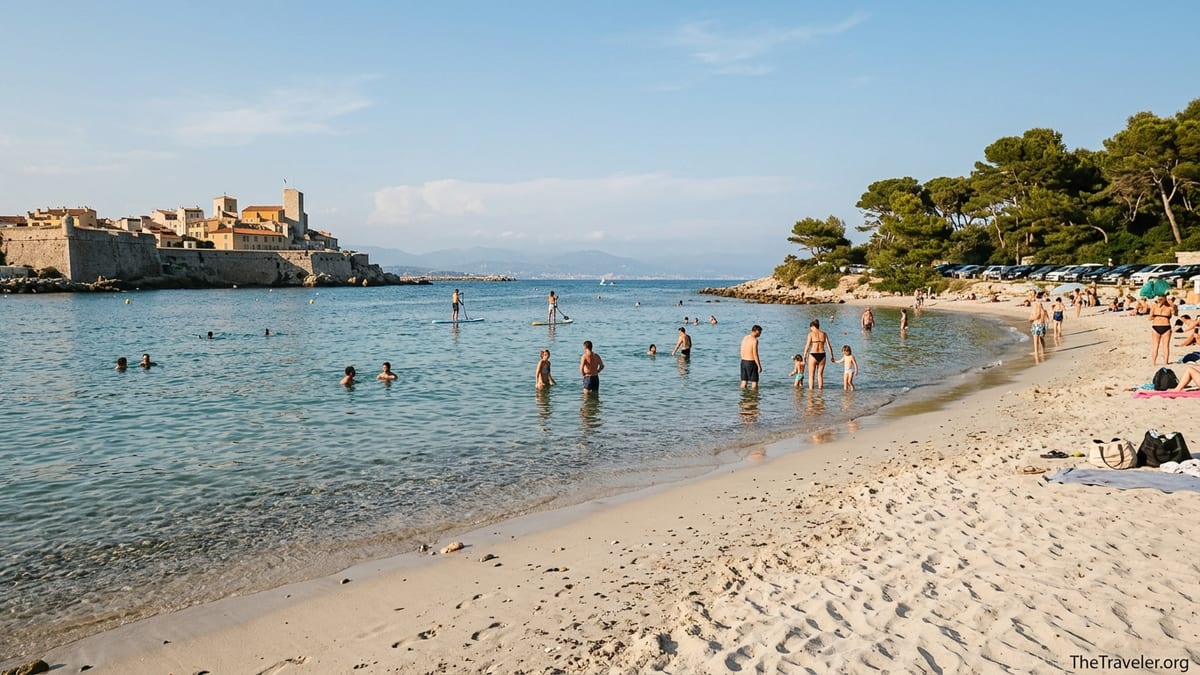
Stand on Plage du Ponteil on a clear day and you look straight across a broad bay toward the ramparts of old Antibes, the towers of the Picasso Museum, and snow‑tipped Alpine peaks in the distance during shoulder seasons. The beach is long but not very wide, and the tree‑lined promenade just behind gives it a relaxed, lived‑in feel. It is where many year‑round residents come for an evening stroll or a quick dip before work in summer. The vibe is social and local, without feeling like a resort strip.
Plage de la Salis continues the same arc of sand but widens slightly in places and feels more open to the sky. Behind the beach you have low dunes, parking and the first pines of Cap d’Antibes rather than a built‑up promenade. The sea here faces more directly onto the curve of the Bay of Angels; on bright mornings colors can be spectacular, with bands of light turquoise over the sand shallows and deeper blue further out. It feels a touch more wild by Côte d’Azur standards, even though you are still only a short walk from town.
In practical terms, both beaches are composed mainly of soft sand with occasional gravel patches nearer the waterline. Water quality at Salis has tested as particularly consistent in recent seasons, which local tourism officials quietly highlight, although Ponteil usually also scores well in routine checks. Many families notice that the seabed stays shallow for a good distance at both, so small children can paddle quite close to shore. Adults who like to float and chat can stand chest‑deep without drifting into the boat lanes marked by buoys.
If you are hoping for dramatic waves for body surfing, you will not find them here most days. The bay is sheltered and the waters are usually calm, which is exactly why these two beaches are so popular for relaxed swimming, paddleboarding and swimming lessons.
Facilities, Comfort and Accessibility
For many readers of TheTraveler.org, the decision between Ponteil and Salis is less about the color of the water and more about comfort: toilets, showers, shade and accessibility. Ponteil scores strongly here. A wide promenade behind the beach offers plenty of benches under established trees, making it easy to step off the sand, sit in the shade and watch the evening light. Seasonal showers run along parts of the beach, and the town has equipped Ponteil as a “handiplage” in summer, with adapted access points and staff trained to help people with reduced mobility into the water.
Food and drink are also slightly more developed around Ponteil. Toward one end you will find a small private section run by Royal Beach, where you can rent a lounger and parasol for the day and order restaurant‑quality dishes and cocktails served to your chair. Exact prices change each season, but travelers recently reported paying around 30 to 40 euros per person for a full day lounger and parasol package in high summer, which is typical for the region. Just behind the promenade you will also find a casual kiosk for fries, panini and ice cream, a small supermarket for picnic supplies, and a pizzeria.
Salis, by contrast, is almost entirely public. You still have cold water showers along the beach and toilets available via the Yacht Club area, but there is less in the way of permanent beachfront business. Instead you will find a scatter of beach kiosks and snack stands selling sandwiches, coffee and soft drinks at prices only slightly above what you would pay in town. For a sit‑down meal, many visitors simply cross the road to a handful of casual restaurants and cafés that serve pizza, salads and seafood without the trappings of a formal beach club.
Both beaches are reachable for travelers using wheelchairs or strollers, though Ponteil’s promenade generally makes rolling along the waterline easier. Salis also offers adapted access in summer, but you may find that the approach over packed sand requires a bit more planning. If someone in your group relies heavily on step‑free routes and firm surfaces, Ponteil has a modest but clear advantage.
Crowds, Atmosphere and Who Each Beach Really Suits
On a hot Saturday in August, both beaches will be busy, but they attract slightly different crowds. Ponteil is a classic “family city beach.” You will see multigenerational French families with beach carts and umbrellas, local teenagers drifting in and out throughout the day, and renters from nearby apartments who come down with a paperback and a bottle of rosé tucked discreetly in their bag. Because the promenade is so pleasant, plenty of people also walk by without swimming, which contributes to the buzz.
Salis draws a more mixed crowd, including walkers heading toward the coastal path around Cap d’Antibes, early‑morning joggers, and visitors staying in the quieter villas and guesthouses east of town. It can feel marginally less dense in the peak of summer, especially toward the far end closer to the cape where the beach widens. In the evening, when the sun drops behind the old town, many locals favor Salis for sunset swims and picnics that stretch into the blue hour.
If you are traveling with small children and want that village‑like, everyone‑watches‑everyone atmosphere, Ponteil is hard to beat. The sea is usually calm, the entry is shallow, and because so many local parents use it, there is an unhurried, neighborly mood. You will hear French spoken more than any other language, with English, Italian and Scandinavian voices sprinkled in.
If you are a couple looking for a slightly quieter stretch to lay out a towel, or a solo traveler who wants to read a book with the smell of pine trees in the air, Salis may suit you better. It still gets busy in high season, but if you arrive before 10:00 in July or August you can usually find space with a clear view of the water and the lighthouse on the cape. In May, June and September it often feels spacious even on sunny days.
Access, Parking and Getting There Without Stress
For travelers staying in Antibes without a car, both beaches are refreshingly straightforward. From the old town walls near the port, it takes around 10 to 12 minutes to walk to Ponteil at a leisurely pace, and another 5 minutes to continue on to Salis. The route follows the sea almost the whole way, so even the approach is scenic. Local buses heading toward Cap d’Antibes stop a short walk from each beach; tickets are inexpensive and can be bought directly from the driver, though services thin out in the late evening.
With a rental car, attention shifts to parking. Behind Ponteil you will find a large dedicated parking area that fills quickly on sunny days in July and August. Around Salis, the main public parking is concentrated along Avenue de la Salis and a small open‑air lot with a few dozen spaces close to the harbor and yacht club. At the time of writing, parking is typically free outside the high summer window and charged at a modest hourly or half‑day rate in peak season. A common local strategy is to arrive before 9:30 in the morning, park near Salis or between the two beaches, enjoy the quieter early hours, then move on once the midday crowds peak.
If you prefer not to drive at all, Antibes works very well with trains and on foot. The main Antibes train station is roughly 20 minutes’ walk from Ponteil, and slightly more to Salis, so many day‑trippers from Nice or Cannes simply step off the train, wander through the old town and follow the waterline to whichever beach they favor. For families pushing buggies or travelers hauling beach gear, budget in a bit more time, but the walk is almost uniformly flat.
For cyclists, a designated coastal bike route links Antibes with neighboring towns and passes near both beaches. You will not be able to ride directly on the promenade or sand, but many visitors lock bikes along nearby railings or in marked stands and then continue on foot. If you rent bikes in town, ask for a simple handlebar lock and avoid leaving valuables in a basket while you swim.
Activities, Watersports and What to Do Beyond Sunbathing
Though both Ponteil and Salis are primarily about swimming and sunbathing, there are subtle differences in what you can actually do once you have spread your towel. Ponteil keeps things deliberately simple. The calm water and gentle slope make it ideal for casual laps along the shore, stand‑up paddling, or children learning to swim. You might see small sailing dinghies offshore or kayaks passing by, but intensive watersports operations are limited so the bay never feels overrun by jet skis or speedboats.
Just beyond Salis, the Antibes Yacht Club offers lessons in dinghy sailing and windsurfing, along with rental of kayaks and paddleboards in season. If you fancy a half‑day on the water rather than just in it, this is often the more convenient end of the bay. Many visitors sign up children for short multi‑day sailing courses in July and August, while parents relax on Salis or stroll back toward town. Prices vary by program and age, but parents report that group kid sessions are competitive with other Riviera resorts and usually book out well in advance.
Both beaches also make excellent gateways to exploring further. From the Salis end, you are a short walk from the famous coastal trail around Cap d’Antibes, where a signed footpath hugs the rocky shoreline past villas and small coves. A common itinerary for active travelers is to swim in the early morning, walk a section of the path as the day heats up, then return to the beach or into town for lunch. From Ponteil, you are closer to the old town, Picasso Museum and covered market, making it easy to split your day between culture and the sea.
Evening activities differ slightly too. Ponteil’s promenade becomes a social stage around sunset, with residents walking dogs, groups of teens gathering on the benches and the occasional pop‑up yoga or fitness session on the sand in late summer. Salis feels calmer and a little darker after sundown, suited to people who want a quiet stroll under the pines and the sound of waves rather than streetlife.
Costs, Food Choices and Planning a Realistic Beach Budget
In a Riviera context, both beaches are pleasantly affordable if you stick to the public sections. Laying your own towel is completely free, including access to the showers, and you will only pay for parking, drinks and snacks. A practical rule of thumb in recent seasons is to allow around 10 to 15 euros per person for a simple beach picnic bought at a nearby supermarket: a baguette, cheese or ham, fruit, a bottle of water and perhaps a pastry for later.
If you opt for a lounger and parasol at Royal Beach on the Ponteil side or another small private setup when available, expect your daily cost to rise significantly. A pair of loungers with an umbrella can easily reach 60 to 80 euros for two people in peak weeks, not including food and drinks. Lunchtime dishes at beach clubs typically run 20 to 35 euros for a main course of grilled fish, salads or pasta. Many budget‑minded visitors therefore split their time, enjoying a single “treat” day at a beach club and relying on the public sands for the rest of their stay.
On the Salis side, the lack of an extensive private club strip keeps spending naturally lower. You are more likely to buy a takeaway panini or salade niçoise from a kiosk or cross the road to a modest café offering fixed‑price lunch menus in the 18 to 25 euro range. In the evening, some visitors pick up a roast chicken and side dishes from a takeaway place in town and bring them down to the sand for a simple picnic dinner as the lights come on across the bay.
Whichever beach you choose, remember that prices for drinks, ice creams and sun‑related products like sunscreen increase noticeably along the seafront. If you are traveling with children or a group, it pays to stock up on basics in Antibes’ supermarkets before you settle in for the day. Refillable water bottles are especially sensible, given how strong the sun can be from late morning onward.
The Takeaway: Which Beach Fits You Better?
If you value convenience, facilities and a lively local atmosphere, Plage du Ponteil is likely to be your natural home base. It is closer to the old town, offers easier promenade access, has a larger cluster of services immediately behind the sand and tends to feel like the communal living room of Antibes on sunny days. Families with young children, travelers with limited mobility and visitors who enjoy a bit of people‑watching between swims generally come away very happy.
If you prefer a slightly more open, natural setting and want to feel a bit closer to Cap d’Antibes and the coastal path, Plage de la Salis will probably speak to you more. The water quality is consistently excellent, the views along the cape are magnificent, and the absence of a fully built‑up promenade gives it a low‑key, holiday‑house mood. Couples, solo travelers and anyone planning to pair beach time with scenic walks often gravitate here.
In reality, the best strategy for many visitors is not to choose at all. Stay flexible, check the wind direction and your own energy each morning, then drift between the two. Start the day with a quiet coffee and swim at Salis, wander back to Ponteil for a late lunch and a shaded stroll, then return to whichever beach feels right for sunset. Because they sit side by side, you can treat them almost as different rooms in the same seaside home.
Whether you end up at Salis, Ponteil or both, the combination of gentle Mediterranean water, soft sand and the stone silhouette of old Antibes at your back is one of the Riviera’s great simple pleasures. With a little planning and realistic expectations about costs and crowds, you can shape the experience that fits you best and still be only a short walk from one of the most atmospheric old towns on the French Mediterranean.
FAQ
Q1. Which beach is better for families with small children, Plage de la Salis or Plage du Ponteil?
Ponteil usually has a slight edge for families thanks to its tree‑lined promenade, easy stroller access, handiplage facilities in season and the very gentle entry into the water, though Salis is also shallow and suitable for kids.
Q2. Is the water cleaner at Plage de la Salis than at Plage du Ponteil?
Recent tests have shown particularly consistent water quality at Salis, which local officials highlight, but both beaches generally benefit from the same sheltered bay and are usually rated safe for swimming in season.
Q3. Do I have to pay to use either beach?
No. Both Plage du Ponteil and Plage de la Salis are primarily public, so you can lay down a towel for free. You only pay for extras such as loungers, parasols, food, drinks and parking in peak months.
Q4. Which beach is closer to Antibes old town?
Ponteil is closer. It takes around 10 to 12 minutes to walk from the ramparts or the port area to Ponteil, and then another few minutes along the bay to reach Salis.
Q5. Is it easy to park near these beaches in summer?
Parking exists behind both beaches, but in July and August spaces fill quickly. Arriving before mid‑morning improves your chances; otherwise, consider walking from town or using local buses.
Q6. Can I rent sunbeds and umbrellas at Plage de la Salis and Plage du Ponteil?
At Ponteil, a small private section and beach club usually offer loungers and umbrellas for a daily fee, especially in high season. Salis is more focused on public sand, so options for rentals are more limited and may vary year to year.
Q7. Which beach is better if I want a quieter, more natural atmosphere?
Salis tends to feel a bit more open and natural, with fewer buildings directly on the waterfront and pines from Cap d’Antibes framing the view. It suits travelers seeking a calmer mood without leaving town.
Q8. Are there restaurants and shops directly behind the beaches?
Ponteil has more immediate options, including a beach club restaurant, snack kiosk, small supermarket and pizzeria just behind the promenade. Salis offers several snack stands on or near the sand and casual restaurants across the road rather than a continuous commercial strip.
Q9. Can I combine a visit to these beaches with the coastal walk around Cap d’Antibes?
Yes. Salis in particular is a convenient starting or finishing point for sections of the Cap d’Antibes coastal path, so many visitors swim first, walk for an hour or two along the cape, then return for another dip or head back into town.
Q10. If I only have one beach day in Antibes, which should I choose?
If you prioritize facilities and an easy connection to the old town, choose Ponteil. If you prefer a slightly more natural setting and plan to walk around the cape, choose Salis. Because they are adjacent, you can also easily sample both in a single day.