


On a coastline blessed with more beaches than many visitors can count, Plage de la Salis manages to feel both classically Riviera and quietly local. Sitting between Antibes’ old town and the villas of Cap d’Antibes, this slim crescent of pale sand has none of the glitz of the big-name private beaches, yet on a summer evening it is exactly where many Antibois choose to swim, stroll and watch the light fade over the Alps. For travelers comparing Antibes’ shores and wondering which spot deserves a precious sun-filled day, understanding what makes Salis different helps you plan a stay that feels less like a postcard and more like real life on the Côte d’Azur.
Get the latest updates straight to your inbox!
Between Old Antibes and Cap d’Antibes: A Beach With Two Personalities
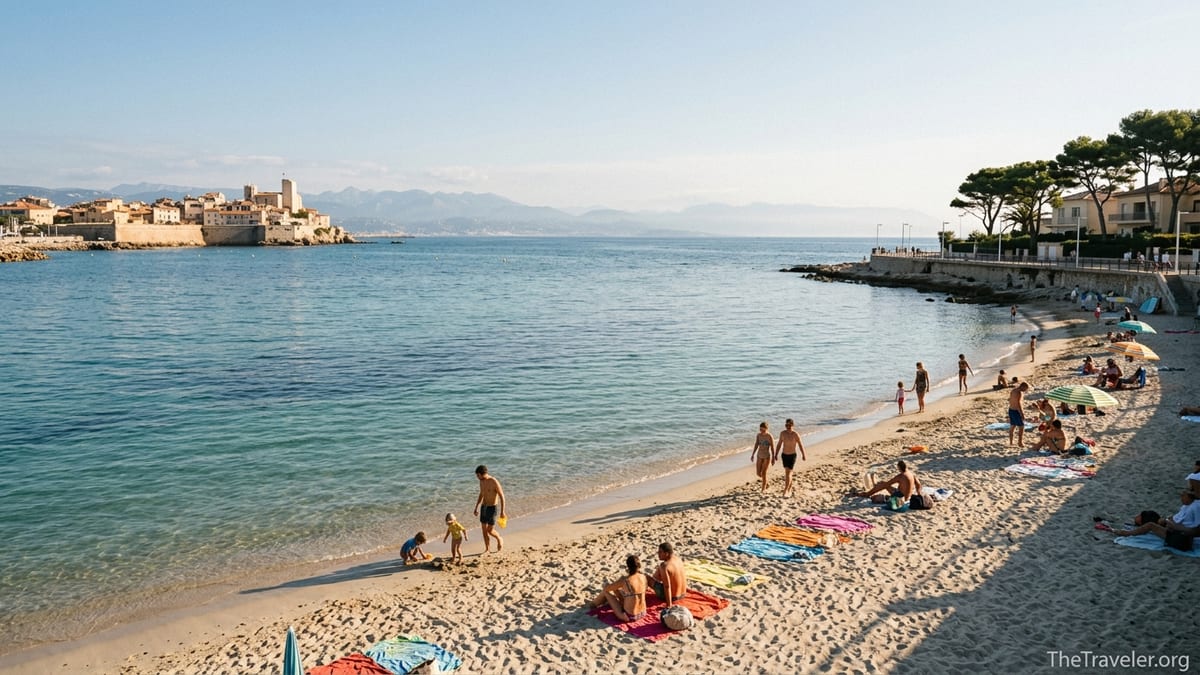
Plage de la Salis occupies a privileged position at the eastern end of Antibes, right where the town gives way to the pine-studded peninsula of Cap d’Antibes. Walk fifteen to twenty minutes on the seafront promenade from the ramparts or Port Vauban and you are already at Salis, yet when you look the other way you see the white villas and umbrella pines that signal the start of the famous cape. This in-between setting gives the beach a dual personality that you do not find at central Plage de la Gravette or at the more residential Plage du Ponteil.
Facing the bay, views are a major part of the appeal. From Salis you can see the ochre walls of Antibes’ old town to one side, the curve of Juan-les-Pins to the other, and on clear days the snowy peaks of the southern Alps far behind Nice. Locals will tell you that this mix is exactly why they come here for evening swims: you keep the town within reach, but your gaze stretches along almost the entire Baie des Anges. At Gravette you are sheltered within a small cove under the walls, and on Garoupe you look mostly onto the cape itself, but at Salis the panorama feels wider and more open.
The setting also affects the atmosphere. Because you reach Salis by strolling past Ponteil, families pushing strollers, teenagers with paddleboards and joggers doing their evening circuit all naturally drift here. The result is an easy, lived-in feeling you rarely find at the more exclusive Garoupe clubs or the busy resort strand of Juan-les-Pins. Travelers who like to feel part of local routines often gravitate to Salis for that reason alone.
Fine Sand, Shallow Sea and Some of Antibes’ Clearest Water
All three of Antibes’ main town beaches, Gravette, Ponteil and Salis, offer sand rather than the large pebbles found in nearby Nice. Where Salis stands out is in the combination of sand quality, shallow gradient and water clarity. The municipality periodically brings in fine sand for Salis and nearby beaches to maintain a soft surface underfoot, something you notice immediately if you have just come from the pebble shore at Cagnes-sur-Mer or central Nice.
The sea here stays shallow for quite a distance, which is why the local tourist office lists both Ponteil and Salis as especially suitable for young children. In practice that means you can wade twenty or thirty metres out and still be only waist deep at average height, depending on tides and recent storms. Parents often choose Salis over the more enclosed Gravette because, despite the slightly longer walk from old town, there is more room to spread out and the seabed under the waterline is generally sandier with fewer scattered stones.
Water quality is another of Salis’ selling points. Regular testing published by French health authorities shows consistently good results along this stretch of shore, and French-language beach guides often highlight Salis as one of the most reliable spots in Antibes for clean, clear water. That does not mean there are never storm-related warnings, but over the course of a normal summer the water here tends to be limpid, particularly in the morning before boats and paddle craft churn up sand. Compared with some sections of Juan-les-Pins, where boat traffic is heavier, many swimmers notice the difference.
In day-to-day terms this translates to simple pleasures: children chasing fish in ankle-deep water, snorkelers exploring near the rocks at the eastern end, and older swimmers doing steady laps parallel to the shore. If you value long, relaxed swims in transparent water without constant waves or swell, Salis is one of the best choices in greater Antibes.
A Fully Public Beach in a Region of Pricey Private Strands
One of the most striking differences between Plage de la Salis and several other famous Antibes beaches is its status as a completely public stretch of sand. There are no private beach clubs here renting out tightly packed rows of loungers at high-season rates that can easily run to 30 or 40 euros per day elsewhere on the Riviera. Instead, anyone can lay down a towel wherever they find space, from the western end near the Antibes Yacht Club to the narrower section heading toward the start of Cap d’Antibes.
Compare this with Garoupe, where much of the central beach is run by private operators offering sunbeds, table service and restaurant dining. Those clubs have their appeal, especially if you like ordering chilled rosé without moving from your lounger, but the cost quickly adds up for couples or families. Salis, by contrast, attracts budget-conscious travelers, local students and residents who are happy to bring their own umbrellas and picnic coolers. For many people, especially anyone staying several days, that freedom makes Salis a practical base beach.
The absence of private concessions does not mean a lack of amenities. A short walk behind the beach brings you to simple snack kiosks selling panini, ice creams and soft drinks at prices closer to what you might pay in town than at a high-end club. Showers and public toilets are available along the promenade. Nearby, small supermarkets on the route from the railway station let you pick up fruit, baguettes and cheese before heading down, a routine many regular visitors adopt rather than relying on more expensive seafront cafés.
For travelers anxious about unanticipated costs, Salis’ public status offers a reassuring predictability. You will not arrive to discover there are no places left except for premium-priced loungers, and you are not obliged to order drinks or meals to justify your presence. On a coast often associated with luxury spending, that alone sets Salis apart.
Safe, Supervised and Accessible for a Wide Range of Travelers
From roughly mid-June to mid-September, Plage de la Salis is one of the Antibes beaches with lifeguard supervision, alongside Gravette, Ponteil and Garoupe. Lifeguard posts and clearly marked swimming zones make the beach an appealing choice for cautious swimmers. Many local families will choose their daily beach according to which sections are supervised that season, and Salis often comes out ahead because of its size, shallow gradient and straightforward access from town.
Accessibility is another area where Salis distinguishes itself. The seafront promenade from Antibes old town is flat and paved, used by pushchairs, wheelchairs and mobility scooters. Although the official “Handiplage” label for enhanced accessibility is more strongly associated with nearby Ponteil, Salis benefits directly from this approach: ramps and relatively even surfaces make it easier for those with limited mobility to get close to the water compared with rockier coves on Cap d’Antibes or the stepped access to Gravette under the walls.
In practical terms, someone staying in a central Antibes apartment can walk from the covered Provençal market to Salis in about twenty minutes at a relaxed pace, much of it along the water. That means you do not need a car or taxi for a beach day, which is not always the case if you want to reach the more remote, picturesque spots like Billionaires’ Bay or the smaller coves scattered along the cape. For visitors who tire easily in the heat or are traveling with grandparents, that convenience can make the difference between an enjoyable outing and one that feels logistically complicated.
Beach safety extends beyond lifeguards. The sea here is more protected than on open stretches of coast, so large waves are rare outside of storms. There are no motorboats anchored close to the swimming perimeter, unlike parts of Juan-les-Pins, and personal watercraft are routed away from the designated bathing zone. All of this adds up to a beach where nervous swimmers and confident lap swimmers can comfortably share the same space.
A Natural Gateway to Scenic Walks and Local Life
Another reason Salis feels different from other Antibes beaches is what lies immediately behind it. Rather than the dense restaurant strip you find along central Juan-les-Pins, the backdrop here is lower rise, with residential streets, a sailing base and the first hints of the Cap d’Antibes coastal path. You can easily combine a half-day at the beach with a walk around the cape or an exploration of nearby neighborhoods, without needing to cross busy main roads or rely on buses.
From the eastern end of Salis it is only a short stroll to the start of one of the most celebrated walks in the area, the coastal path around Cap d’Antibes. Many walkers time their day so that they swim at Salis in the morning, hike the rocky path in the afternoon when the light is softer on the water, and then return for another dip before dinner. That kind of seamless transition from sandy family beach to wilder rocky coastline is hard to replicate at Gravette or Ponteil, whose surroundings are more urban.
Local life is very present here. On weekday mornings outside the peak season you will see retirees swimming gentle lengths, groups of friends meeting for a quick dip before work, and sailing school students rigging dinghies at the base nautique by Salis. On summer evenings, informal games of pétanque appear just behind the promenade, and families linger on the sand long after official lifeguard hours end. While any Antibes beach can feel touristy in August, Salis tends to retain a larger proportion of residents than the postcard-perfect Garoupe or the nightlife-oriented shores of Juan-les-Pins.
For visitors, that atmosphere offers an easy way to plug into daily rhythms. Instead of planning a rigid “beach day,” you can treat Salis as an extension of town life: grab pastries from a boulangerie, walk down for a morning swim, head back to explore the Picasso Museum or the market, then return for an evening picnic. Few other beaches in Antibes facilitate that kind of come-and-go pattern while still feeling open and scenic.
Comparing Salis With Gravette, Ponteil, Garoupe and Juan-les-Pins
To appreciate what makes Plage de la Salis stand out, it helps to compare it directly to Antibes’ other major beaches. Plage de la Gravette, tucked just below the old town walls, wins for sheer convenience and shelter. Families love its enclosed horseshoe shape, and after a swim you are only steps from ice cream parlors and the market halls. Yet Gravette is quite small, so in high summer space becomes tight, and the views are mostly inward toward the ramparts rather than along the bay.
Ponteil, located between town and Salis, offers a long, gently curving strip of sand with particularly calm water and additional accessibility features. It is ideal for people who want a short, easy stroll from the center and value minimal waves above all. However, because the road runs directly behind much of Ponteil, the setting feels a little more urban. Salis, further along the same bay, trades a slightly longer walk for a more scenic backdrop and wider panorama, which many travelers find more “holiday feeling.”
Further out on Cap d’Antibes, Garoupe has long been associated with Riviera glamour, private beach clubs and photogenic turquoise shallows. The sand is lovely and the water inviting, but significant sections are occupied by paying establishments. If you are looking for a freely accessible, unsegmented public beach, Salis offers a more democratic alternative, without sacrificing the sense of being at the gateway to Cap d’Antibes.
Across the headland, the beaches of Juan-les-Pins present yet another personality. There, the strand is lined with restaurants, cocktail bars and private clubs, and the focus is as much on nightlife and watersports as on daytime swimming. For visitors who want lively evenings right on the sand, Juan-les-Pins is a strong choice. Those who picture leisurely swims, family picnics and sunset walks tend to find Salis closer to their imagined Riviera pace, especially if they are staying within walking distance in Antibes itself.
Practical Details: Getting There, When to Go and What It Costs
Reaching Plage de la Salis is straightforward if you are staying in or near Antibes. From the SNCF railway station or the main bus stops by Place Charles de Gaulle, it is roughly a twenty to twenty-five minute walk through the old town and along the seafront quay past Port Vauban and the bastion. Many visitors treat this as part of the experience, stopping for a coffee in the old town before continuing to the beach. Taxis or ride-hailing services can shorten the journey, but during peak season car access is less efficient than walking due to traffic and limited parking.
If you do arrive by car, you will find a small municipal car park at the eastern end of Salis and additional spaces along Boulevard James Wyllie, though these fill quickly on sunny weekend days from June to early September. The limited parking is one reason many locals prefer to come on foot, by bicycle or by the small local bus services that run along the coast. For day-trippers based in Nice or Cannes, the train to Antibes combined with the seaside walk is often the most relaxed option.
Costs at Salis are comparatively modest by Riviera standards, simply because the beach is public and you are not obliged to rent loungers. Expect to pay a little more than inland prices for snacks or drinks at seafront kiosks and cafés, but you can control your budget by bringing provisions from supermarkets in town. Renting a kayak or paddleboard from operators near the sailing base typically runs to a few tens of euros for an hour, similar to rates along the Côte d’Azur, although exact prices change from season to season.
Timing your visit is crucial if you want to experience Salis at its best. In July and August, arrive before mid-morning to secure a comfortable space on the sand, especially at weekends. Outside those peak months, particularly in late May, June and September, the beach often has a more spacious, local feel while the sea remains warm enough for swimming. Early evening on clear days can be magical, as the sun drops behind the Esterel hills near Cannes and the lights of Antibes begin to glow behind you.
The Takeaway
In a region where beaches range from wild rocky coves to meticulously serviced private clubs, Plage de la Salis strikes a rare balance. It is fully public yet far from spartan, close to town yet open to big bay views, family-friendly without feeling like a children’s playground. Its fine sand, shallow, consistently clear water and lifeguard supervision in high season make it a comfortable choice for less confident swimmers, while its role as a gateway to Cap d’Antibes appeals to walkers and more active travelers.
Compared with Gravette, Ponteil, Garoupe and the beaches of Juan-les-Pins, Salis offers perhaps the most “everyday Riviera” experience: the place where locals come after work, where visitors can mix a museum morning with an afternoon swim, and where your only essential expense is a sunhat and a bottle of water. For travelers seeking a beach in Antibes that feels both accessible and authentically tied to local life, Plage de la Salis is hard to beat.
FAQ
Q1. How do I get to Plage de la Salis from Antibes old town?
Walk along the seafront promenade from the ramparts or Port Vauban, following the coast past Plage du Ponteil. The stroll takes around fifteen to twenty minutes at a relaxed pace.
Q2. Is Plage de la Salis sandy or pebbly?
Plage de la Salis is predominantly sandy, with fine sand maintained by the municipality. You may find a few scattered stones near the waterline, but most of the beach is soft underfoot.
Q3. Are there private beach clubs or paid loungers at Salis?
No, Salis is a fully public beach without private clubs occupying the sand. You can bring your own towel and umbrella, and you are not required to rent a lounger or order food.
Q4. Is the water at Plage de la Salis safe and clean for swimming?
Regular testing by French authorities generally shows good water quality here, and the bay is shallow and protected. As always, it is wise to pay attention to any posted local advisories.
Q5. Is Salis a good choice for families with small children?
Yes. The combination of shallow, usually calm water, sandy seabed and seasonal lifeguard supervision makes Salis particularly popular with families who want an easy, low-stress beach day.
Q6. What facilities are available on and around the beach?
You will find public showers and toilets along the promenade, simple kiosks for snacks and drinks, and nearby sailing and watersports operators offering kayaks or paddleboards in season.
Q7. When is the best time of day to visit Plage de la Salis?
Mornings offer the calmest water and more space on the sand, especially in July and August. Early evenings are also beautiful, with softer light and many locals coming for a swim.
Q8. How does Salis compare with Plage de la Gravette and Plage du Ponteil?
Gravette is closer to the old town but smaller and more enclosed, while Ponteil is long and very calm but more urban behind the beach. Salis has a more open panorama and a slightly wilder, gateway-to-Cap-d’Antibes feel.
Q9. Can I reach the Cap d’Antibes coastal path from Salis?
Yes. From the eastern end of Plage de la Salis it is a short walk to the start of the coastal path around Cap d’Antibes, making it easy to combine a beach swim with a scenic hike.
Q10. Is parking available near Plage de la Salis?
There is a small municipal car park at the eastern end of the beach and additional street parking nearby, but spaces fill quickly in peak season, so many visitors prefer walking or using public transport.