


That's where campervans come in. And the question keeps coming up in travel forums and pub conversations: is hiring one a genuinely better way to travel, or just a more expensive version of camping?
The honest answer depends on where you're going, who you're with, what kind of trip you want, and how long you've got. So let's pull it apart properly.
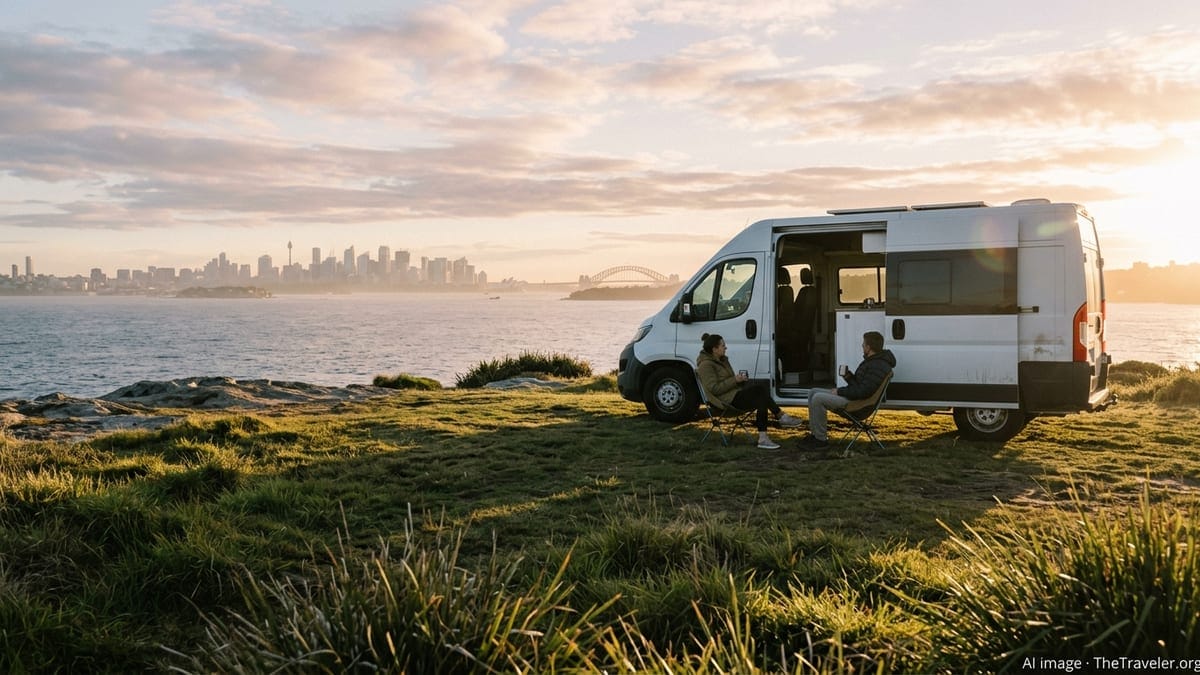
What does a campervan trip replace?
A campervan replaces several things at once: your hotel, your hire car, most of your restaurant meals, and a chunk of your daily transport spend. That's the part people forget when they look at the daily rate and panic.
A mid-range hotel in a major city sits somewhere between $180 and $300 a night. Add a hire car at $80 a day, plus $100 a day eating out, and you're staring down $400 minimum before you've done anything fun. A campervan rolls those costs into one number, and you get to wake up next to a beach instead of a hotel car park.
The catch is that you're driving every day. Some people love that. Others hate it by day four. Knowing which kind of traveller you are matters more than the price comparison.
Where does it make the most sense?
A few countries keep showing up as the obvious places to try this style of trip, and each one rewards it for slightly different reasons.
Australia. The east coast between Sydney and Cairns is built for it. Free camping spots, national parks every few hours, beach towns spaced for a day's drive, and a sealed road the whole way. Picking up Sydney camper van rentals straight from the airport means you skip the city entirely if you want to, or spend two days in Bondi before heading north. The road north through Byron Bay, Noosa, the Whitsundays and on up to Cairns is one of the great drives.
New Zealand. The South Island in particular almost demands a campervan. Distances between towns are short, the scenery changes every hour, and the freedom camping rules are some of the friendliest in the world. Grabbing Christchurch campervan rentals puts you a few hours from Lake Tekapo, Mount Cook, Arthur's Pass and the start of the West Coast loop. You can do a proper South Island circuit in ten days without rushing.
The United States. California specifically. The Pacific Coast Highway, the national parks of the Sierra Nevada, the redwoods up north, the desert drive down to Joshua Tree. A camper van rental in San Francisco gets you onto Highway 1 within an hour, with Big Sur and Yosemite both within a day's drive. The American park system is also set up for vehicle-based travel in a way most countries aren't.
What's the catch?
There always is one. A few things to think about honestly before you book.
You will drive more than you expect. Even on a relaxed itinerary, you're probably looking at three or four hours behind the wheel most days. If your idea of a holiday is reading by a pool, this isn't your trip.
Showers and laundry need planning. Most paid campsites have both, and the apps that show you where they are are good now. But you can't just rock up anywhere and expect facilities. A bit of forward thinking saves a lot of grief.
Fuel costs add up. A campervan drinks more than a hatchback. Budget for it. And, finally, two adults in a small van for two weeks tests any relationship. Bigger vans exist for a reason.
Is it better for families or couples?
Both, but differently. Families with kids under twelve get the most out of it. The novelty of sleeping in the van wears off slowly for kids, the lack of restaurant meals saves a fortune, the constant change of scenery keeps everyone interested, and there's no nightly hotel check-in routine to drag them through. School holidays in Australia and New Zealand are basically built around this kind of trip.
Couples do well too, especially on shorter loops of seven to ten days. Long enough to settle in, short enough that the small space doesn't start to feel smaller.
Solo travellers can make it work, but the maths gets harder. A van for one person costs nearly the same as a van for two, and the security side of things needs more thought.
What about just doing hotels instead?
For city-focused trips, hotels still win. If you're flying into Sydney for five days to see the Opera House, eat your way through Surry Hills, catch a show and bar-hop in Newtown, a campervan is the wrong tool. You'll spend the whole time looking for parking.
The campervan question only makes sense when the landscape between cities is the point of the trip. The drive is the holiday. If you'd be just as happy flying between two cities and ignoring everything in between, save your money and book flights.
The Takeaway
A campervan trip suits a specific kind of traveller. Someone who wants to wake up somewhere different every few days, doesn't mind a bit of driving, would rather cook on a camp stove with a view than queue for a restaurant, and is happy to swap a polished hotel lobby for a national park.
If that sounds like you, the answer is yes. Almost every traveller who tries it once does it again. The places it works best (Australia's east coast, New Zealand's South Island, California, the western states more broadly) have built decades of infrastructure around vehicle travel, which makes a first-timer trip much easier than people expect.
If it doesn't sound like you, that's fine too. Hotels exist for good reasons. But the question is at least a fair one to ask before booking the same kind of trip you've been booking for years.